



Key takeaways:
- The Scaling Gap: While 78% of finance firms use AI tactically, only 8% can scale it. Prototyping is the bridge from "experiment" to "enterprise-grade."
- Months to Days: AI-assisted mapping and synthetic data compress the validation cycle, allowing you to stress-test complex journeys in a fraction of the traditional time.
- Built-in Compliance: By simulating millions of "edge-case" interactions early, you identify regulatory and CX friction points before investing in heavy engineering.
- The Prodigy Advantage: Success requires a repeatable engine. Ciklum’s Prodigy methodology turns rapid prototypes into production-ready assets with a proven, risk-managed roadmap.
It wasn’t so long ago that being a “fast follower” was considered a blue-chip strategy in the Banking, Financial Services, and Insurance (BFSI) sector. The playbook was simple: let the agile fintech startups take the initial risks, watch which trends gained traction, and then react with scaled, polished innovations backed by your massive capital and existing customer base.
In today’s market, that strategy is a recipe for irrelevance.
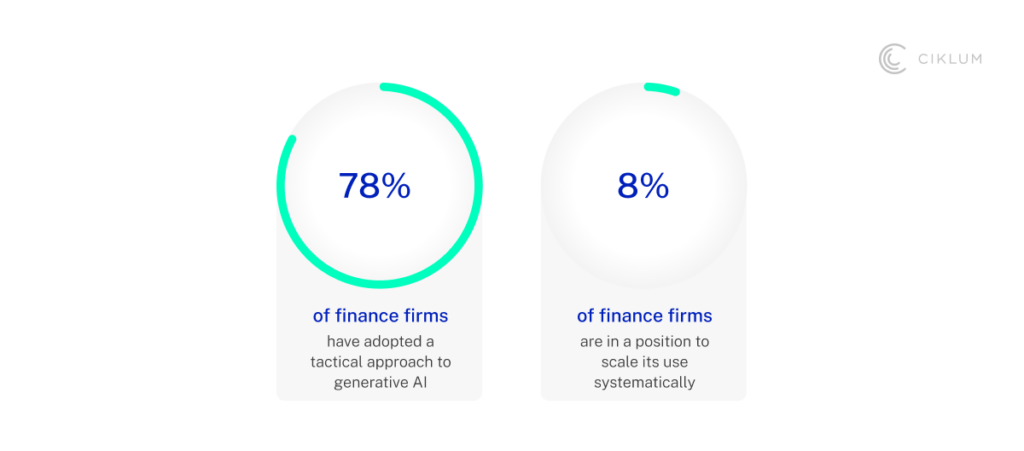
As we move deeper into 2026, the gap between "having an AI strategy" and "executing an AI-driven product" is widening. IBM research has highlighted a startling disconnect: while 78% of finance firms have adopted a tactical approach to generative AI, a mere 8% are actually in a position to scale its use systematically.
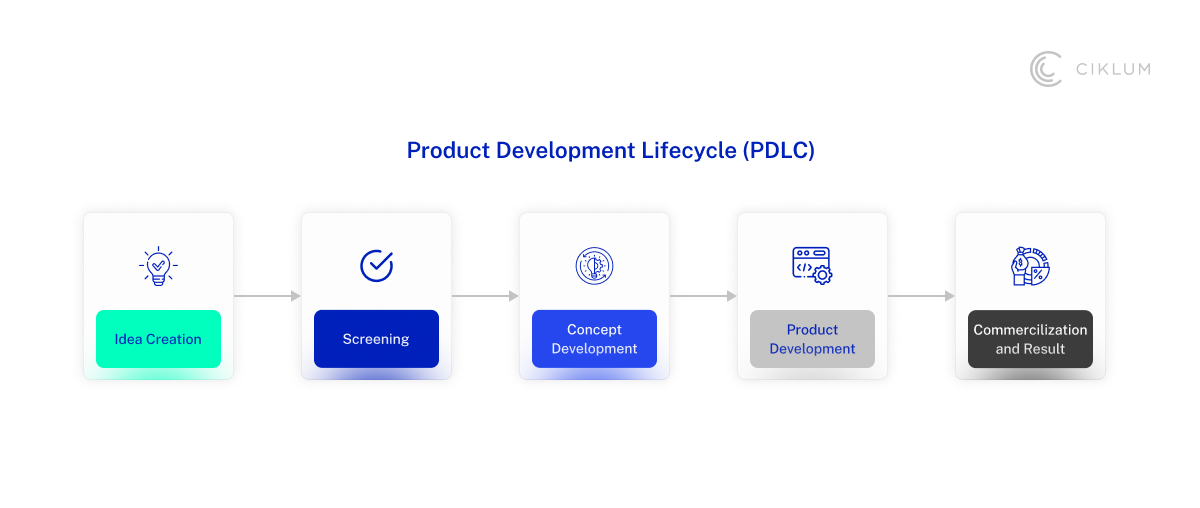
The bottleneck isn't a lack of vision; it is a legacy Product Development Lifecycle (PDLC) that was built for a pre-AI world. To bridge this gap, BFSI leaders must involve AI much earlier - at the prototyping stage.
The Innovation Paradox: What’s Holding BFSI Back?
In an era where "switching as a service" makes it effortless for customers to move their assets to a competitor, speed-to-market is the only true moat. Yet, established providers find themselves trapped by three systemic friction points:
1. The "Waterfall" Hangover
Even in organizations claiming to be "Agile," the reality is often "Water-Agile-Fall." The time taken to move from a high-level concept to a functional wireframe involves dozens of stakeholders, manual documentation, and months of delay. By the time a prototype is ready for testing, the market has often moved on.
2. The Rigidity of Legacy Roadmaps
Traditional development roadmaps are often too brittle to accommodate the non-linear nature of AI. When a new Large Language Model (LLM) capability emerges or a regulatory shift occurs, rigid roadmaps can’t pivot, leading to products that are "born obsolete."
3. The Compliance Bottleneck
In a heavily regulated industry, risk-aversion is a feature, not a bug. However, the traditional way of addressing risk—waiting until the end of the development cycle to perform audits—creates massive rework. Stakeholders often veto innovative ideas simply because they cannot visualize how the risk will be mitigated in a live environment.
How AI-Driven Prototyping Rewrites the Rules
AI-driven prototyping allows teams to fail fast, learn cheaply, and scale safely. It isn't just about "coding faster"; it’s about changing the physics of product validation.
Journey Visualization at Warp Speed
Traditionally, mapping a customer journey—such as a complex mortgage application or a commercial insurance claim—takes weeks of workshops. AI-assisted mapping tools can now ingest existing process documentation and regulatory requirements to generate high-fidelity, interactive flows in hours. This allows CX leaders to "walk through" the experience before a single line of production code is written.
Stress-Testing with Synthetic Personas
One of the greatest risks in BFSI is the "edge case." What happens when a customer with a non-traditional income stream applies for credit? Instead of waiting for real-world beta testing (which carries reputational risk), AI-driven prototyping uses synthetic data to simulate millions of user interactions. You can stress-test hyper-personalized models against a thousand different "financial personalities" overnight to identify friction points proactively.
"Shift-Left" Compliance and Risk Reduction
By using AI to prototype, you can validate regulatory scenarios in a sandbox environment. You can "ask" the prototype how it handles GDPR data requests or how it explains a credit denial (Explainable AI). This ensures that security, accessibility, and compliance are baked into the DNA of the product, rather than bolted on as an afterthought.
Where Theory Meets ROI
To see the true power of AI-driven prototyping, we must look at the highest-impact customer journeys in the BFSI ecosystem:
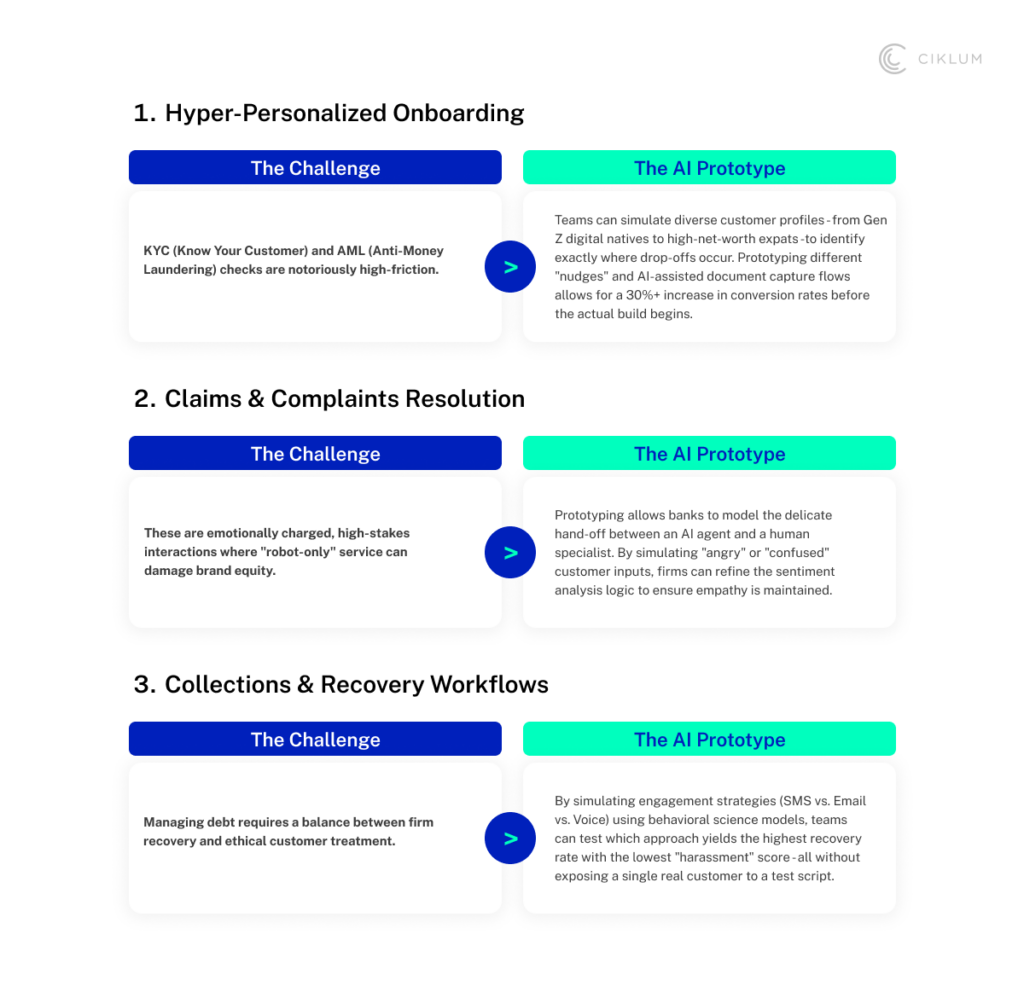
1. Hyper-Personalized Onboarding
- The Challenge: KYC (Know Your Customer) and AML (Anti-Money Laundering) checks are notoriously high-friction.
- The AI Prototype: Teams can simulate diverse customer profiles - from Gen Z digital natives to high-net-worth expats -to identify exactly where drop-offs occur. Prototyping different "nudges" and AI-assisted document capture flows allows for a 30%+ increase in conversion rates before the actual build begins.
2. Claims & Complaints Resolution
- The Challenge: These are emotionally charged, high-stakes interactions where "robot-only" service can damage brand equity.
- The AI Prototype: Prototyping allows banks to model the delicate hand-off between an AI agent and a human specialist. By simulating "angry" or "confused" customer inputs, firms can refine the sentiment analysis logic to ensure empathy is maintained.
3. Collections & Recovery Workflows
- The Challenge: Managing debt requires a balance between firm recovery and ethical customer treatment.
- The AI Prototype: By simulating engagement strategies (SMS vs. Email vs. Voice) using behavioral science models, teams can test which approach yields the highest recovery rate with the lowest "harassment" score - all without exposing a single real customer to a test script.
Introducing Ciklum’s Prodigy: Your Roadmap to AI Industrialization
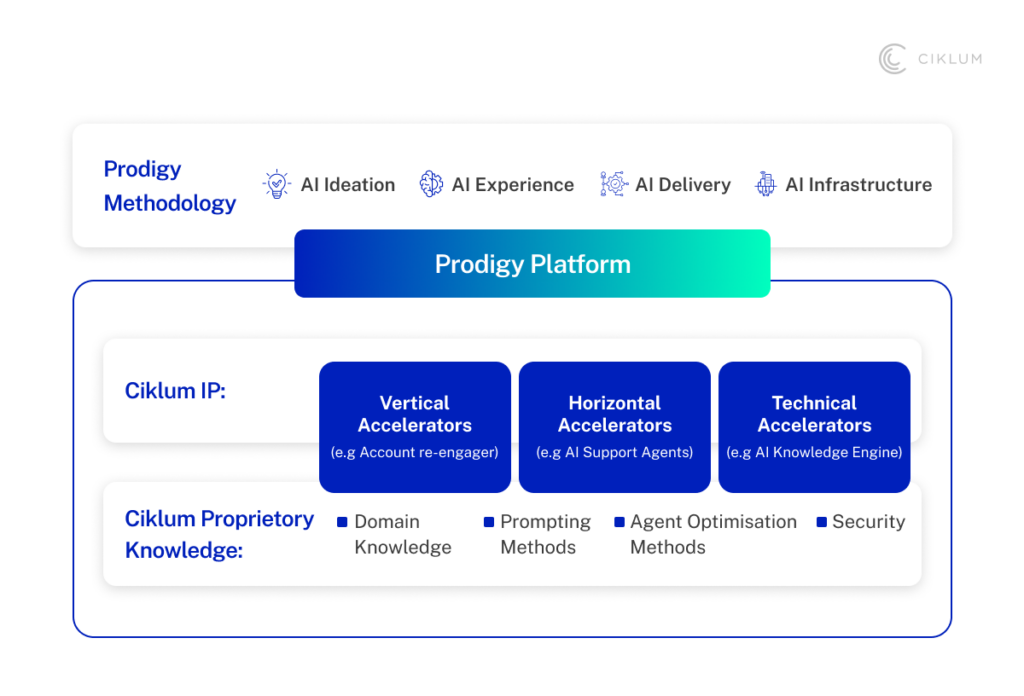
AI-driven prototyping only delivers value when it is embedded into a repeatable, industrial-grade delivery system. This is the core of Ciklum’s Prodigy methodology.
Prodigy is more than a platform; it is an AI-accelerated engine designed to turn "AI ambition" into "production reality." It helps BFSI leaders move beyond the "Pilot Purgatory" (where 92% of firms currently reside) by providing:
- Proprietary Accelerators: Pre-built AI modules for common BFSI tasks (e.g., document parsing, risk scoring) that can be dropped into prototypes.
- The "Build WITH AI" Approach: We don't just build AI products; we use AI to accelerate the PDLC - from automated unit testing to self-generating documentation.
- Risk-Managed Scaling: Prodigy provides a structured framework to reuse proven AI patterns across the entire enterprise, ensuring that a success in the "Lending" department can be quickly replicated in "Wealth Management."
With over 40 PoCs already successfully transitioned to production, Prodigy is the bridge for organizations ready to move from experimentation to sustainable advantage.
Conclusion: Speed is a Byproduct of Better Decisions
In the BFSI sector, AI-driven prototyping is not about moving faster for the sake of speed. It is about making better decisions earlier -when change is still cheap, risk is manageable, and the final outcome can still be shaped.
The organizations that win the next decade won't be the ones with the biggest R&D budgets; they will be the ones that stop treating AI as a "feature" to be added later and start treating it as the foundation of how products are conceived, tested, and delivered.
Don't let your PDLC be the bottleneck to your brilliance.
Ready to transform your innovation pipeline? Contact the Ciklum team today to see a demo of the Prodigy methodology in action and learn how we can help you shrink your development cycles from months to days.
By Ciklum Editorial Team

Ciklum’s Editorial Board is a collective of experienced writers and industry experts, bringing together perspectives shaped by real-world engineering and delivery experience. Through collaborative insights, the team explores how technology, AI, and digital innovation move from concept to execution across industries.
Blogs
Discover Similar Insights