

- What Is Legacy Modernization?
- Why Modernization Matters Now More Than Ever
- Types of Modernization: The 7-R Framework
- AI-Enabled Modernization: The New Paradigm
- Microservices Migration Strategy: The Strangler Pattern
- Cloud-Native Architecture Benefits
- Modernization for Regulated Industries
- 12-Month Modernization Roadmap
- ROI Modeling: Justifying the Investment
- How Our Modernization Teams Work
- Conclusion: Modernization is the Foundation of the AI Era
- Frequently Asked Questions (FAQs)
Legacy modernization is the enterprise process of transforming outdated applications, infrastructure, and data platforms into cloud-native, API-driven, and AI-ready systems that improve agility, security, scalability, and long-term ROI.
In the current economic landscape, "legacy" is no longer just a technical term for old code-it is a business constraint. As we move through 2026, the gap between organizations running on rigid, monolithic systems and those leveraging agile, AI-native architectures has become a chasm that defines market leadership.
For global enterprises, Legacy System Modernization is no longer optional; it is the prerequisite for participating in the AI economy.
Enterprises that modernize strategically achieve:
- 30–50% faster release cycles
- 20–40% infrastructure cost optimization
- AI-ready platforms within 12 months
This article explains how enterprises modernize safely, incrementally, and profitably using proven architectures, AI-enabled execution, and ROI-driven roadmaps.
What Is Legacy Modernization?
Legacy modernization is the process of transforming outdated software systems-often monolithic, high-maintenance, and difficult to integrate-into modern, agile, and scalable architectures.
Modernization is a multi-dimensional transformation that typically involves:
- Architectural Shifts: Moving from Monoliths to Software Architecture Services like Microservices or Serverless.
- Infrastructure Evolution: Transitioning from on-premises data centers to Cloud Platforms.
- Operational Integration: Infusing DevOps and Cloud Management into the core development lifecycle to ensure continuous delivery.
Why Modernization Matters Now More Than Ever
The urgency for modernization in 2026 is driven by three primary "burning platforms":
- The AI Mandate: You cannot run meaningful Generative AI or Agentic workflows on top of siloed, "dark" data. Modernization is the foundation for Enterprise-Ready AI.
- Talent & Maintenance: Finding developers for COBOL or 15-year-old Java is becoming impossible. Modern stacks are essential for talent retention.
- Operational Resilience: Legacy systems are brittle. According to DORA metrics, modernized systems have 40% fewer failures and recover 5X faster.
Get My Modernization ROI Estimate
See how much you could save on maintenance in 12 months.
Let’s Talk Legacy TransformationTypes of Modernization: The 7-R Framework
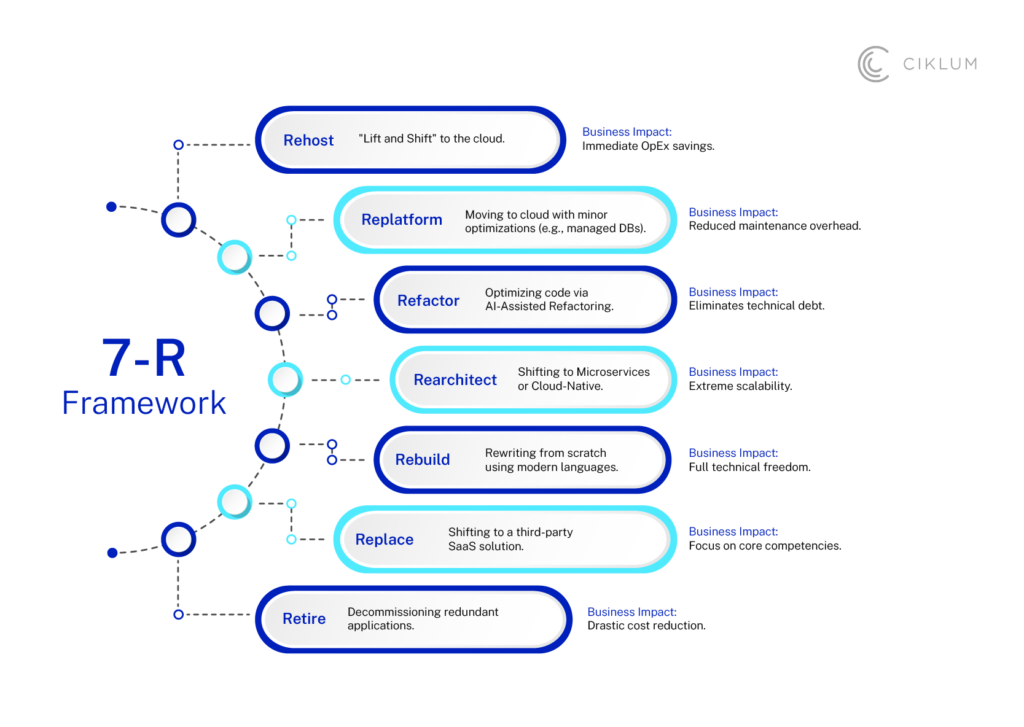
At Ciklum, we apply a strategic "R" framework to determine the most cost-effective path for every asset in your portfolio.
AI-Enabled Modernization: The New Paradigm
In 2026, manual modernization is a relic of the past. Ciklum utilizes AI-Augmented Engineering to accelerate the transformation timeline by up to 40%.
- Automated Code Translation: AI agents analyze legacy code (like COBOL or legacy .NET) and suggest equivalent, optimized versions in Go or Python.
- Dependency Mapping: LLMs scan undocumented legacy estates to visualize "hidden" risks before migration.
- Self-Healing Architecture: Modern systems built today use Intelligent Automation to proactively resolve common errors before they impact the user.
Microservices Migration Strategy: The Strangler Pattern
The biggest risk in modernization is the "Big Bang" rewrite. We recommend the Strangler Fig Pattern, an incremental approach that ensures business continuity.
- Identify a Feature: Pick a high-value, low-risk module (e.g., "User Profile").
- Build a Microservice: Create a modern version using Product Engineering Services.
- Redirect Traffic: Use an API Gateway to shift users to the new service.
- Repeat: Slowly "strangle" the monolith until it can be safely decommissioned.
Cloud-Native Architecture Benefits
Moving to a cloud-native state yields immediate dividends through Cloud Transformation Optimization:
- Elastic Scalability: Pay only for what you use, scaling to zero during idle time.
- Security at Scale: Implement Zero-Trust security and Digital Assurance directly into your CI/CD pipelines.
- Faster Innovation: Deploy updates multiple times per day using DORA-validated practices.
Modernization for Regulated Industries
For sectors like Banking, Healthcare, and Insurance, modernization must be compliance-first.
- Zero-Trust Security: Shifting from "perimeter" security to identity-based data protection.
- Compliance-as-Code: Automating HIPAA or GDPR checks into the deployment pipeline.
- Data Sovereignty: Leveraging Data and AI Services to ensure data residency while maintaining performance.
12-Month Modernization Roadmap
A high-impact modernization journey typically follows this timeline:
Phase 1: Assessment & Strategy (Months 1-2)
- Inventory: Audit all apps via Solution Discovery.
- ROI Modeling: Calculate the cost of "doing nothing" vs. modernization.
Phase 2: Foundation & Pilot (Months 3-5)
- Cloud Landing Zone: Set up AWS/Azure/GCP environments.
- PoC: Execute a pilot using AI-Assisted Legacy Refactoring.
Phase 3: Scaling Migration (Months 6-10)
- Sprint Cycles: Execute the Strangler Pattern for core modules.
- Enablement: Train internal teams to manage the new stack.
Phase 4: Optimization & Handover (Months 11-12)
- FinOps: Fine-tune cloud costs and performance.
- Sustainability: Final decommissioning of the legacy hardware.
ROI Modeling: Justifying the Investment
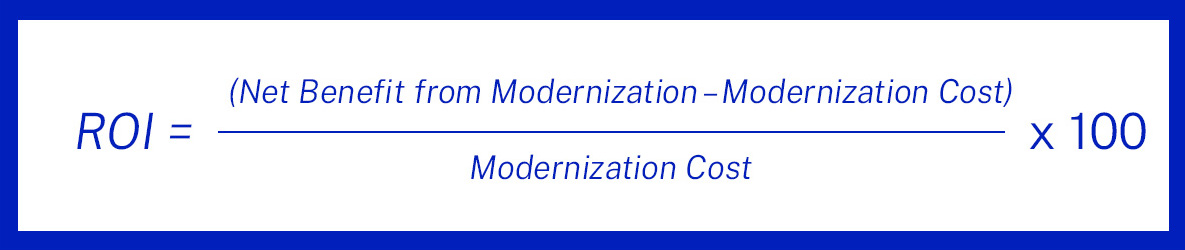
To gain executive buy-in, you must quantify the benefits. We use the following formula:
Key ROI Drivers:
- Direct Savings: Eliminating legacy licensing and data center maintenance.
- Developer Velocity: 40% increase in feature delivery speed.
- Risk Reduction: Mitigating the cost of downtime (est. $300k/hr for Tier-1 apps).
How Our Modernization Teams Work
Ciklum doesn't just deliver code; we provide an Experience Engineering approach. Our squads are comprised of:
- Architects: Designing for 10-year scalability.
- AI Engineers: Leveraging LLMs for rapid code conversion.
- QA Specialists: Ensuring zero-defect delivery via Digital Assurance.
Conclusion: Modernization is the Foundation of the AI Era
Legacy modernization is no longer a "back-office" IT project; it is a front-line competitive strategy. As we have explored in this guide, the cost of maintaining outdated systems-measured in technical debt, security risks, and missed AI opportunities-now far outweighs the investment required to transform them.
By 2025, the organizations that lead their industries will be those that successfully transitioned from rigid monoliths to agile, Cloud-Native architectures. They will be the ones leveraging AI-Assisted Refactoring to move faster than their competitors and using Microservices to pivot their business models in weeks, not years.
The Path Forward with Ciklum
At Ciklum, we believe that modernization is not just about changing code; it’s about changing what your business is capable of. Our approach combines:
- AI-Augmented Engineering: To reduce timelines and human error.
- Business-Centric ROI: Ensuring every technical change drives a measurable financial outcome.
- Experience Engineering: Fusing high-end Product Engineering Services with deep industry expertise in FinTech, Healthcare, and beyond.
Don’t let your legacy estate be the anchor that holds back your digital future. Whether you are looking to Legacy Refactor a single mission-critical application or migrate your entire infrastructure to the Cloud Platforms, the time to build your 12-month roadmap is now.
Get My Modernization ROI Estimate
See how much you could save on maintenance in 12 months.
Let’s Talk Legacy Transformation
Frequently Asked Questions (FAQs)
We focus on three key metrics: reduction in annual maintenance costs (typically 25-40%), increased speed-to-market for new features, and the mitigation of costly regulatory fines through automated compliance reporting.
Can legacy systems be modernized to support Generative AI?
Yes. We specialize in building real-time data pipelines and modernizing legacy APIs to ensure your core systems are "AI-Ready," allowing for seamless integration with LLMs and predictive analytics.
How does Ciklum handle data security during a cloud migration?
For our US clients, we adhere to SOC2, HIPAA, and PCI-DSS standards. We use automated testing and secure "squad augmented" workflows to ensure zero data leakage during the transition from legacy to cloud.
What is the average timeline for a core system modernization?
While timelines vary, our "Modernization Roadmap" typically delivers a functional MVP or a modernized high-priority module within 3 to 6 months, ensuring you see business value long before the full migration is complete.
What is the difference between legacy modernization and digital transformation?
Digital transformation is a broad business strategy focused on changing how an organization operates using digital tech. Legacy modernization is a critical subset that involves updating the underlying technical systems (the "engine") to support those new business models.
How long does a typical legacy modernization project take?
While timelines vary, a phased approach using the "Strangler Pattern" typically delivers its first production pilot within 3–5 months, with full-scale transformation of a major system taking 12–18 months.
Can AI really automate the modernization of COBOL or old Java code?
Yes, through Ciklum’s AI-Assisted Legacy Refactoring, we use LLMs to analyze, map dependencies, and suggest modern code equivalents, accelerating the process by up to 40%.
How do I calculate the ROI of modernization?
ROI is calculated by measuring direct savings (reduced license/cloud costs) plus indirect gains (faster developer velocity and reduced risk of downtime) against the total cost of the transformation.
By Ciklum Editorial Team

Ciklum’s Editorial Board is a collective of experienced writers and industry experts, bringing together perspectives shaped by real-world engineering and delivery experience. Through collaborative insights, the team explores how technology, AI, and digital innovation move from concept to execution across industries.
Blogs
Discover Similar Insights