



The retail industry is at the precipice of its most significant transformation since e-commerce. For decades, the dominant model has been reactive: retailers analyze past data, forecast future demand, and wait for customers to browse their channels, physical or digital. That reactive posture is now under pressure. The complexity of modern commerce (dynamic pricing, fragmented supply chains, and hyper-demanding consumers) requires a fundamentally different approach.
What’s emerging is not an incremental upgrade, but a complete rethinking of how retail operates.
We are transitioning from Omni-channel operations to an agentic-centric operating model. In this new paradigm, advanced AI agents capable of perceiving, reasoning, acting, and learning are not just tools; they are the connective tissue of the enterprise.
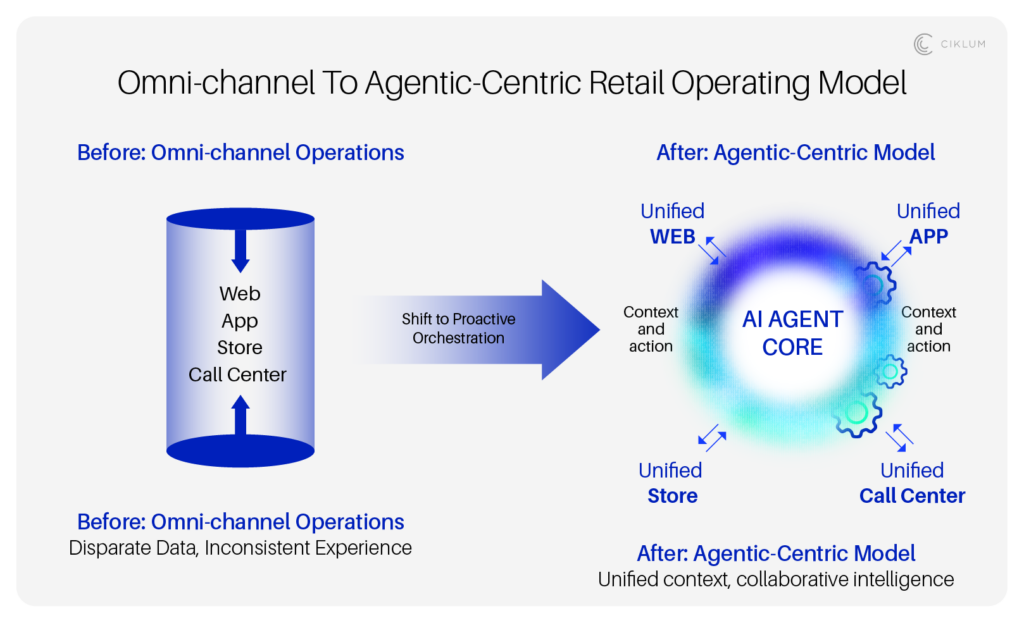
Defining the Agentic-Centric Model
The agentic model is an ecosystem. At its center is an AI Agent Core, a collection of specialized, interoperable AI agents that integrate data from every touchpoint. They don't just generate reports for humans to read; they negotiate with suppliers, optimize inventory placement, personalize marketing, and manage customer service interactions autonomously, always aligned with defined business goals.
The Rise of Agent-Led Shopping
The most visible manifestation of this shift is in the customer experience itself. We are moving beyond the search bar toward agent-led shopping.
In an agentic model, the customer interacts with a sophisticated curation agent. Instead of returning a list of products, the agent curates a complete solution and the experience is frictionless, predictive, and intensely personalized.
Reimagining Digital Channels, Including the Store
The agentic shift forces a radical rethinking of where and how commerce happens.
Digital channels today (websites and apps) are largely static catalogs. In an agentic world, they become dynamic interfaces generated in real-time by a presentation agent, tailored to the specific user's intent. If a customer is browsing for durable hiking gear, the entire layout (navigation, imagery, product highlights) dynamically restructures to prioritize durability, technical specs, and utility.
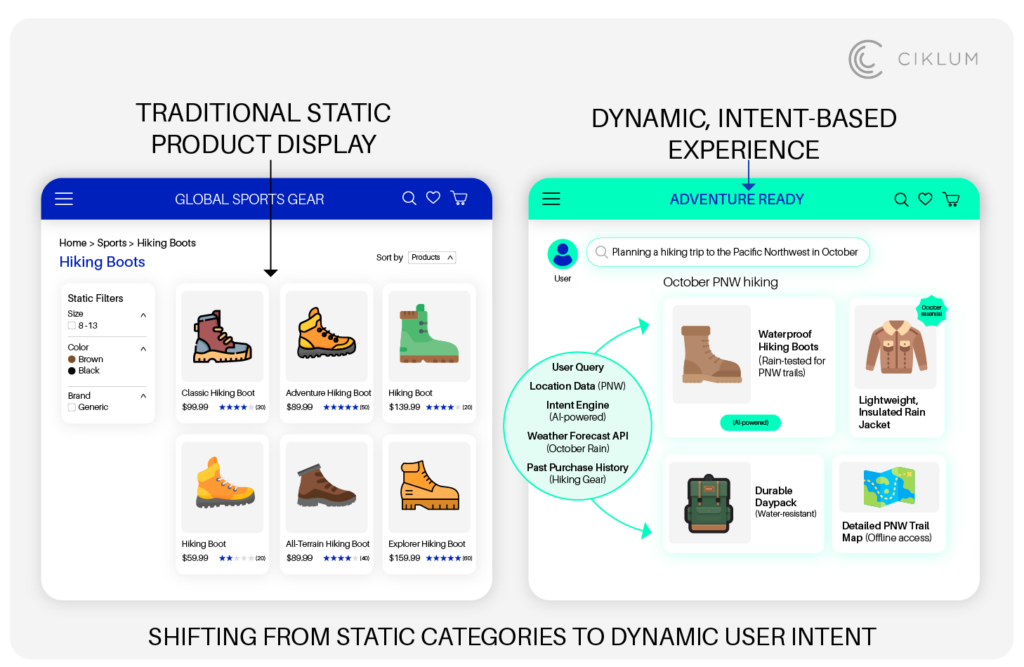
The physical store does not disappear; it becomes a powerful node within the agentic ecosystem, serving two key functions:
1. Immersive fulfillment: The store operates as a micro-fulfillment center optimized by agents for speed and local demand.
2. High-touch experience: In-store associates are empowered by agents. An associate's tablet, connected to the Agent Core, provides real-time insights; the agent handles the data synthesis, leaving the human free to provide authentic hospitality. Ciklum's work with a leading US footwear brand illustrates this shift: replacing fixed POS registers with mobile devices gave associates the freedom to serve customers anywhere on the floor, with full access to inventory, customer history, and recommendations.

The Human Role: From Operator to Orchestrator
The transition to an agentic model doesn't make humans obsolete; it makes them strategic conductors. While AI agents handle the heavy analytical and transactional lifting, humans move "up the stack" to focus on strategy, empathy, creativity, and defining the ethical and business guardrails for the agentic systems.
The Merchandiser
Traditionally, a merchandiser's work has been dominated by spreadsheets, manual forecasting, and supplier negotiations. In the agentic model, the merchandiser becomes a strategic orchestrator. They define the high-level strategy, e.g., "Maximize margin on premium footwear while achieving 95% sell-through by season's end" and input these goals into the agent orchestration layer.
The agents then execute autonomously. A pricing agent dynamically adjusts prices in response to competitor activity and local demand. An inventory agent optimizes reorder points and redirects stock between stores and distribution centers. A supplier management agent continuously tracks KPIs such as On-Time In-Full (OTIF) rates, defect frequencies, and billing discrepancies, ensuring improved value from suppliers.
The merchandiser reviews exceptions, monitors agent performance, and focuses on the next season's creative concept and new product introductions.
The Supply Chain Officer
Supply chain has always been a game of predicting the unpredictable. The old model meant reacting to disruptions with manual interventions and incomplete visibility.
In an agentic model, the SCO manages an agent-led predictive inventory and logistics optimization system. Agents continuously ingest transactional data, weather patterns, shipping telemetry, raw material availability, and geopolitical news to build dynamic simulations. They proactively mitigate risk across fulfillment, inventory holding, last-mile logistics, and reverse logistics by sensing, deciding, and acting within guardrails.
The result: the SCO moves from a reactive posture of fire-fighting to managing a self-healing, autonomous network capable of complex, real-time optimization.
The Marketer
Marketing shifts from periodic campaign execution to continuous, intent-driven personalization. Campaign orchestration, loyalty and CRM, and the personalization engine all evolve from segment-based batch processing to real-time, agent-orchestrated engagement.
In the agentic model, marketers are creative strategists. They define brand identity, tone of voice, and campaign objectives. The core workload is then handled by a matrix of specialized agents that execute, measure, and optimize continuously.
Customer Service
Customer service has traditionally been a cost center focused on reactive resolution, fixing problems after they happen. It's often a frustrating experience for both customers and overworked agents.
In the agentic model, Customer Service Associates (CSAs) are empowered by a background layer of proactive resolution agents. When a shipping delay occurs, the proactive agent doesn't just notify the customer; it automatically generates a personalized apology using the correct brand voice (refined by marketing agents), offers a relevant gesture of goodwill such as free expedited shipping on the next order and updates the unified customer profile.
When a human CSA does handle a complex case, they are supported by a co-pilot agent that summarizes the entire customer journey and context, suggests resolution options based on policy and history, and even drafts the communication. The human agent is free to focus entirely on empathy and problem-solving.
The Shared Platform: Agentic Infrastructure
Moving to an agentic-centric model is not an overnight upgrade; it requires a re-architecture of the retail technology stack. Autonomous intelligence cannot be layered on top of siloed, legacy systems.
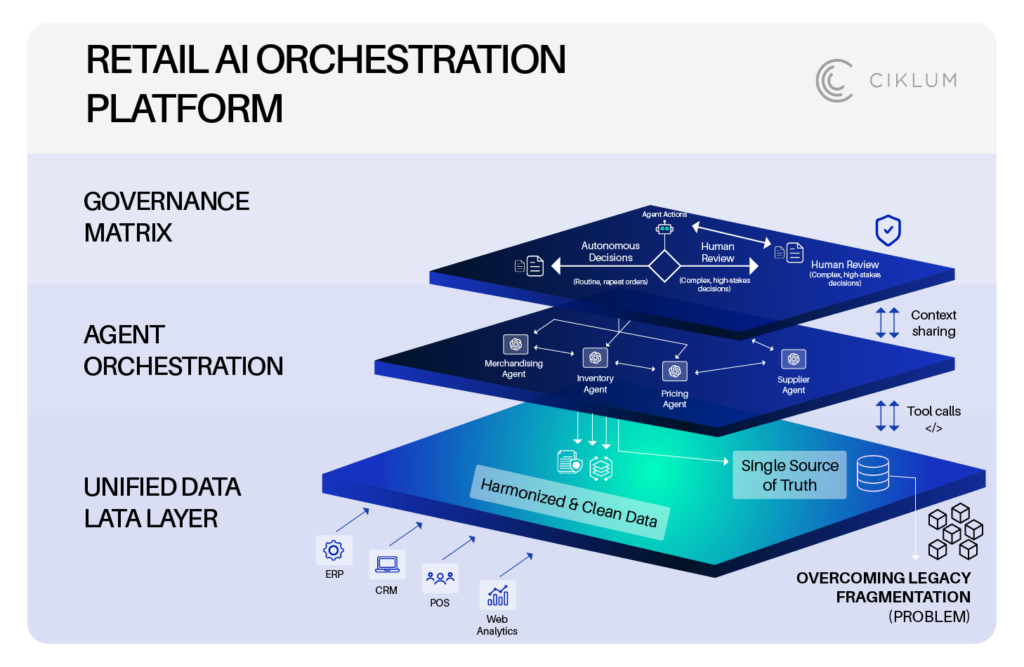
Unified Data Fabric
Agents are only as intelligent as the data they can access. Most retailers operate with data trapped in disparate silos: ERP (inventory), CRM (customer), web analytics, and point-of-sale systems.
A Unified Data Fabric breaks these silos. It ingests, cleanses, harmonizes, and structures data from all sources in real-time, providing the single source of truth that agents require to build an accurate and dynamic context. Without this unified fabric, agents will make decisions based on incomplete or conflicting information.
Orchestration Layer and Interoperability
Sitting above the data fabric is the orchestration layer. A mature agentic ecosystem will not use a single monolithic AI. Instead, it deploys a matrix of specialized agents and defines the standards for how these agents communicate, share context, and access the underlying data fabric.
Governance and Trust Layer
Which decisions are autonomous? Which requires human approval? How are agent actions audited? Compliance (GDPR, consumer protection), brand safety, and operational accountability must be built into the architecture from the start. The governance layer establishes strict guardrails, defining exactly what agents can and cannot do through granular access controls. The trust layer ensures transparency via comprehensive audit trails and human-in-the-loop oversight for high-stakes decisions. These frameworks are essential to guarantee that agents act reliably, securely, and in strict alignment with human intent.
Where to Start
The temptation is to automate everything at once. The retailers who actually get to production resist that impulse and start by asking a simpler question: where does the level of agent autonomy match the risk?
Some transactions are straightforward enough that full automation makes sense right away, i.e., repeat orders, subscription refills, routine replenishment. The rules are clear, the stakes are low, and the cost savings are immediate and measurable.
Other decisions are more nuanced. When a purchase involves personal taste, significant spend, or complex compatibility, the agent's job is to narrow the options and do the legwork, not to make the final call. The customer still decides; the agent just makes the decision easier and faster.
Post-purchase is where most retailers underinvest. Returns, service requests, and loyalty interactions are high-volume, often frustrating, and full of patterns an agent can learn quickly. Start by letting agents handle the routine cases (standard returns, order status, basic account changes) and widen the scope as the system proves itself and exception rates drop.
In practice, the path looks the same almost everywhere: audit what data is actually connected and where it breaks; pick two or three use cases where you can measure the outcome clearly; build with guardrails and instrument everything from day one; and only expand once you have evidence that governance holds up under real conditions.
The Rewired Retail Operation
The transition to an agentic-centric operating model is not just a technological imperative; it is a strategic one. As the velocity of retail commerce continues to accelerate, the traditional, reactive, and siloed model will fail to keep pace with consumer expectations and the complexity of global operations.
By unifying their data, empowering their workforce, and adopting an AI Agent Core, retailers can achieve true operational agility. The retailers who succeed will be those who embrace the collaborative intelligence of the agentic shift, transforming from reactive sellers of goods into proactive orchestrators of commerce solutions.

By Sreekumar Veluthakkal

Director - Retail and Consumer Goods
Sreekumar Veluthakkal is a Consulting Director for Retail and Consumer Goods at Ciklum, where he helps global retailers and consumer brands rethink how they operate and compete through AI, digital innovation, and intelligent retail systems.
Blogs
Discover Similar Insights

Agentic AI in Retail: Closing the Gap Between Customer Intent and Enterprise Systems
Learn More
From AI Interest to Engineering-Ready Mandates: Why The Market Needs AI Clinics, Not More AI Pilots
Learn More
Agentification of Payments: A Strategic Shift for PSPs
Learn More
Explainable AI in Banking: Designing Transparent, Auditable Models for Credit, Risk, and Compliance
Learn More