



- Key takeaways
- Why Enterprise AI Strategy Fails: The Structural Root Cause
- Agentic AI Strategy: When AI Moves from Assisting to Owning Work
- What Makes an AI Initiative Engineering-Ready?
- AI Prioritisation Framework: What Earns the Right to Be Built
- The PRIME AI Governance Framework: How to Make Scalable AI Decisions
- The Go or No-Go Checklist Before Build
- AI Scaling Barriers: The Feasibility Gates Most Leaders Miss
- In Summary: Bridging AI Strategy and AI Reality
Key takeaways
- Clear selection and prioritisation are now essential for AI initiatives to scale.
- Agentic AI is shifting work from execution to supervision across core business functions.
- Objective, financial-led evaluation is necessary to move AI beyond isolated wins.
- AI Strategy Leadership Clinics provide the decision discipline needed to align ambition, governance, and execution before scale begins.
Why Enterprise AI Strategy Fails: The Structural Root Cause
If you zoom out, a consistent pattern shows up across large organisations. There is no shortage of AI ideas. Teams launch pilots, demos impress leadership, and internal momentum builds fast. For a while, it feels like progress. Then those initiatives run into operational reality - security reviews, data constraints, legacy integration, ownership questions, and risk controls.
Many initiatives stall before they ever become part of day-to-day work. The organisation stays busy experimenting, but the impact stays thin. This is where AI Strategy Leadership Clinics create value. They give leadership teams a structured way to pressure-test AI ideas, prioritise the right use cases, and turn scattered ambition into an engineering-ready AI roadmap before build begins. The data reflects this reality.
- Most AI PoCs never graduate into widescale deployment. In one study, 88% failed to make that jump, with only 4 out of 33 reaching production.
- In 2025 alone, 42% of companies scrapped the majority of their AI initiatives before they ever had a chance to scale.
The failure usually comes from familiar places: weak data foundations, unclear ownership, underestimated integration effort, and vague ROI measurement.
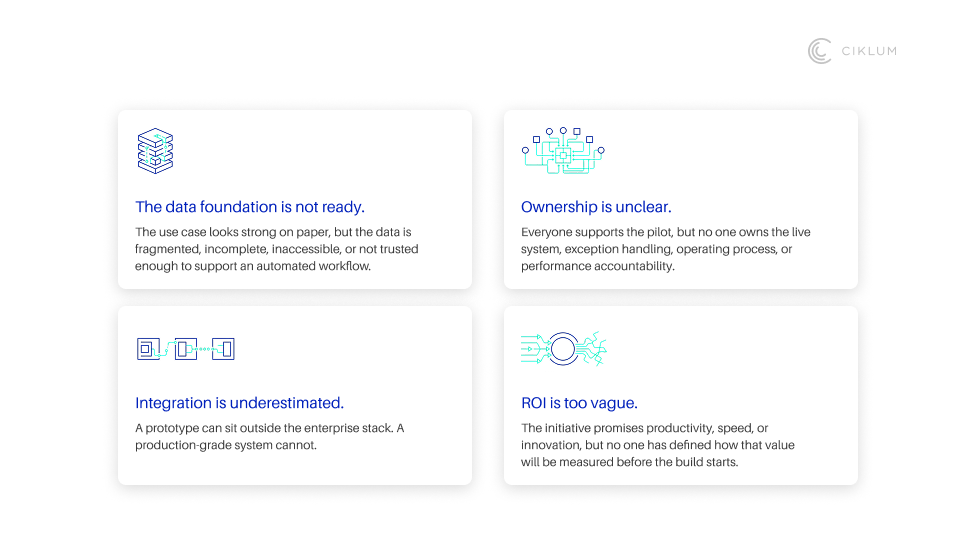
This is why AI governance matters. It forces the organisation to decide what good looks like before engineering time, budget, and credibility are spent.
Agentic AI Strategy: When AI Moves from Assisting to Owning Work
AI is moving beyond assistance and into execution. Agentic AI refers to AI systems that can take sequences of actions autonomously to complete a goal. They do not just suggest the next step. They plan, act, coordinate, and respond to changing conditions within defined boundaries.
That changes the operating question. When AI only assists, the risk is usually limited to recommendation quality. When AI starts owning parts of the workflow, the risk expands into approvals, auditability, escalation, accountability, and trust.
In a UK insurance context, an agentic claims system might review submitted evidence, check policy rules, prepare a settlement recommendation, and route only exceptions to a human handler. The human still decides the final approval threshold and owns customer-facing accountability. In practice, this shifts human roles from doing the work to supervising, approving, and governing it.
Let’s take banking as an example too. An underwriting risk agent might gather affordability data, compare it against internal policy, identify anomalies, and prepare a decision pack for review. But a human would still approve exceptions and sign off on cases that fall outside the approved operating model.
That change raises the cost of “pilot culture.” Running isolated experiments without a platform strategy, governance model, or operating ownership doesn’t just slow progress - it compounds risk and creates rework
At this stage, scale depends on two elements working together.
- The first is a strategic filter, where leadership defines the central question that matters to the business. The kind of question that forces trade-offs and narrows attention to a small number of opportunities with the potential to move the needle.
- The second is an execution engine, capable of turning those decisions into production-grade systems that can survive actual operational pressure.
This is what the AI Strategy Leadership Clinics are designed to do: create the conditions for scale before the build starts - when decisions are still cheap, and course correction is still possible.
What Makes an AI Initiative Engineering-Ready?
A good AI idea is not the same as an engineering-ready AI mandate. A good idea might have a compelling use case, a strong sponsor, and a clear business pain point, but it is not enough. An engineering-ready initiative has passed five checks. This is the point where a broad artificial intelligence strategy has to become specific enough for engineering, governance, and operations to act on it.
| Readiness check | What it proves |
| Business value | The initiative is tied to cost reduction, revenue uplift, margin improvement, risk reduction, or time savings. |
| Data readiness | The data exists, can be accessed, and is reliable enough to support the use case. |
| Integration fit | The system can connect to the workflows, tools, and platforms it needs to influence. |
| Ownership | The business knows who runs it, who approves it, and who handles exceptions. |
| Measurement | Success can be tracked through defined metrics before full deployment. |
If an idea cannot pass these checks, it may still be interesting. But it is not ready for build.
This is also where an AI operating model becomes essential. An AI operating model defines how AI is governed, funded, built, monitored, improved, and owned across the business. Without it, every use case becomes a one-off project. With it, the organisation has a practical AI strategy framework for deciding which opportunities are mature enough to move forward.
AI Prioritisation Framework: What Earns the Right to Be Built
At the heart of the AI Strategy Leadership Clinics is one uncomfortable but essential question: “Which AI ideas deserve to exist beyond a slide deck?”
The purpose of selection is to move beyond traditional AI strategy consulting and instead take a long list of possible AI initiatives and determine which ones are worth leadership attention and investment.
Organisations that succeed with AI filter ideas early, before engineering time, credibility, and budget are consumed. Candidate use cases are examined holistically, removed from their original team context, and evaluated at an enterprise level.
Prioritisation
Ideas are taken out of their original context and examined. An initiative that felt urgent inside one function now has to justify itself at a business level. This is often where teams realise that some projects exist simply because they were easy to start or well-sponsored, rather than because they were truly critical.
Validation
Instead of asking only “can we build this,” it’s imperative to ask the more important question: “should we?” Early feasibility checks bring up technical, data, integration, and organisational risks before time and money are spent. This step exists to stop teams from prototyping their way into dead ends and calling it progress.
Sequencing
The ideas that survive are mapped into a phased timeline, with clear dependencies, workstreams, and ownership. Sequencing is what allows an execution team to take over without guesswork, re-interpretation, or another round of alignment theatre.
By the end of this process, the backlog becomes a revenue-ready pipeline, made up only of initiatives that have survived all the checks. If it can’t survive selection, it doesn’t deserve engineering time.
The PRIME AI Governance Framework: How to Make Scalable AI Decisions
Most AI funding stories start with a strong sponsor and a slick demo. But demos do not prove scalability. Inside the AI Strategy Clinics, prioritisation is not left to intuition. PRIME is the AI governance framework used to test which initiatives deserve to move forward before anything enters build.
Potential: Does It Support the Strategic Ambition?
Potential asks whether the initiative supports a meaningful business priority, not just a local improvement. A strong use case connects clearly to growth, customer experience, risk reduction, or another strategic goal. If the idea is interesting but disconnected from the wider business direction, it should not move forward yet.
Reach: Who and What Does It Affect?
Reach tests whether the use case is big enough to justify investment. The strongest AI initiatives affect high-volume workflows and important customer journeys. A narrow tool may still be useful, but it may not deserve early priority if the impact stays limited.
Impact: What Is the Financial Upside?
Impact forces the conversation into measurable value. The initiative should have a clear link to cost reduction, margin improvement, revenue growth, time savings, or risk reduction. If the value case depends on vague efficiency claims, it needs more work before it becomes a build priority.
Measurability: Can We Prove It Works?
Measurability asks whether success can be tracked clearly. Before build starts, teams need a baseline, target metric, and measurement method. Without that, the organisation may end up debating whether the system worked after the money has already been spent.
Effort: What Will It Really Take?
Effort looks at the true cost and complexity of delivery. This includes data readiness, integration needs, governance requirements, operating ownership, and long-term maintenance. Some ideas look simple in a demo but become expensive once they meet real systems, real users, and real controls. PRIME forces every AI idea to answer the questions that matter: how it affects the P&L, who uses it, what it depends on, and what could break when it scales. Because a demo can be impressive and still be a dead end. According to a 2025 AI Adoption Report, there is an 80% vs 37% success gap between organisations with and without a formal strategy, a gap driven by selection discipline rather than model quality.
The Go or No-Go Checklist Before Build
Before an AI initiative enters delivery, leaders should be able to answer five questions with confidence.
| Question | Go signal | No-go signal |
| Is there a business owner? | One accountable leader owns the outcome. | Ownership is shared, implied, or unclear. |
| Is the value measurable? | There is a baseline and target metric. | The value case is mostly narrative. |
| Is the data usable? | Required data is available, accessible, and trusted. | Data access or quality is still unresolved. |
| Is the workflow ready? | The AI system has a defined place in the operating process. | The team has not decided how people will use it. |
| Is the risk understood? | Compliance, security, bias, and accountability have been reviewed. | Risk review is being pushed to “later.” |
This checklist is deliberately simple. It exists to expose weak assumptions early.
AI Scaling Barriers: The Feasibility Gates Most Leaders Miss
According to Gartner, 30% of GenAI projects are expected to be abandoned after the PoC stage, often due to data quality issues, unclear value, or rising costs. To address this, as part of the AI Strategy Clinics, feasibility gates are applied before initiatives move into delivery. The point is to stop weak ideas early, not rescue them late.
Gate #1: Data and Orchestration Readiness
Agentic systems depend on clean data flows, integration across systems, and an orchestration layer that can manage the workflow end-to-end. If that foundation isn’t in place, the initiative is effectively building another silo with better branding. When that’s the case, this is where it ends.
Gate #2: Trust by Design
Regulatory, ethical, and accountability considerations are assessed before build, creating a practical, responsible AI framework around what the system can do, where human approval is required, and who remains accountable.
For UK enterprises, this also means recognising where local governance and EU exposure overlap. Even post-Brexit, firms selling into the EU or deploying AI systems whose outputs are used there may need to account for EU AI Act obligations alongside UK data protection and sector-specific expectations.
By being brutally honest early, organisations protect their ability to move fast later, once the system is live, visible, and under pressure.
Gate #3: Ownership and Operating Fit
Even technically feasible AI fails without ownership and operational fit. This gate defines who runs the system, how it integrates into workflows, how exceptions are handled, and what “good” looks like once it is live.
In Summary: Bridging AI Strategy and AI Reality
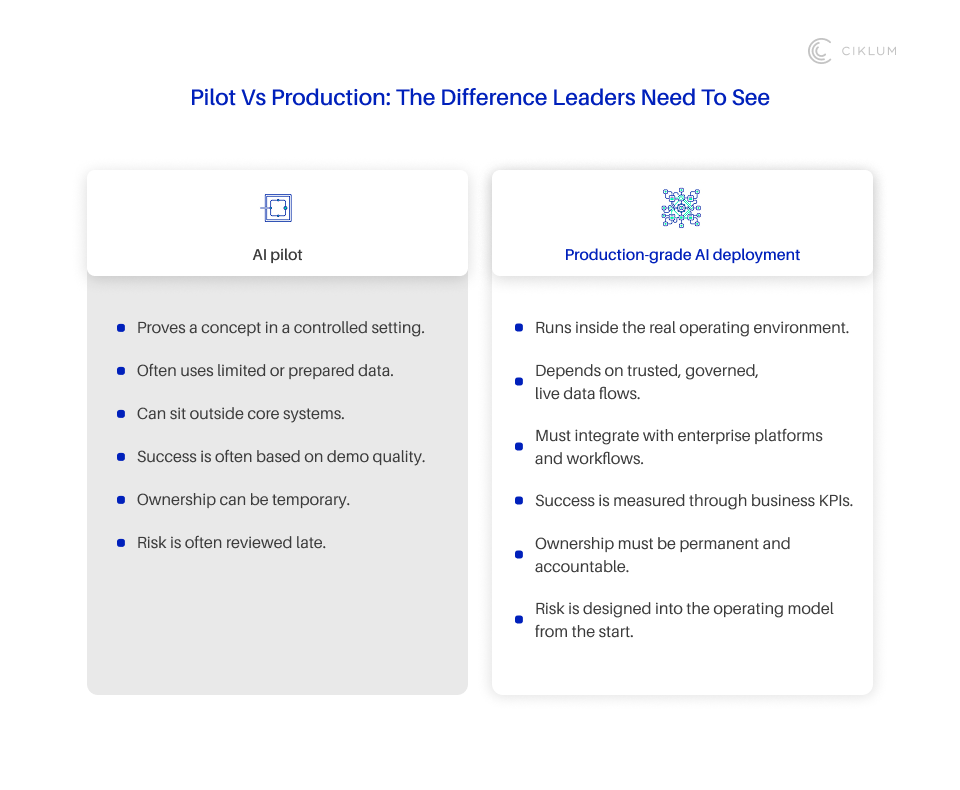
Strategy without engineering turns into a theatre show. Engineering without strategy turns into waste. Most AI programmes collapse somewhere in between.
The AI Strategy Clinics bridge that gap by turning intent into engineering-ready mandates: a shared narrative, prioritised use-case portfolio, feasibility gates, governance model, and a clear execution path that holds up under real-world pressure.
If AI in your organisation has stopped being exciting and started being serious, the next move may not be another pilot. It may be a better decision process.
The AI Strategy Leadership Clinics are designed for that moment – helping leadership teams pause, pressure-test assumptions, make trade-offs, and leave with a funded, actionable roadmap in weeks, not months.

By Yannique Hecht

Senior Director - AI R&D
13+ Exp
Yannique Hecht is the Senior Director of AI R&D at Ciklum, and a strategist with 13+ years of experience building at the intersection of product, AI, and strategy. He has led large, cross-functional teams and advised Fortune 500 companies on designing, building, and scaling next-generation digital products and AI-driven platforms.
Blogs
Discover Similar Insights

Healthcare Digital Transformation Challenges: Why Programs Fall Short Post-Implementation
Learn More
The Buyer Shift: From AI Pilots to Agentic and AI-Enabled SDLC
Learn More
The AI Operational Gap in BFSI: Why AI Strategies Are Failing To Deliver Business Value
Learn More
Why Enterprise AI Automation Programs Fail, and How to Make Sure Yours Doesn’t
Learn More