



Key takeaways
- Most retailers still deliver “multi-channel,” not omnichannel. The shopper is recognized, but not remembered
- Agentic AI is not a better chatbot. It is an orchestration layer that can understand intent and take actions across enterprise systems
- If AI is not connected to CRM, inventory, pricing, and fulfilment, it will overpromise and break trust
- The fastest path to production value is typically two parallel tracks: inventory intelligence and loyalty intelligence
- The winners in 2026 will treat AI as an engineered capability, not a series of disconnected pilots
One Shopper, Three Realities
A customer is shopping for a dress for an upcoming occasion.She starts on the website and saves a few options. She opens the app on the commute and expects to pick up where she left off. Later, she walks into the store to try it on and asks for help.
Instead of one continuous experience, she gets three disconnected conversations.
- The website shows one set of recommendations.
- The app suggests different items, often generic.
- In store, the associate cannot see what she viewed, what she saved, or what she needs.
Even worse, basic facts drift. Availability, promotions, delivery promises, and substitutions vary by channel. It feels like the brand has no memory.
This is still the reality for many retailers in 2026. AI has been deployed widely, but continuity breaks at the seams. The problem is not imagination. It is architecture.
Retail’s next competitive frontier is not a new channel. It is a connected intelligence layer that understands shopper intent, links it to enterprise systems in real time, and orchestrates journeys that are personal and operationally truthful.
The Omnichannel Illusion
Most retail leaders believe they have omnichannel because they have built multiple touchpoints.
They have a loyalty program, an app, eCommerce, store tech, customer service automation, and “personalization.” On paper, it looks complete.
But customers do not experience your stack. They experience continuity.
In practice, many retailers still have a single root problem: customer and transaction data remains fragmented across store, eCommerce, and loyalty.
That fragmentation leads to inconsistent experiences and it makes it difficult to scale advanced personalization reliably and compliantly.
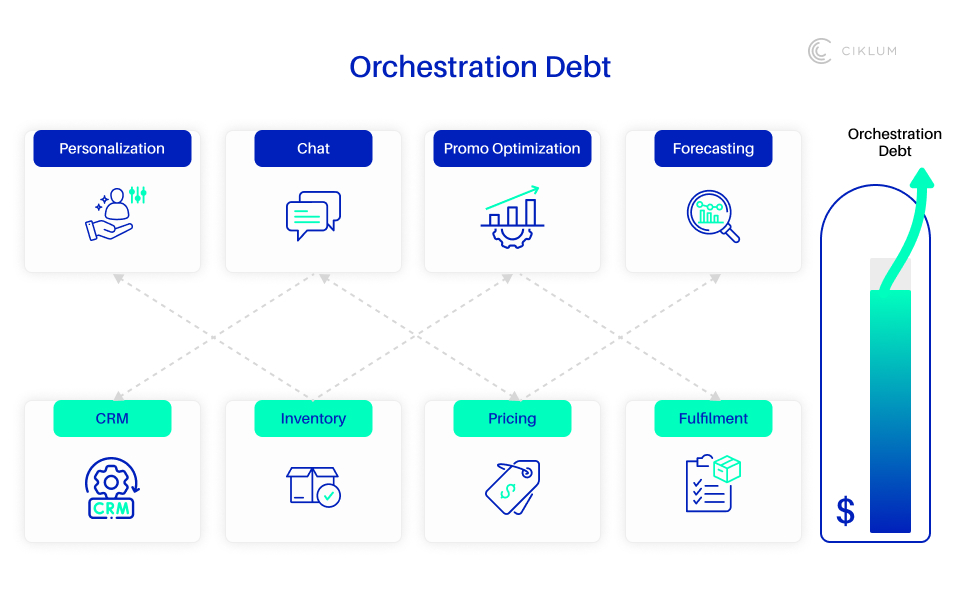
This is where I see retailers accumulate what I call orchestration debt.
Orchestration debt is the compounding cost of deploying “smart” capabilities in silos. Each new AI feature looks useful in isolation, but it increases complexity if it is not wired into operational truth.
Here is what orchestration debt looks like day to day:
- A recommendation engine suggests items without checking real-time availability.
- Customer service cannot see store activity or app behavior, so the shopper repeats themselves.
- Promotions are computed differently in different systems, which creates pricing confusion.
- Inventory teams optimize replenishment on one timeline while marketing launches offers on another.
When these misalignments happen, the customer experience does not just feel clumsy. It feels dishonest.
What Agentic AI Actually Means for Retail
Agentic AI is not simply conversational AI with better answers – it’s the shift from AI that responds to AI that orchestrates.
An agentic system can:
- interpret intent
- plan steps to achieve a goal
- call tools and services across the business
- take actions, within guardrails
- learn from outcomes
That last part matters. Retail is full of goal-driven moments:
- “Find something that fits this occasion, my size, my budget, and my delivery window.”
- “Reserve it near me, but only if it is actually available today.”
- “Apply my loyalty benefits in the best way without me doing the math.”
- “Help me return this smoothly, and remember my preferences next time.”
In these moments, customers are not asking for “content.” They’re asking for the business to make something happen.
The most powerful agentic systems don’t just respond to requests. They read operational signals (inventory risk, fulfilment constraints, pricing conflicts, service friction) and resolve issues before the customer even notices them.
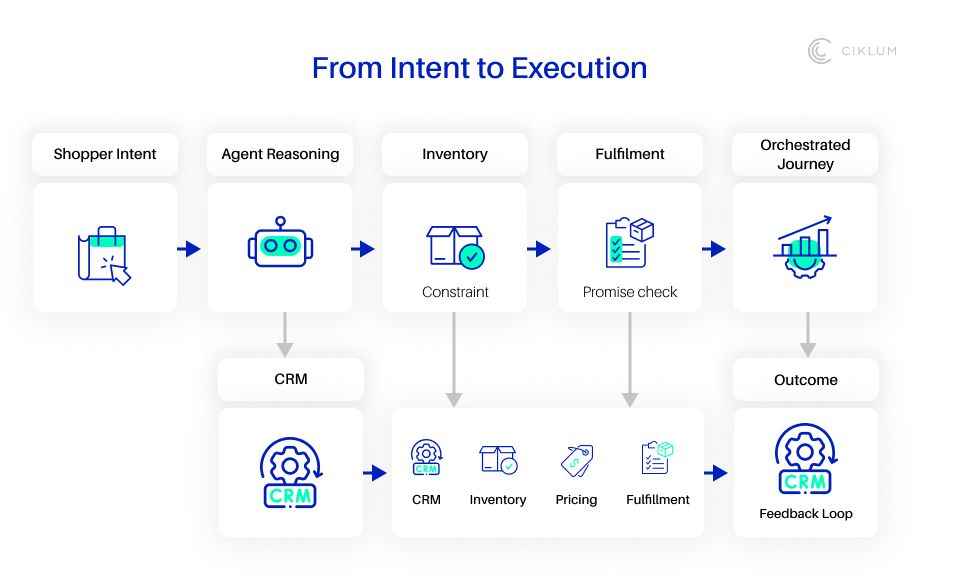
In production, the agent’s job is simple to describe and hard to build: turn intent and signals into a sequence of reliable system actions.
That is why the most practical retail agents tend to land in two high-impact loops.
Loop 1: Inventory intelligence (the operational truth loop)
Retailers want to reduce stockouts and overstock at the same time. They need demand forecasting that works at SKU, store, and regional levels. They also need “inventory-aware” offers so the experience never sells what cannot be delivered.
This is not only an operational objective. It is an experience objective. It’s customer experience, because availability accuracy is trust. Practically, that means watching orders, delivery status, and inventory signals in real time, and intervening early before a “small mismatch” turns into a broken promise.
Loop 2: Loyalty intelligence (the customer value loop)
Retailers want to detect churn early, understand why it is happening, and trigger retention journeys before the customer disappears. That is the difference between reactive discounts and proactive relationship management.
This is where agentic orchestration becomes a loyalty engine, not just a marketing engine.
The Integration Imperative
Most retail AI fails before it scales for one reason.
It cannot reliably access and act on the systems that determine what is true.
If an agent cannot see real-time inventory, it will recommend items that are not available. If it cannot query fulfilment capacity, it will promise delivery windows the business cannot keep. If it cannot reconcile pricing and promotions, it will create inconsistency across channels.
This is exactly why many retailers still feel stuck. Intelligence exists, but it is not connected to execution. Fragmented data leads to inconsistent experiences and makes compliant personalization hard to scale.
On the operational side, the problems are equally concrete:
- Poor data quality and organizational silos limit forecasting performance.
- Planners and merchants do not trust AI recommendations.
- Slow, calendar-based planning cycles cannot react to real-time demand.
That “trust” point is critical.
Accuracy is necessary. Adoption is what delivers value.
The minimum systems an agent needs to be trustworthy
If you want agentic AI that does not hallucinate retail reality, you need connected access to:
- CRM and identity
Customer profile, history, consent, preferences, and live context. - Inventory
Real-time availability across stores and network, including substitutions and delivery ETAs. - Pricing and promotions
Policy-driven pricing logic, offer eligibility, and margin constraints. - Fulfilment
What can be promised now, including pick-up readiness, delivery windows, returns routing, and last-mile constraints.
If those are disconnected, the AI experience becomes theatre. It looks smart until it has to keep a promise.
PRODIGY: How Ciklum Engineers AI that Scales
Retail AI usually doesn’t stall because the model is wrong. It stalls because the path from prototype to production is messy: integration gaps, unclear ownership, weak measurement, and no repeatable way to improve the system over time.
Prodigy is Ciklum’s proprietary AI platform and delivery methodology built to solve that. It combines reusable accelerators and agent components with an end-to-end approach that takes teams from discovery to deployment and continuous improvement.
What makes Prodigy especially effective in retail is that it is designed to turn “agentic AI” into a production capability, not a one-off pilot:
1) Retail accelerators that reduce time-to-production
Retail has repeatable patterns. Shopper journeys, store operations, customer service flows, demand and inventory loops. Starting from proven patterns shortens the path from idea to deployment.
2) AI PDLC orchestration, not a handoff
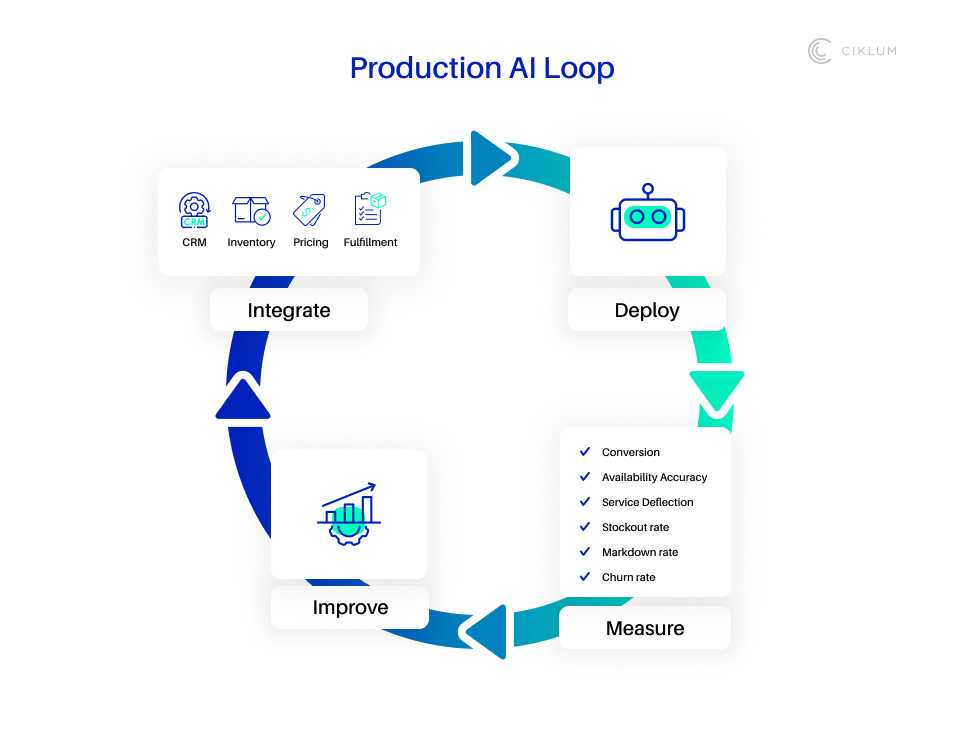
Retail AI changes with seasonality, promotions, supply volatility, and consumer behavior. You need the full AI lifecycle: design, build, deploy, monitor, improve. That is how systems stay reliable over time.
3) Vendor-agnostic by design
Retail stacks evolve. Model providers evolve. Ciklum’s approach is to engineer solutions that can adapt rather than lock you into a single vendor.
4) Data sovereignty and in-environment deployment
Retailers need control. Security, compliance, and operational resilience depend on where data lives and how it is accessed. A production approach respects that reality.
5) Value from early deployment
In retail, credibility is earned fast. Quick wins that are measurable create momentum and fund the roadmap.
The Trust Layer
Even the best-engineered AI fails if customers and associates do not trust it.
Trust is not a brand slogan. It is built into product behavior.
In agentic retail, trust comes from simple, practical mechanics:
- Inventory-aware truthfulness
Never recommend what cannot be delivered. If inventory confidence is low, the agent should say so and offer options. - Promise discipline
Every delivery estimate should be grounded in fulfilment reality, not best-case optimism. - Explainable choices
Not academic explanations. Human ones. “I chose this because it matches your budget, your size, and your delivery window.” - Graceful escalation
When confidence drops, hand off to a human with full context intact. - Consistent memory across channels
Customers should never feel like they are starting over. Continuity is part of trust.
The operational version of trust matters too. If planners do not trust recommendations, they will not act. The system will not scale.
A Practical Framework for 2026
Retail transformation fails when it becomes vague. The safest way forward is a phased plan that delivers measurable outcomes early and scales deliberately.
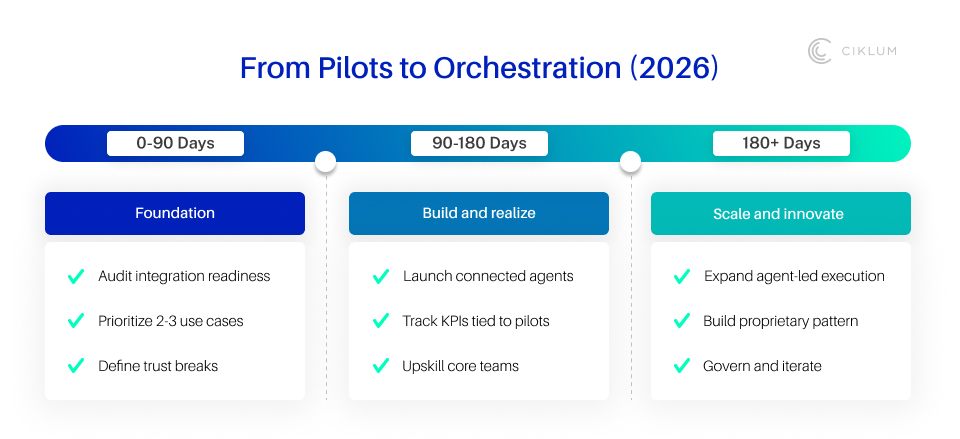
Phase 1 (0–90 days): Foundation
- Audit integration readiness. Identify what systems need to talk to each other and where truth currently breaks.
- Pick 2–3 high-value use cases with measurable outcomes. Focus on frequency, friction, and business impact.
- Establish instrumentation and baselines. Define what “trust breaks” look like in your context (availability mismatches, promise failures, inconsistent pricing).
Phase 2 (90–180 days): Build and realize
- Deploy connected agents with guardrails. Start with use cases tied to operational truth and clear ROI.
- Instrument for measurement and reliability. Track promise kept rate, availability accuracy, churn reduction, and cost-to-serve.
- Upskill internal teams. Make the system auditable and usable so planners and frontline teams trust it.
Phase 3 (180+ days): Scale and innovate
- Expand agent coverage across the value chain: service, store operations, promotions, merchandising, replenishment, and loyalty.
- Move toward responsible autonomy. Increase automation where trust and governance are mature.
- Build proprietary differentiation. Encode your brand experience and your operational advantage into reusable agent patterns.
The Next Decade of Loyalty Will Be Engineered
Retailers who treat AI as a series of product sprints will stay stuck in pilots. The demos will look impressive. The experience will still break at the seams.
Retailers who treat AI as an engineered capability will close the gap between customer intent and enterprise systems. They will build journeys that are personalized and operationally viable. They will keep promises consistently, across every touchpoint.
That is the defining advantage in 2026.
If you’re done piloting, the fastest route to value is to pick one place where customer intent breaks, then build one connected agent loop that can act across CRM, inventory, pricing, and fulfilment with clear KPIs.
Ciklum helps retailers do that using Prodigy, to accelerates production deployments through retail-ready accelerators, integration-first engineering, and continuous improvement, without vendor lock-in.

By Sarah Topping

Principal Lead - Intelligent Automation & Conversational AI
Sarah leads Conversational AI at Ciklum, spearheading AI-powered transformations in retail, publishing, and automotive. With a decade of experience, she develops award-winning virtual assistants and champions Responsible AI to enhance user experiences and operational efficiency.
Blogs
Discover Similar Insights

From AI Interest to Engineering-Ready Mandates: Why The Market Needs AI Clinics, Not More AI Pilots
Learn More
Agentification of Payments: A Strategic Shift for PSPs
Learn More
Explainable AI in Banking: Designing Transparent, Auditable Models for Credit, Risk, and Compliance
Learn More
Enterprise AI Automation: A Practical Guide to GenAI, AI Agents and Intelligent Workflows
Learn More