



Key takeaways:
- Legacy SDLC principles are looking increasingly outdated as AI capabilities expand
- Slow, rigid, fragmented development is at risk of errors, delays and costly remediation work
- AI can be deployed at every stage of the SDLC, reshaping engineers’ roles as holistic “conductors”
- A strong commitment to AI SDLC embedding can drive long-term returns on investment
The Software Development Lifecycle (SDLC) is essential for any organization planning, designing, building, testing, deploying and maintaining software systems. It’s the best way to ensure that the development process is logically structured, and maximizes the chances of quality solutions being delivered on time, on budget and without disruption.
But like many areas of technology, artificial intelligence has a major part to play in taking SDLC to the next level. McKinsey research has found that AI can improve developer productivity by up to 45% - but code generation is only one part of the story. AI is already starting to have a positive influence on SDLC from end to end, collapsing stages, automating workflows and integrating intelligence throughout.
Such is the scale of AI’s potential for SDLC that now is the time to stop thinking about AI as a tool for coding acceleration, and to start viewing it as an enabler of systemic transformation at workflow level. This blog will explore the guiding principles behind that mindset shift, and how to approach the change in practice.
Software Development Lifecycle: The Core Phases
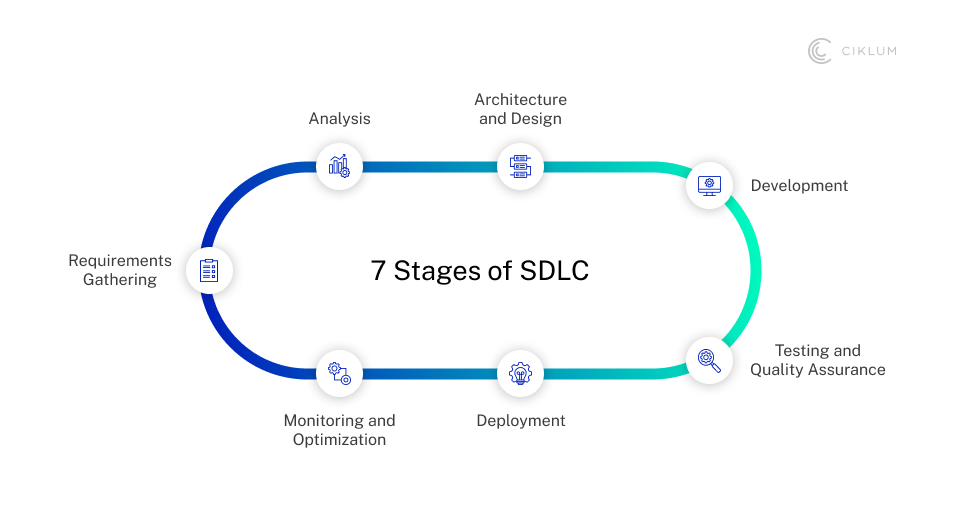
There remain several different ways for SDLC to be applied by organizations, such as Waterfall, Agile, Scrum, DevOps or hybrid). However, the core phases behind it remain consistent:
- Requirements gathering: Defining business problems, user needs, scope, constraints and high-level outcomes to shape entire product directions. Despite the importance of this point, it remains based on incomplete information or assumptions far too often.
- Analysis: Refining, validating and assessing requirements for feasibility, taking into account dependencies, integration constraints, risks, data needs, and regulatory implications
- Architecture and design: Technical leaders get to work designing the system, including data models, APIs, components, infrastructure, security, guardrails and user flows. It is at this point where key decisions have the biggest influence on cost, scalability, complexity, and long-term maintainability.
- Development: Engineers write code, create integrations, configure infrastructure and build features. Given that this is traditionally the most labor-intensive and time-consuming phase, it’s understandable that many organizations have applied AI code generation support here first.
- Testing and quality assurance: Comprehensive checks to ensure the system is safe and functions properly, testing units, integration, regression, performance, security and user acceptance. Although this is an important step, the manual and repetitive nature of many tests can make it a bottleneck at times.
- Deployment: CI/CD pipelines, manual approvals or automated deployment systems release software into production environments. These processes require careful coordination across engineering, architecture, DevOps, and security.
- Monitoring and optimization: The story doesn’t end with software release. Development teams are still responsible for many tasks that are critical for stability and long-term ROI, including performance monitoring, bug detection, error handling, observability, load optimization and continuous improvement.
Why the Traditional SDLC Model Now Falls Short
Those core SDLC processes listed above have served many businesses and development teams well for many years. However, they were generally designed for an era of software development that was slower and more predictable.
But in recent years, the advent of continuous delivery, AI systems, rapidly evolving requirements and complex, interconnected architectures has made the ‘old’ way look increasingly unfit for purpose without any changes.
Organizations sticking with their legacy processes are finding them:
- Slow and sequential: where work waits for handoffs until previous phases have been completed
- Document-heavy: where key knowledge and information often resides in static documents
- Manual process-heavy: where humans still have to write, review, test and deploy
- Fragmented: where teams operate in silos without enough communication or collaboration
- Prone to errors: where mistakes in early phases have major effects downstream
- Rigid: where changes towards the end of the cycle lead to costly rework and delays
Six Ways to Rethink the SDLC with AI Accelerated Development
As AI capabilities have advanced, the more the inefficiency and risk of traditional SDLC processes have been exposed. AI now makes meaningful contributions to every phase of the lifecycle, which means you’ll need to rethink the lifecycle from the ground up, across requirements gathering, architecture creation, code generation and cross-repository awareness.
How this will look for your organization in practice will vary from others, depending on your typical development style and how you like to operate. But the following principles and technologies will give you a general idea of the best way forward:
The “How vs. What” Framework
Historically, most developers have focused on the “how” of development, i.e. writing code. But if AI can handle much of that work now, human focus can concentrate on the “what” instead, and take a more holistic view.
Key questions they will now be asking will include:
- What problem(s) are we solving?
- What constraints must be set?
- What principles must guide design?
- What are the guardrails, safety and governance considerations?
This will make engineers system designers rather than just practical implementers. A good way to consider this change is that they will go from “violinists” that manually play every note, to “conductors” that orchestrate systems and agents.

The U-Shaped Productivity Curve
An MIT Sloan study of AI adoption in manufacturing firms found that early adopters saw a dip in productivity to begin with, before they recovered to outpace non-adopters in productivity and market share. This U-shaped curve is because it takes time for teams to learn new AI tools, change their habits and redesign workflows - but once they have, the results are transformative.
Given that this curve can be applied across discovery, coding, testing, review, deployment, monitoring and documentation, this is an important part of making AI for the SDLC a success. However, it will require a shift in mindset for leaders who expect AI to generate return on investment immediately.

The Jevons Paradox
Taken from 19th-century economics, the Jevons paradox is the idea that resource consumption increases when it becomes cheaper and/or easier to use. In the context of AI, as AI tool efficiency goes up and their cost goes down, it becomes simpler and more cost-effective to build software using those tools.
In turn, this generates demand for software, as the ability to create more features, apps and custom products expands. Maintenance demands will be higher, as well technical debt and complexity overheads.
So, to return to the theme of “conductors” and “violinists”, this expanded estate will need more engineering demand (and not necessarily developer demand) to manage AI agents, development processes and integrations.

Agentic SDLC
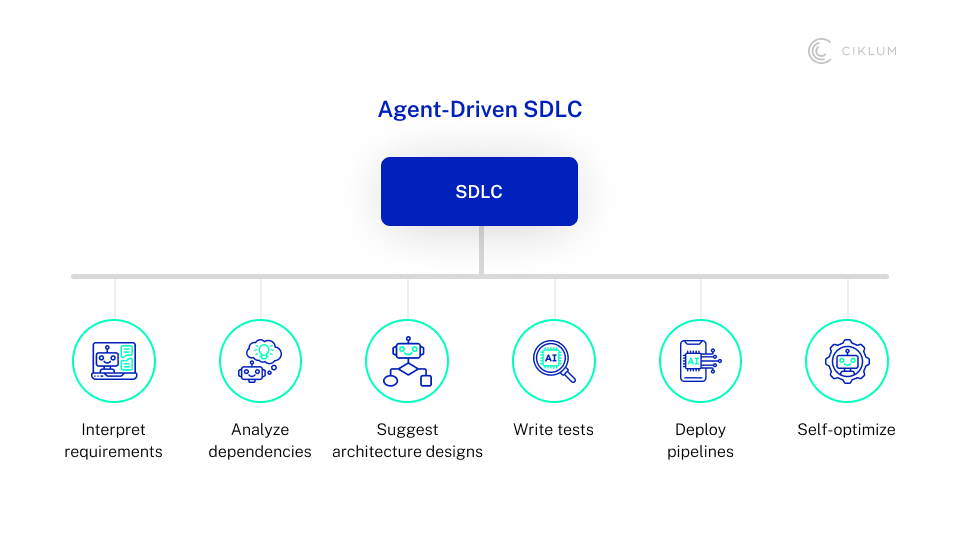
While AI can be used as an ‘autocomplete’ tool for code, the abilities of AI agents mean that AI should be deployed as a collaborator throughout SDLC. An agent-driven SDLC will be able to interpret requirements, analyze dependencies, suggest architecture designs, write tests, deploy pipelines and self-optimize across all of these processes - as well as generating code at scale.
New Engineering Skills
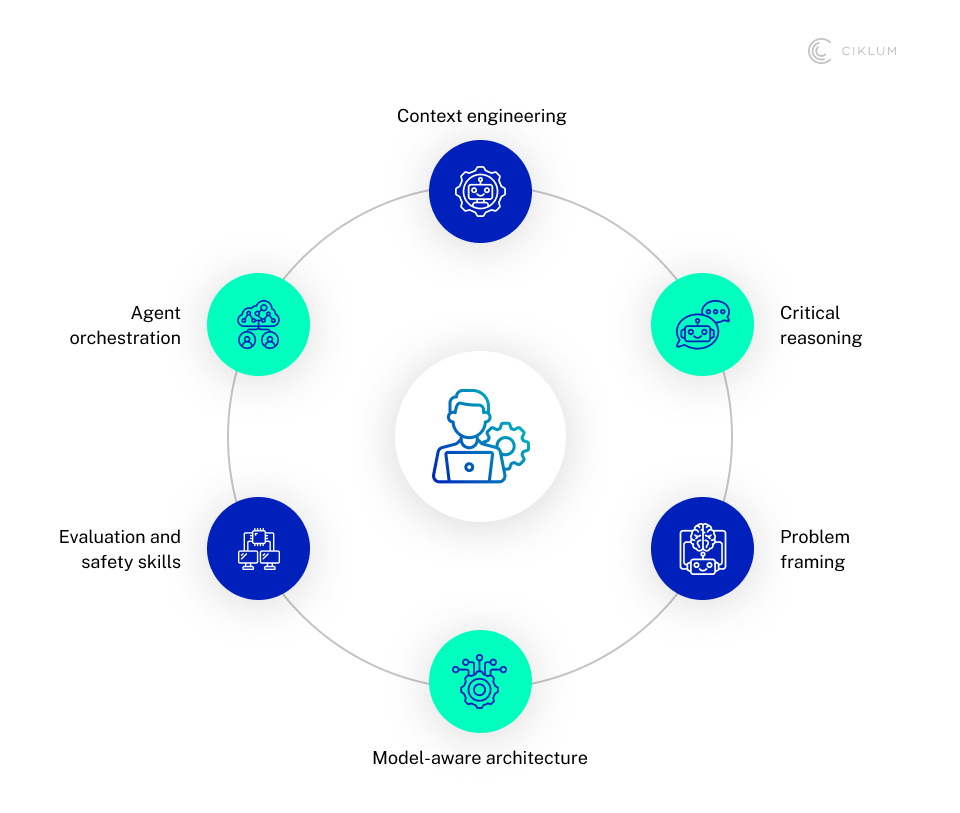
Your new “conductors” will require different skills to make use of the expanded application of AI. They’ll need to be proficient in context engineering, model-aware architecture, agent orchestration, prompt systems design, critical reasoning, problem framing, human-in-the-loop governance, and evaluation and safety skills - and they’ll need to keep all of these up-to-date in line with industry trends.
The new challenges for engineers mean they need to act more and more as tech leads, conducting teams of agents rather than writing every line of code themselves. Engineers are also now more accountable for work done by "someone" - or something - else, not only by them alone as was traditionally the case. This shift in responsibility requires new forms of oversight, quality control, and strategic thinking.
As Jensen Huang, CEO of Nvidia, puts it: "engineers won't be replaced by AI — but engineers who don't use AI will be replaced by those who do."
In Summary: Start with Ciklum’s AI Strategy Clinic
So how can you start applying these principles in practice, and make AI work for your Software Development Lifecycle?
The best first step you can take on that journey is to sample Ciklum’s AI Strategy Clinic. Our experienced experts can help you:
- Redesign your SDLC workflows
- Modernize your engineering operating models
- Identify high-value use cases across your SDLC
- Help you build the governance frameworks
- Upskill your teams in new AI-native capabilities
- AI Native SDLC
With our help, you can scale your use of AI with strategy, governance and confidence. Find out more about our AI Strategy Enablement Center of Excellence, and to discuss your specifics, get in touch with the Ciklum team today.

By Julian Beckers

Global Director - Gen AI & Automation
Julian Beckers is the Global Director of GenAI and Automation at Ciklum, where he advises organizations on how to translate emerging AI capabilities into sustainable business impact.
Blogs
Discover Similar Insights

From AI Interest to Engineering-Ready Mandates: Why The Market Needs AI Clinics, Not More AI Pilots
Learn More
Agentification of Payments: A Strategic Shift for PSPs
Learn More
Explainable AI in Banking: Designing Transparent, Auditable Models for Credit, Risk, and Compliance
Learn More
Payments Without Friction: Modern Checkout Is Your Competitive Edge
Learn More