


- Key Takeaways
- AI Is No Longer Just Accelerating The SDLC
- What Is The Agentic SDLC? A Practical Definition
- How The Agentic SDLC Differs From AI-Assisted Development
- Why Traditional SDLC Models Now Fall Short
- The Productivity Reality: Why AI Gains Do Not Always Reach Delivery
- The AI Code Quality Problem: What The Data Shows
- Context Engineering: The New Core Engineering Skill
- What A Practical Agentic SDLC Workflow Looks Like
- Governance And Security In An Agentic SDLC
- AI Software Development Tools In 2026
- The Jevons Paradox Of AI Software Development
- Start With Ciklum’s AI Strategy Clinic
Key Takeaways
- AI in the software development lifecycle is moving beyond coding assistance into agentic SDLC orchestration.
- AI developer productivity gains are real, but they do not automatically translate into faster enterprise delivery.
- The new bottleneck is shifting from code generation to review, quality, governance, and architecture.
- AI-generated code increases the need for stronger code review, testing, security, and human-in-the-loop controls.
- In 2026, the specification is becoming the new code: better requirements, context engineering, and acceptance criteria now determine how well AI agents perform.
- Enterprise engineering teams need an operating model for AI, not just a bigger set of AI software development tools.
AI Is No Longer Just Accelerating The SDLC
The Software Development Lifecycle has always existed to bring order to complexity. Requirements, analysis, architecture, development, testing, deployment, monitoring, and optimization give teams a structured way to plan and deliver quality software.
But the old SDLC was designed for a slower era.
Today, delivery environments are more interconnected, requirements change faster, and AI is collapsing the boundaries between phases. Code generation is only the most visible part of the change. AI can now interpret requirements, generate tests, summarize technical debt, review pull requests, propose architecture patterns, automate deployment steps, and monitor production behavior.
That is why the question for enterprise engineering leaders is no longer, “Can AI accelerate software development?” It can.
The harder question is: what happens to the entire SDLC when AI stops behaving like a tool and starts behaving like an execution layer?
This is the shift from AI-assisted software development to the agentic SDLC.
What Is The Agentic SDLC? A Practical Definition
An agentic SDLC is a software development lifecycle where AI agents do more than assist individual tasks. They interpret goals, plan steps, use tools, act across systems, generate or modify outputs, evaluate results, and escalate to humans when judgement or accountability is required.
In an AI-assisted SDLC, a developer asks for help. In an agentic SDLC, an AI agent can carry part of the workflow.
That distinction matters. A coding assistant may suggest a function. An agentic workflow can interpret a requirement, identify affected repositories, draft code, generate tests, prepare a pull request, summarize risk, and route the change for review.
The human role does not disappear. It changes.
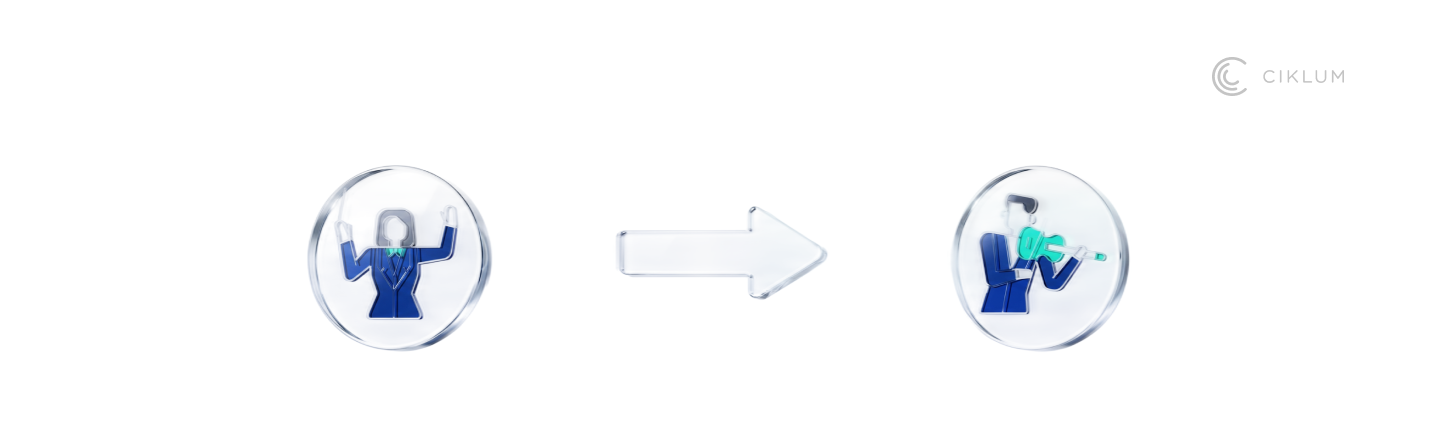
Engineers become conductors, not violinists. They no longer need to manually play every note. They design the score, set constraints, orchestrate agents, review outputs, and decide where human judgement must remain in control.
How The Agentic SDLC Differs From AI-Assisted Development
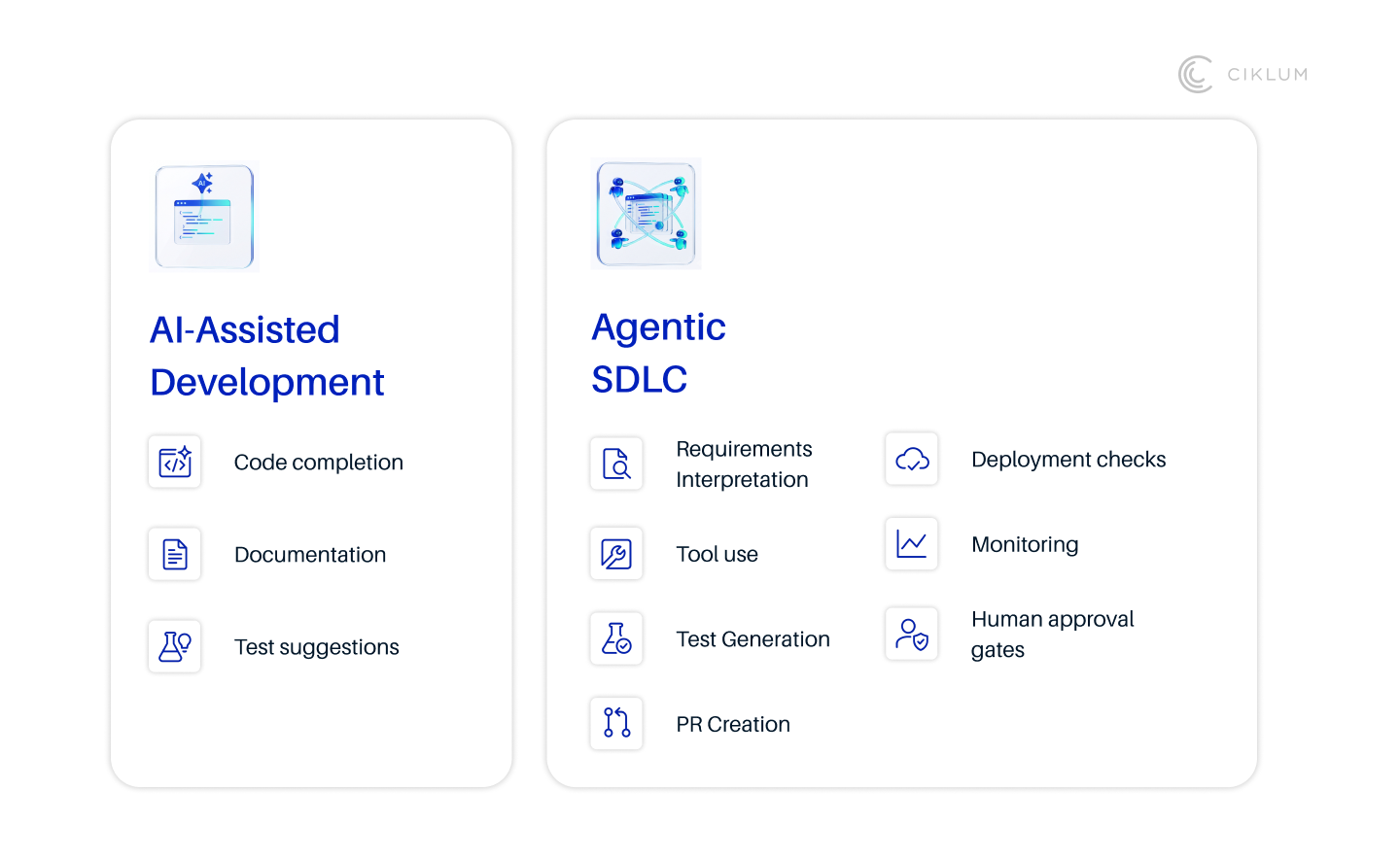
AI-assisted development usually improves the productivity of an individual engineer. It helps with code completion, documentation, boilerplate, test creation, or debugging.
The agentic SDLC changes the workflow itself.
Five differences matter most:
- From suggestion to execution
AI does not only recommend. It can take structured actions across tools. - From task help to lifecycle orchestration
AI supports requirements, architecture, coding, testing, deployment, and monitoring. - From prompt quality to context quality
The performance of AI agents depends on requirements, acceptance criteria, architecture context, and system knowledge. - From speed to throughput
Faster code generation only matters if review, testing, security, and deployment can keep up. - From individual productivity to governed delivery
The enterprise value comes from safe, repeatable, auditable workflows.
This is why the agentic SDLC is not just a tooling upgrade. It is an operating model shift.
Why Traditional SDLC Models Now Fall Short
Traditional SDLC processes still have value, but they were not built for AI-native engineering.
They are often:
- slow and sequential;
- document-heavy;
- dependent on manual handoffs;
- fragmented across teams and tools;
- vulnerable to early requirement errors;
- rigid when late change appears;
- too weak on AI-specific governance.
AI exposes those weaknesses because it accelerates output. If your requirements are vague, AI produces vague output faster. If your architecture is poorly documented, AI amplifies that uncertainty. If your review process is already overloaded, AI increases the queue.
That is the central paradox of AI in SDLC: it makes strong engineering systems stronger and weak systems more fragile.
The 2025 DORA report makes a similar point, describing AI as an amplifier. It magnifies the strengths of high-performing organizations, but also magnifies dysfunction where teams lack the right practices, trust, and operating model.
The Productivity Reality: Why AI Gains Do Not Always Reach Delivery
AI developer productivity is real, but it is often misunderstood.
McKinsey research has reported significant productivity gains from generative AI in software-related tasks, and many engineering teams see clear improvements in code generation, documentation, boilerplate, and test creation. But the enterprise outcome is more complicated.
A developer may generate code faster, while the organization still delivers at the same speed.
Why? Because software delivery is a system. If one part accelerates and the rest does not, the bottleneck simply moves.
Faros AI’s 2025 research found that teams with high AI adoption completed 21% more tasks and merged 98% more pull requests, but pull request review time increased 91%. In other words, AI accelerated production, but review capacity became the constraint.
That is the new productivity curve. First, teams see local gains. Then they hit system bottlenecks. Only after they redesign review, testing, deployment, governance, and observability do they see durable enterprise impact.
This is why leaders should not measure AI success only by lines of code, pull requests, or time saved. They should measure lead time, change failure rate, review latency, rework, defect escape rate, and business outcomes.
The AI Code Quality Problem: What The Data Shows
AI-generated code is not automatically bad. But it is not automatically safe, maintainable, or architecturally sound either.
The quality issue is not that AI cannot produce working code. Often, it can. The issue is that AI-generated code can look correct while hiding defects, security risks, duplication, weak abstractions, or architectural misalignment.
Stack Overflow’s 2025 Developer Survey shows a trust problem: many developers use AI, but confidence in AI output remains limited, especially among experienced developers who are accountable for production systems. Sonar’s 2026 State of Code research also points to a verification bottleneck: developers spend meaningful effort reviewing, testing, and correcting AI output.
That should not surprise engineering leaders. AI is excellent at generating plausible code. But plausibility is not the same as production readiness.
The more AI accelerates creation, the more enterprises need:
- stronger AI code review;
- automated test generation and validation;
- secure coding checks;
- architectural review;
- dependency and licence scanning;
- explainable change summaries;
- human approval gates for high-risk changes.
AI code quality is not solved by asking developers to “be careful”. It is solved by designing quality gates that scale at the same speed as AI-generated output.
Context Engineering: The New Core Engineering Skill
Context engineering is more than prompt writing.
It is the discipline of giving AI systems the right information, structure, constraints, and feedback so they can produce useful, safe, and consistent outputs.
In practice, context engineering means engineers must know how to:
- structure requirements for AI interpretation;
- provide architecture and repository context;
- define coding standards and guardrails;
- connect AI tools to relevant documentation;
- design reusable prompt and agent patterns;
- control what data agents can access;
- evaluate output quality;
- decide when humans must intervene.
This is why senior engineers become more important in an AI-native environment. AI can generate code, but it cannot own the architecture, accountability, or product judgement behind that code.
The best engineers will increasingly act as system designers, reviewers, evaluators, and orchestrators.
What A Practical Agentic SDLC Workflow Looks Like
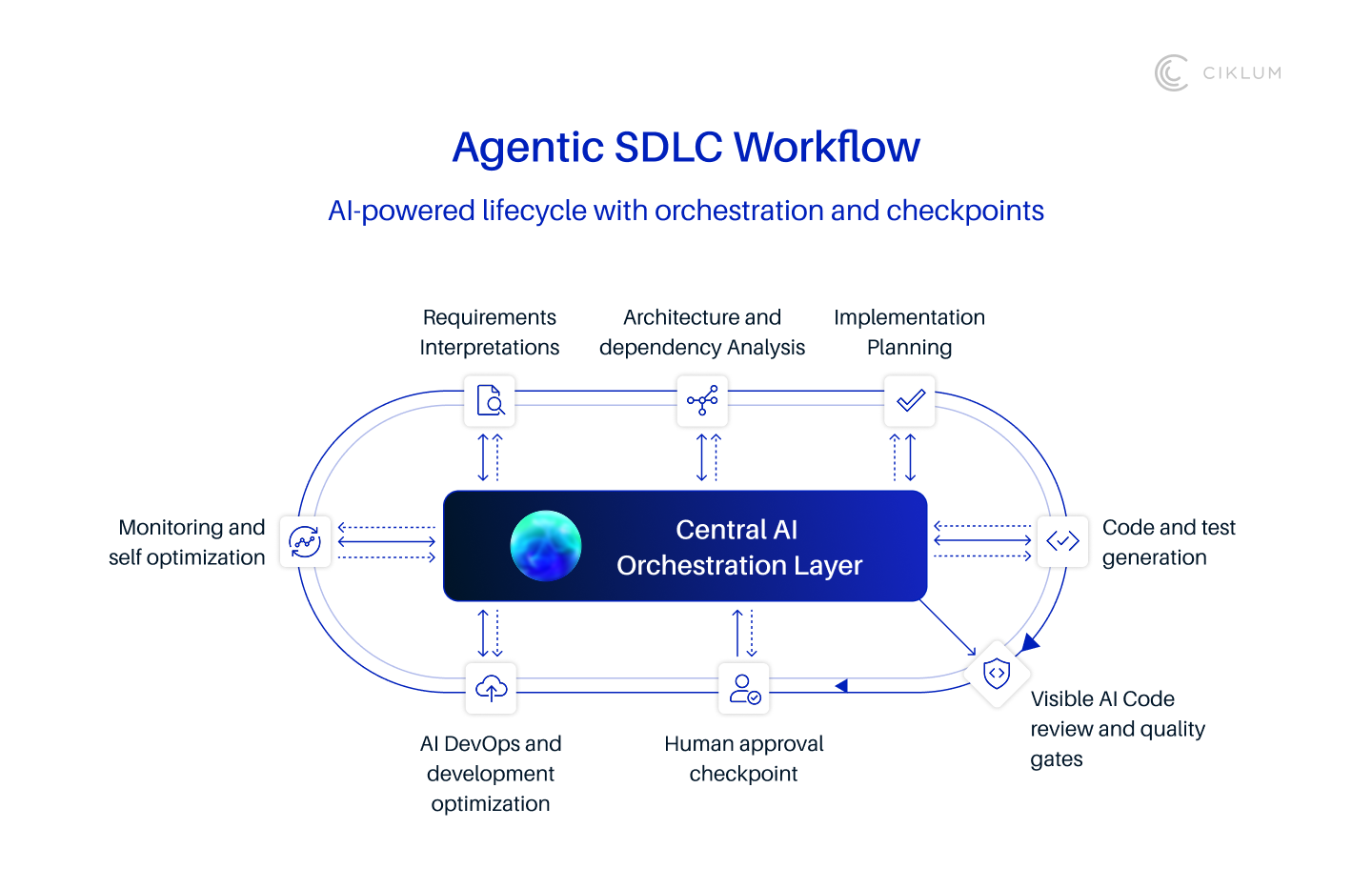
A practical agentic SDLC does not remove humans. It places humans at the right checkpoints.
A simplified workflow looks like this:
- Requirements Interpretation
AI agents parse business requirements, user stories, constraints, and acceptance criteria. - Architecture And Dependency Analysis
Agents identify affected services, repositories, APIs, data models, and risks. - Implementation Planning
Agents propose implementation steps, test coverage, review requirements, and deployment dependencies. - Code And Test Generation
AI generates code, unit tests, integration tests, documentation, and change summaries. - AI Code Review And Quality Gates
Automated checks validate security, style, dependencies, test coverage, architecture rules, and known failure patterns. - Human Review
Engineers review strategic, architectural, high-risk, or ambiguous decisions. - AI DevOps And Deployment Automation
Agents prepare release notes, validate pipeline readiness, monitor deployment signals, and trigger rollback recommendations if needed. - Monitoring And Self-Optimization
AI summarizes production issues, detects patterns, recommends fixes, and feeds learning back into the next cycle.
The goal is not full autonomy everywhere. The goal is designed autonomy: automate what is repeatable, govern what is risky, and preserve human judgement where accountability matters.
Governance And Security In An Agentic SDLC
Governance becomes more important when AI agents can act.
An AI coding assistant that suggests code is one risk profile. An AI agent that can modify repositories, open pull requests, trigger deployments, or change infrastructure configuration is another.
The OWASP Top 10 for Agentic Applications highlights the need for a shared language around securing autonomous, tool-using AI systems. Key risks include agents misusing tools, operating beyond intended privileges, being manipulated away from their goals, or taking actions that are difficult to audit.
Enterprise engineering teams should build governance into the SDLC, not add it later.
That means:
- identity and access controls for AI agents;
- least-privilege permissions;
- tool-use boundaries;
- source traceability;
- human approval gates;
- audit logs;
- policy-based deployment controls;
- secure prompt and context management;
- rollback and escalation paths;
- monitoring for unexpected agent behaviour.
Human-in-the-loop governance must be explicit. Teams need to know where AI can act alone, where it can recommend, where approval is required, and who is accountable if something fails.
AI Software Development Tools In 2026
Enterprise teams are no longer choosing one AI tool for the whole SDLC. They are combining multiple tools across different stages.
Common categories include:
- AI coding assistants;
- agentic coding environments;
- AI code review tools;
- test generation tools;
- documentation generators;
- DevOps and CI/CD automation;
- observability and incident summarization;
- security and vulnerability analysis;
- architecture and dependency mapping.
Tools such as GitHub Copilot, Claude Code, Cursor, Gemini Code Assist, and Codex-style agents are part of a broader ecosystem. The important question is not which one is best in isolation. It is how the tool fits into the enterprise engineering workflow.
Engineering leaders should evaluate tools against five criteria:
- Context Fit
Can it understand your codebase, architecture, standards, and domain? - Quality Controls
Does it integrate with review, testing, security, and compliance gates? - Governance
Can access, data use, logging, and agent actions be controlled? - Workflow Integration
Does it work with your IDEs, repositories, CI/CD, ticketing, and observability tools? - ROI
Does it improve delivery outcomes, not just individual productivity?
The future is multi-tool, but the review and governance layer must be shared.
The Jevons Paradox Of AI Software Development
The Jevons Paradox comes from 19th-century economics: when a resource becomes cheaper or easier to use, consumption often increases rather than decreases.
AI creates the same effect in software.
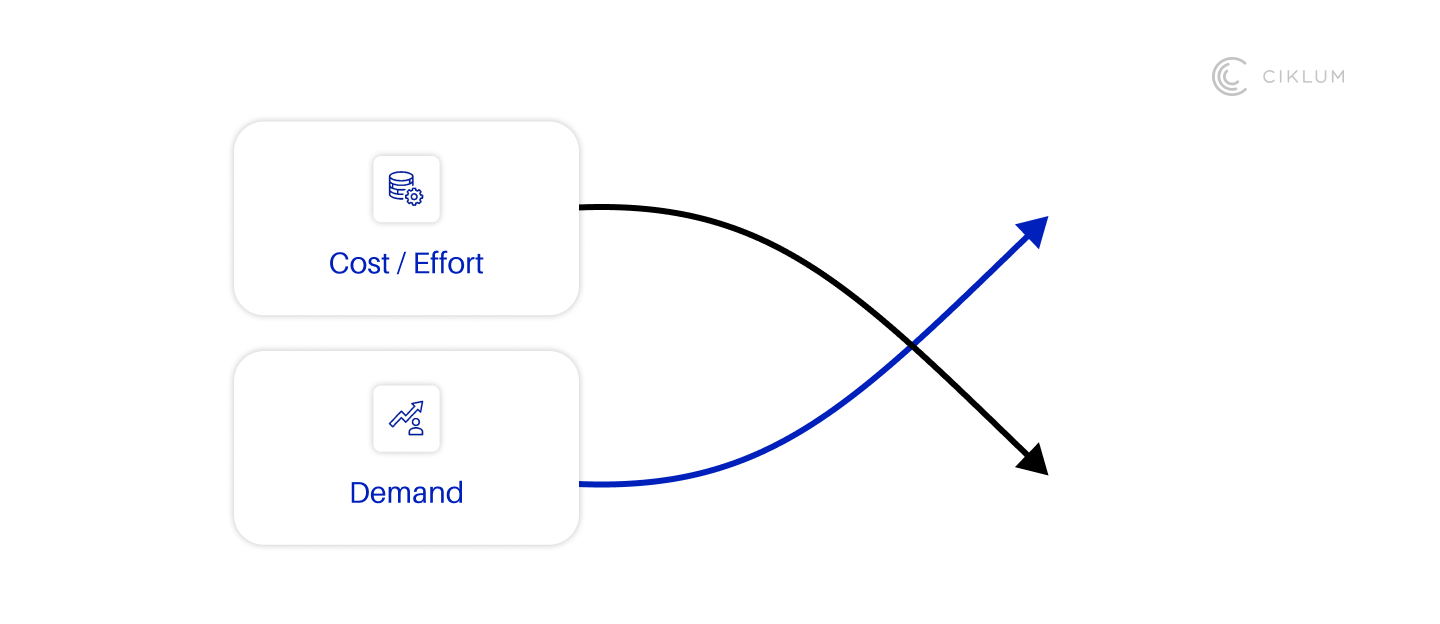
As code becomes easier and cheaper to generate, organizations will build more software. More features. More internal tools. More automations. More integrations. More experiments. More maintenance obligations.
This is why AI will not necessarily reduce engineering demand. It will increase the demand for engineering leadership.
The estate grows. The number of systems grows. The review burden grows. The need for architecture, integration, governance, testing, observability, and technical debt management grows with it.
That is why the conductor metaphor matters. The future engineer is not just a faster coder. The future engineer is responsible for orchestrating agents, tools, systems, standards, and outcomes at greater scale.
Start With Ciklum’s AI Strategy Clinic
The agentic SDLC is not about buying more AI tools. It is about redesigning the software development lifecycle so AI can create value safely, repeatably, and at scale.
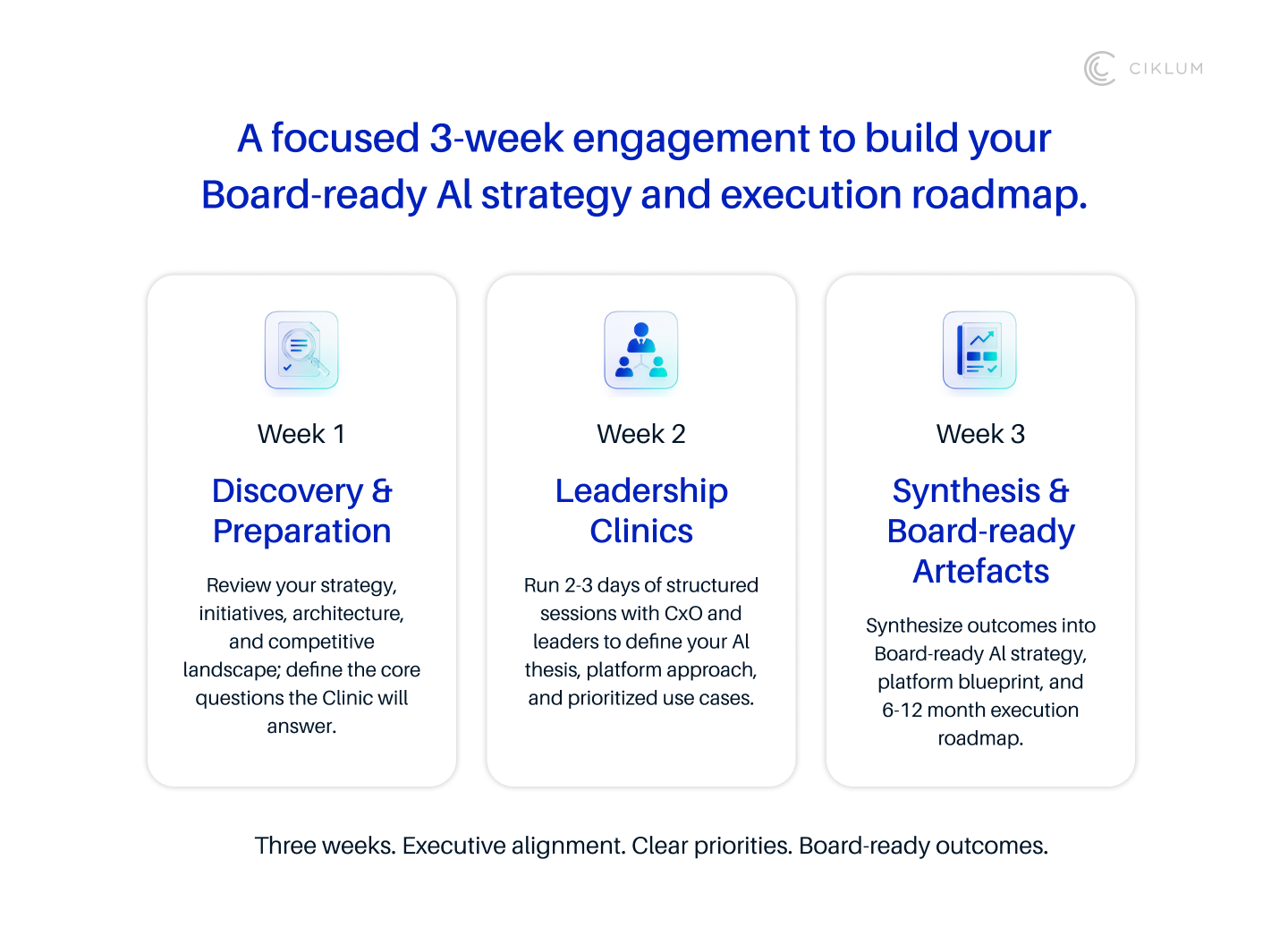
Ciklum helps enterprise engineering teams move from AI experimentation to AI-enabled engineering operations.
Through our AI Strategy Clinic and AI-Enabled Engineering capabilities, we help teams:
- assess where AI can improve the SDLC;
- identify high-value use cases across discovery, delivery, QA, DevOps, and RunOps;
- redesign workflows around AI agents and human checkpoints;
- build governance and security controls;
- modernize engineering operating models;
- improve code review, testing, and quality gates;
- upskill teams in context engineering, agent orchestration, and AI-native delivery.
AI will not replace engineering discipline. It will reward it.
The organizations that win will not be the ones that generate the most code. They will be the ones that build the strongest operating model around AI.
Discuss your SDLC transformation with Ciklum’s AI Strategy Clinic and explore how to build an agentic, governed, AI-enabled engineering lifecycle.

By Julian Beckers

Global Director - Gen AI & Automation
Julian Beckers is the Global Director of GenAI and Automation at Ciklum, where he advises organizations on how to translate emerging AI capabilities into sustainable business impact.
Blogs
Discover Similar Insights

How to Make Omnichannel Strategies Truly Improve Customer Experience
Learn More
Healthcare Digital Transformation Challenges: Why Programs Fall Short Post-Implementation
Learn More
AI-Ready Data Infrastructure for Financial Services: A Practical Guide for UK Banks and Insurers
Learn More
Designing Scalable Software Architecture for High-Growth Products
Learn More