



Key Takeaways
- In 2026, the AI budget is still flowing into areas that leave scale barriers untouched.
- Many enterprises are investing in foundations without first identifying the constraint holding scale back.
- Agentic AI is moving into live operations faster than governance models are being rebuilt to manage it.
- The leaders who win the next AI cycle will spend on the right things, not the most things.
The Most Expensive Mistake in Enterprise AI Implementation
The most expensive thing an organisation can do with AI right now is spend confidently on the wrong things.
Global AI spending is set to hit $2.5 trillion in 2026, which tells us enterprises are making a serious bet on the technology. And yet, only 39% of technology leaders say their AI investments are actually improving financial performance.
Enterprises are not ignoring AI. Many are doing exactly what the last two years told them to do, and still not seeing the returns they expected.
Two years ago, the argument was relatively straightforward: stop buying tools before you have the foundations in place. Most enterprise leaders understand that now. The new problem is subtler and considerably more expensive.
Organisations are investing in the right categories. They are still misallocating within them.
Foundational budget is flowing, but it does not always reach the constraint blocking scale. The gap between where money goes and where AI breaks is becoming one of the most expensive problems in enterprise transformation.
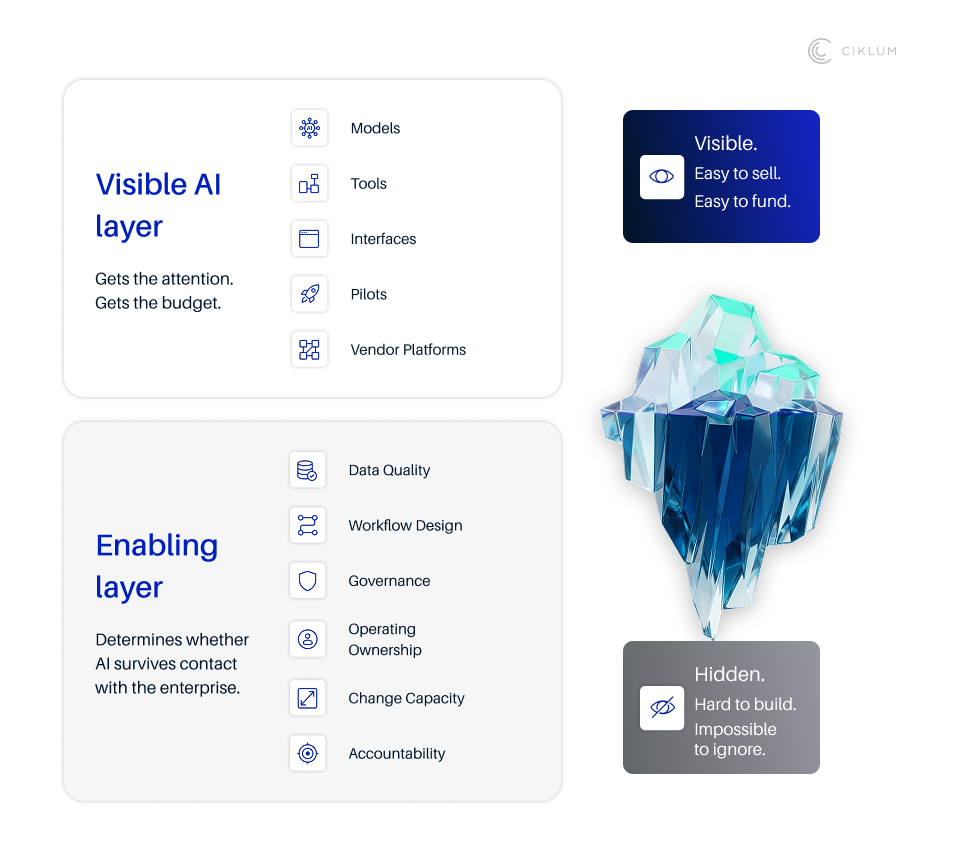
Where AI Misallocation Shows Up in 2026
Foundational spend is still misallocated
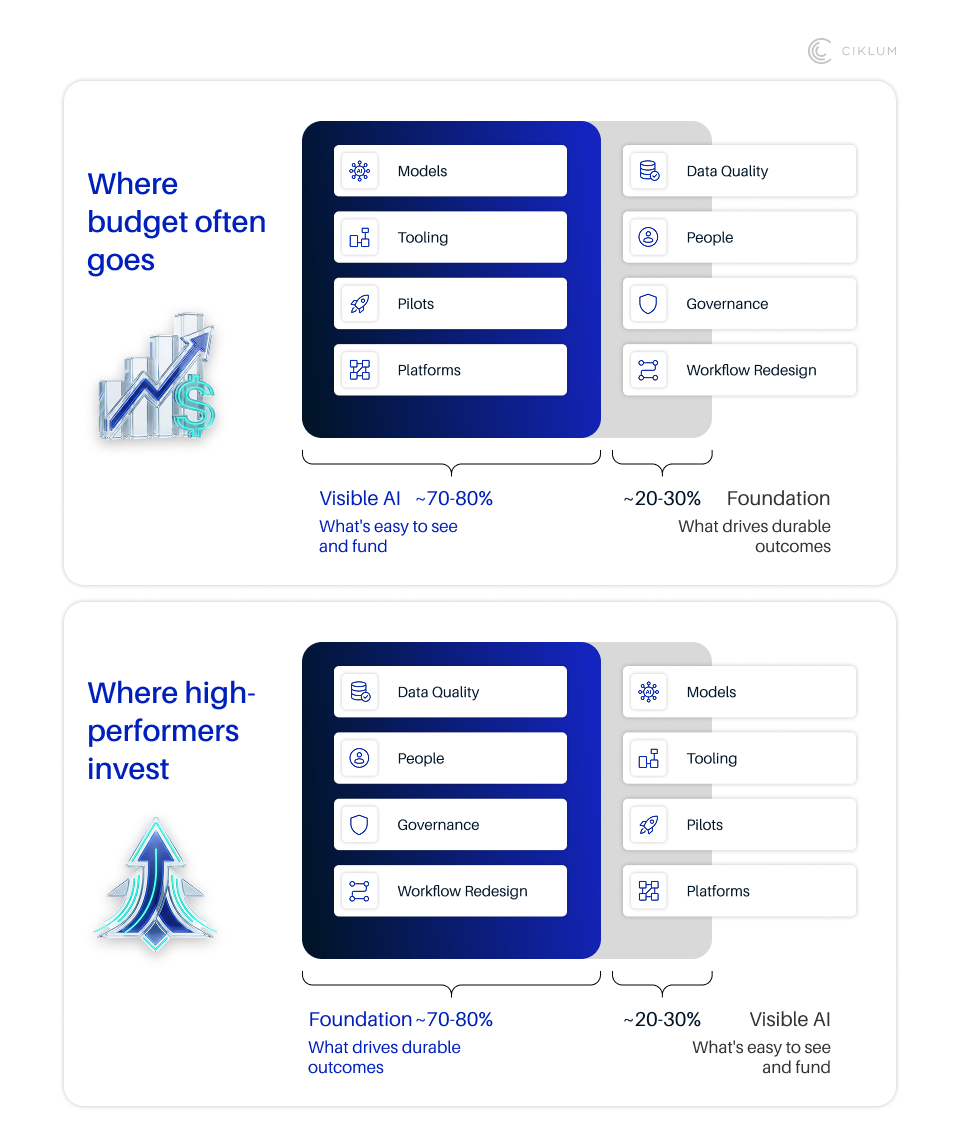
Gartner’s 2026 data says that organisations with successful AI outcomes invest up to 4x more in foundational areas such as data quality, AI governance, AI-ready people, and change management. The payoff is significant, with up to 65% better business outcomes compared with organisations that experience poor AI outcomes.
The misallocation now sits inside the foundation. Enterprises are buying data platforms, setting up governance tools, and running AI literacy programmes. All of that matters, but it is not always the constraint.
What is harder, and often more politically disruptive, is redesigning operating models and building AI accountability structures and AI judgement at the leadership level. These areas rarely look like clean technology investments, but they often decide whether AI works in production.
Governance is lagging behind AI agents
Agentic AI - systems that can act, decide, escalate, and operate across tools with limited human instruction - are entering enterprise operations now.
Budget is moving toward agentic capability faster than the governance infrastructure needed to manage it.
When an AI agent sends a customer communication, triggers a procurement workflow, updates a record, or makes an operational recommendation that turns out to be wrong, who owns that? What boundary was the system operating within? What should have triggered human review? What happens when the action is technically correct but commercially risky?
Many governance frameworks were written for AI that supports human work. Agentic AI carries a different risk profile because it can take action across live processes. Operational, regulatory, and commercial risk starts building when that shift is funded faster than it is governed.
Workflows still aren’t AI-ready
McDonald’s AI drive-thru pilot remains a useful illustration of what happens when AI enters a real operating environment. The technology was tested for a specific task, but the workflow around it was the real system being tested, including accents, background noise, order corrections, staff handoffs, menu complexity, and exceptions that do not follow a neat script.
Anyone who has sat in a drive-thru understands this immediately. That system was harder than the model.
Misallocation becomes very practical over here. Every enterprise leader understands that layering AI on old processes does not transform the economics of the work. They know it. They still do it because deploying another tool is easier to approve than redesigning the workflow around it.
Adoption Looks Strong Until Readiness Breaks
AI adoption used to be a useful signal. It showed whether an organisation was willing to move from discussion into production. In 2026, most enterprises can prove AI is present across the business. Far fewer can prove the business is ready to scale it.
Misallocation becomes harder to spot once AI activity spreads. Budget keeps moving toward more use cases, more tools, and more capability, while the readiness gaps that limit scale stay untouched.
One business unit may be running production-grade AI while another is still experimenting with basic tools. Governance may lag behind technology. Data infrastructure may improve while workflows remain unchanged. From a distance, the organisation looks active. Up close, readiness is uneven in exactly the places scale depends on.
The better question for leadership has changed: From “How widely are we using AI?” to “Which readiness gap is most likely to break the next investment?”
Until leaders can answer that clearly, adoption metrics create a false sense of progress. They show movement, but not durability. In enterprise AI, movement without durability quickly becomes another form of misallocated spend.
AI readiness needs to be diagnosed across several dimensions such as strategy, data, and governance, because a single maturity label rarely explains why so many enterprise AI strategies fail before they reach scale.
Why the Real Constraint Is Hard to See From the Inside
AI problems rarely wear the right label. A weak pilot gets blamed on the model when the real issue is AI data readiness, workflow logic, or governance that was never built for live AI behaviour.
Diagnosis is also a visibility problem. IT sees architecture. HR sees workforce readiness. Data teams see pipelines. Business units see demand. No single view shows the full system, so organisations fix the part they can see and leave the actual constraint untouched.
A maturity score will not solve this on its own. It may show where the organisation sits today, but it does not reveal which constraint is actually blocking scale.
Four questions worth answering before committing more budget:
| Question | What it reveals |
| Are we investing in the right constraints, or the most visible ones? | Whether the next budget cycle will reach the actual blocker. |
| Have workflows been redesigned for AI-augmented operations, or just supplemented with tools? | Whether AI is changing work or sitting on top of old processes. |
| Is accountability for AI outcomes shared across functions, or siloed within one team? | Whether ownership is strong enough to scale. |
| Is governance operating at runtime, against live AI behaviour, or sitting in a policy document? | Whether risk and performance can be managed in production. |
These questions move the conversation directly toward which constraint is stopping AI from scaling and whether that is where the next investment is going.
How to Build an AI Strategy for Enterprise: Diagnosis Before Prescription
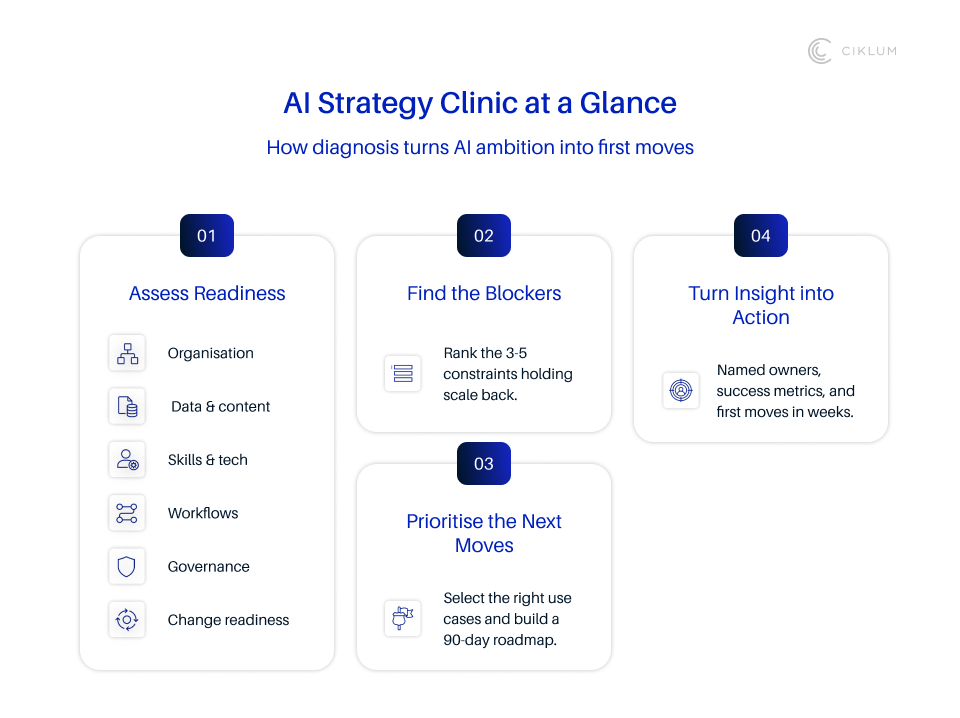
The AI Strategy Clinic is built for organisations that already have intent, investment, and parts of the foundation in place, but still cannot see clearly where scale keeps breaking.
The Strategy Clinic gives leadership a focused diagnostic across readiness dimensions that decide whether AI can move into production: Data quality, AI governance, workflow maturity, skills, change capacity, and the operating model around AI.
The value comes from seeing how those dimensions connect. A data issue may slow one use case. A governance gap may block another. A workflow problem may quietly reduce the value of both. The diagnostic identifies the constraint on the next phase of growth, then gives leadership a ranked view of blockers, prioritised use cases, named owners, success metrics, and a 90-day roadmap.
Enterprises that come out ahead will be the ones that knew, with specificity, what was standing between their current AI investment and the returns they were promised, and fixed that first.
AI compounds safely and measurably when it is built on the right foundations. It stalls when the constraint remains invisible.
Find out where the scale is actually breaking. Book an AI Strategy Clinic and leave with a prioritised roadmap in weeks, not quarters.

By Yannique Hecht

Senior Director - AI R&D
13+ Exp
Yannique Hecht is the Senior Director of AI R&D at Ciklum, and a strategist with 13+ years of experience building at the intersection of product, AI, and strategy. He has led large, cross-functional teams and advised Fortune 500 companies on designing, building, and scaling next-generation digital products and AI-driven platforms.
Blogs
Discover Similar Insights

The Agentic Shift: Rewiring the Retail Operating Model
Learn More
Agentic AI in Retail: Closing the Gap Between Customer Intent and Enterprise Systems
Learn More
Agentification of Payments: A Strategic Shift for PSPs
Learn More
Explainable AI in Banking: Designing Transparent, Auditable Models for Credit, Risk, and Compliance
Learn More