



- Key Takeaways
- The Structural Failure of Enterprise AI
- When AI Starts Owning Work, Not Just Assisting It
- The Logic of Selection: What Earns the Right to be Built
- PRIME: The Decision Framework Used Inside the AI Strategy Clinics
- The Silent Killers of Scale: Feasibility Gates
- In Summary: Bridging AI Strategy and AI Reality
Key Takeaways
- Clear selection and prioritisation are now essential for AI initiatives to scale.
- Agentic AI is shifting work from execution to supervision across core business functions.
- Objective, financial-led evaluation is necessary to move AI beyond isolated wins.
- AI Strategy Leadership Clinics provides the decision discipline needed to align ambition, governance, and execution before scale begins.
The Structural Failure of Enterprise AI
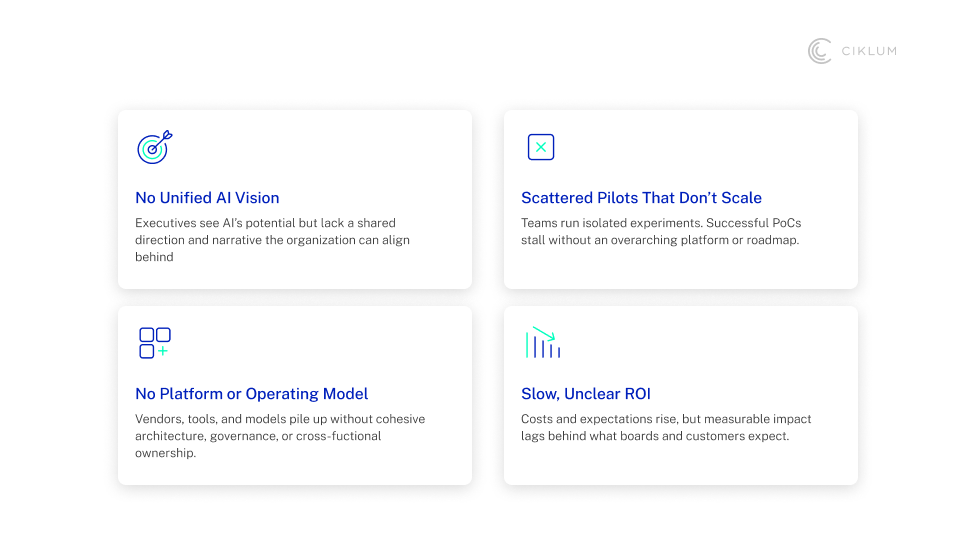
If you zoom out, a consistent pattern shows up across large organisations. There is no shortage of AI ideas. Teams launch pilots, demos impress leadership, and internal momentum builds fast. For a while, it feels like progress.
Then those initiatives run into operational reality - security reviews, data constraints, legacy integration, ownership questions, and risk controls. Many initiatives stall before they ever become part of day-to-day work. The organisation stays busy experimenting, but the impact stays thin.
The data reflects this reality.
- Most AI PoCs never graduate into widescale deployment. In one study, 88% failed to make that jump, with only 4 out of 33 reaching production.
- In 2025 alone, 42% of companies scrapped the majority of their AI initiatives before they ever had a chance to scale.
When AI Starts Owning Work, Not Just Assisting It
AI is moving beyond assistance and into execution. Agentic systems are increasingly taking on outcome-impacting responsibilities, making decisions, coordinating work, and responding dynamically to changing conditions. In practice, this shifts human roles from doing the work to supervising, approving, and governing it.
That change raises the cost of “pilot culture.” Running isolated experiments without a platform strategy, governance model, or operating ownership doesn’t just slow progress - it compounds risk and creates rework
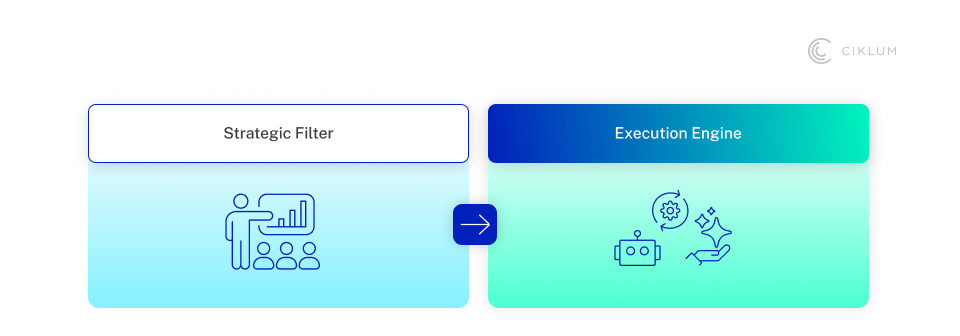
At this stage, scale depends on two elements working together.
The first is a strategic filter, where leadership defines the central question that truly matters to the business. The kind of question that forces trade-offs and narrows attention to a small number of opportunities with the potential to move the needle.
The second is an execution engine, capable of turning those decisions into production-grade systems that can survive actual operational pressure.
This is what the AI Strategy Leadership Clinics is designed to do: create the conditions for scale before the build starts - when decisions are still cheap, and course correction is still possible.
The Logic of Selection: What Earns the Right to be Built
At the heart of the AI Strategy Clinics is one uncomfortable but essential question early: Which AI ideas deserve to exist beyond a slide deck?
The purpose of selection is to take a long list of possible AI initiatives and determine which ones are worth leadership attention and investment.
Organisations that succeed with AI filter ideas early, before engineering time, credibility, and budget are consumed. Candidate use cases are examined holistically, removed from their original team context, and evaluated at an enterprise level.
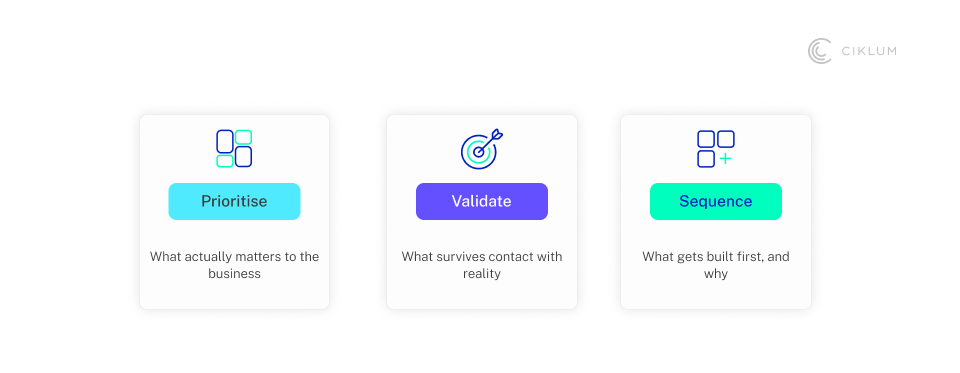
Prioritisation
Ideas are taken out of their original context and examined side-by-side. An initiative that felt urgent inside one function now has to justify itself at a business level. This is often where teams realise that some projects exist simply because they were easy to start or well sponsored, rather than because they were truly critical.
Validation
Instead of asking only “can we build this,” it’s imperative to ask the more important question: “should we?” Early feasibility checks bring up technical, data, integration, and organisational risks before time and money are spent. This step exists to stop teams from prototyping their way into dead ends and calling it progress.
Sequencing
The ideas that survive are mapped into a phased timeline, with clear dependencies, workstreams, and ownership. Sequencing is what allows an execution team to take over without guesswork, re-interpretation, or another round of alignment theatre.
By the end of this process, the backlog becomes a revenue-ready pipeline, made up only of initiatives that have survived all the checks. If it can’t survive selection, it doesn’t deserve engineering time.
PRIME: The Decision Framework Used Inside the AI Strategy Clinics
Most AI funding stories start with a slick demo and a strong sponsor. But over time, it becomes harder to separate promising ideas from battle-tested ones. Even with 72% of organisations reporting they measure ROI, many still struggle to tie returns to systems that scale, as per Wharton Human-AI Research.
Inside the AI Strategy Clinics, prioritisation is not left to intuition. PRIME is the decision framework used during the clinic to evaluate which initiatives earn the right to move forward, before anything enters build.
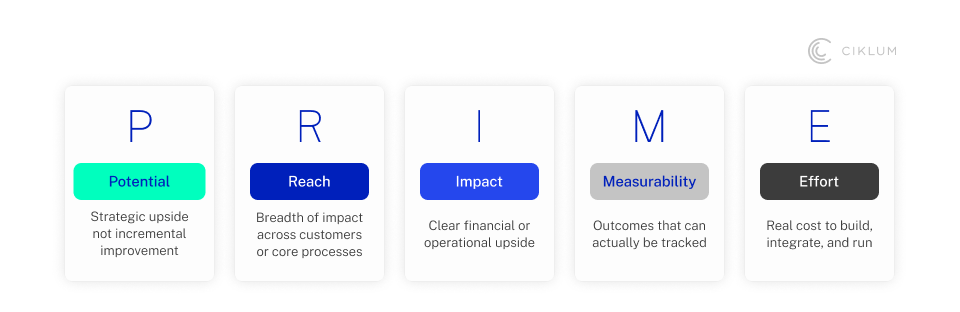
Each potential use case is assessed across five dimensions:
- Potential: Does this meaningfully support the organisation’s 10x strategic ambition?
- Reach: How broadly does this affect users, customers, or core processes?
- Impact: What is the tangible financial upside? Cost, margin, risk reduction, growth. Pick one.
- Measurability: Can we tell if it’s working without squinting at dashboards and debating definitions?
- Effort: what is the true cost and complexity to deliver and maintain?
If the only proof is a great demo and a strong sponsor, PRIME forces you to ask how it affects the P&L, who uses it, and what breaks when you roll it out. Because a demo can be impressive and still be a dead end.
According to a 2025 AI Adoption Report, there is an 80% vs 37% success gap between organisations with and without a formal strategy, a gap driven by selection discipline rather than model quality.
The Silent Killers of Scale: Feasibility Gates
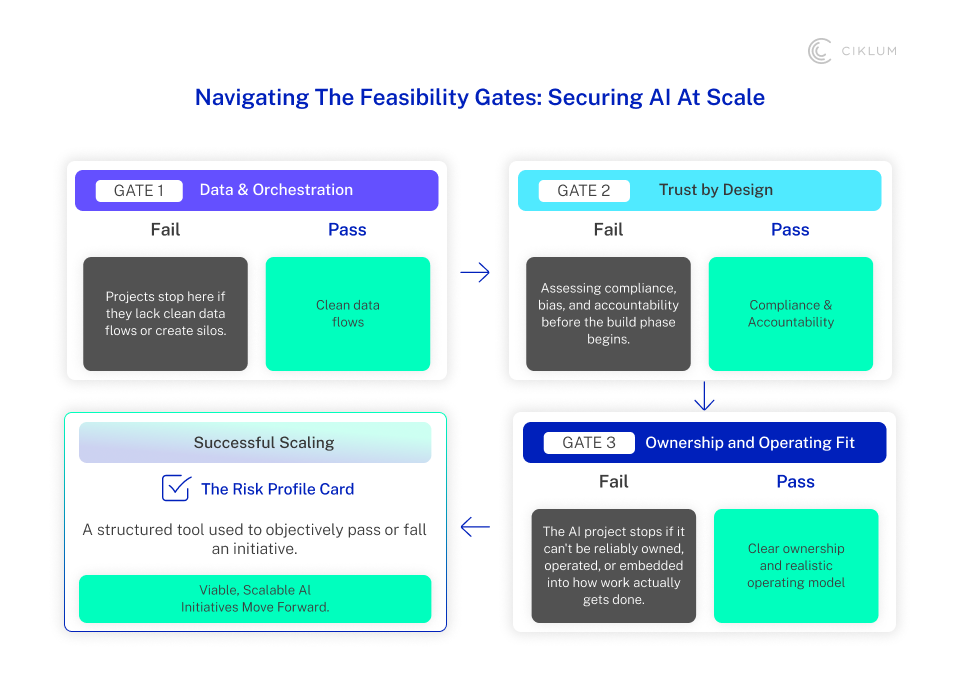
According to Gartner, 30% of GenAI projects are expected to be abandoned after the PoC stage, often due to data quality issues, unclear value, or rising costs. To address this, as part of the AI Strategy Clinics, feasibility gates are applied before initiatives move into delivery.
Gate #1: Data and Orchestration Readiness
Agentic systems depend on clean data flows, integration across systems, and an orchestration layer that can manage the workflow end-to-end. If that foundation isn’t in place, the initiative is effectively building another silo with better branding. When that’s the case, this is where it ends.
Gate #2: Trust by Design
Regulatory, ethical, and accountability considerations are assessed before build. Use cases that introduce unmitigated compliance risk, bias exposure, or unclear responsibility are stopped early. By being brutally honest early, organisations protect their ability to move fast later, once the system is live, visible, and under pressure.
Gate #3: Ownership and Operating Fit
Even technically feasible AI fails without ownership and operational fit. This gate defines who runs the system, how it integrates into workflows, how exceptions are handled, and what “good” looks like once it is live.
In Summary: Bridging AI Strategy and AI Reality
Strategy without engineering turns into a theatre show. Engineering without strategy turns into waste. Most AI programmes collapse somewhere in between.
The AI Strategy Clinics bridges that gap by turning intent into engineering-ready mandates: a shared narrative, prioritised use-case portfolio, feasibility gates, governance model, and a clear execution path that holds up under real-world pressure.
If AI in your organisation has stopped being exciting and started being serious, the next move may not be another pilot. It may be a better decision process.
The AI Strategy Leadership Clinics is designed for that moment - helping leadership teams pause, pressure-test assumptions, make trade-offs, and leave with a funded, actionable roadmap in weeks, not months.

By Yannique Hecht

Senior Director - AI R&D
13+ Exp
Yannique Hecht is the Senior Director of AI R&D at Ciklum, and a strategist with 13+ years of experience building at the intersection of product, AI, and strategy. He has led large, cross-functional teams and advised Fortune 500 companies on designing, building, and scaling next-generation digital products and AI-driven platforms.
Blogs
Discover Similar Insights

The Agentic Shift: Rewiring the Retail Operating Model
Learn More
Agentic AI in Retail: Closing the Gap Between Customer Intent and Enterprise Systems
Learn More
Agentification of Payments: A Strategic Shift for PSPs
Learn More
Explainable AI in Banking: Designing Transparent, Auditable Models for Credit, Risk, and Compliance
Learn More