


Key Takeaways
- Reactive vs. autonomous: Most retail operations still run on reactive logic (detect a problem, then respond). Agentic AI shifts this to systems that anticipate, decide, and act autonomously.
- Use cases span the value chain: From personalization and inventory to pricing, customer service, visual search, cart recovery, store layout, and autonomous checkout.
- Architecture matters: Successful agentic systems rely on orchestration, a unified data fabric, a robust action layer, and trust and governance.
- Operating model shift: The transition is from humans managing processes to humans setting objectives and guardrails for autonomous systems. It’s an operational transformation, not just a technology project.
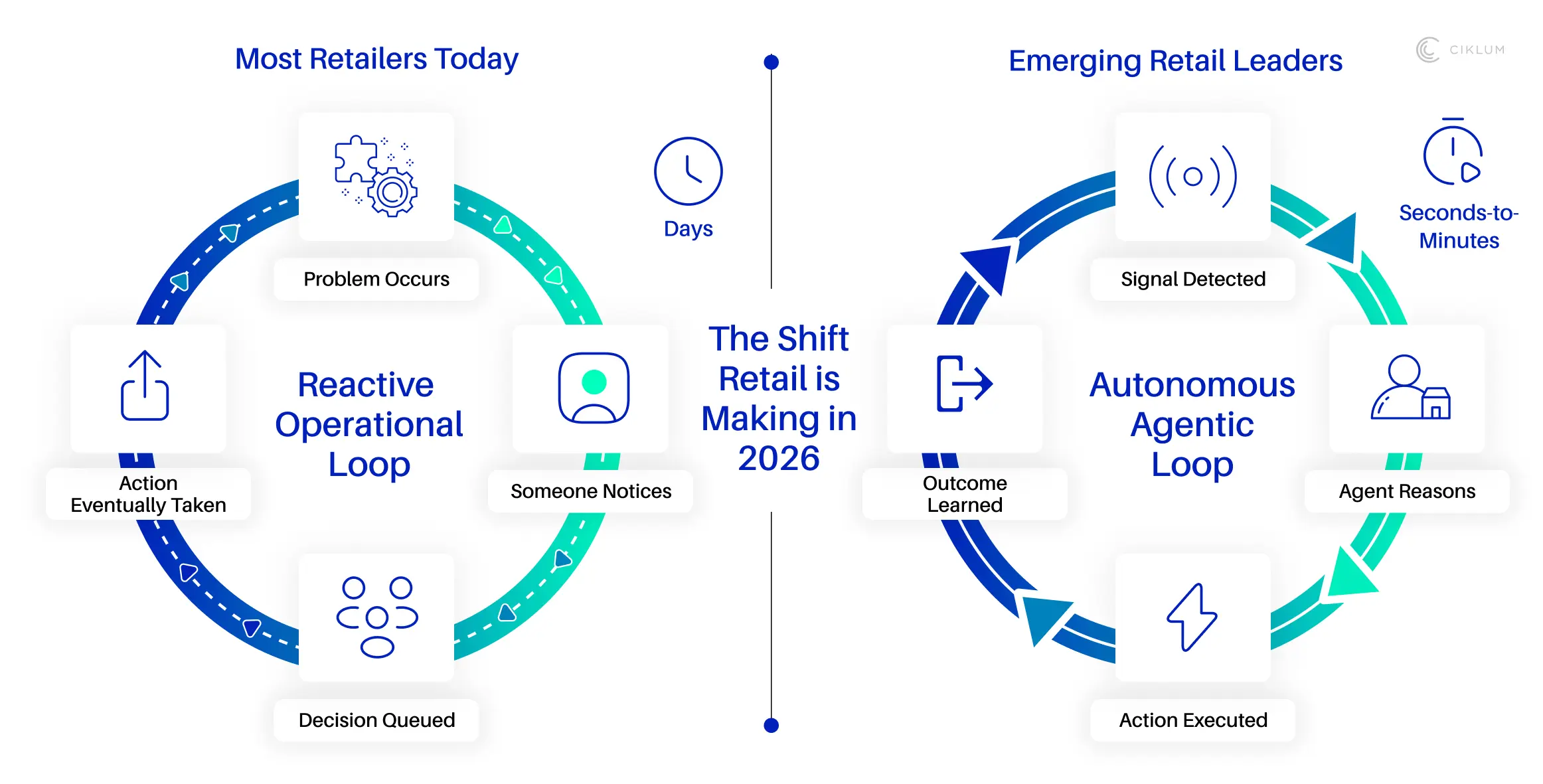
The retail industry has spent the better part of two decades digitizing operations. Point-of-sale systems went digital. Inventory moved to databases. Customer interactions became tracked and logged. Yet despite this transformation, a fundamental paradox remains: most retail operations still run on reactive logic.
The shelf empties. Someone notices. An order gets placed. Days later, the product arrives.
A customer abandons their cart. A generic email fires. Perhaps they return.
A competitor changes their pricing. Eventually, the pricing team catches up.
This reactive pattern (wait for the problem, then scramble to fix it) represents the operational reality for most retailers today. But something different is emerging: a shift from systems that digitize reactive processes to systems that operate autonomously.
For more on how AI agents and autonomous orchestration enable this shift, see our services overview.
Use Cases Driving Operational Transformation
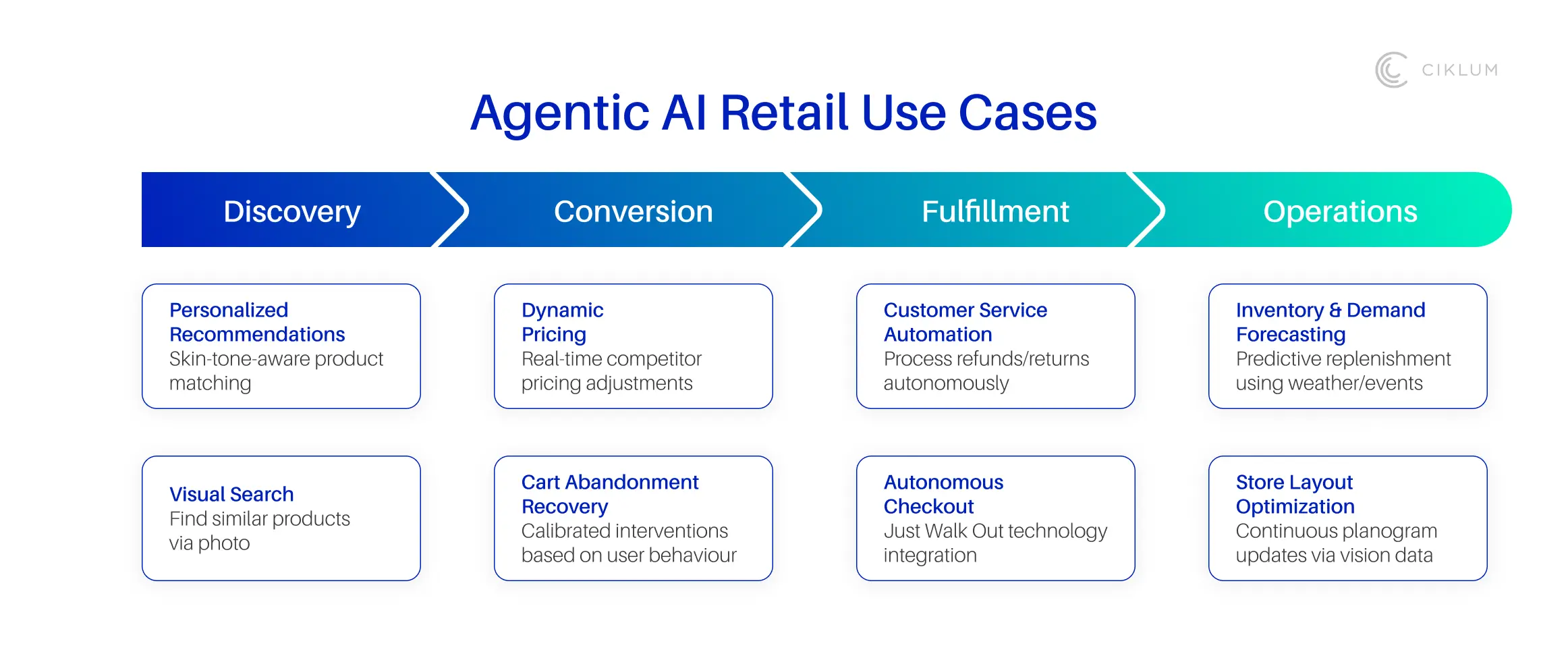
Agentic AI isn't just a futuristic concept, it's driving tangible, measurable impact for retailers today. By embedding intelligence and autonomy into core business functions, agentic systems are redefining how retailers connect with customers, manage operations, and respond to market dynamics. The following use cases illustrate how agentic AI is moving retail from incremental improvements to fundamental reinvention, enabling organizations to anticipate needs, automate decisions, and achieve new levels of operational excellence.
Personalized Product Recommendations and Discovery
Traditional recommendation engines operate on relatively simple logic: collaborative filtering ("customers who bought this also bought that") or content-based matching. Agentic systems take a fundamentally different approach.
These agents analyze customer behavior across multiple touchpoints to deliver personalized suggestions that adapt in real-time to individual intent. They consider browsing patterns, seasonal preferences, purchase history, weather conditions, local events, and contextual signals to predict what a customer might want, often before the customer explicitly searches for it.
How it works in practice: The agent continuously monitors customer interactions and contextual data. When a customer browses a product category, the agent doesn't just surface similar items. It considers the customer's style preferences, budget patterns, and current context. If the weather forecast shows a temperature drop, the agent might surface knitwear options to a customer who has previously purchased cold-weather items.
Retailers like Sephora have implemented visual analysis capabilities that recommend makeup products based on skin tone, previous purchases, and current trends, then suggest complementary products and complete looks. The agent can also predict replenishment timing based on typical usage patterns.
This represents a shift from "campaign-based" personalization where marketing teams craft segments and messages, moving to real-time, context-aware interactions that feel intuitive rather than algorithmically generated.
Inventory Management and Demand Forecasting
Inventory accuracy remains one of retail's most persistent challenges. Manual shelf auditing is time-consuming and error-prone, and the gap between what systems show and what's actually on shelves creates cascading problems for omnichannel fulfillment.
Agentic inventory systems fuse historical sales data, weather patterns, economic indicators, local events, and social signals to forecast demand and manage replenishment autonomously. These systems don't just predict. They act.
How it works in practice: The inventory agent continuously ingests data from multiple sources such as POS systems, warehouse management systems, weather APIs, event calendars, social media trends. It uses predictive models to forecast demand at the SKU level, accounting for seasonality, promotions, and external factors.
When the agent detects a demand surge or supply disruption, it doesn't flag the issue for human review. It autonomously triggers replenishment orders, reroutes inventory between locations, or adjusts allocations. If an item shows unexpected velocity at one store while sitting stagnant at another, the agent can initiate a transfer.
Some retailers have deployed physical agents such as autonomous robots that patrol store aisles, scanning products using computer vision and RFID technology. When these robots detect an empty shelf, they verify the backend system, generate pick lists for associates if items are in the back room, or trigger reorders if items are truly out of stock.
This closes the loop between detection and action. Rather than generating reports that someone eventually reviews, the system maintains continuous inventory awareness and responds in real-time.
Dynamic Pricing Optimization
Static pricing has always been a compromise. Setting prices requires balancing competitive positioning, margin targets, inventory levels, and demand, and by the time a pricing decision is implemented, the underlying conditions may have already changed.
Agentic pricing systems operate in real-time, continuously monitoring competitor prices, inventory levels, demand elasticity, and customer engagement signals. They simulate pricing scenarios to identify optimal price points that maximize the retailer's specific objective, whether that's market share, revenue, or margin.
How it works in practice: The pricing agent monitors competitor prices through API integrations, tracks inventory levels, and analyzes demand patterns. Unlike rules-based engines that apply predetermined formulas, these agents learn from context and optimize continuously through micro-adjustments.
Importantly, these agents understand complex interdependencies. They account for "halo effects" where lowering the price of a popular item might drive sales of related accessories and "cannibalization" where discounting a premium product might undercut private label alternatives. The agent optimizes for total basket profitability rather than individual item margins.
During unexpected events, this responsiveness becomes particularly valuable. When regional weather changes or local events shift demand patterns, pricing agents can launch relevant promotions within hours rather than waiting for the weekly planning cycle. The agent identifies the opportunity, selects relevant SKUs, calculates discount depth, and pushes promotions to digital channels and electronic shelf labels.
Customer Service and Support Automation
Customer service has traditionally been a cost center characterized by slow response times and inconsistent resolutions. Generative AI improved the conversational quality of chatbots, but Agentic AI has transformed their utility by granting them execution authority. These agents don't just talk, they resolve.
How it works in practice: Customer service agents are integrated with CRM, order management, and payment systems. They have the authority to process refunds and returns, manage payment disputes, update invoice details, track shipments, and modify orders, all according to policy rules, but without requiring human intervention for routine cases.
When a customer requests a return, the agent instantly verifies eligibility against the retailer's policy, checking purchase date, item condition, and customer history. If the request meets criteria, the agent approves the refund or issues a return shipping label immediately. For complex cases that fall outside standard parameters, the agent escalates to human representatives with complete context, including transaction history, previous interactions, and a summary of the issue.
Modern agents also operate proactively. They can detect when shoppers stall on checkout pages and offer contextual help before abandonment occurs. They identify delivery delays linked to supplier backlogs and proactively notify customers with new estimated arrival times, offering rescheduling options or goodwill credits when service level agreements are breached.
This proactive capability addresses a fundamental limitation of traditional customer service: by the time a customer contacts support, the experience has already degraded. Agentic systems intervene earlier, resolving issues before they become complaints.
Visual Search and Product Discovery
Text-based search assumes customers know what to call what they're looking for. Visual search agents enable a different interaction model: customers can upload an image and find similar products available for purchase.
How it works in practice: Visual search agents use computer vision and multimodal AI to analyze uploaded images, extracting style attributes, colors, patterns, and contextual elements. They search product catalogs using vector similarity matching, finding visually similar items.
Advanced implementations go further. When a customer uploads an image of a living room they admire, the agent doesn't just identify individual items, it suggests complete room configurations with available products at appropriate price points. Fashion retailers use these agents to create complete outfit recommendations based on a single uploaded item, considering the customer's existing purchase history and style preferences.
Retailers like Stitch Fix and Zalando have pioneered styling agents that interpret complex, natural language requests: "I need an outfit for a rustic summer wedding that isn't too formal" and generate personalized, shoppable recommendations. This shifts the e-commerce experience from "search and filter" to "describe what you need and receive solutions."
Cart Abandonment Recovery
Cart abandonment represents a significant gap between expressed intent and completed purchase. Traditional recovery approaches (generic reminder emails sent hours or days later) treat abandonment as a single event rather than a signal to understand.
How it works in practice: Cart abandonment agents analyze user behavior signals in real-time, including time spent on checkout pages, form field interactions, cursor movements, and navigation patterns. When they detect hesitation or abandonment intent, they intervene contextually rather than reactively.
The agent recognizes that different abandonment reasons require different interventions. Price sensitivity might warrant a discount. Shipping concerns might trigger an offer of expedited delivery. Trust issues might prompt security assurances or guarantees. The agent calibrates its response based on the signals it observes and the customer's history.
These agents also orchestrate follow-up across channels, including email, SMS, and push notifications, with personalized messaging that reflects the specific context of the abandoned session rather than generic reminders.
Store Layout and Merchandise Optimization
Physical retail success depends significantly on how products are positioned, which items get premium placement, how traffic flows through the space, and which product adjacencies drive additional purchases.
How it works in practice: Store optimization agents analyze foot traffic patterns from computer vision systems, dwell times at specific sections, and purchase data to understand customer flow. They identify opportunities to optimize product placement, cross-merchandising, and layouts.
The agent might recommend moving seasonal items to high-traffic areas when weather patterns shift, or adjusting displays based on real-time sales velocity. In advanced implementations, the agent provides specific planogram updates to store staff mobile devices, ensuring layout optimization happens continuously rather than seasonally.
This transforms category management from a periodic planning exercise to a dynamic optimization process. Merchandising decisions that previously required weeks of data collection and analysis can happen in response to current conditions.
Autonomous Checkout and In-Store Operations
Physical retail locations are deploying autonomous systems that reduce labor requirements while improving customer experiences. Computer vision tracks customer movements, identifies products selected, and processes transactions automatically.
How it works in practice: Autonomous checkout agents use computer vision, sensor fusion, and machine learning to track customers throughout the store. They identify products picked up through image recognition, maintain a virtual shopping cart, and process payment automatically when customers exit.
Inventory robots roam store aisles, scanning products to maintain accurate inventory counts and identify out-of-stock situations. These robots act as physical agents that navigate dynamic environments, working around carts, customers, and displays to create a continuous "digital twin" of the store's inventory state.
This addresses a fundamental limitation of traditional retail operations: the gap between what systems believe is on the shelf and what's actually available to customers. Continuous autonomous scanning maintains accuracy that periodic manual counts cannot achieve.
The Architecture That Makes This Possible
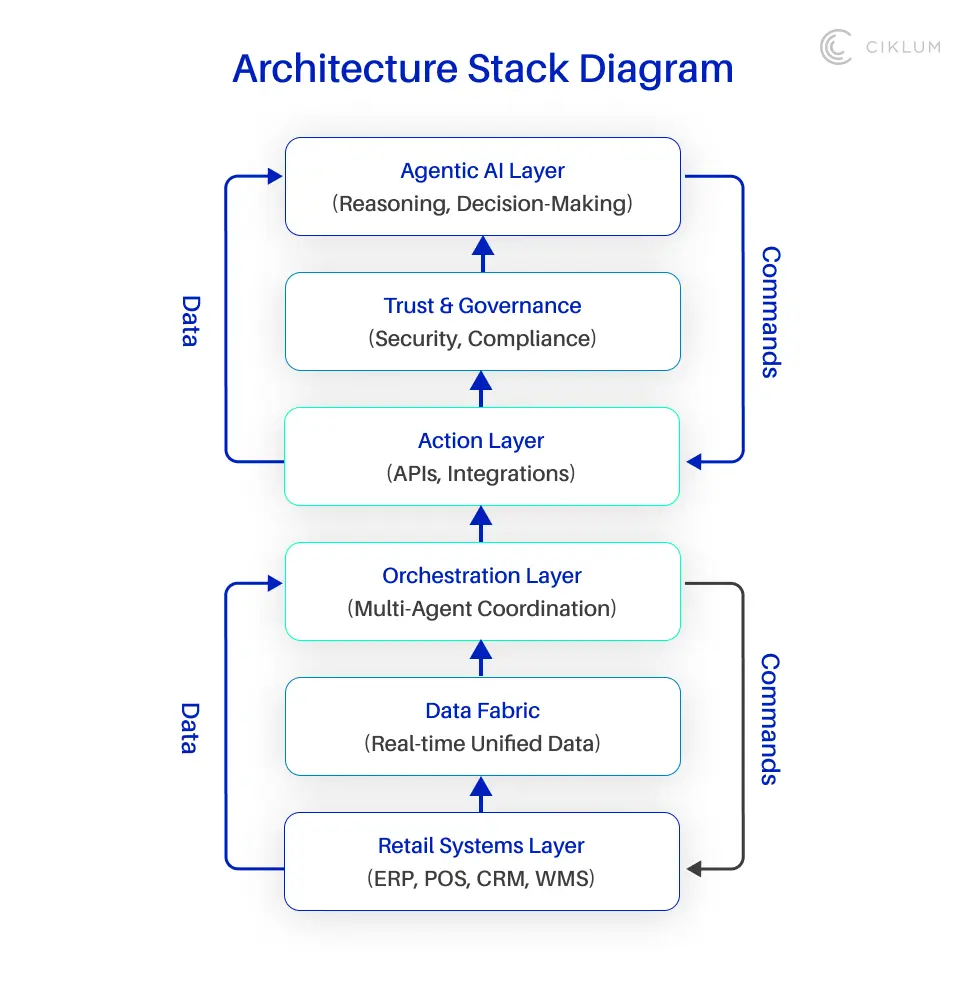
Successfully implementing agentic AI requires more than deploying a chatbot or integrating an API. These systems require a technology stack designed for autonomous operation. Organizations building these foundations often draw on generative AI and decision science alongside modern data platforms to unify data and enable real-time reasoning.
Data Fabric: Agents require unified, real-time data access across traditionally siloed systems. A data fabric connects ERP, POS, CRM, and warehouse management systems into a coherent information layer that agents can query continuously.
Orchestration Layer: Systems that manage reasoning logic and coordinate multiple specialized agents. This layer ensures that agents working on related problems share context and collaborate effectively as in the inventory agent's demand forecast informing the pricing agent's decisions, for example.
Action Layer: The ability to execute relies on robust APIs and integration standards that allow AI systems to interface securely with enterprise software. Agents need to push buttons, trigger workflows, update databases, and send notifications across the retail technology stack.
Trust and Governance Layer: Autonomous systems require security, compliance, and transparency controls. This layer ensures that autonomous actions align with business policies, regulatory requirements, and ethical guidelines. It includes audit trails, approval workflows for sensitive actions, and explainability features.
The Operational Shift
The transition from reactive to autonomous retail represents more than a technology upgrade. It changes the fundamental operating model, shifting from human operators managing processes and making decisions to human strategists setting objectives and guardrails for autonomous systems.
This shift doesn't eliminate human roles. It changes them. Category managers shift from data aggregation to strategy development. Customer service representatives handle complex cases that require judgment and empathy. Store associates focus on customer experience rather than repetitive tasks.
The retailers navigating this transition successfully are those who recognize it as an operational transformation rather than a technology project, one that requires rethinking processes, roles, and decision-making structures alongside deploying new systems.
The question isn't whether autonomous systems will reshape retail operations. The question is how quickly organizations can adapt their operating models to take advantage of capabilities that are already proven and rapidly maturing.
Get in touch with our team today to find out more about transforming your payment systems and delighting your customers.

By Ciklum Editorial Team

Ciklum’s Editorial Board is a collective of experienced writers and industry experts, bringing together perspectives shaped by real-world engineering and delivery experience. Through collaborative insights, the team explores how technology, AI, and digital innovation move from concept to execution across industries.