



Key Takeaways
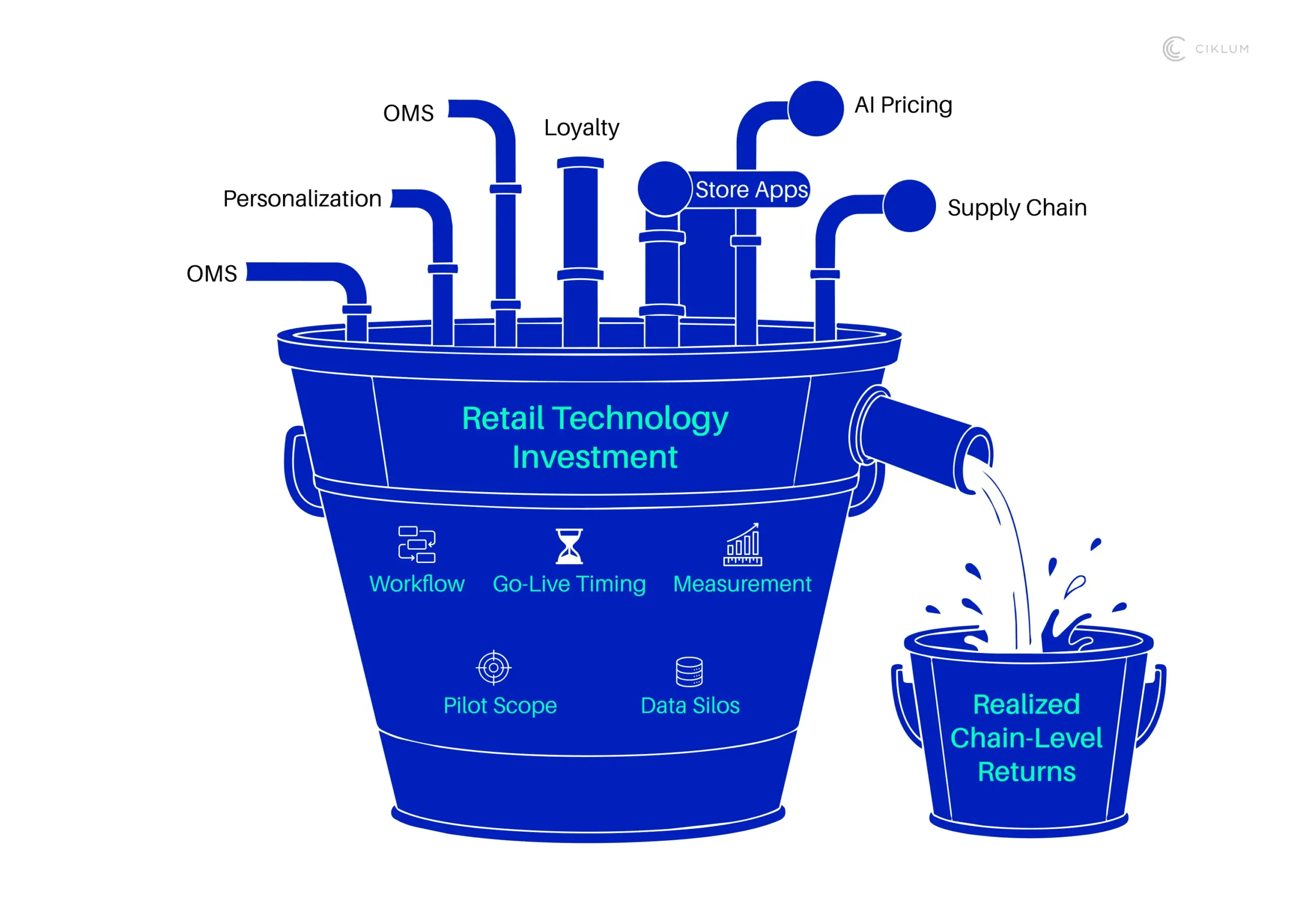
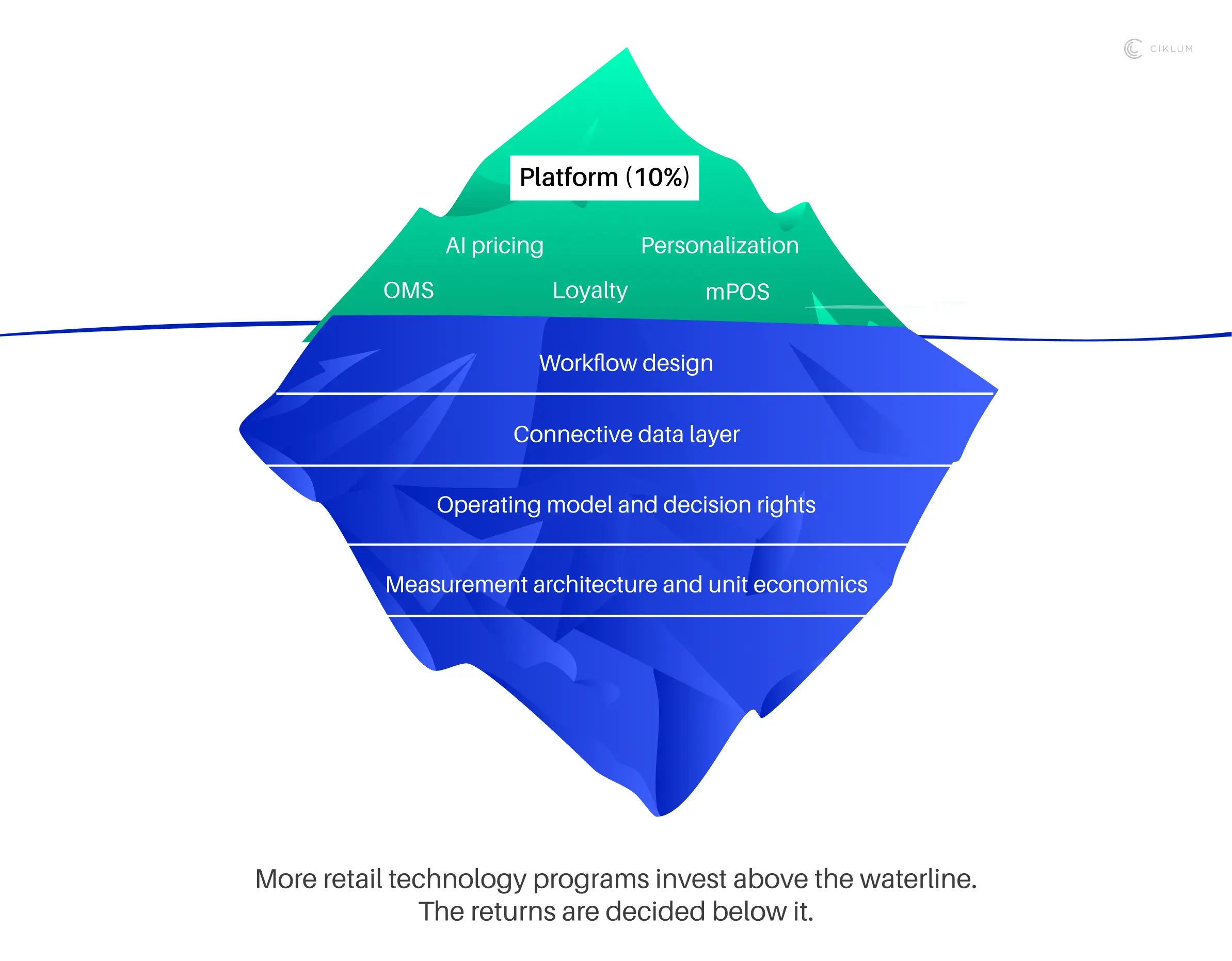
- Holistic Redesign: Most retail technology investment underdelivers because workflow, data, and operating model are not redesigned alongside the platform.
- Pilot Limitations: A pilot that performs in three flagship stores is not evidence that the program will pay back across the chain.
- Post-Launch ROI: Modernization ROI is captured after go-live, not at it. The operating model has to adapt before the unit economics move.
- Outcome Metrics: Top-quartile retailers measure programs against unit economics, not activity. Tickets closed and stores live tell you whether the program ran. Conversion per session, cost per fulfillment, and margin per SKU tell you whether it paid back.
The Math Problem on Every Retail CFO's Desk
Picture the technology page in a retail CFO's quarterly board pack. The capital line is clean. The roadmap shows a respectable list of platforms shipped: a new OMS, a personalization engine, a refreshed loyalty stack, an AI pricing pilot, a store-app refresh. Vendor invoices have been paid. Programs have gone live. And yet, when the same pack opens at the unit-economics page, the numbers that the original business cases promised to move are largely unchanged. Conversion is flat. Markdown leakage is the same. Cost per fulfillment has improved in the three pilot stores and nowhere else.
This is not a one-retailer pattern. It is a structural one, and most of it is downstream of beliefs that look reasonable on a roadmap slide but consistently fail to translate into chain-level returns. Five of those beliefs do most of the damage.
Five Myths Behind the Pilot-to-Chain ROI Gap
Myth 1: A better platform will fix unit economics.
It rarely does. The platform is downstream of the workflow it is supposed to change. When the workflow stays the same, the new platform inherits the same friction the business case promised to remove. A common observation across retail engineering engagements is that the most underperforming AI deployments are technically successful and operationally invisible. The model ships, the dashboard updates, but no business decision changes downstream. Recent analysis on AI-powered retail decision-making frames the same point about traditional business intelligence in the sector: static reports and dashboards have been holding retailers back for years, with human bottlenecks in analysis and the lag between data collection and decision implementation eroding any value the underlying tooling was supposed to deliver. A better platform sits on top of those bottlenecks, not in place of them.
Myth 2: A successful pilot proves the case.
A pilot is insulated. It runs on a controlled workflow with leadership attention, dedicated data, and an exception process that absorbs friction quietly. The chain operates inside the actual workflow, with siloed systems, inconsistent data, and exceptions handled locally. When the pilot moves to the chain, it inherits all the friction the pilot was insulated from.
The retailers who break this pattern do so by transforming the chain at the same time they transform the platform. Salling Group, Denmark's largest retailer, runs more than 1,500 stores across Netto, Føtex, Bilka, Salling, and BR, and serves over ten million customers each week. The transformation challenge was not finding new tooling. It was replacing a deeply embedded legacy estate while keeping the chain running. Through a long-running engineering partnership, the group rebuilt its e-commerce platform and the internal tools underneath it, with delivery teams progressively folded into Salling's own cadence. The result included a 40% reduction in technology costs, exponential growth in e-commerce revenue, and a measurable rise in employee retention. The returns reproduced at chain level because the workflow, the data layer, and the operating model moved together.
Myth 3: Modernization ROI is locked in at go-live.
It is not. The platform shipping is step one. The returns appear only as the operating model around it adapts. A US footwear brand running an end-of-life Apropos POS system had a platform that was visibly old, but the deeper cost was the operating constraint it imposed. E-commerce, retail, and store operations could not move at the same cadence as customer expectations. After migrating to a cloud-based Aptos platform and introducing mPOS in stores, maintenance and hardware costs dropped, store operations accelerated, and the brand finally had a foundation that could support new commerce experiences instead of resisting them. The visible event was the migration. The ROI was harvested in the quarters that followed, as store teams, merchandising, and digital began running at the cadence the new platform allowed.
Myth 4: Vertical AI and personalization can compensate for fragmented data.
They cannot. They magnify the fragmentation. A loyalty engine that cannot see real-time inventory cannot make the right offer. A pricing engine that cannot see local demand cannot adjust effectively. An AI personalization model that cannot see returns data optimizes for a customer who does not exist. As a recent analysis of unified commerce and vertical AI agents notes, the dominant barriers to retail AI adoption today are siloed data, embedded legacy systems, and the change management work needed to absorb new capabilities into the operating model. Agentic systems are only as effective as the data fabric beneath them. The connective data layer is therefore the highest-leverage retail technology investment of the next three years. Without it, every individual platform underperforms its business case. With it, each new platform compounds.
Myth 5: Program activity is the same as ROI.
Tickets closed, stores live, models deployed, conversion lift in pilot. These are useful execution signals, but they describe whether the program ran, not whether it paid back. Retailers that maximize returns rebuild the measurement layer before, or alongside, the technology layer. They track unit economics monthly across the full estate. They measure conversion per session, not pilot lift. They benchmark cost per fulfillment, not deployment count. The tools they choose become a function of which ones move those numbers.
A Pre-Investment Checklist
Before signing the next retail technology contract, the following questions are usually more predictive of returns than any vendor demo.
- Have we defined the unit economics this program needs to move, before we shortlist platforms?
- Have we mapped and redesigned the workflow this technology is supposed to change?
- Can our data layer expose customer, inventory, and pricing context across channels in real time?
- Will category, merchandising, store ops, and pricing teams operate at the cadence this platform makes possible?
- Will we measure outcomes at chain level, on unit economics, monthly, instead of stopping at pilot lift?
If the answer to two or more is no, the platform is not the constraint. The four conditions surrounding it are.
In Summary
Retail technology ROI challenges go deeper than vendor selection. They are operating model challenges that surface as technology underperformance. The platforms are not the problem. The way platforms, processes, data, and measurement are stitched together is. Returns fall short when retailers overlay new tools on old workflows, leave data trapped in silos, lag on adapting the operating model to new capabilities, or stop measuring at go-live.
The retailers reaching the top quartile of returns share a recognizable pattern. They redesign the workflow before they pick the platform. They treat the connective data layer as the foundation of every subsequent investment. They restructure category, store, and pricing operations at the cadence the new platform allows. They measure unit economics, not activity. The four conditions are interdependent. Sequenced as a continuous loop, the returns compound with each pass.
Frequently Asked Questions
Why do strong pilots so often fail to reproduce at the chain level?
The pilot operates inside a controlled workflow with leadership attention and clean data. The chain operates inside the actual workflow, with siloed systems and inconsistent data. When the pilot moves to the chain, it inherits all the friction the pilot was insulated from. The fix is to redesign the workflow and connect the data layer before scaling, not after.
What is the single highest-leverage move to maximize returns from retail technology investment?
Build a connective data layer. Most individual retail platforms underperform their business case because they cannot see real-time customer, inventory, and pricing context across channels. With the data fabric in place, every subsequent platform investment compounds rather than competes with the last one.
When should a retailer bring in external engineering support?
Two windows produce the highest ROI. The first is during workflow redesign and data-layer foundation, where outside perspective on integration and operating model cuts through political friction faster than internal facilitation. The second is during platform engineering investment, where engineers with prior platform and CI/CD experience compress build time from years to quarters. Both require bandwidth that scaling in-house teams rarely have spare.

By Ciklum Editorial Team

Ciklum’s Editorial Board is a collective of experienced writers and industry experts, bringing together perspectives shaped by real-world engineering and delivery experience. Through collaborative insights, the team explores how technology, AI, and digital innovation move from concept to execution across industries.
Blogs
Discover Similar Insights

Breaking the Reactive Cycle: Moving Retail from Digital Logic to Autonomous Agency
Explore the Retail Analysis
Intelligent Automation in Retail: Five Predictions Shaping 2026 and Beyond
Learn More
The Business Blueprint for Intelligent Personalization in Retail
Learn More
The Impact of GenAI on Customer Service in Retail
Learn More