



Key takeaways:
- Making AI drive long-term value is a top business challenge and priority
- Compounding AI systems use data to generate insights, to improve outcomes that boost adoption
- That adoption then generates more data, helping AI capabilities grow exponentially
- Ciklum’s ‘Five Leading Indicators Framework’ can establish your current compounding readiness
We thought we had reached the frontier of AI integration: copilots launched, agents deployed, pilots completed. But crossing that frontier was only the beginning. Most enterprises have now moved past the initial wave of AI experimentation and are recognizing a more difficult challenge: turning AI into long-term, scalable business value.
The data illustrates this clearly:
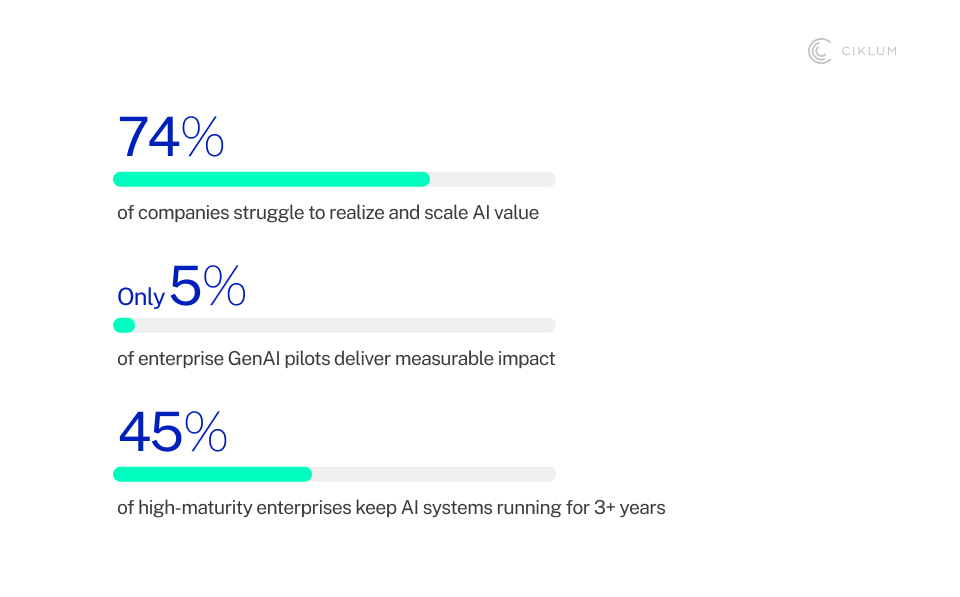
- 74% of companies struggle to realize and scale AI value
- Only 5% of enterprise GenAI pilots deliver measurable impact
Meanwhile, the most mature organizations demonstrate that sustained value is achievable. 45% of high-maturity enterprises keep AI systems running for 3+ years, giving them the usage, learning cycles and proprietary data required to become smarter, more efficient and more accurate over time.
This raises a critical question: what differentiates organizations that scale AI from those that stall? Compounding AI Systems — AI ecosystems that continuously improve through usage, proprietary data and network effects.
In this blog, we outline how compounding AI systems work, how they differ from traditional deployments, and how to assess your organization’s readiness to build them.
What Are Compounding AI Systems?
Compounding AI systems are AI ecosystems designed to grow in capability, accuracy and business value over time. By combining multiple models, agents and workflows, they form an integrated system that is greater than the sum of its parts.
Unlike traditional deployments, compounding systems:
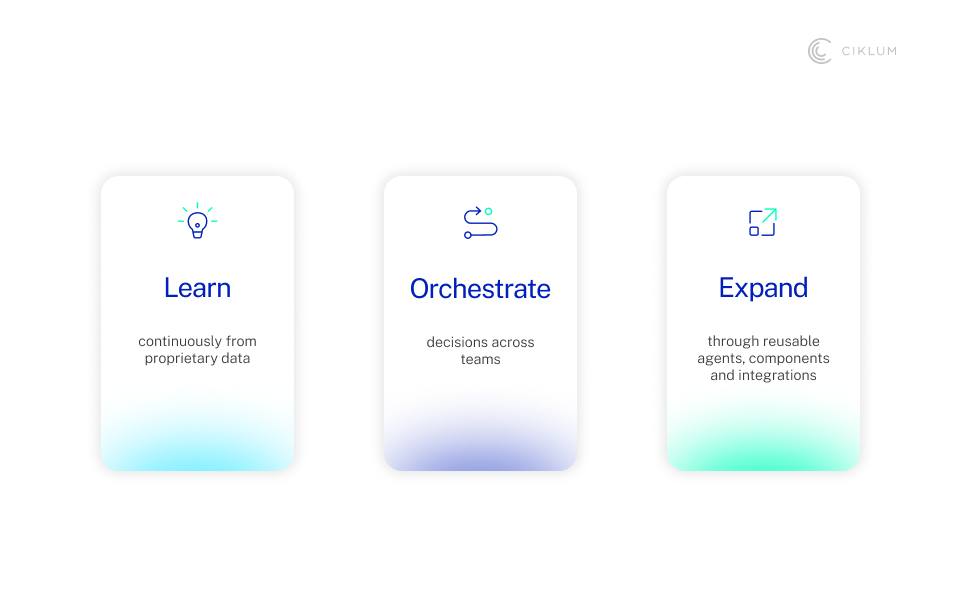
- Learn continuously from proprietary data
- Orchestrate decisions across teams
- Expand through reusable agents, components and integrations
This maximizes its chances of business viability and success, well beyond the prospects of many traditional deployments which show early promise and then stall.
The Three Key Mechanics of Compounding AI Systems
There are three main mechanics involved in compounding AI systems, and these are the characteristics that stand these ecosystems out from the crowd:
Proprietary Intelligence Flywheels
A Proprietary Intelligence Flywheel is a self-reinforcing loop, where models, products and customer experiences continually drive improvements. Insights and learnings from one stage improve and empower the next, creating a virtuous circle that takes the AI model forward.
One area where it has been deployed is in drug development and safety monitoring in the pharmaceutical sector. Real-world patient data, such as adverse reactions, side effects, genomic indicators and demographic variables, is fed into AI agents. AI then finds emerging patterns, such as links between specific chemical compounds and particular side effects.
This allows the company to refine its R&D and clinical trial design, refining formulations, improving dosage recommendations and altering trial cohort selection. The result is better products, better patient outcomes, stronger regulatory evidence and greater adoption, which in turn generates more proprietary data and strengthens the model even further.
And because the data involved is proprietary, it’s impossible for competitors to replicate this exactly, making the flywheel a unique driver of business advantage.
Orchestrated Decision Networks
Orchestrated Decision Networks take the abilities of AI systems beyond individual tasks, and use multi-agent deployments to optimize entire decision-making processes end-to-end, providing a coordinated intelligence layer business-wide.
This has been used by a global payments provider to substantially cut the timeframe of fraud checks and Enhanced Due Diligence (EDD) reviews. The orchestrated network combined:
- A CRM and behavioral analysis agent to review transaction history, merchant behavior and metadata
- A fraud signal detection agent that used custom machine learning to identify anomalies, laundering patterns or suspicious flows
- A compliance scanning agent to check against sanctions lists, PEP databases, adverse media, and regulatory risks
- A parent agent to consolidate output into risk scoring, draft documentation and to recommend next actions
- A ‘human-in-the-loop’ compliance analyst to verify output and approve actions
This reduced decision time from days to minutes, improved fraud detection accuracy, and increased trust among merchants and consumers.
Ecosystem Positioning
Ecosystem positioning means treating AI not as a series of point solutions, but as a platform: a shared environment where models, agents, workflows and components can be reused and extended across the organization.
A strong agent creation and orchestration platform will allow enterprises to build this capability quickly, and intelligently scale it as required, through the help of:
- Ready-made templates for different teams, such as marketing, product, operations, engineering, etc.
- Model-agnostic capabilities that work with OpenAI, Anthropic, local LLMs, and more.
- Plug-and-play integrations with enterprise systems
- Shared components that can be reused across agents and departments
As a result, every new agent enriches the platform, creating a network effect where adoption, reuse and integration grow exponentially.
How To Tell If You Have AI Systems That Compound Value
Even if you already have AI systems in place, it can be difficult to see whether they have the potential to compound or if they’re destined to stall.
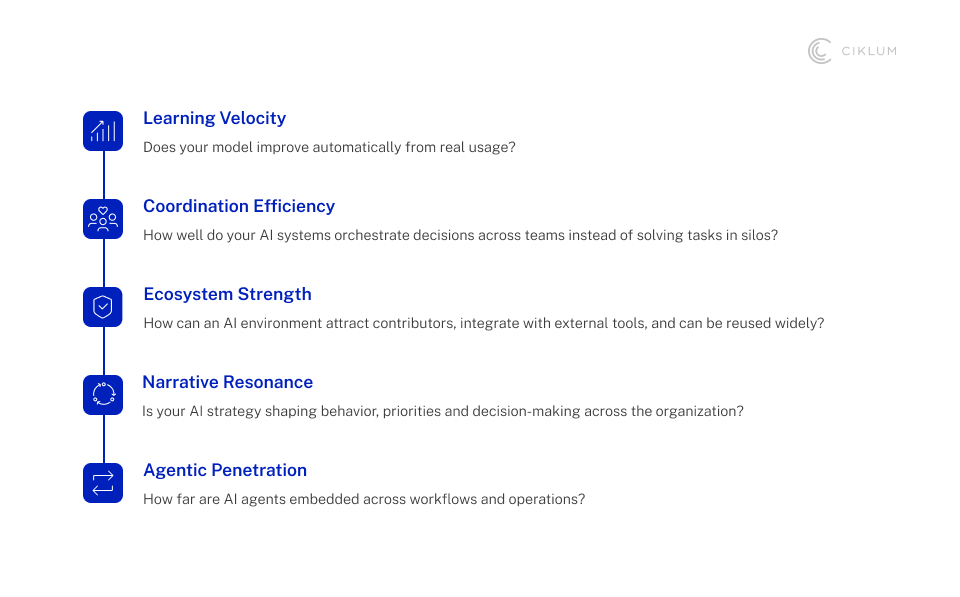
To help organizations diagnose this, Ciklum developed the Five Leading Indicators Framework - a maturity model that reveals whether your AI ecosystem is on a compounding trajectory.
The five indicators are:
Learning Velocity: Does your model improve automatically from real usage?
This refers to the speed and consistency with which your AI systems can be improved by real-world usage.
Good models improve automatically as data flows through them, with deeper insights, better outcomes and improved adoption. If learning velocity is high, then your organization is building experience-fed intelligence using proprietary data, in a way that your competitors cannot replicate.
Coordination Efficiency: How well do your AI systems orchestrate decisions across teams instead of solving tasks in silos?
This is the level at which AI systems can orchestrate decisions across teams, functions, and workflows, rather than solving tasks in silos. For example, multi-agent systems coordinating fraud checks will pull signals from CRM, payments, compliance and KYC, gathering evidence and drafting decisions for human-in-the-loop approval.
These cross-functional flows mean AI can act as an integrated decision layer that compounds intelligence, and not a stagnating collection of automation.
Ecosystem Strength: How can an AI environment attract contributors, integrate with external tools, and can be reused widely?
This is where multiple teams can reuse shared agents, templates and workflows, supported by model-agnostic orchestration across LLMs, internal models and third-party tools.
This allows the AI system to behave like a platform rather than a set of projects, with new skills, integrations and data sources introduced by the community increasing the system’s total collective value.
Narrative Resonance: is your AI strategy shaping behavior, priorities and decision-making across the organization?
The level of internal and market traction for your AI strategy and outcomes, and how that is influencing behavior, adoption, and investment. For example: are teams referencing the AI strategy in their planning and prioritization? Are early wins boosting organizational buy-in? Are stakeholders referencing AI success as proof points?
This cultural and strategic momentum can make a real difference in compounding the benefits of AI, by accelerating adoption and resource allocation.
Agentic Penetration: How far are AI agents embedded across workflows and operations?
Agentic penetration assesses whether AI agents operate far beyond simple LLM interfaces or isolated pilots. AI agents would be performing multi-step workflows, conducting autonomous or semi-autonomous decision-making processes, and would be integrated with many other tools (for example,
Agents integrated with CRM, ERP, payments, compliance and HRIS).
Along with the ability to spin up temporary agents on demand, this level of penetration is a major indicator that AI is considered less of a tool, and more of an operational fabric that drives compounding effects.
In Summary: A Path To AI Value Realization
Organizations that build compounding AI systems move beyond isolated wins and create AI capabilities that become more accurate, more integrated and more valuable every day.
By assessing your readiness across the Five Leading Indicators, you can determine whether your AI ecosystem is compounding, or stalling.
Ciklum helps enterprises design and scale AI systems that continuously learn, orchestrate, and deliver measurable business value.
To take the next steps on your road towards compounding AI systems, explore Ciklum’s AI incubator and our AI strategy enablement Center of Excellence.
By Ciklum Editorial Team

Ciklum’s Editorial Board is a collective of experienced writers and industry experts, bringing together perspectives shaped by real-world engineering and delivery experience. Through collaborative insights, the team explores how technology, AI, and digital innovation move from concept to execution across industries.
Blogs
Discover Similar Insights

Agentic AI in Retail: Closing the Gap Between Customer Intent and Enterprise Systems
Learn More
From AI Interest to Engineering-Ready Mandates: Why The Market Needs AI Clinics, Not More AI Pilots
Learn More
Agentification of Payments: A Strategic Shift for PSPs
Learn More
Explainable AI in Banking: Designing Transparent, Auditable Models for Credit, Risk, and Compliance
Learn More