



Key Takeaways
- Rule-based automation excels at stable, repetitive tasks but breaks on input or format changes; fixes require manual re-scripting.
- Intelligent systems add ML, NLP, and LLMs to interpret unstructured data, infer intent, and adapt from outcomes, handling exception-heavy workflows rules cannot.
- Core differentiators context awareness, continuous learning, autonomous orchestration, and governance by design for explainable, traceable decisions at scale.
- Strategic shift: enterprises run both, but the trend is toward systems that refine how work is done rather than repeating fixed steps faster.
- Architecture: workflow/orchestration, reasoning (LLMs), and data/memory layers so rule-based automation becomes one block in a system that can sense, think, and act across the enterprise.
Enterprise AI automation has evolved far beyond scripts and macros. What began as simple task automation has transformed into a new paradigm where intelligent systems understand context, learn from data, and orchestrate complex workflows across the entire organization. For enterprise leaders evaluating automation investments, understanding this shift from rule-based tools to intelligent systems is essential.
The Foundation: Rule-Based Automation
Traditional rule-based automation, including classic robotic process automation (RPA), operates on predefined "if-this-then-that" logic. These systems excel at stable, repetitive tasks: form filling, report generation, data entry, and basic approvals. When processes are consistent and inputs are predictable, rule-based automation delivers reliable results at scale.
However, rule-based systems struggle when reality doesn't match the script. A missing field, an unexpected format, or a new exception case can halt the entire workflow. Every change requires manual re-scripting by developers who understand both the business process and the technical implementation. In dynamic enterprise environments, this brittleness becomes a significant limitation.
The Shift: What Makes Automation Intelligent
Intelligent automation layers AI techniques such as machine learning, natural language processing, and large language models on top of traditional execution capabilities. Instead of following only hard-coded paths, intelligent systems can interpret unstructured data, infer intent, and adapt decisions based on patterns in historical outcomes.
The core capabilities that distinguish intelligent systems include:
Context Awareness - Intelligent systems interpret inputs in real time, combining operational data, historical records, and policies to understand the full picture before acting. Rather than processing each transaction in isolation, they consider relationships and dependencies across the enterprise.
Continuous Learning - Models improve by analyzing outcomes, error patterns, and user feedback. This reduces the constant rule maintenance that burdens traditional automation programs and allows systems to handle novel situations more gracefully over time.
Autonomous Orchestration - AI agents can plan multi-step workflows, call tools and APIs, and coordinate other bots to deliver complete outcomes, not just individual tasks. This moves automation from task-level efficiency to process-level transformation.
Governance by Design - Policy, compliance rules, and audit trails are embedded directly in the automation fabric. Decisions remain explainable and traceable at scale, which is critical for regulated industries.
Rule-Based Automation vs Intelligent AI Systems: Key Differences
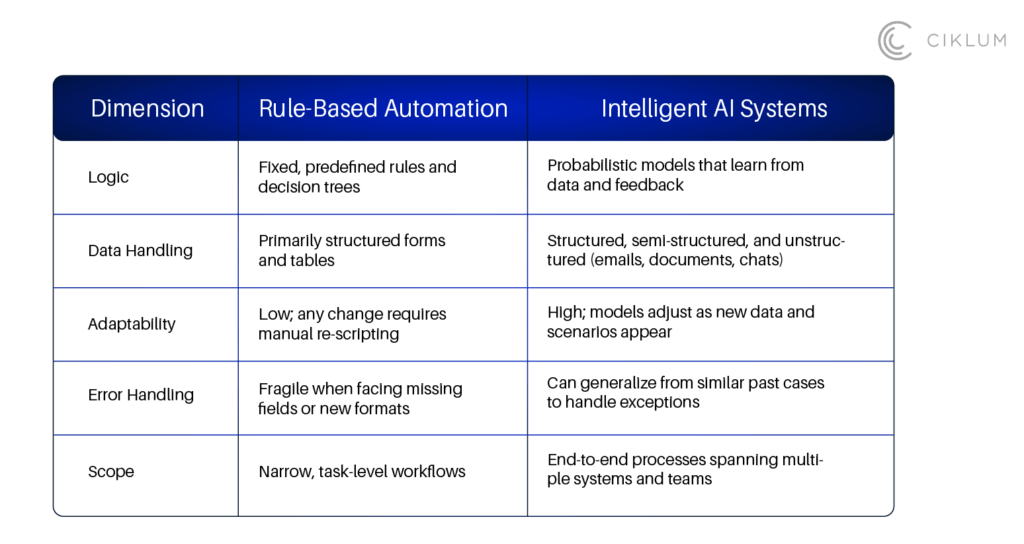
In practice, many enterprises run both types of automation. The strategic shift, however, is toward intelligent systems that continuously refine how work is done instead of simply repeating yesterday's steps faster.
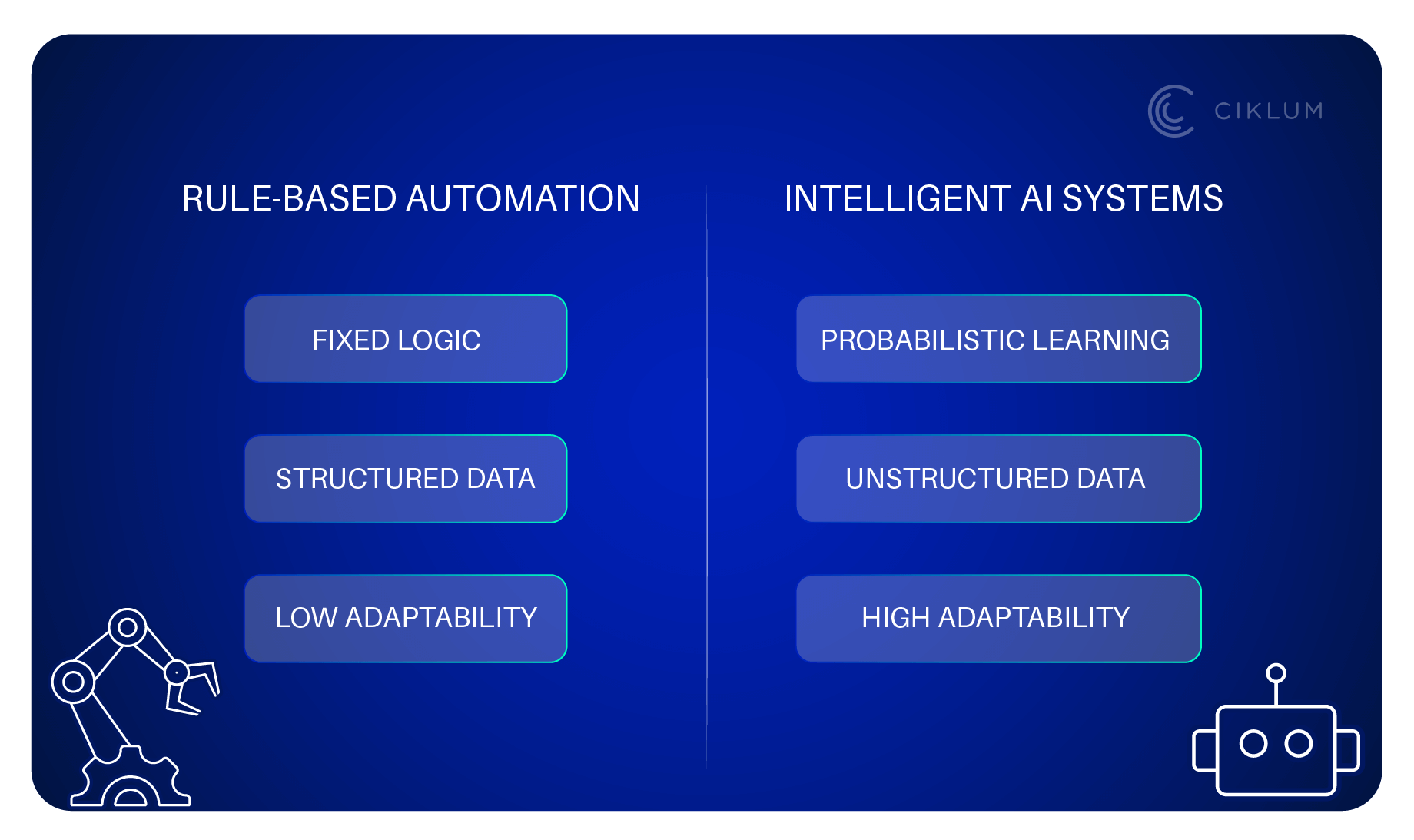
A Practical Example
Consider invoice processing. A rule-based RPA bot copies invoice fields into an ERP system. It works well when invoices follow a consistent format from known vendors.
An intelligent system takes a fundamentally different approach. It can read any invoice format, validate line items against contracts and purchase orders, flag anomalies for review, assess compliance risk, and recommend optimal payment terms based on historical vendor behavior. When a new vendor submits an invoice in an unfamiliar format, the intelligent system adapts; the rule-based bot fails.
Why This Matters for Enterprises
The move to intelligent automation is driven by the explosion of unstructured data and rising expectations for speed and resilience. Emails, documents, chats, and logs now dominate enterprise information flows. Rule-based tools alone cannot process this complexity at the pace business demands.
Intelligent systems allow organizations to:
- Automate exception-heavy workflows that were previously "too messy" to digitize
- Compress decision cycles by bringing analytics and decisioning directly into operational workflows
- Maintain compliance through built-in monitoring, logging, and policy enforcement even as regulations evolve
According to McKinsey research, generative AI could add trillions in economic value by automating tasks that were previously beyond the reach of traditional automation, particularly those involving unstructured data and judgment.
This is why leading organizations now treat AI automation as a strategic capability rather than a back-office cost play.
The Architecture Behind Intelligent Automation
Enterprise AI automation brings RPA, AI models, and AI agents into a single, coordinated system. This typically includes:
- A workflow or orchestration layer that sequences tasks and routes work to the right agent or tool
- A reasoning layer powered by LLMs and other models to interpret inputs, draft content, and make recommendations
- A data and memory layer that provides governed access to enterprise data, ensuring decisions are grounded in accurate, up-to-date information
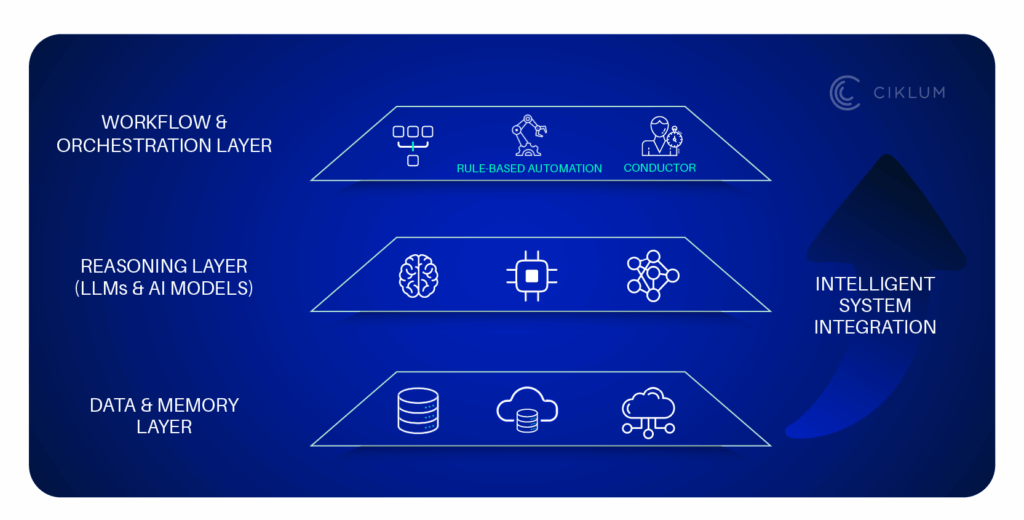
Rule-based automation becomes one building block inside a broader intelligent system that can sense, think, and act across the entire enterprise.
Enterprise AI automation has moved from scripts and fixed rules to systems that understand context, learn from outcomes, and orchestrate work across the organization. Rule-based automation still has a place for stable, repetitive tasks, but the strategic shift is toward intelligent systems that handle exceptions, adapt to change, and deliver end-to-end outcomes. Leading organizations run both, with rule-based execution as one layer inside a broader architecture that can sense, think, and act.


By Ciklum Editorial Team

Ciklum’s Editorial Board is a collective of experienced writers and industry experts, bringing together perspectives shaped by real-world engineering and delivery experience. Through collaborative insights, the team explores how technology, AI, and digital innovation move from concept to execution across industries.
Blogs
Discover Similar Insights

Enterprise AI Automation vs RPA: Why Rules Alone No Longer Scale
Learn More
Enterprise AI Automation: A Practical Guide to GenAI, AI Agents and Intelligent Workflows
Learn More
Legacy Modernization: Architecture, AI, Cloud, ROI & Roadmaps
Learn More
Intelligent Automation in Retail: Five Predictions Shaping 2026 and Beyond
Learn More