



Key Takeaways
The cloud vs on premise healthcare debate is no longer binary: In 2026 the question is not whether a provider should be in the cloud or on-premises. It is which workloads belong where, and how to run both well together. The honest answer for almost every provider is hybrid.
Compliance is a design input, not a deciding vote: Both cloud and on-premises can be made HIPAA-compliant. Security and compliance depend on how the environment is configured and governed, not on where the servers physically sit.
Cloud wins on scale, AI, and pace, on-prem wins on control and certain latency cases: The cloud has pulled clearly ahead for elastic demand, analytics, and AI readiness. On-premises still earns its place for specific latency-sensitive, data-residency, or deeply embedded legacy workloads.
What works is workload-by-workload placement, not a single bet: The providers getting this right in 2026 stopped arguing about the model and started placing each system where it runs best, with a deliberate plan for security, integration, and cost across both.
For most of the last decade, the cloud versus on-premises question in healthcare came with a default answer that depended on who you asked. Cloud vendors said move everything. Cautious IT leaders, mindful of patient data and aging systems, said keep it in the building. Both positions were really about risk tolerance more than about what actually serves patients and clinicians.
By 2026 that framing has worn out. The cloud vs on premise healthcare question is no longer a single decision a provider makes once for the whole estate. It is a series of smaller decisions about where each workload belongs, made against criteria that matter in healthcare specifically, compliance, latency, data residency, cost, security, and increasingly AI readiness. The providers doing this well are not loyal to either model. They are deliberate about matching workloads to the environment that runs them best.
This article looks at what each model genuinely gets right and wrong in healthcare, the decision criteria that actually matter, and what works in practice in 2026.
The Debate Is Not Cloud vs On-Prem Anymore
The most useful thing to say about the cloud versus on-premises argument in 2026 is that it is the wrong argument. Treating it as an all-or-nothing choice forces a provider to optimize the whole estate for the constraints of its most sensitive workload, which is how organizations end up either keeping everything on aging hardware because of one strict-residency system, or pushing everything to the cloud and then fighting latency and cost on workloads that never belonged there.
The reality is that a hospital or health system runs dozens of very different workloads. A patient portal, a data warehouse, an imaging archive, a real-time monitoring device, a billing system, an AI model for risk scoring. These have completely different demands for scale, latency, residency, and security. Forcing them all into one model guarantees that some of them run in the wrong place. The mature position is to stop asking "cloud or on-prem" as a single question and start asking it per workload.
That reframing is what makes the rest of the decision tractable. Once the question becomes "where does this specific system run best," the criteria become concrete and the answer stops being ideological.
What Each Model Actually Gets Right and Wrong
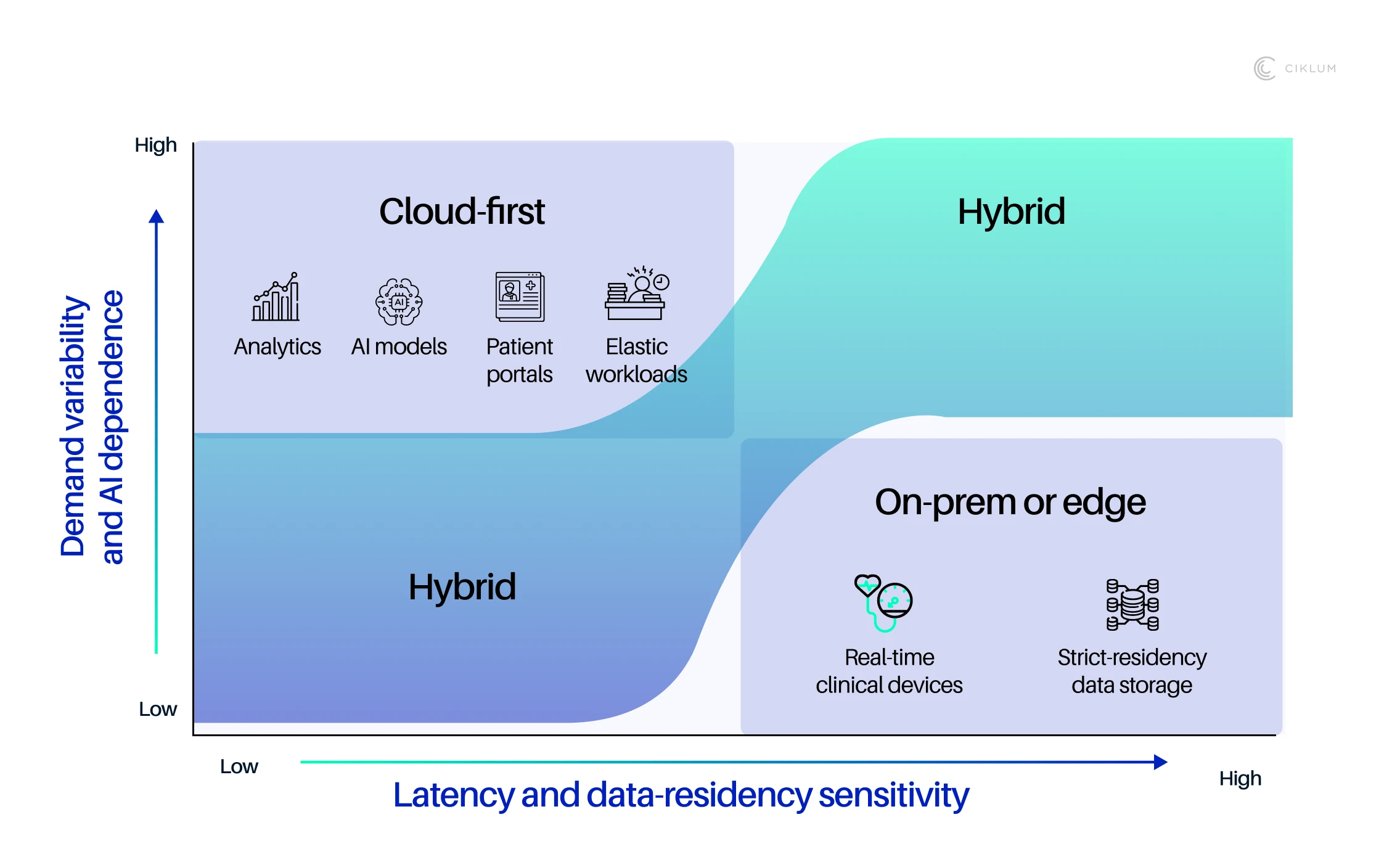
Both models have genuine strengths in healthcare, and pretending otherwise is how providers make expensive mistakes in either direction.
Where On-Premises Still Earns Its Place
On-premises is not legacy thinking. For specific workloads it remains the right call. Real-time clinical systems that cannot tolerate network latency or an internet dependency, certain medical devices and operating-room systems, and data governed by strict residency or sovereignty rules can all justify staying local. Some providers also have deeply embedded legacy systems where the cost and risk of moving outweigh the benefit in the near term.
The honest weakness of on-premises is everything that involves scale and change. Capacity is fixed and expensive to expand, so demand spikes are hard to absorb. Disaster recovery is the provider's full responsibility. And the pace of adopting new capabilities, particularly AI and advanced analytics, is slower because the supporting infrastructure has to be built and maintained in-house.
Where Cloud Pulls Ahead
The cloud has pulled clearly ahead for most of the rest. Elastic demand, the kind a patient portal sees during open enrollment or a vaccine campaign, is exactly what cloud handles well and on-premises handles badly. Analytics and AI workloads benefit enormously from cloud scale and managed services, which is decisive as AI moves from pilot to production. Disaster recovery, backup, and geographic resilience are far easier to achieve. And the pace of adopting new capabilities is faster because the infrastructure is already there.
The cloud's real risks are not about whether it can be secure. They are about whether it is configured and governed correctly. A misconfigured cloud environment is a breach waiting to happen, and cloud cost can spiral when workloads are lifted and shifted without being designed for it. Both are solvable, but neither is automatic.
The Decision Criteria That Actually Matter in Healthcare
Once the question is per workload, a consistent set of criteria decides where each one belongs.
Compliance and security come first, but they do not pick a side: Both cloud and on-premises can meet HIPAA requirements. The HHS HIPAA Security Rule requires administrative, physical, and technical safeguards for protected health information regardless of where it lives, and HHS guidance is explicit that cloud services can be used compliantly with the right safeguards and agreements in place. Compliance is therefore a design and governance question, not a location question. The deciding factor is whether the environment is configured, monitored, and audited correctly.
Latency and clinical workflow tolerance: Some clinical systems need responses measured in milliseconds and cannot depend on a network round trip. Those belong on-premises or at the edge. Most administrative, analytics, and patient-facing systems tolerate cloud latency comfortably.
Data residency and sovereignty: Where regulation or policy requires patient data to stay within a specific jurisdiction or facility, that constraint drives placement directly. Cloud regions and sovereign cloud options have narrowed this gap, but some requirements still point to on-premises.
Cost profile, honestly modeled: Cloud shifts capital expense to operating expense and rewards elastic, well-architected workloads. It punishes steady-state workloads that were lifted and shifted without redesign. On-premises rewards predictable, constant load and punishes variability. The right model depends on the workload's actual demand shape, not on a generic cost claim.
AI and analytics readiness: This is the criterion that has shifted the balance most in 2026. AI in healthcare, from diagnostics to operations, depends on scalable compute and unified data, which is far easier to assemble in the cloud. Workloads tied to the AI roadmap increasingly point cloud-first for that reason alone.
What Actually Works in 2026: Hybrid by Design
The model that works for almost every healthcare provider in 2026 is hybrid, but hybrid done deliberately rather than by accident. Many providers already run a hybrid estate by default, simply because they adopted cloud for some systems while keeping others local. The difference between an accidental hybrid and a deliberate one is whether the placement, security, integration, and cost were designed or just happened.
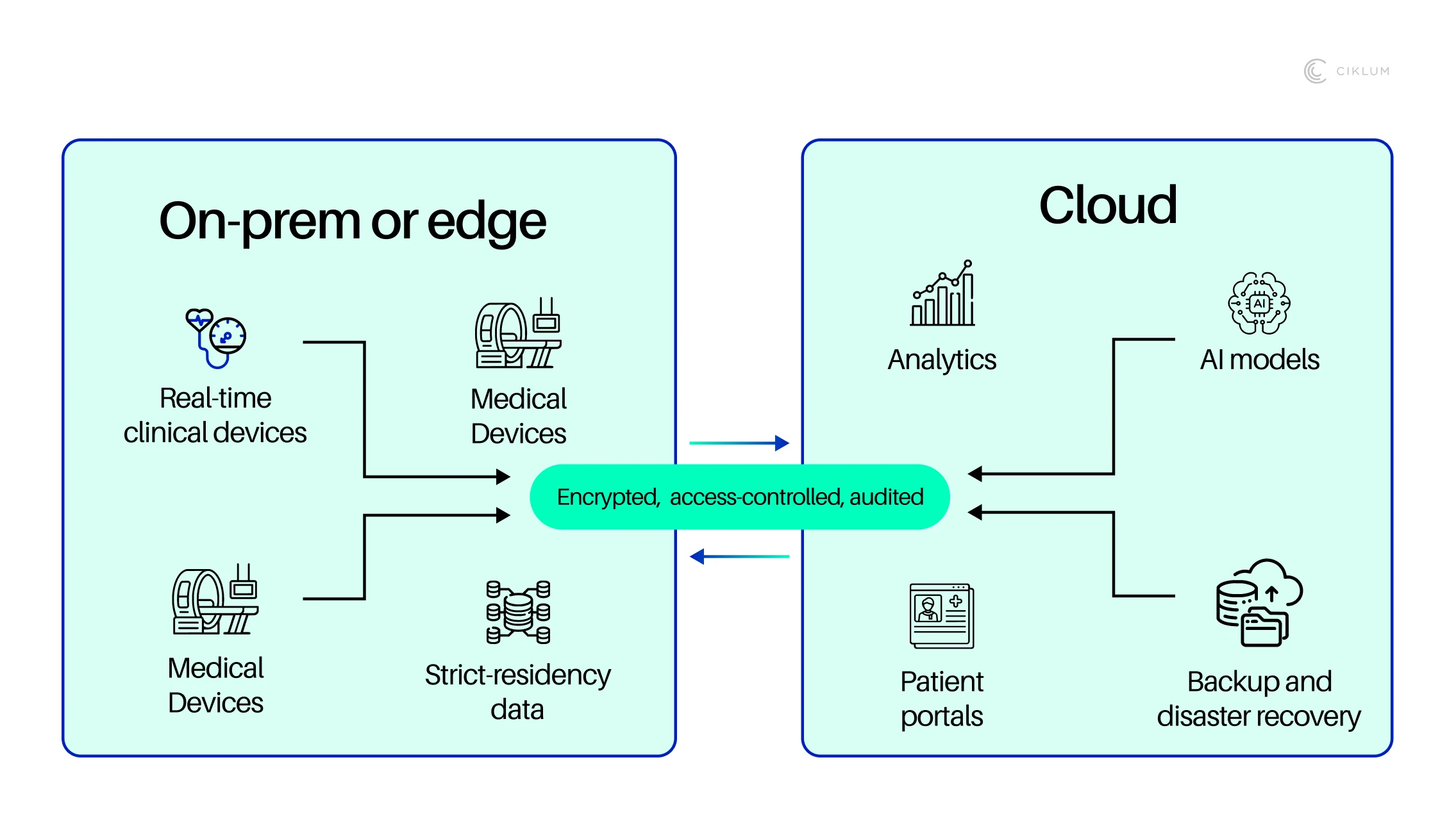
Hybrid by design starts with workload placement. Each system is assessed against the criteria above and placed where it runs best, with real-time clinical and strict-residency workloads kept local or at the edge, and elastic, analytics, and AI workloads moved to the cloud. The two environments are then connected with secure, well-governed integration so data flows where it needs to without creating new exposure.
Security and compliance are built into the cloud side from the start rather than bolted on. Our analysis of HIPAA-secure cloud configuration and migration for healthcare providers makes the operational case that secure data transfer, access control, encryption, audit logging, and disaster recovery belong inside the cloud design itself, so compliance evidence is generated as part of running the environment rather than reconstructed for an audit. That discipline is what makes the cloud side of a hybrid estate as defensible as the local side.
Finally, the workloads that do move are modernized rather than lifted and shifted. A system simply copied into the cloud usually brings its costs and limitations with it. The incremental approach, building the modern capability alongside the old one and migrating in controlled steps, is what captures the cloud's real benefits while keeping care running. Our cloud and DevOps engineering teams work with providers on exactly this, because the value of the cloud comes from designing for it, not from relocating into it.
What This Looks Like in Practice
A deliberate hybrid approach is not theoretical. It shows up in how modern healthcare platforms are built and run.
Our work with a telehealth platform that scaled to more than a million clinicians is a useful example of the cloud side done well. The early phase was not new clinical features. It was building the foundation with full Infrastructure as Code and continuous monitoring, so the platform could scale securely and ship capability at speed on infrastructure that was built once and ran reliably. That is what the cloud delivers when it is designed for rather than migrated into, the elastic scale and pace that on-premises cannot match for a workload like real-time virtual care.
The same logic runs in reverse for workloads that belong local. A real-time monitoring system in a hospital, or data under strict residency rules, stays where latency and control demand, while the analytics and AI built on top of that data run in the cloud. The point is not that one model won. It is that each workload landed where it runs best, and the two were connected deliberately and securely.
That is what actually works in 2026. Not cloud everywhere, not on-premises forever, but a hybrid estate designed workload by workload, with compliance and security built into both sides.
In Summary
The cloud vs on premise healthcare debate has matured past the point where a single answer makes sense. Both models can be made compliant and secure, both have genuine strengths, and forcing the whole estate into one of them guarantees that some workloads run in the wrong place. The real decision is per workload, against criteria that matter in healthcare, compliance and security, latency and clinical tolerance, data residency, cost shape, and AI readiness.
What works in 2026 is hybrid by design. Place real-time clinical and strict-residency workloads on-premises or at the edge. Move elastic, analytics, and AI workloads to the cloud. Build security and compliance into the cloud side from the start, connect the two environments with governed integration, and modernize what moves instead of lifting and shifting it. That is the approach that serves patients, clinicians, and the budget at the same time.
Ciklum's healthcare engineering, cloud, and data teams work with providers to design and run exactly this kind of deliberate hybrid estate. If the cloud versus on-premises question is on the table, talk to our specialists about placing each workload where it actually runs best.
Frequently Asked Questions
1. Is cloud or on-premises more secure for healthcare data?
Neither is inherently more secure. Both cloud and on-premises can meet HIPAA requirements, and security depends on how the environment is configured, monitored, and governed rather than on where the servers physically sit. A well-architected cloud environment can be more secure than a poorly maintained local one, and a misconfigured cloud environment can be a serious risk. The deciding factor is the rigor of the design and operations, not the location.
2. Why is hybrid the recommended model for healthcare in 2026?
Because healthcare providers run many different workloads with different needs, and no single model serves all of them well. Real-time clinical systems and strict-residency data often belong on-premises or at the edge, while elastic, analytics, and AI workloads run better in the cloud. Hybrid lets each workload land where it runs best, as long as the placement, security, and integration are designed deliberately rather than left to accumulate by accident.
3. When does on-premises still make sense in healthcare?
For workloads that cannot tolerate network latency, such as certain real-time clinical and operating-room systems, for data under strict residency or sovereignty rules, and for deeply embedded legacy systems where the near-term cost and risk of moving outweigh the benefit. These are specific cases, not a reason to keep the whole estate local.
4. Does moving to the cloud automatically reduce costs?
No. The cloud reduces cost for elastic, well-architected workloads and can increase cost for steady-state systems that are lifted and shifted without redesign. Cloud shifts capital expense to operating expense, which suits variable demand and penalizes workloads that were never designed for it. Honest cost modeling against each workload's actual demand shape matters more than a generic cost claim.
5. When should a provider bring in external engineering support?
Two moments produce the highest return. The first is the workload assessment and hybrid design, where an outside view helps place each system correctly and avoids both over-migrating and over-retaining. The second is the secure cloud migration itself, where engineers with prior HIPAA-compliant cloud experience can configure, migrate, and govern the environment without disrupting care. Both need bandwidth that healthcare IT teams, already running daily operations, rarely have spare.

By Ciklum Editorial Team

Ciklum’s Editorial Board is a collective of experienced writers and industry experts, bringing together perspectives shaped by real-world engineering and delivery experience. Through collaborative insights, the team explores how technology, AI, and digital innovation move from concept to execution across industries.