



Key Takeaways
- RPA excels at structured, repetitive tasks in stable applications but breaks when inputs vary, UIs change, or exceptions multiply.
- Rules alone don't scale because modern enterprises run on unstructured data, fluid processes, and constant regulatory change that scripts cannot interpret or adapt to.
- Enterprise AI automation extends RPA by adding a cognitive layer (ML, NLP, LLMs) and orchestration that can understand content, make decisions, and coordinate end-to-end workflows.
- The hybrid model keeps RPA for deterministic execution while AI handles interpretation, decision-making, and exception routing.
- Strategic impact shifts from back-office cost reduction to enterprise-wide agility, better decisions, and new digital operating models.
Enterprise AI automation and traditional RPA sit on the same spectrum, but they were built for very different eras of work. As processes, data, and regulations grow more complex, rule-based bots alone simply cannot keep up. For enterprise leaders evaluating their automation strategy, understanding when RPA is enough and when it isn't has become a critical decision
What RPA Was Designed For
RPA (Robotic Process Automation) was created to mimic human actions in software: clicking buttons, copying fields, and moving data between systems using predefined scripts. It shines when:
- Tasks follow clear, repetitive steps in stable applications
- Inputs arrive in structured formats like standard forms or tables
- The goal is incremental efficiency in back-office workflows such as invoicing or report generation
In these scenarios, RPA delivers fast ROI, high accuracy, and impressive time savings. The problems start when organizations push bots beyond this comfort zone. Bots depend on specific screens, selectors, and layouts, so even minor UI or process changes can break them. As the number of bots and exceptions grows, maintenance effort and technical debt rise sharply.
Why Rules Alone No Longer Scale
Today's enterprises are driven by fluid processes and messy data such as emails, PDFs, chats, contracts, and logs. Rule-based bots have no real understanding of content or context; they only follow the instructions they were given. This leads to three scaling problems:
Cognitive limits - Scripts cannot interpret language, infer intent, or adjust logic when conditions change. An invoice in a new format, a contract with unusual terms, or an email with ambiguous instructions will halt the workflow or produce errors.
Process gaps - RPA automates tasks, not entire journeys. Handoffs, decisions, and edge cases still fall to humans, creating bottlenecks that limit the value of automation.
Change pressure - New products, policies, and regulations require constant rule updates. At scale, maintaining hundreds of bots with thousands of rules becomes unmanageable. Many RPA programs stall or underperform when pushed beyond simple, repetitive tasks into complex, exception-heavy processes, especially if intelligence isn't layered in. This is a key reason enterprises are now shifting from copilot-style tooling to full operating-model thinking.
How Enterprise AI Automation Extends RPA
Enterprise AI automation treats RPA as one component in a broader intelligent system rather than the main act. It combines:
- RPA and workflow engines as the "hands" that execute repeatable steps
- AI models (ML, NLP, LLMs) as the "brain" that understands content, predicts outcomes, and recommends actions
- AI agents and orchestration platforms as the "conductor," coordinating multi-step processes across systems, handling exceptions, and enforcing policies
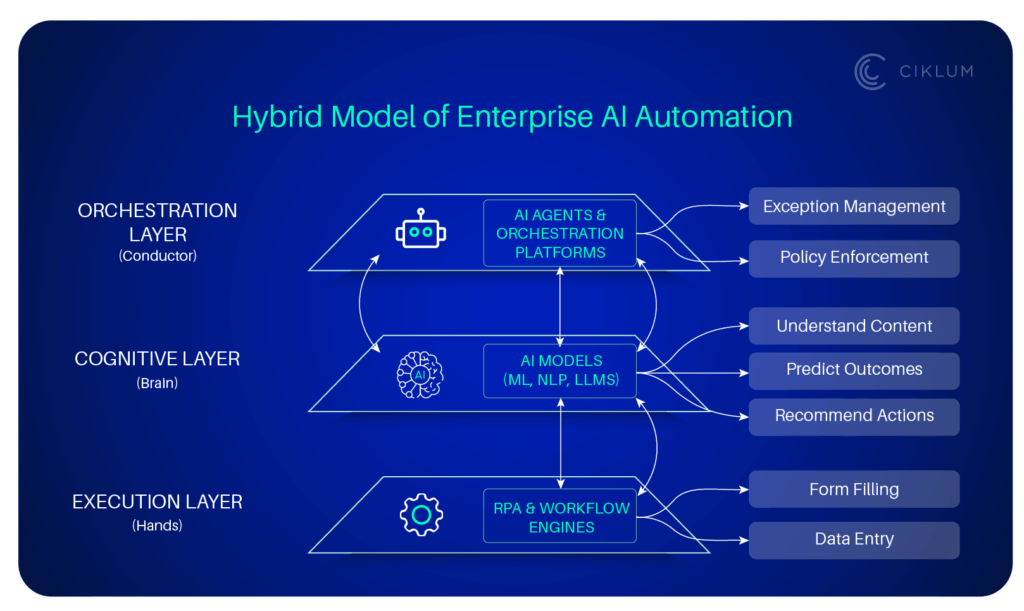
This stack can read and interpret unstructured inputs, apply policies dynamically, and choose how to act rather than just replaying a fixed script. Rules become guardrails, while intelligence drives decisions. Over time, these layers compound in value as models learn from outcomes and refine their own logic.
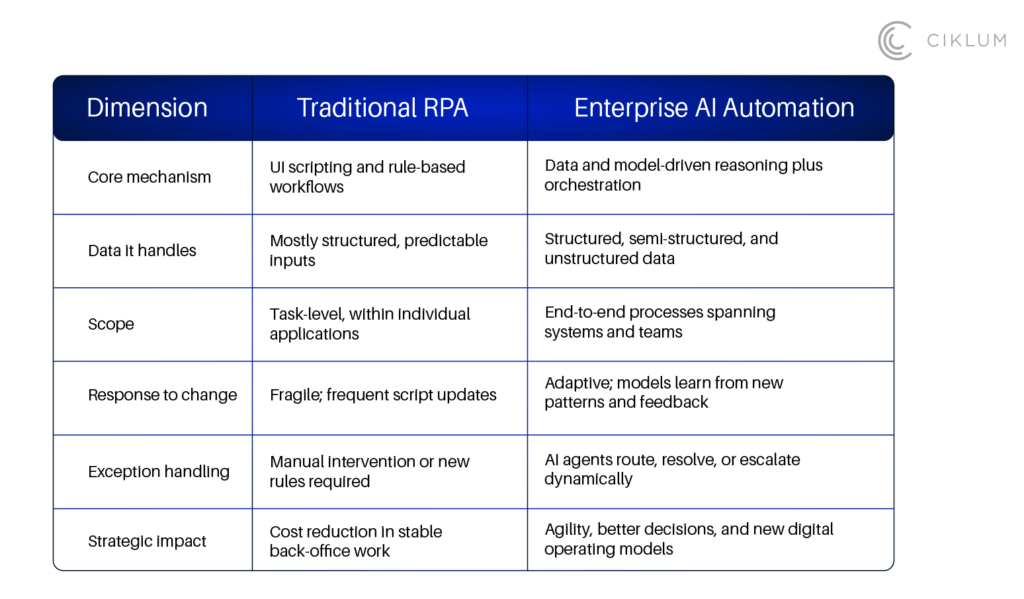
Side-by-Side: RPA vs Enterprise AI Automation
When to Use Each and How to Evolve
RPA remains valuable when you need quick, deterministic automation over stable, UI-driven tasks, especially in legacy environments without APIs. But if your goal is to automate cross-functional journeys, handle messy data, or keep pace with constant business change, you need enterprise AI automation.
Leading organizations are moving toward a hybrid model:
- RPA continues to execute repetitive steps efficiently where processes are stable
- AI services interpret inputs, score risks, and propose actions based on context and learning
- Agentic orchestration platforms manage end-to-end flows, governance, and human-in-the-loop moments
This approach preserves RPA investments while unlocking the adaptability that modern enterprises require. Organizations looking to design this hybrid operating model can explore the full framework in our guide to enterprise AI automation.
By Ciklum Editorial Team

Ciklum’s Editorial Board is a collective of experienced writers and industry experts, bringing together perspectives shaped by real-world engineering and delivery experience. Through collaborative insights, the team explores how technology, AI, and digital innovation move from concept to execution across industries.
Blogs
Discover Similar Insights

Enterprise AI Automation Explained: From Rule-Based Automation to Intelligent Systems
Learn More
Enterprise AI Automation: A Practical Guide to GenAI, AI Agents and Intelligent Workflows
Learn More
Legacy Modernization: Architecture, AI, Cloud, ROI & Roadmaps
Learn More
Intelligent Automation in Retail: Five Predictions Shaping 2026 and Beyond
Learn More