



- Key Takeaways
- Why Agentic AI Is Not Just the Next Version of GenAI
- When AI Stops Waiting for Instructions
- Organisations Are Reassigning Ownership, Not Just Automating Tasks
- What AI-Native Really Means in Practice
- Autonomy Without Governance Creates New Risk
- Why Observability Matters More Than Trust
- In Summary: The Human Role Becomes Orchestration
Key Takeaways
- Work no longer waits for human prompts once intent is set.
- Autonomy without governance increases operational risk.
- Human roles evolve toward orchestration and judgment.
- Agentic capabilities are becoming embedded across enterprise software.
Why Agentic AI Is Not Just the Next Version of GenAI
Agentic AI is often described as the next step after generative AI. A smarter assistant. A more capable automation layer. That framing is understandable, but it’s also misleading. It suggests progress is happening along a familiar path, when in reality the path itself is changing. Unlike model upgrades such as the shift from GPT-3 to GPT-4, which were largely iterative, this change is structural rather than incremental.
Generative AI made it easier for machines to produce content, summaries, and recommendations on demand. Agentic AI changes something more fundamental by introducing systems that can take an objective and move work forward on their own.
As a result, tasks don’t sit in queues waiting for attention. Work moves because the system is designed to follow through, handling handoffs, follow-ups, and next steps without waiting for human prompts. Over time, this is why agentic behaviour stops being an experiment and starts becoming an assumption built into enterprise software.
In simple terms, organisations are moving from AI that responds to prompts to AI that progresses work on its own once intent is set.
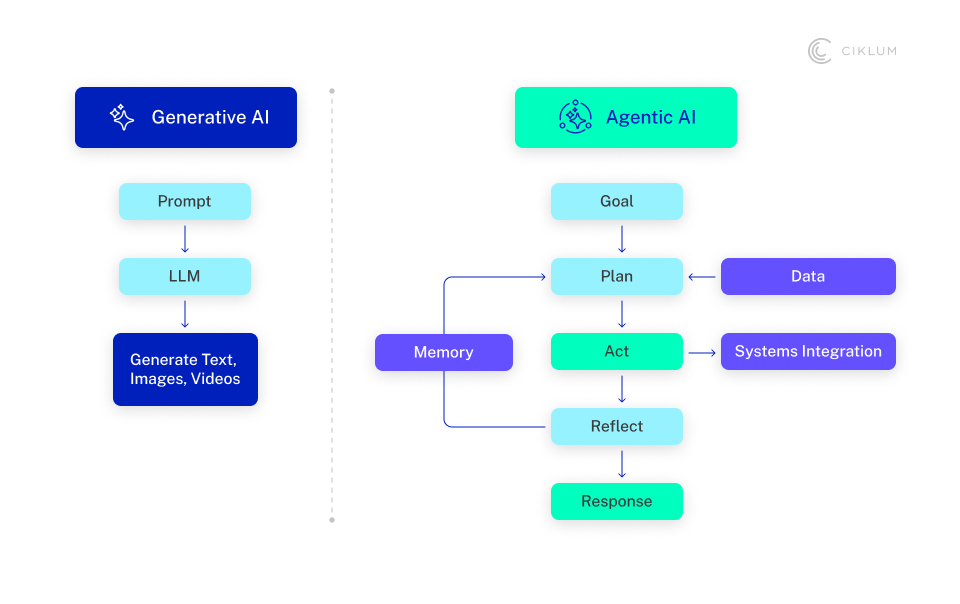
This article breaks down how agentic AI is quietly reshaping enterprise execution, why many early efforts will stall, and why strong governance becomes essential as autonomy embeds itself into the stack.
When AI Stops Waiting for Instructions
We know how traditional AI works. A human provides an input, the system produces an output, and the interaction ends. Agentic systems don’t need to be told exactly what to do at every step. They decide how to proceed, interact with other systems, execute actions, and adjust when conditions change. The output is not a single response, but continued progress toward a defined goal.
This distinction matters in day-to-day operations. Many processes slow down because someone needs to approve, follow up, or remember to move things along. Agentic systems remove that friction. Execution keeps going unless something genuinely needs human judgment. In insurance claims, for example, the delay is rarely in assessment, but in handoffs between review, approval, and follow-up. The same pattern appears in areas like finance operations, where work stalls between reconciliation, approval, and exception handling, exactly the gaps that agentic systems begin to close.
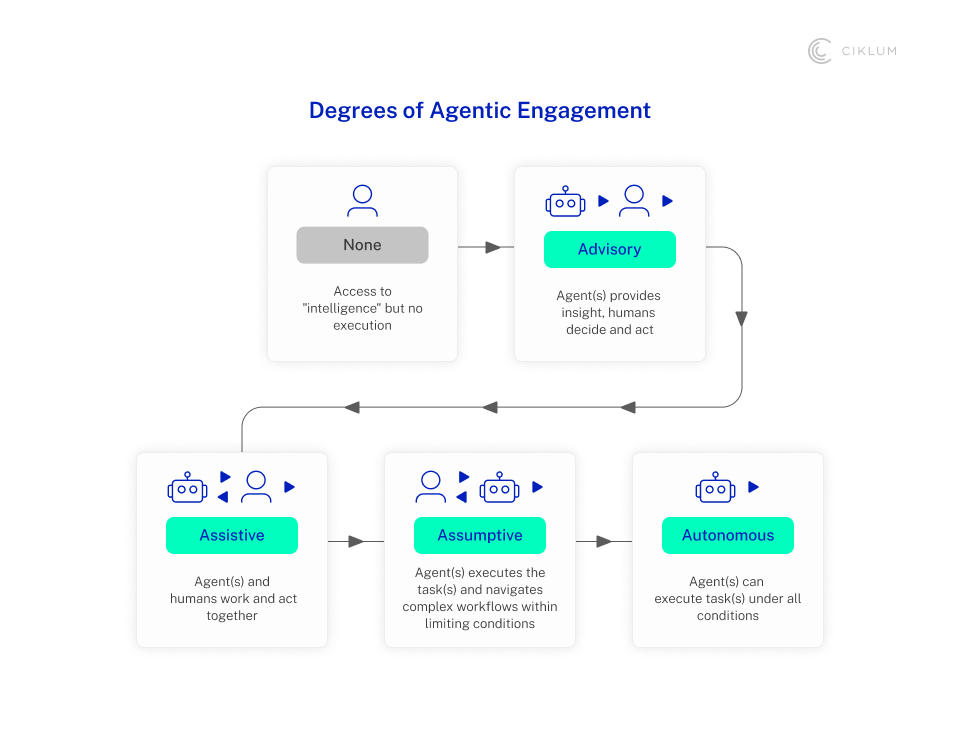
That’s why most leaders barely notice it at first. Nothing breaks. No alerts fire. Work simply stops getting stuck in the places where it used to pause. As agentic capabilities mature, analysts expect a growing share of routine enterprise decisions to be handled autonomously, instead of waiting for approvals at every stage.
Organisations Are Reassigning Ownership, Not Just Automating Tasks
For decades, ownership and execution were tightly linked. Teams were accountable for outcomes because they also performed the work required to achieve them.
As agentic systems take on execution, that link loosens. Software handles coordination, follow-through, and monitoring, while humans move upstream to set direction, define constraints, and intervene where judgment or risk is involved.
This shift becomes clear in transaction-heavy, customer-facing environments. Ciklum partnered with a global payments organisation to introduce agentic systems into customer support, cutting operational workload by nearly 50%. What changed most was leadership focus, shifting away from supervising individual interactions and toward setting the boundaries and accountability for autonomous execution.
As a result, roles evolved and success became less about completing tasks and more about shaping outcomes. No roles disappear overnight. Instead, work carries on with fewer delays, fewer escalations, and fewer moments where progress stalls waiting for a human nudge.
What AI-Native Really Means in Practice
As agentic systems become more common, many organisations describe themselves as becoming AI-native. In many cases, that label simply reflects broader use of AI tools. In reality, AI-native means something more specific.
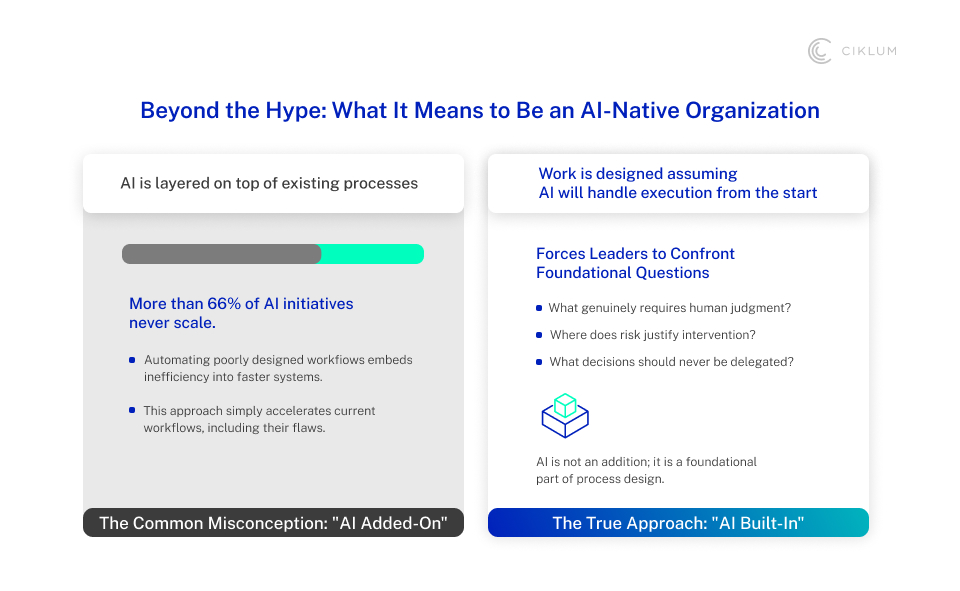
An AI-native organisation designs work assuming that some execution will be handled by non-human factors from the start. AI is not added on top of existing processes, but built into how those processes are designed.
This forces leadership teams to confront questions that were easier to avoid during earlier experiments.
- What genuinely requires human judgment?
- Where does risk justify intervention?
- What decisions should never be delegated?
Deloitte’s research underscores the difficulty of scaling AI. More than two-thirds of leaders report that only a small portion of their Gen AI experiments are likely to scale. When broken processes are automated, failure simply happens faster. Meaningful scale comes from redesigning work, not accelerating it.
Autonomy Without Governance Creates New Risk
Autonomy speeds things up and allows work to scale, but it also raises the stakes. When systems act on their own, one decision can quickly cascade across customers, revenue, and trust before anyone has time to intervene.
This is not a hypothetical concern. McKinsey reports that nearly 50% of organisations using generative AI have experienced at least one negative outcome, often not because the model failed, but because governance and control were never designed in from the beginning.
In many organisations experimenting with generative and agentic systems, early incidents are already surfacing. A customer-facing agent may resolve issues faster than any human team could, until an edge case pushes it beyond policy boundaries, triggering incorrect refunds and compliance breaches that take weeks to unwind. The system did exactly what it was designed to do, just without the safeguards leadership assumed were in place.
The Black Box Problem, Explained Simply
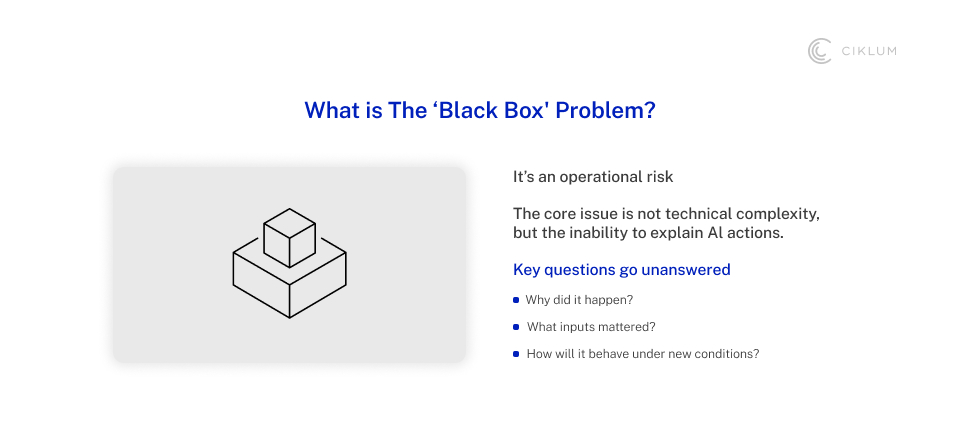
When leaders talk about black-box systems, the concern is not technical complexity. It is an operational risk. A system becomes a black box when it acts, but no one can clearly explain why it did what it did, or how it will behave under new conditions. Without that clarity, accountability becomes ambiguous, leaving legal, risk, and compliance teams unsure where responsibility sits when autonomous decisions have real-world consequences.
This is why trust alone is not enough. Trust may be acceptable when AI advises humans, but it breaks down when AI executes work on their behalf. As autonomy increases, organisations need visibility into how decisions are made, how reliably systems behave over time, and when they drift.
Why Observability Matters More Than Trust
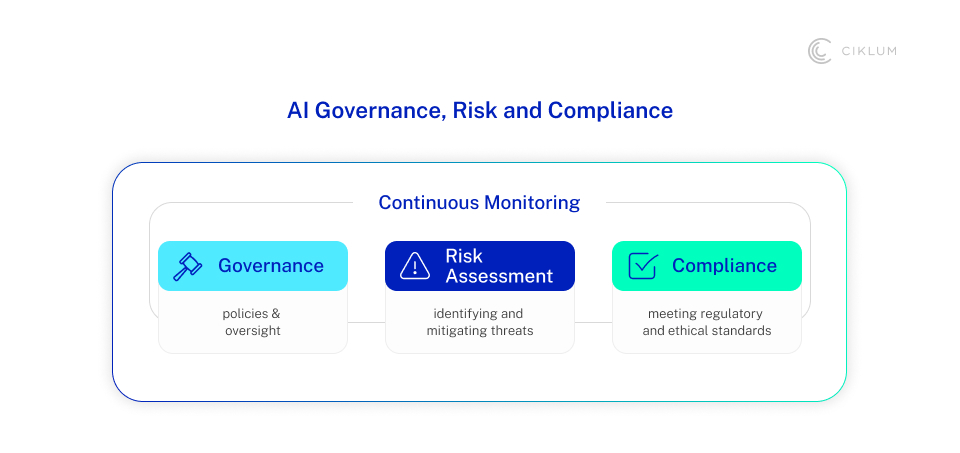
Governance in agentic systems is not about slowing things down or micromanaging software. It is about designing autonomy to operate within visible, enforceable boundaries. Leaders need to see how decisions were reached, track how reliably systems perform over time, and detect drift before it turns into financial, compliance, or reputational damage.
Agentic systems, therefore, must be orchestrated, not simply deployed. That orchestration includes decision logging, reliability monitoring, clear escalation paths, and fail-safes for high-stakes intervention. In practice, this orchestration layer may require new roles or mandate closer collaboration across product, operations, risk, and legal teams. Governance cannot be pushed down to IT or compliance; it is an operating-model decision that sits squarely with leadership.
In Summary: The Human Role Becomes Orchestration
Agentic AI does not remove the need for humans. It changes what humans are responsible for. Over time, the most valuable leaders will not be those who approve the most work, but those who design the conditions under which work can safely move on its own, by setting clear decision boundaries, escalation rules, and accountability.
This transition will not arrive as a big announcement or a big bang moment. Most organisations will recognise it only in hindsight, when fewer meetings are needed to unblock progress and fewer emails are sent asking who owns what.
The enterprises that succeed will treat agentic AI not as a tool to bolt on, but as a new class of digital workforce that must be governed, observed, and deliberately integrated into how value is created, with the same discipline applied to human teams and core platforms.If you want to turn these shifts into measurable impact, Ciklum’s AI specialists can help identify where autonomy makes sense, design the governance and observability layer, and move from pilots to production with control rather than chaos. Get in touch with us today.

By Enver Cetin

Intelligent Automation Principal Lead
Enver specializes in Intelligent Automation and AI, leading transformative projects that enhance business efficiency. With expertise in Generative AI and digital management, he integrates cutting-edge AI solutions into business strategies. Enver holds advanced degrees in Business Consulting and Computer Science, driving Ciklum’s mission of industry innovation.
Blogs
Discover Similar Insights

Enterprise AI Automation: A Practical Guide to GenAI, AI Agents and Intelligent Workflows
Learn More
Connecting AI to Your Business: A Complete Guide to MCP Servers
Learn More
The 2026 GenAI Watchlist: Five Trends That Will Redefine Technology
Learn More
Ciklum Client Conference 2025: Winning in the Intelligence Age
Learn More