



Modern product teams often fail because they make high-stakes decisions based on outdated or incomplete customer insights, not because they lack ideas or engineering capability.
AI is accelerating customer discovery by enabling teams to operate with continuous, intelligence-led insights that reduce risk, improve decision quality and accelerate time-to-value. All whilst keeping human judgment at the center of strategic decisions.
In this blog, Daniel Jennings, Associate Vice President of Customer Experience at Ciklum, explores what this shift means for enterprise product teams.
Key takeaways:
- AI handles the time-consuming analysis, freeing teams to focus on strategy and decision-making
- Major savings potential across time, resources, remediation and speed-to-market
- Continuous analysis powered by AI, allows teams to keep customer discovery dynamic as consumer trends evolve
Customer discovery - the practice of integrating customer insights into product development decisions - remains one of the slowest and most fragmented disciplines in enterprise product organizations. While engineering and design have undergone rapid transformation, discovery is still held back by outdated processes: 10–12 week cycles, fragmented data scattered across systems, static personas that rarely update, and subjective interpretation that leads to late-stage invalidation.
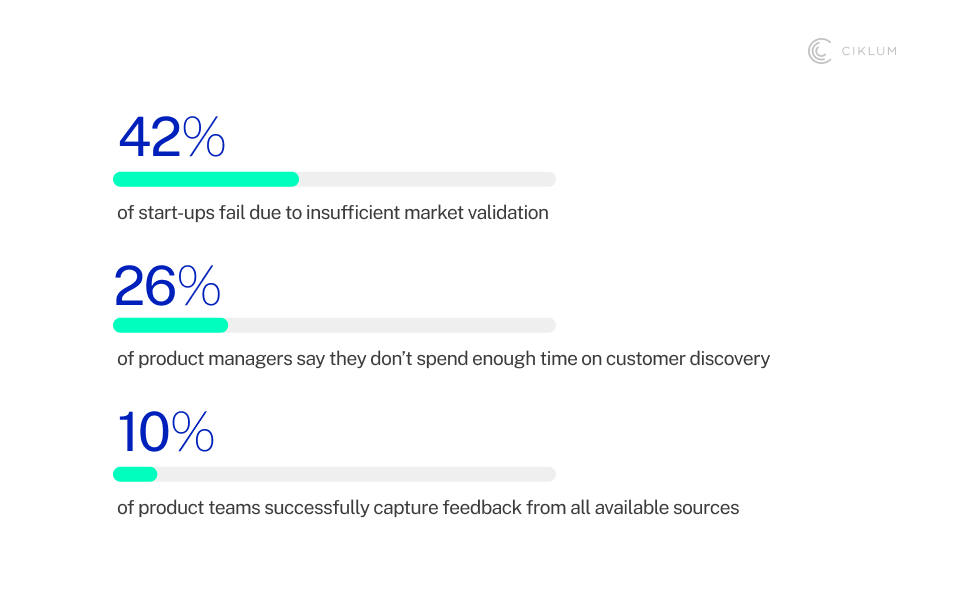
The statistics around customer discovery tell the story:
- According to Edition, 42% of start-ups fail due to insufficient market validation
- Gartner has found that 26% of product managers say they don’t spend enough time on customer discovery
- Only 10% of product teams successfully capture feedback from all available sources, according to Productboard
For enterprises, this translates into stalled product strategies, high-cost pivots, missed opportunities, and delayed time-to-value. But what is holding customer discovery back - and how can AI help solve those challenges?
Why Traditional Discovery Fails
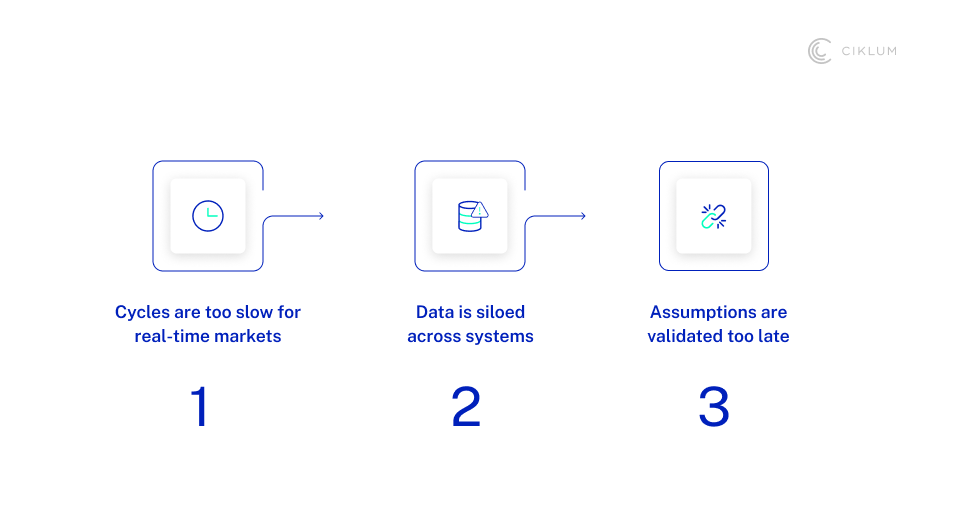
Traditional discovery was built for slower markets and predictable customer behavior. It breaks down in enterprise environments for three structural reasons:
1. Cycles are too slow for real-time markets, with insights becoming outdated by the time synthesis is complete.
2. Data is siloed across systems and teams as CRM, support, sales, research and market channels are rarely unified or analyzed holistically.
3. Assumptions are validated too late, as customer behavior shifts faster than annual or quarterly persona updates. This means that by the time teams recognize the mismatch, designs are locked in and engineering is already underway.
Even though so many areas of business operations have been transformed by automation and AI, the same can’t be said of many organizations’ customer discovery strategies.
Many traditional approaches are still highly manual in nature, and can be expensive, because they rely on small samples, subjective interpretations, and time-consuming synthesis. Instead, enterprises need a discovery model that is dynamic, multi-sourced and continuously refreshed.
AI Discovery: Accelerating Human-Led Customer Understanding
The opportunity lies not in replacing human expertise, but in removing the manual bottlenecks that prevent teams from applying it effectively. AI handles the time-consuming synthesis and pattern recognition that traditionally bog down discovery cycles, freeing product teams to focus on what humans do best: interpreting insights, making strategic decisions, and applying judgment to complex customer problems.
This shift speeds up every stage of the customer discovery process, including persona generation, interview capture, synthesis, pattern analysis, sentiment clustering, Jobs-To-Be-Done mapping, behavioral segmentation, and opportunity analysis.
The breakthrough is that these processes can now be accelerated to operate on a continuous basis, allowing product teams to uncover insights in days rather than months, saving significant time and resources.
This shift happens through three structural accelerators, each addressing a fundamental limitation in traditional discovery:
- AI-powered persona intelligence: AI tools can rapidly draft and update personas, using a combination of market-scale behavioral data, search and language patterns, early interview signals and customer journeys. Product teams then validate, refine and contextualize these drafts to ensure personas evolve in real time as customer behavior shifts.
- Automated discovery synthesis: instant synthesis capabilities remove the most time-consuming manual process of customer discovery. This gives teams more time for critical interpretation and strategic thinking. As a result, discovery cycles shrink from months to hours, reducing cognitive bias and improving clarity.
- Rapid insight loops: AI surfaces patterns and speeds up hypothesis testing, insight refinement, persona updates and opportunity mapping, while human judgment determines which insights matter most and how to act on them. Crucially, it also moves learning inside the discovery phase instead of months after it.
Applying AI Customer Discovery In Practice
Case Study 1: Trading Platform – Uncovering a Hidden High-Value Segment
A trading platform had built its strategy on assumptions about customer behavior, resulting in a limited view of the market opportunity. When the team used AI to analyze interviews, behavioral signals, and linguistic patterns at scale, they uncovered what traditional research had missed.
Key Findings:
- A previously unidentified high-value customer segment
- Distinct behavioral patterns and unmet needs specific to this group
- New Jobs-To-Be-Done clusters that emerged directly from user language
The impact: The team reframed their entire product direction, reprioritized which features to build first, eliminated roadmap waste, and achieved stronger alignment across the organization.
Case Study 2: Product Platform – Catching a Costly Mistake Early
A product team was ready to build a PRD generator based on what they thought customers wanted. Before committing resources, they used AI to synthesize interviews, workflow patterns, and documentation—which helped them spot a critical disconnect.
Key Findings:
- Users didn't want PRD automation at all
- What they actually needed was an AI collaborator for discovery work
- The real value was in challenging their assumptions, not generating documents
The impact: The early pivot avoided significant wasted engineering costs, sharpened the value proposition, and put the product on a much stronger path to product-market fit.
Enterprise Outcomes:What AI Discovery Unlocks
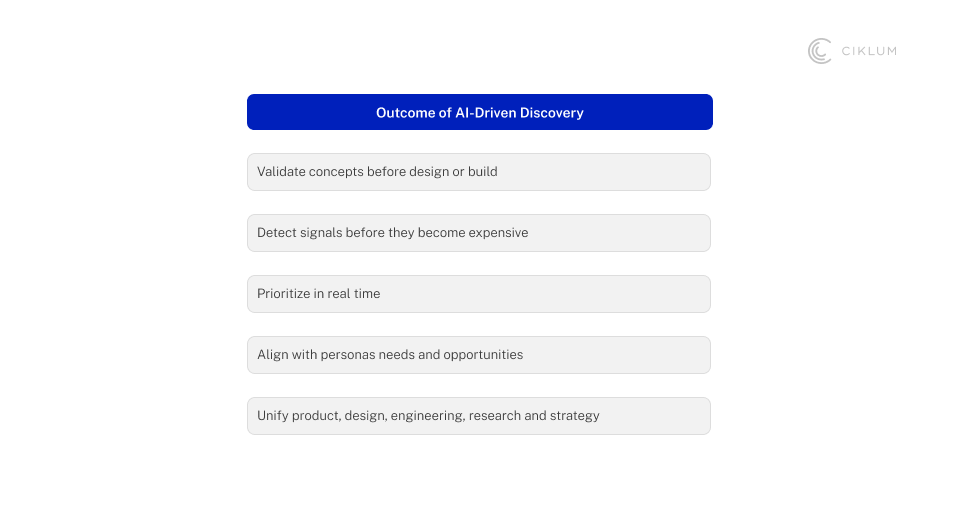
AI-assisted discovery is becoming the foundation of evidence-led product development, which is essential for competitive enterprise product organizations. Today, AI-accelerated discovery already helps organizations:
- Validate concepts before design or build
- Detect signals before they become expensive
- Prioritize in real time
- Align with personas needs and opportunities
- Unify product, design, engineering, research and strategy
AI-powered discovery is not a research enhancement. It is an operating model upgrade that speeds up how enterprises understand customers, de-risk decisions and allocate investments—with human expertise guiding every strategic decision. This helps them simultaneously improve product development across time, cost, quality, product performance, and risk-reduction, backed up by informed strategic decision-making every step of the way.
To explore how AI-driven discovery can be embedded in your product organization, book a demo of the Ciklum AI Incubator today.

By Daniel Jennings

Associate Vice President, Customer Experience
Danny shapes winning product strategies and digital experiences at Ciklum, leveraging 15+ years of expertise in Telco, Martech, Retail, and B2B SaaS. With a proven record of launching FTSE-recognized products, he drives market success and has generated hundreds of millions in revenue.
Blogs
Discover Similar Insights

From AI Interest to Engineering-Ready Mandates: Why The Market Needs AI Clinics, Not More AI Pilots
Learn More
Agentification of Payments: A Strategic Shift for PSPs
Learn More
Explainable AI in Banking: Designing Transparent, Auditable Models for Credit, Risk, and Compliance
Learn More
Payments Without Friction: Modern Checkout Is Your Competitive Edge
Learn More