



Key Takeaways
- AI agents are goal-driven systems that perceive, reason, act via tools/APIs, and learn from outcomes with minimal human direction.
- Unlike chatbots (reactive) and RPA (rule-based, brittle), they pursue outcomes across systems and adapt to new scenarios.
- Capabilities: autonomy, multi-tool orchestration, adaptability, scalability, and built-in governance.
- Use cases: finance, customer support, IT operations (AIOps), and supply chain where variability and cross-system coordination matter.
- Impact: cost reductions, productivity gains, and faster response times in early deployments.
AI agents are transforming enterprise operations by acting as autonomous teammates that pursue goals across systems. Unlike simple bots or chatbots, they observe environments, plan steps, execute actions, and learn from outcomes. For enterprise leaders exploring the next wave of automation, understanding what agents actually do (and where they deliver measurable value) is essential.
What AI Agents Are and What They Aren't
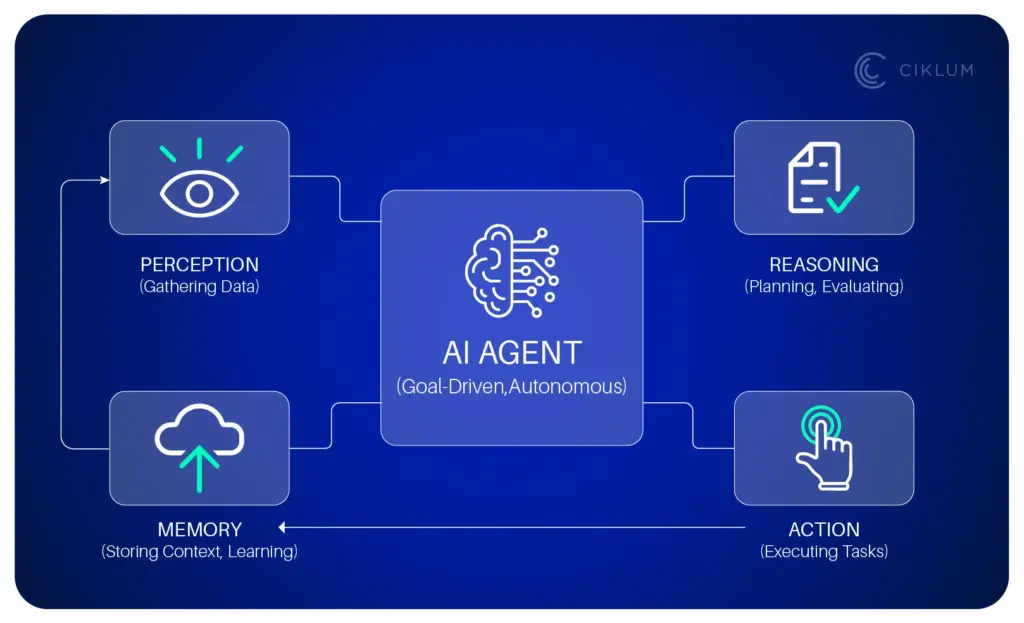
An enterprise AI agent is a software system designed to achieve specific business objectives with minimal human intervention. Core components include:
- Perception: Gathering data from APIs, databases, emails, or sensors to understand the current state
- Reasoning: Using LLMs and planning algorithms to break goals into steps and evaluate options
- Action: Calling tools, bots, or APIs to execute tasks, with feedback loops to adjust if needed
- Memory: Storing context from past interactions to improve future performance
The following diagram visualizes these core components and their cyclical interaction.
AI agents differ fundamentally from:
- Chatbots, which respond reactively to queries without pursuing goals or taking independent actions. A chatbot answers questions; an agent resolves problems.
- RPA bots, which follow fixed rules without understanding context or adapting to changes. An RPA bot executes scripts; an agent decides what to do next.
Agents thrive where workflows require judgment, coordination across systems, and handling of unstructured data.
Core Capabilities That Drive Enterprise Value
Enterprise AI agents deliver value through four key strengths:
Autonomy. Agents operate 24/7 toward defined outcomes, reducing manual handoffs and enabling continuous processing without human bottlenecks.
Multi-tool orchestration. Agents integrate with ERPs, CRMs, email systems, and custom APIs to execute complex workflows that span multiple applications and data sources.
Adaptability. They learn from feedback and adjust to new scenarios such as policy changes, market shifts, or new data patterns without requiring manual re-scripting.
Scalability. One agent design can handle thousands of similar tasks while governance layers ensure compliance, auditability, and appropriate human oversight.
These capabilities enable agents to move beyond task automation into process transformation. In regulated sectors such as healthcare, agentic AI is already rewiring how organizations operate from scheduling and documentation to cross-department coordination.
Where AI Agents Add Real Value
Agents shine in high-impact areas with variability, data volume, and cross-system needs.
Finance and Compliance. Agents automate invoice processing by reading PDFs, matching against purchase orders, flagging anomalies, and routing approvals while enforcing policies and auditing decisions. Banks such as Santander have automated mortgage transfer processes with intelligent document processing and RPA integration, meeting SLAs and cutting manual overhead. Validation and governance remain critical as agents touch sensitive financial data.
Customer Support. Support agents resolve queries end-to-end: analyzing tickets, pulling customer history, checking inventory, issuing refunds via APIs, and following up. They escalate only novel or high-risk cases. Enterprises report faster resolutions and higher customer satisfaction scores. The impact of GenAI on customer service in retail shows how conversational and task-oriented agents are reshaping support at scale.
IT Operations (AIOps). Agents monitor systems, diagnose issues, deploy fixes via scripts, and notify teams, preventing outages proactively rather than reacting to them. This minimizes downtime and frees IT staff from routine alerts.
Supply Chain. Optimization agents forecast demand, reroute shipments during disruptions, negotiate with vendors via email, and update ERPs all in real time. Multi-agent systems coordinate sourcing, risk assessment, and logistics simultaneously. Real-world implementations range from AI-driven fleet and route optimization (e.g. fuel and emissions savings) to centralized supply chain visibility and forecasting that cut stock-outs and automate reporting.
AI Agents vs Chatbots and RPA
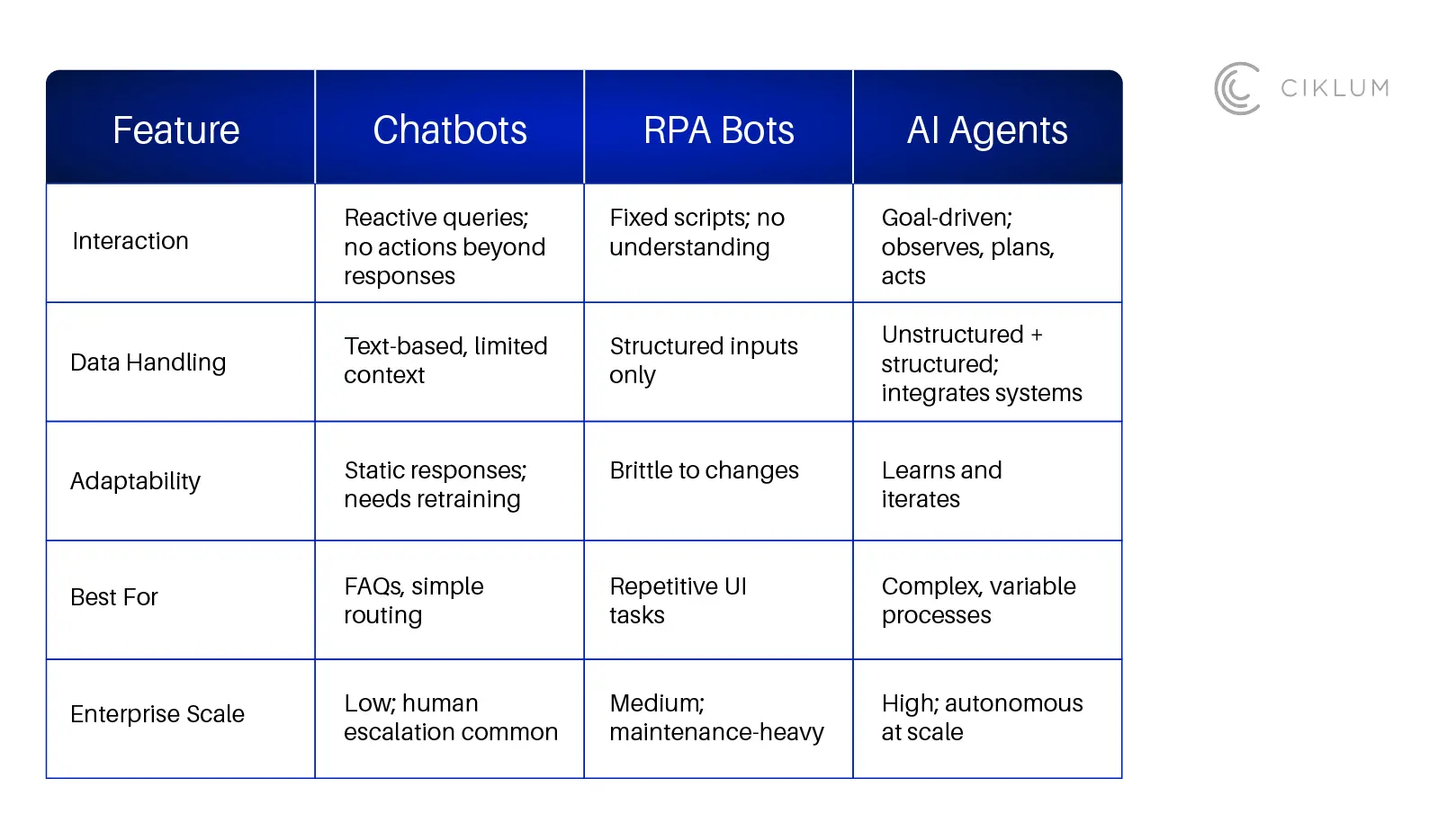
Agents often incorporate RPA for execution and chatbots for user interfaces, creating hybrid systems where each component plays to its strengths. For multi-agent orchestration and governance in practice, see our guide to enterprise AI automation.
Real-World Business Impact
Enterprises deploying AI agents report significant results:
- Cost savings: reduction in operational expenses through automation of routine cognitive work
- Productivity gains: Workers shift to strategic tasks
- Risk reduction: Proactive anomaly detection cuts fraud and compliance issues before they escalate
- Revenue lift: Faster responses and personalization boost customer satisfaction and upsell opportunities
Finance teams, for instance, use agents for autonomous invoice reconciliation, saving weeks of manual effort monthly. According to Deloitte's 2025 AI Trends report, organizations with mature agentic AI deployments are seeing measurable competitive advantages in speed-to-market and operational resilience. At Seeking Alpha, automation of testing and delivery cut release cycle time by 50%, illustrating how agentic and automated workflows accelerate product teams as well as operations.
In short, AI agents are not a replacement for every bot or chatbot; they are the layer that coordinates them toward business outcomes. The enterprises gaining the most are those that treat agents as part of a broader automation strategy with clear goals, governed tool access, and human oversight where it matters.
By Ciklum Editorial Team

Ciklum’s Editorial Board is a collective of experienced writers and industry experts, bringing together perspectives shaped by real-world engineering and delivery experience. Through collaborative insights, the team explores how technology, AI, and digital innovation move from concept to execution across industries.
Blogs
Discover Similar Insights

Enterprise AI Automation vs RPA: Why Rules Alone No Longer Scale
Learn More
Enterprise AI Automation Explained: From Rule-Based Automation to Intelligent Systems
Learn More
Enterprise AI Automation: A Practical Guide to GenAI, AI Agents and Intelligent Workflows
Learn More
Intelligent Automation in Retail: Five Predictions Shaping 2026 and Beyond
Learn More