

- Key Takeaways:
- The AI Has The Intelligence. It Simply Lacks The Context
- Understanding the Business Problem
- What is the Model Context Protocol?
- Business Value of MCP
- Real-World Use Cases
- Technical Implementation Overview
- Challenges and Mitigations
- Conclusion: From Demos to Business Value
- Frequently Asked Questions
Key Takeaways:
- The context gap between AI capabilities and business data access prevents enterprises from realizing AI's full potential
- The N×M integration problem creates exponential complexity when connecting multiple AI tools to multiple business systems
- MCP standardizes AI-to-system connections, transforming custom integrations into reusable organizational assets
- Organizations that implement MCP today position themselves for the agentic AI future where AI actively participates in business processes
The AI Has The Intelligence. It Simply Lacks The Context
AI assistants today can write poetry, debug code, and explain quantum physics. They bring remarkable reasoning capabilities to any conversation. Yet the real opportunity for enterprises lies in connecting these powerful tools to the data that matters most: your business systems.
Without proper integration, even the most capable AI operates with a significant blind spot. It can discuss industry trends and general best practices, but it can't tell you about your company's Q3 revenue, your customer support ticket backlog, or the status of a specific project in Jira. The AI has the intelligence; it simply lacks the context.
This context gap is an architectural challenge, not a limitation of AI itself. Large language models are trained on public data, which means they possess broad knowledge but have no inherent access to your private SQL databases, active support tickets, or internal documentation. When asked about your specific business without this connection, even well-designed AI systems may fill gaps with plausible-sounding but inaccurate responses, a phenomenon known as hallucination.
The good news: this challenge has a solution. The Model Context Protocol (MCP) provides a standardized way for AI systems to connect securely to your real business data. With proper MCP implementation, AI transforms from a general-purpose tool into a context-aware assistant that genuinely understands your organization, delivering accurate, grounded responses based on actual data rather than educated guesses.
Understanding the Business Problem
The N×M Integration Nightmare
Before examining the solution, let's understand the problem enterprises face when trying to connect AI to their systems.
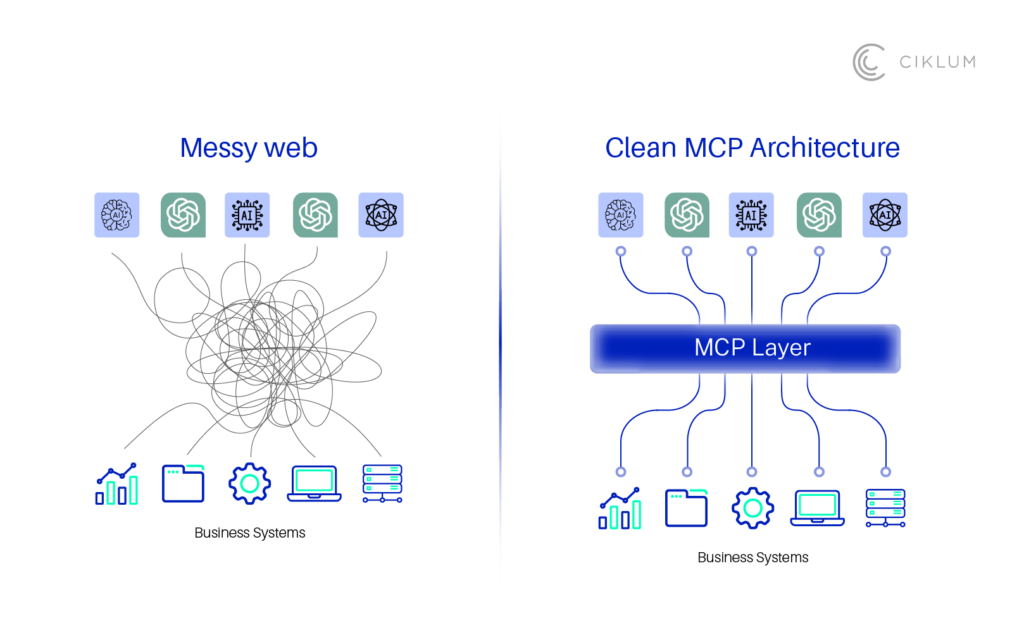
Imagine your organization wants to deploy three AI tools: Claude for strategic analysis, a custom chatbot for HR inquiries, and an AI coding assistant for your engineering team. You also want these tools to access three internal systems: your PostgreSQL database, Google Drive, and Slack.
In the traditional approach, you would need to build nine distinct integration layers: one for each AI-to-system combination. Each integration requires:
- Custom authentication logic
- Bespoke API wrappers
- Distinct error handling
- Separate security audits
- Individual maintenance cycles
Now scale this to the reality of enterprise environments: dozens of AI tools, hundreds of internal systems, and the number of required integrations explodes exponentially. This "N×M problem" is why most organizations remain stuck with AI demos that never reach production. To learn more about moving beyond proof-of-concepts, explore our Enterprise-ready AI solutions.
Why Generic AI Hallucinates Your Business Data
When you ask an AI assistant about your business without providing context, it faces an impossible choice: admit ignorance or generate a plausible-sounding response based on general patterns.
Most models choose the latter. They hallucinate.
This happens because:
- Training data cutoff: Models don't have access to information created after their training date
- No proprietary knowledge: Your internal data was never part of training
- Pattern completion bias: Models are optimized to generate coherent responses, even when they lack information
- Absence of grounding: Without real data to anchor responses, the model fills gaps with statistical predictions
The business impact is significant. Teams lose trust in AI outputs. Decisions get made on fabricated data. And organizations pull back from AI adoption entirely, missing legitimate opportunities for efficiency gains.
Core Pillars of Tangible Enterprise AI Value
For AI to deliver business value, it needs:
- Access to current data: Real-time or near-real-time information from business systems
- Appropriate permissions: Role-based access that respects organizational security policies
- Auditability: Clear records of what data AI accessed and when
- Standardization: A consistent approach that doesn't require rebuilding integrations for every new tool
- Governance: Centralized control over AI capabilities and data access
This is precisely what the Model Context Protocol provides. For enterprises looking to implement AI solutions that meet these requirements, our AI-Enabled Engineering services help design and deploy production-ready AI systems.
What is the Model Context Protocol?
A Universal Adapter for AI
The Model Context Protocol (MCP) is an open standard that defines how AI systems connect to external tools, data sources, and services. Introduced by Anthropic in November 2024 and now governed by the Linux Foundation's Agentic AI Foundation (with backing from OpenAI, Google, Microsoft, and AWS), MCP has rapidly become the industry standard for AI integration.
Think of MCP as "USB-C for AI." Just as USB-C standardized how devices connect to peripherals, eliminating the chaos of proprietary cables, MCP standardizes how AI systems connect to data sources. Build a connector once, and any MCP-compatible AI tool can use it.
The Three -Tier Architecture
MCP operates through three components:
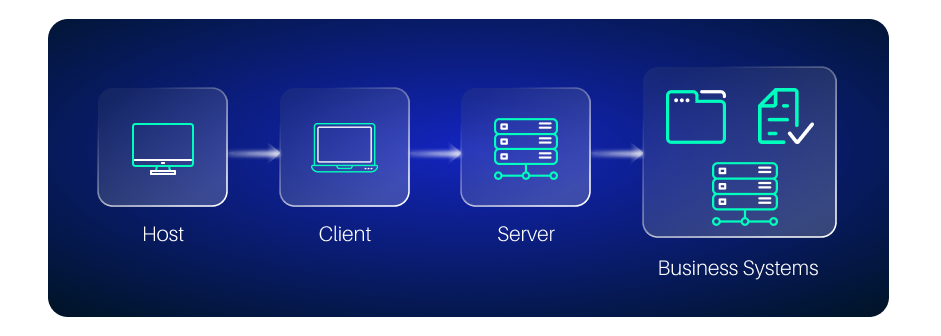
Hosts: The applications where users interact with AI: Claude Desktop, Cursor IDE, VS Code, or custom chat interfaces. The host manages the user experience and coordinates communication.
Clients: Protocol handlers embedded within hosts that maintain connections to MCP servers. Each client talks to one server, translating user requests into protocol calls.
Servers: Lightweight services that expose specific capabilities. A server might wrap a database, an API, a file system, or any other resource you want AI to access. Servers are independent and composable, you can run multiple servers simultaneously, each handling different systems.
This separation of concerns means you can add new data sources without modifying your AI applications, and upgrade AI tools without rebuilding your integrations.
The Three Core Primitives
MCP exposes capabilities through three types of interactions:
Tools enable AI to take action. They function like remote procedure calls. The AI can invoke a tool to query a database, send an email, create a ticket, or perform any defined operation. Tools have clear input schemas and can produce side effects.
Resources provide read-only data access. They represent information the AI can retrieve and incorporate into its context, such as documentation, database records, log files, or current system states. Resources support subscriptions, enabling real-time updates when data changes.
Prompts standardize interaction patterns. They're reusable templates that structure how users engage with specific workflows, ensuring consistent, best-practice interactions across the organization.
Business Value of MCP
Grounding AI in Reality
The most immediate benefit of MCP is reducing hallucinations through data grounding.
When an MCP server connects AI to your actual business systems, the model no longer needs to guess. Ask about a customer's order status, and the AI queries your order management system. Ask about project progress, and it pulls data from your project management tool. Ask about inventory levels, and it checks your actual inventory database.
This grounding doesn't guarantee perfect accuracy. The AI can still misinterpret data or draw incorrect conclusions. But it eliminates the category of errors where AI invents information wholesale. The model works with real data rather than statistical approximations of what the data might be.
Velocity and Reduced Technical Debt
In the pre-MCP era, every new AI integration meant custom development. Python scripts wrapping APIs, JSON schemas for the LLM, manual HTTP transport handling, bespoke authentication, all repeated for each combination of AI tool and data source.
MCP inverts this equation. Build a robust MCP server for your ERP system once, and that interface becomes a reusable asset available to every AI initiative in your organization. The marginal cost of adding new data sources approaches zero, and you eliminate the "house of cards" architecture where a single API change breaks multiple systems.
Centralized Governance and Security
Perhaps the most compelling business argument for MCP is control.
Without a standard protocol, API keys and database credentials scatter across scripts, notebooks, and environment variables on individual machines. Security policies exist in documentation that developers may or may not follow. Auditing AI data access requires forensic investigation across disparate systems.
MCP centralizes this chaos. Security policies (such as "only senior HR staff can access salary data") get enforced at the server level. The AI client simply requests a capability; the MCP server decides whether to grant it based on authenticated identity. Every access attempt can be logged, creating a unified audit trail.
For enterprises operating under regulatory requirements (GDPR, HIPAA, SOX), this centralized governance is essential.
Vendor Neutrality
MCP is an open standard, not proprietary technology. Your MCP servers work with Claude, with GPT models, with open-source alternatives, and with whatever AI systems emerge in the future. Investments in MCP infrastructure aren't tied to any single vendor's roadmap.
This neutrality provides negotiating leverage with AI vendors, flexibility to adopt better tools as they emerge, and protection against the risk of any single provider changing direction.
Real-World Use Cases
Intelligent Document Processing
Traditional challenge: Custom OCR scripts that break frequently, difficult integration with approval workflows, manual handoffs between systems.
MCP-enabled approach: An MCP server wraps document processing tools and connects to approval databases. AI orchestrates extraction, validation, and routing through a unified interface.
Business impact: Organizations report meaningful reductions in document processing time, with staff redirected from data entry to high-value verification and exception handling. This aligns with our Intelligent Automation capabilities that streamline document workflows across industries.
Customer Support Knowledge Navigation
Traditional challenge: Support agents toggle between CRM, wikis, and ticketing systems. AI assistants have limited context windows and can't access real-time customer data.
MCP-enabled approach: A unified support MCP server connects all relevant systems. AI queries real-time customer status, purchase history, and ticket context on demand.
Business impact: Lower average handle times, improved first-contact resolution rates, and support agents who spend less time searching and more time solving. For financial services organizations, see how we've implemented similar AI-driven customer support solutions in our Banking & Financial Services case studies.
Supply Chain Responsiveness
Traditional challenge: Data locked in static dashboards. Response to disruptions is reactive, relying on humans to notice problems and coordinate responses.
MCP-enabled approach: AI agents monitor live logistics feeds via MCP. They proactively model disruption scenarios and suggest order adjustments before problems cascade.
Business impact: Faster response to supply chain disruptions, reduced costs from proactive rather than reactive management, better inventory optimization.
Regulatory Compliance
Traditional challenge: Manual auditing of documents against changing regulations. Error-prone processes that consume significant staff time before each audit.
MCP-enabled approach: MCP servers connect to regulatory databases and internal document stores. AI continuously monitors for compliance gaps and flags issues before they become audit findings.
Business impact: Reduced compliance risk, lower audit preparation costs, and continuous rather than periodic compliance monitoring.
Developer Productivity
Traditional challenge: Developers context-switch between codebases, documentation, issue trackers, and communication tools. AI coding assistants lack context about the specific project.
MCP-enabled approach: MCP servers expose repository context, documentation, issue trackers, and team knowledge. AI assistants understand the specific project, its patterns, and its requirements.
Business impact: Faster onboarding for new team members, reduced time searching for information, and AI suggestions that align with project-specific standards. MCP enables the type of AI Agents & Autonomous Orchestration that automate workflows and enhance developer productivity.
Technical Implementation Overview
Transport Options
MCP supports multiple transport mechanisms for different deployment scenarios:
Stdio Transport runs servers as local processes, communicating through standard input/output. This approach works well for development tools and desktop applications where AI and server run on the same machine. Zero network overhead, inherits local permissions, and is simple to configure.
HTTP with Server-Sent Events (SSE) enables remote MCP servers accessible over networks. The client establishes a persistent connection for server-to-client messages while sending requests via HTTP POST. This transport supports standard authentication (OAuth, API keys), works through firewalls, and scales to multiple concurrent users.
Streamable HTTP represents the evolution of the SSE approach, with improved handling of streaming operations and better protocol efficiency. It's becoming the recommended transport for new remote deployments.
Building Servers: The Technology Stack
MCP servers can be built in multiple languages, with Python and TypeScript having the most mature ecosystems.
Python with FastMCP offers the fastest path to productivity. FastMCP abstracts protocol complexity, automatically generating schemas from type hints and docstrings:
TypeScript with the official SDK provides type safety and integrates well with Node.js ecosystems. It uses Zod for runtime schema validation, ensuring AI requests match expected formats.
Java with Spring AI serves enterprises with existing Spring Boot infrastructure, allowing existing microservices to expose MCP capabilities with minimal changes. For organizations planning their technical architecture, our Software Architecture services help design scalable, maintainable integration patterns.
Security Considerations
Production MCP deployments require careful attention to security:
Authentication: Remote servers should use OAuth 2.0 or similar standards. Never deploy open MCP servers accessible without authentication.
Authorization: Implement role-based access at the server level. The server - not the AI - decides what data each user can access.
Input validation: Validate all inputs before processing. AI systems can pass unexpected or malformed data; servers must handle this gracefully.
Audit logging: Log every tool call, resource access, and authentication event. This trail is essential for security monitoring and compliance.
Sandboxing: Run MCP servers with minimal permissions. A server exposing weather data shouldn't have access to your customer database.
Challenges and Mitigations
Security Risks
The challenge: MCP servers expose internal systems to AI access. Misconfigured servers, over-privileged access, or malicious inputs could lead to data breaches or unintended actions.
Mitigation strategies:
- Deploy servers with least-privilege permissions
- Require human approval for sensitive operations (human-in-the-loop)
- Separate read-only and write-capable servers
- Regular security audits of MCP infrastructure
- Use sandboxed execution environments
Complexity of Advanced Tasks
The challenge: While MCP excels at straightforward data retrieval, complex workflows involving time-dependent calculations, multi-step reasoning, or stateful operations remain challenging.
Mitigation strategies:
- Design tools for atomic, well-defined operations
- Build verification steps into complex workflows
- Use human review for high-stakes decisions
- Iterate on tool design based on actual usage patterns
Ecosystem Maturity
The challenge: MCP is evolving rapidly. Some implementations are immature, poorly maintained, or have security vulnerabilities. Not all MCP servers in public registries meet enterprise standards.
Mitigation strategies:
- Prefer servers from established vendors with support commitments
- Conduct security reviews before deploying third-party servers
- Build internal servers for critical systems rather than relying on community options
- Stay current with MCP specification updates
Organizational Adoption
The challenge: Technical capability doesn't guarantee business adoption. Users need to trust AI outputs, understand capabilities and limitations, and integrate new tools into existing workflows.
Mitigation strategies:
- Start with enthusiastic early adopters
- Demonstrate clear value in initial use cases
- Provide training on appropriate AI usage
- Establish feedback channels for continuous improvement
- Celebrate and publicize wins
Conclusion: From Demos to Business Value
The gap between impressive AI demonstrations and actual business value has frustrated organizations for years. AI assistants that can discuss philosophy but can't access your customer database aren't useful for enterprise work.
MCP bridges this gap. By standardizing how AI connects to business systems, it transforms general-purpose language models into context-aware assistants grounded in your actual data. The result is AI that knows your business, which is not a hallucinated approximation, but the real thing.
The benefits compound. Every MCP server you build makes every AI tool more capable. Every integration becomes a reusable asset. The initial investment in MCP infrastructure pays dividends across all future AI initiatives.
Organizations adopting MCP today position themselves for the agentic AI future where AI doesn't just answer questions but actively participates in business processes, with appropriate oversight and control. Learn more about how agentic AI transforms enterprise operations in our related insights.
The technology exists. The standards are maturing. The ecosystem is growing. The question isn't whether to adopt MCP, but how quickly you can move from experimentation to production value.
Frequently Asked Questions
MCP (Model Context Protocol) is an open standard that lets AI assistants connect to your business systems, databases, and tools. Think of it as a universal adapter: instead of building custom integrations between every AI tool and every data source, you build one MCP server per system, and any MCP-compatible AI can use it. This is why it's often called "USB-C for AI."
AI models hallucinate when they lack access to accurate information and fill gaps with plausible-sounding guesses. MCP reduces hallucinations by giving AI direct access to your real data. When you ask about a customer's order status, the AI queries your actual order system rather than inventing an answer. This grounding in real data eliminates the category of errors where AI fabricates information entirely.
Both. Developers build and maintain MCP servers, but the benefits flow directly to business users. Customer support teams get AI assistants that know customer history. Sales teams get AI that understands pipeline data. Finance teams get AI that can query actual financial systems. The technical investment enables business value across the organization.
APIs require custom integration code for each AI-tool combination. If you have 5 AI tools and 10 data sources, that's potentially 50 custom integrations to build and maintain. MCP standardizes this: build 10 MCP servers (one per data source), and all 5 AI tools can use them immediately. MCP also provides built-in patterns for authentication, error handling, and capability discovery that you'd otherwise build from scratch.
The primary risks involve exposing internal systems to AI access. Misconfigured servers might grant excessive permissions. AI systems might pass unexpected inputs. Credentials might be improperly managed. These risks are manageable through standard security practices: least-privilege permissions, input validation, authentication requirements, audit logging, and regular security reviews.
By Ciklum Editorial Team

Ciklum’s Editorial Board is a collective of experienced writers and industry experts, bringing together perspectives shaped by real-world engineering and delivery experience. Through collaborative insights, the team explores how technology, AI, and digital innovation move from concept to execution across industries.
Blogs
Discover Similar Insights

Agentic AI in Retail: Closing the Gap Between Customer Intent and Enterprise Systems
Learn More
From AI Interest to Engineering-Ready Mandates: Why The Market Needs AI Clinics, Not More AI Pilots
Learn More
Agentification of Payments: A Strategic Shift for PSPs
Learn More
Explainable AI in Banking: Designing Transparent, Auditable Models for Credit, Risk, and Compliance
Learn More