



- Key Takeaways
- Is CCaaS Genuinely a New Market Opportunity?
- What CCaaS Really Means Now
- How AI Is Transforming Modern Contact Centres
- Why CCaaS Programmes Fall Short of Their Potential
- How Ciklum Builds AI-Native Contact Centres
- Why Partnerships Matter in CCaaS Transformation
- In Summary: The Future Contact Centre Is Engineered, Not Installed
Key Takeaways
- CCaaS has moved beyond cloud telephony. It is becoming the AI-native operating layer for customer experience.
- The biggest conversational AI contact centre trends are agentic AI, voice AI agents, omnichannel convergence, real-time agent assist, and predictive service.
- UK enterprises should treat CCaaS as an operating model transformation, not just a platform migration.
- The winners will be organisations that engineer AI, people, data, workflows, and contact centre platforms together from the start.
Is CCaaS Genuinely a New Market Opportunity?
Yes. Contact Centre as a Service, or CCaaS, is no longer repackaged cloud telephony. It is a structurally different model for customer operations: cloud-native, omnichannel, AI-ready, consumption-based, and built for continuous improvement.
The global contact centre as a service market was estimated at USD 5.82 billion in 2024 and is projected to reach USD 17.12 billion by 2030, growing at a 20.3% CAGR from 2025 to 2030. Grand View Research also points to remote and distributed workforces, AI, automation, and omnichannel engagement as key growth drivers.
For UK enterprises, this matters because the contact centre is no longer just a cost centre. It is where customer trust, operational intelligence, service efficiency, and revenue protection now meet. The SEO brief rightly frames this article around a dual intent: market education and commercial investigation, aimed at UK enterprise leaders evaluating cloud migration or AI augmentation before an RFP or partner shortlist.
The first wave of contact centre AI delivered useful gains: chatbots, IVR replacement, routing, summarisation, and agent assist. But enterprise buyers are now asking a harder question: what does the whole contact centre look like when AI is designed in from the start, not added later?
That is where CCaaS becomes a genuine market opportunity.
What CCaaS Really Means Now
A modern CCaaS platform brings together cloud-native contact centre infrastructure, voice, chat, email, WhatsApp, SMS, social, app, web, AI-powered routing, analytics, CRM integration, workforce management, and reporting.
But the real shift is not the platform feature list. It is the operating model.
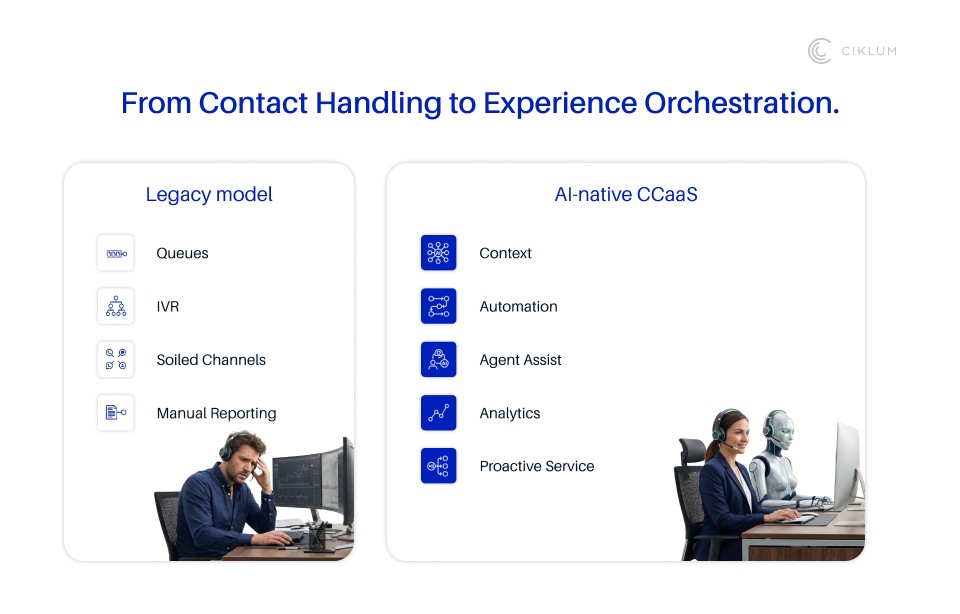
Traditional contact centres were built around queues, channels, and agent availability. Modern CCaaS is built around customer intent, context continuity, automation, and resolution. In other words, it moves the enterprise from contact handling to experience orchestration.
This is why contact centre transformation UK programmes increasingly need more than a licence and a migration plan. They need experience design, AI architecture, CRM and knowledge integration, workforce adoption, governance, and post-go-live optimisation.
How AI Is Transforming Modern Contact Centres
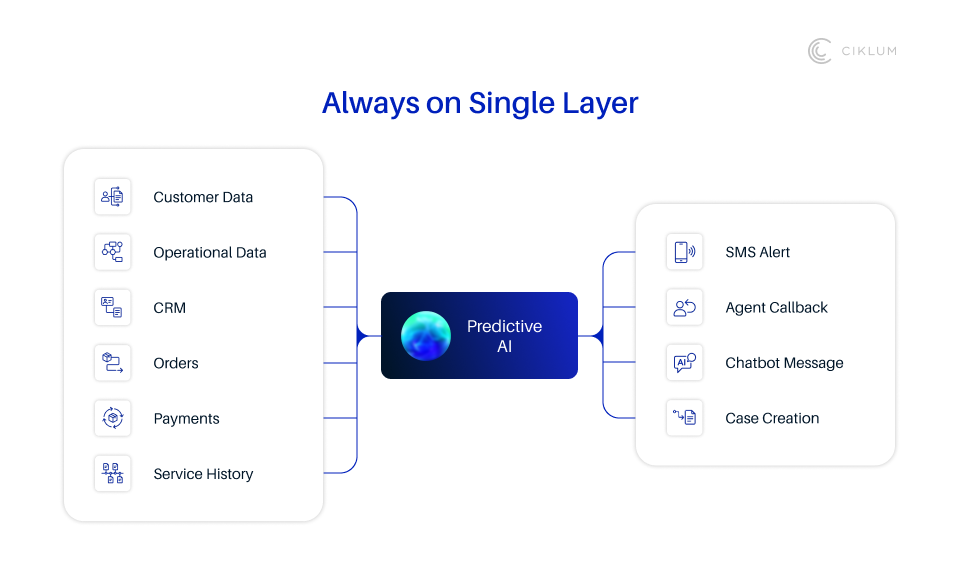
AI is reshaping the contact centre from a reactive support function into an intelligent customer operations layer. Agentic AI resolves tasks, voice agents modernise legacy IVR, omnichannel CCaaS preserves context across every interaction, real-time agent assist improves human performance, and predictive AI helps organisations solve issues before customers need to make contact.
- Agentic AI Turns Answers Into Outcomes
Agentic AI moves beyond chatbot responses by interpreting intent, triggering workflows, updating CRM records, escalating safely, and completing multi-step customer tasks across connected business systems. - Voice Is the Hardest and Most Valuable Channel to Transform — Voice remains one of the most expensive and complex contact centre channels because customers use it for urgent, emotional and high-stakes issues. Modernising it means moving beyond rigid IVR menus toward natural conversation, authentication, intent detection, safe escalation and workflow execution. The organisations that solve voice well unlock some of the highest transformation value.
- Omnichannel Creates Continuous Customer Context
True omnichannel CCaaS connects voice, chat, WhatsApp, email, app, CRM, and agent desktops so customers never repeat themselves when switching channels. - Real-Time Agent Assist Improves Human Performance
Agent assist supports live interactions with knowledge articles, compliance prompts, next-best actions, sentiment signals, and summaries, helping agents resolve faster and more consistently. - Predictive AI Reduces Avoidable Demand
Predictive AI analyses customer behaviour, interaction patterns, and operational signals to flag issues early, trigger proactive support, protect CSAT, and reduce inbound contact volume.
Why CCaaS Programmes Fall Short of Their Potential
Most CCaaS programmes fall short because they are treated as platform migrations, when the real value sits in the operating model around the platform.
Chatbots, IVR replacement, routing, summarisation and agent assist have all delivered gains. But the next stage is about connecting those capabilities into one operating layer, not adding them around the edges of legacy systems.
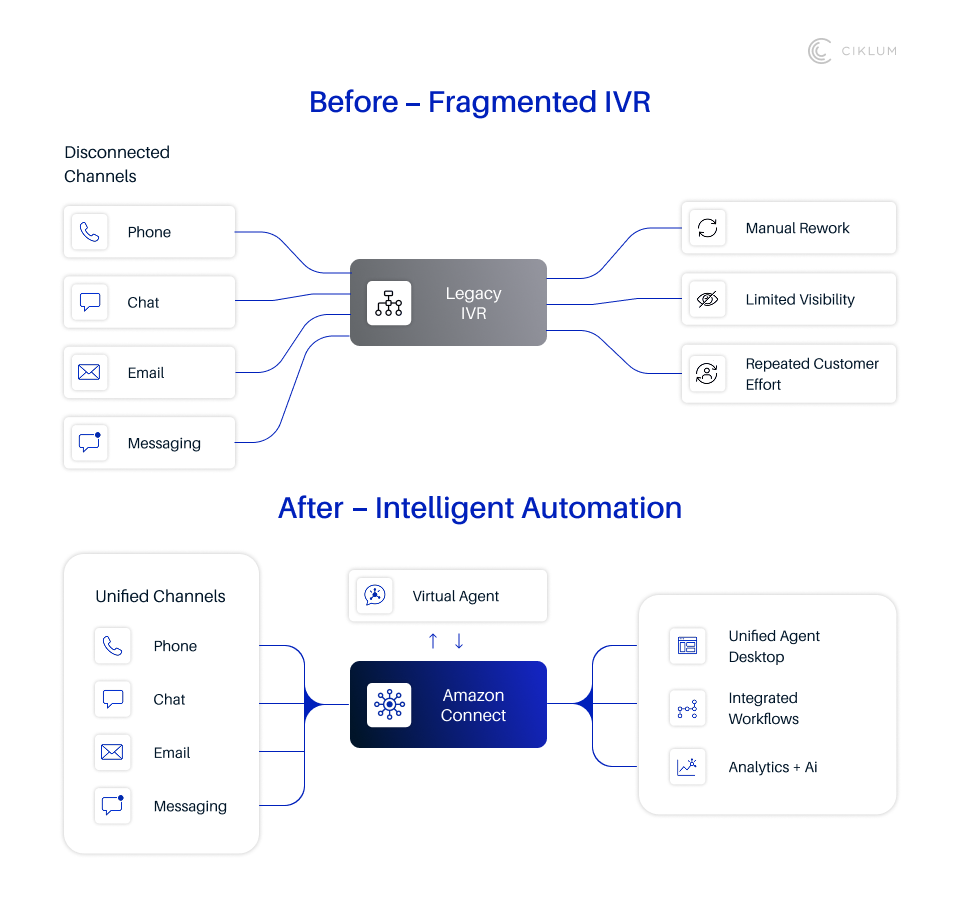
Without that shift, the IVR simply moves to the cloud, pilots remain disconnected, agents keep switching tools, and customers still repeat themselves. The platform is rarely the issue. The operating model is.
A modern contact centre transformation programme needs:
- experience design that defines where AI should resolve, assist, or escalate;
- platform architecture that avoids vendor bias and supports long-term flexibility;
- conversational and agentic AI designed for real workflows;
- enterprise integration across CRM, knowledge, identity, workforce, and reporting systems;
- data and analytics that measure resolution, containment, sentiment, QA, and cost-to-serve;
- governance, adoption, and change management so the transformation sticks beyond go-live.
Ciklum’s CCaaS practice proposal identifies this wider transformation requirement clearly, covering assessment and strategy, migration and implementation, AI-augmented agent experience, conversational AI and self-service, workforce management integration, and managed services / AI Ops.
How Ciklum Builds AI-Native Contact Centres
Ciklum approaches contact centre transformation as experience engineering, not platform deployment.
That means starting with the customer and agent journey, then engineering the cloud, AI, data, integration, and governance architecture needed to deliver it. Ciklum combines conversational AI, voice assistants, CRM integration, agentic workflows, omnichannel automation, RAG, analytics, and production-grade delivery into one transformation model.
Ciklum’s G&A Partners case study shows this model in practice. The company had fragmented channels, a legacy IVR that created compliance risk, unreliable transfer visibility, and limited service-level reporting. Ciklum helped modernise the environment with Amazon Connect migration, AI-driven virtual agent capability, a unified agent interface, live presence data, and real-time analytics.
Why Partnerships Matter in CCaaS Transformation
Best-in-class contact centres are built through ecosystems, not isolated tools.
Ciklum’s platform-agnostic approach means the architecture starts with the outcome, not the vendor relationship. Amazon Connect, Genesys, NICE, CRM platforms, workforce tools, analytics platforms, conversational AI layers, and data infrastructure can all play a role depending on the organisation’s needs.
Ciklum’s AWS Advanced Tier Services Partner status recognises its technical expertise, skilled certified professionals, and experience delivering cloud-based solutions. Ciklum is also an Authorised boost.ai Partner, strengthening its ability to design, deploy, and scale production-grade conversational AI in complex enterprise environments.
This matters because the future of CCaaS is not a vendor selection exercise. It is an integration, orchestration, and governance challenge.
In Summary: The Future Contact Centre Is Engineered, Not Installed
The contact centres that define customer experience in the next five years are being built now.
They will not be built by selecting the right platform alone. They will be built by treating the contact centre as a designed system where AI, people, data, channels, and processes are engineered together from the start.
CCaaS is becoming the operating layer for customer experience. Conversational AI is becoming the execution layer. Agentic AI is becoming the resolution layer. And the enterprise contact centre is becoming a source of intelligence, loyalty, and growth.
For UK enterprises, the opportunity is clear: move beyond migration, and build the AI-native contact centre.
Speak to Ciklum about building a contact centre that is intelligent, connected, measurable, and ready for the next generation of customer experience.

By Sarah Topping

Principal Lead - Intelligent Automation & Conversational AI
Sarah leads Conversational AI at Ciklum, spearheading AI-powered transformations in retail, publishing, and automotive. With a decade of experience, she develops award-winning virtual assistants and champions Responsible AI to enhance user experiences and operational efficiency.
Blogs
Discover Similar Insights

AI in Retail: Why Omnichannel Breaks Down — and How Agentic AI Fixes It
Learn More
What’s Holding Back Healthcare Software Innovation and How to Accelerate It
Learn More
How to Make Omnichannel Strategies Truly Improve Customer Experience
Learn More
Healthcare Digital Transformation Challenges: Why Programs Fall Short Post-Implementation
Learn More