



- Key Takeaways
- The Gap Between Ambition and Patient Impact
- Handoff One: From Concept to Compliant Product
- Handoff Two: From Compliant Product to Clinical Workflow
- Handoff Three: From Pilot to Operational Scale
- Handoff Four: From Single System to Healthcare Ecosystem
- In Summary
- Frequently Asked Questions
Key Takeaways
- Innovation doesn't fail at the idea stage. It fails at the handoff: The barriers are not a lack of ambition or budget. They sit at four specific transition points where promising technology stalls before reaching patients.
- Compliance is not the enemy of speed. Untreated compliance debt is: Building regulatory requirements into the development process early is faster than retrofitting them after the fact.
- Pilots prove the concept. They rarely prove the scale: The infrastructure, security, and operational design needed to run a healthcare software product for thousands of users is different in kind from what sustains a controlled trial.
- Clinical adoption is the last mile, and the most expensive: A product that is technically approved, clinically validated, and operationally deployed still fails if clinicians do not use it in actual care delivery.
The Gap Between Ambition and Patient Impact
Healthcare software is being built at a pace the industry has never seen before. Diagnostic AI, remote monitoring, agentic clinical assistants, predictive analytics, automated documentation: the concept pipeline is full. The gap between what is being built and what is reliably reaching patients and clinicians is widening just as fast.
McKinsey research on digital transformation in health systems finds that AI, machine learning, and deep learning could generate between two hundred and three hundred and sixty billion dollars in net healthcare savings. It also finds that roughly three quarters of health system executives believe their organizations' digital investments may be falling short of their potential. Both findings are true at the same time because investment is not the binding constraint. Execution at each transition point is.
The WHO's global health workforce projections add a second dimension of pressure. A projected global shortage of ten million health workers by 2030 means that software that gets stuck in procurement cycles, pilot programs, or compliance reviews is not just a missed business opportunity. It is a delayed solution to a clinical crisis that is already deepening. That pressure argues for solving the innovation handoffs, not for accepting them as permanent features of the industry.
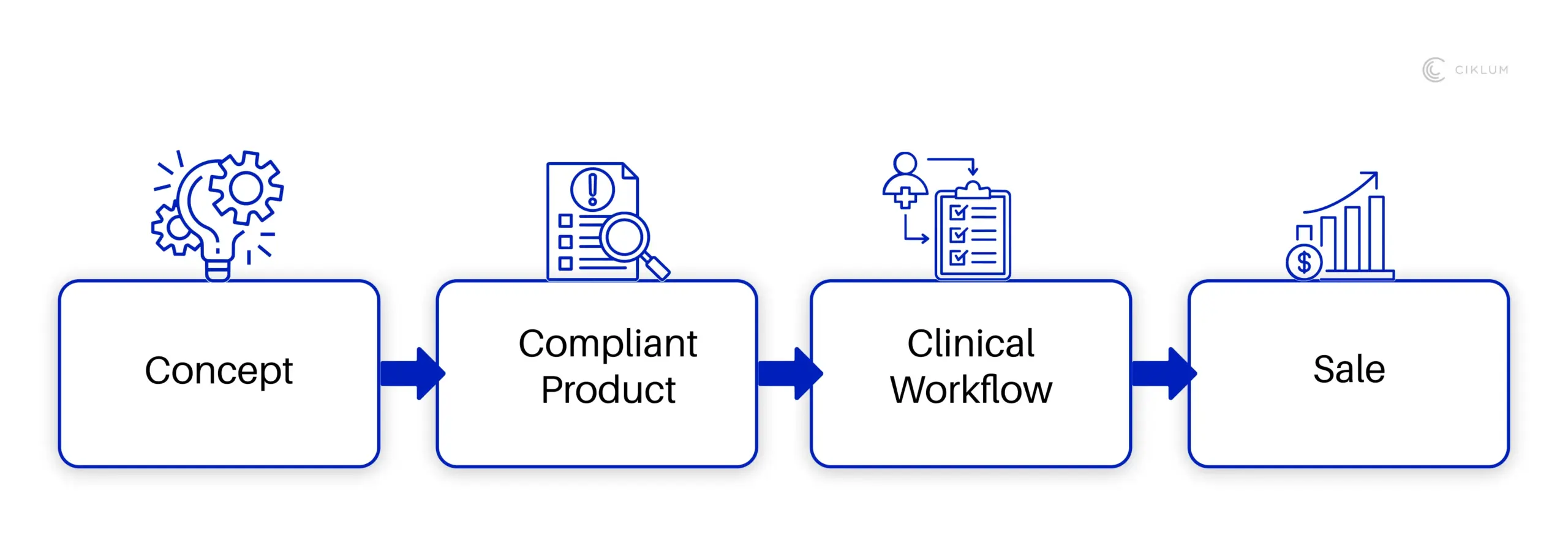
Handoff One: From Concept to Compliant Product
The first handoff is where the largest proportion of healthcare software projects stall or slow unexpectedly. Moving from a working prototype to a product that can be deployed in regulated healthcare environments requires navigating a regulatory landscape that most software teams are not prepared for at the concept stage.
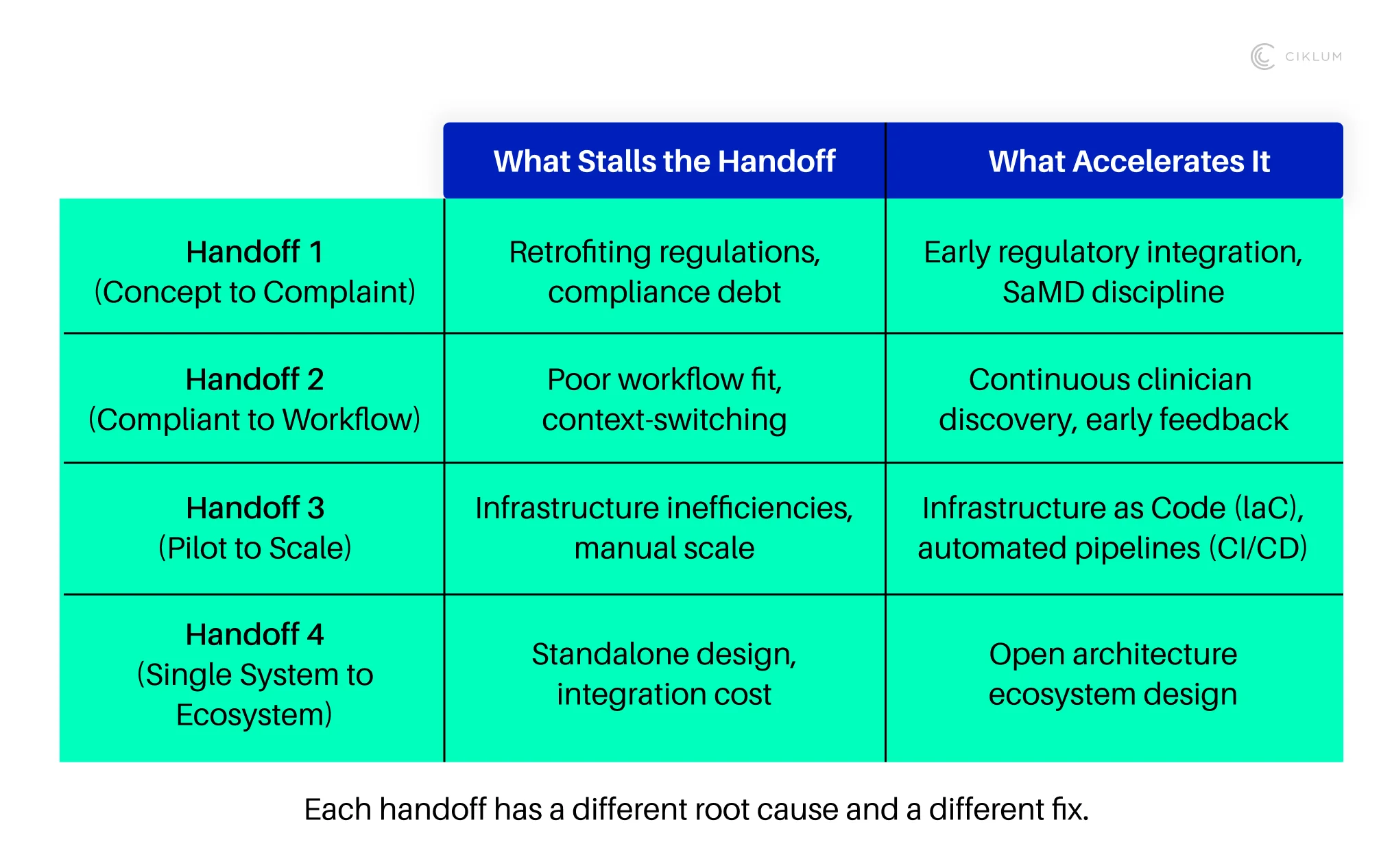
In the United States, software that delivers a clinical function is classified by the FDA as Software as a Medical Device. That classification triggers requirements under 21 CFR Part 820, IEC 62304, and the FDA's Digital Health Center of Excellence framework. These are not optional additions to a product. They determine how development is documented, how testing is conducted, how risk is managed, and how post-market performance is tracked. Teams that encounter these requirements after the product is built face months of retrofitting. Teams that encounter them at the design stage treat them as a development discipline rather than a compliance project.
Ciklum's analysis on digital assurance in medtech software frames this directly. Digital assurance is not a testing phase appended to development. It is the practice of embedding quality, compliance traceability, and risk control into every stage of the software development lifecycle, so that the path from working code to audit-ready product does not require a separate project. HIPAA-related barriers surface in a large proportion of healthcare AI implementations, most commonly around data de-identification and consent frameworks. Building those controls into the architecture from the start reduces both implementation delays and the downstream cost of compliance gaps.
Handoff Two: From Compliant Product to Clinical Workflow
The second handoff is less visible and harder to address with engineering alone. A product that clears regulatory approval still has to fit into the workflow of the clinician who is expected to use it. That fit is rarely guaranteed by the approval itself.
Clinical workflow is dense. Physicians and nurses work in environments with competing demands, time constraints, documentation requirements, and established habits built over years of practice. Software that adds steps, interrupts existing patterns, or requires context-switching between systems tends to be used inconsistently, worked around, or quietly abandoned. The adoption data reflects this. Even when tools are available, clinical use at the point of care consistently lags behind access rates.
The acceleration here is not a design problem, though design matters. It is a product development methodology problem. Healthcare software built with clinicians throughout the development process, not only at the requirements stage, tends to fit the workflow better because the people who will use it have shaped it. Continuous discovery rhythms, where product teams run regular structured sessions with clinical users and adjust based on observed behavior, compress the gap between what the software does and what clinicians actually need. This is where Ciklum's approach to reducing development time in healthcare produces compounding value: faster cycles mean earlier clinical feedback, which means fewer expensive corrections late in development.
Handoff Three: From Pilot to Operational Scale
The third handoff is the one the industry most consistently underestimates. Healthcare pilots are usually run on favorable conditions: a motivated team, a bounded patient population, a controlled environment, and direct access to the engineers who built the system. They produce encouraging results. They also create the false impression that what worked in the pilot will work at scale.
Scaling healthcare software introduces a different class of problems. Compliance obligations that were manageable in a controlled environment become infrastructure concerns at volume. Security vulnerabilities that were acceptable risks in a limited deployment become audit findings when the user base is in the thousands. Manual processes that held the pilot together, such as onboarding, monitoring, and incident response, cannot be operated by hand at scale.
Doxy.me, the world's leading telemedicine software provider, faced exactly this. Rapid growth exposed infrastructure inefficiencies, security risks, and compliance challenges that were manageable when the product was smaller but became critical at scale. Working with Ciklum, the team rebuilt the infrastructure using 100% Infrastructure as Code, automated CI/CD pipelines with HIPAA-compliant security validation at every stage, and deployed across multiple AWS regions to ensure availability and resilience. The result was a platform capable of serving over one million healthcare professionals across more than 180 countries without the compliance and operational risk the earlier infrastructure carried. The technology worked at pilot scale. The architecture did not. Rebuilding the architecture was the acceleration investment that made the scale possible.
Handoff Four: From Single System to Healthcare Ecosystem
The fourth handoff is the one that determines whether the product creates compounding value or ceiling-limited value. A healthcare software product that cannot exchange data with the systems around it, the EHR, the lab system, the pharmacy, the payer, the patient's devices, will always be limited to what its own data can support. In a care environment built on connected decisions, that is a significant constraint.
This handoff connects back to interoperability but is distinct from it. The question here is not whether a standard exists for exchange. It is whether the product was designed with ecosystem participation in mind, or designed as a standalone tool and then asked to integrate afterward. The second path consistently creates more technical debt, more integration cost, and more data quality problems than the first.
Where this handoff is solved well, the effects extend beyond the product itself. Ciklum's analysis on agentic AI in healthcare illustrates the ceiling that becomes available when the foundation is in place: AI that triages, routes, documents, and adapts based on connected patient data across systems, delivering outcomes that no single-system tool can approach. That ceiling is only accessible to products that cleared the ecosystem handoff.
In Summary
Healthcare software innovation rarely fails for lack of vision, resources, or technical expertise. Instead, it meets its biggest obstacles at the critical handoffs: (1) transforming a working prototype into a compliant product, (2) moving from regulatory approval into real clinical workflows, (3) taking pilots to reliable operational scale, (4) and evolving individual products into interconnected parts of the broader healthcare ecosystem. Each transition introduces its own unique challenges and success at one handoff does not guarantee success at the next.
The organizations that consistently make it through these inflection points do so by rethinking development fundamentals. Rather than treating compliance as a discrete hurdle at the end, they weave regulatory requirements and quality controls directly into design, coding, and deployment. They engage clinical users not solely during requirements gathering, but continuously, testing, observing, and iterating so each release fits the realities of frontline care. Anticipating scale, they invest early in robust, automatable infrastructure and security that can carry the load from pilot to production rather than patching weaknesses after failure. This approach is less about spending more, and more about building smarter and earlier for the realities ahead.
Finally, successful teams understand that healthcare is not an isolated software silo, but a connected ecosystem requiring products to communicate, share data, and reinforce one another’s value. They prioritize open architecture and ecosystem integration from day one, so products can seamlessly fit into care pathways, data exchanges, and patient journeys. In this way, the innovation’s potential is not limited by the boundaries of a single tool, but amplified through its connections.
Frequently Asked Questions
1. Why does healthcare software take so long to reach clinical use compared to other industries?
Three factors compound each other. Regulatory requirements for software that affects clinical decisions are significantly more demanding than in most other industries, which adds time to the concept-to-compliant handoff. Clinical workflows are more resistant to change than most software environments, which makes the adoption handoff harder. And healthcare infrastructure, often built on legacy EHR and data systems, creates integration complexity that slows both deployment and ecosystem connection.
2. How can compliance requirements be managed without slowing innovation?
By treating compliance as architecture rather than as a review stage. Teams that embed regulatory traceability, data governance, audit logging, and security controls into the development process from the start typically move faster overall than teams that build first and retrofit compliance afterward. The retrofitting phase is where most time is lost.
3. What is the most common reason healthcare pilots fail to scale?
The most common reason is infrastructure that was designed to support a controlled trial rather than production at volume. This shows up as manual onboarding processes, compliance automation that was not built into the deployment pipeline, and security configurations that were acceptable at small scale but become audit findings at larger ones. Designing for the scale you intend to reach, rather than for the pilot you are currently running, is the intervention that prevents this.
4. When is the right time to bring in external engineering support for a healthcare software program?
The highest-value windows are at the earliest design stage, where an experienced team can identify regulatory and compliance requirements before they become retrofitting problems, and at the transition from pilot to scale, where infrastructure, security, and operational design need to be rebuilt rather than extended. Both windows are cheaper to address proactively than reactively.
By Ciklum Editorial Team

Ciklum’s Editorial Board is a collective of experienced writers and industry experts, bringing together perspectives shaped by real-world engineering and delivery experience. Through collaborative insights, the team explores how technology, AI, and digital innovation move from concept to execution across industries.
Blogs
Discover Similar Insights

How to Make Omnichannel Strategies Truly Improve Customer Experience
Learn More
Healthcare Digital Transformation Challenges: Why Programs Fall Short Post-Implementation
Learn More
AI-Ready Data Infrastructure for Financial Services: A Practical Guide for UK Banks and Insurers
Learn More
Designing Scalable Software Architecture for High-Growth Products
Learn More