



Key Takeaways
- The 73/27 split: 73% of recent EHR go-lives land below the Arch Collaborative satisfaction average. Only 27% land above, and what separates them is operating model, not vendor choice.
- Sociotechnical, not technological: The biggest healthcare digital transformation challenges sit in training, governance, legacy integration, and workforce design. Replacing the vendor rarely fixes a program failing on those dimensions.
- Usability drives burnout: Mayo Clinic Proceedings graded EHR usability an F. Every 1-point improvement in usability score correlates with a 3% reduction in the odds of physician burnout.
- The post-go-live dip is real: Productivity typically stays below baseline for 4 to 12 months post-go-live. The 27% who cross the dip treat the first 24 months as an engineering program, not a handoff.
Healthcare Digital Transformation Is Now Decided After Go-Live, Not Before
For the past decade, most healthcare digital transformation conversations were about getting signed contracts, picked vendors, and a credible rollout plan. That phase is closing. Almost every large provider has now stood up a new EHR, rolled out a patient portal, and layered on AI-assisted tooling. The live question has shifted from whether to digitalize to what happens in the 12 to 24 months after the vendor leaves the room.
The data is unforgiving. In KLAS Arch Collaborative's 2025 analysis of recent EHR implementations, 40% of healthcare leaders reported "significant misses" in their rollout and another 22% reported average satisfaction with room for improvement (KLAS Arch Collaborative, 2025). Of 22 health systems that measured clinician EHR experience within two years of go-live, 73% scored below the Arch Collaborative average. Only 27% landed above.
Broader research reaches the same conclusion. A bibliometric review in the Journal of Business Research found that more than 80% of digital transformation initiatives end in failure, with "heightened vulnerability to failed transformation efforts" concentrated in the early adoption and post-implementation phases. Healthcare is not an outlier. It is a particularly expensive instance of the pattern.
The urgency behind this shift is hard to ignore. Post-implementation failure quietly reclassifies eight- and nine-figure investments as "platform cost" while clinician satisfaction, productivity, and measurable ROI drift below plan.
The Five Challenges Defining Healthcare Digital Transformation Post-Implementation
The challenges that actually decide whether a program reaches durable impact are a consistent five.
The Sociotechnical Gap
A 15-year evaluation of three national digitalization programs in the English NHS, covering £13 billion of investment and more than 1,000 interviews, concluded that "the most significant challenges were not technological but sociotechnical". Programs launched with inflated expectations, politically driven timelines, unstable governance, and drifting objectives. The technology worked. The program around the technology did not.
At ground level, that gap shows up as a clinician logging in to the new system to find the workflow unchanged from the one the rollout was supposed to redesign, with the administrative load that workflow automation was meant to lift still sitting on the same people.
The Training Cliff
Training is consistently one of the two weakest elements of the EHR experience in the US, and the one most tightly correlated with downstream satisfaction. After the cutover event, most organizations cut education sharply.
A counter-example from the KLAS case studies: Inova Health System launched an incentive-backed advanced education program and saw a 29% improvement in provider agreement that ongoing training was effective. Ochsner Health System, starting from a baseline where only 17% of providers felt proficient, redesigned onboarding and go-live education with Amplifire and moved providers into the 90th percentile for ongoing EHR education effectiveness (KLAS Arch Collaborative case studies, 2025).
The Governance Vacuum
Deloitte and the Scottsdale Institute's 2025 survey of US health system leaders found that 50% report gaps in accountability for tracking value, and 40% point to insufficient post-implementation audits as a top challenge, Only about half regularly assess the impact of a new system on consumer experience, workforce productivity, or clinician experience.
Deloitte calls this the tech value gap: health systems spend billions, track direct costs and savings, and leave harder-to-measure outcomes unmeasured. That is how the original business case quietly stops being validated.
The Legacy Integration Debt
Every large NHS evaluation flagged integration with legacy systems as a central constraint on progress. Intermountain Healthcare's published evaluation of its commercial EHR rollout saw productivity outcomes recover within 1 to 12 months, but some quality and safety measures never returned to baseline, in part because missing functionality was only identified once the system was operational.
The clean reference architecture in the business case rarely survives contact with the real estate. That gap is where deferred legacy modernization and HIPAA-compliant cloud work reappear as unplanned post-implementation spend.
The Measurement Blind Spot
Productivity impact is visible in peer-reviewed research, but most providers do not measure it. A Springer-published study found surgical case turnover time rose from 53.0 to 63.0 minutes in the first month after go-live and stayed elevated for five months. A separate study observed on-time operating-room first starts dropping from 64% to 41% in the first month, taking four months to recover. These drops are reproducible. They are almost never in the original benefits case, and they are usually invisible to the part of the organization tracking where AI is already producing measurable results in healthcare.
The Pitfalls Most Healthcare Organizations Still Fall Into
Even with the data in plain view, the same operating mistakes keep showing up inside healthcare digital transformation programs.
Treating Go-Live as the Finish Line
Many organizations declare victory on cutover day and dissolve the program structure that got them there. The board deck moves on. The frontline then spends 12 to 24 months absorbing productivity drag, clinician dissatisfaction, and silent value leakage.
Cutting Training the Moment the Vendor Leaves
Initial training is usually vendor-funded. Post-go-live education is not. When the cutover budget closes, so does role-specific training. Proficiency stalls where the learning curve left it, which is rarely where productivity is supposed to land.
Letting the Governance Team Dissolve
The implementation steering committee disbands. The executive sponsor moves on. The clinical informatics team shrinks. No one owns the workflow. When Deloitte reports that 50% of surveyed leaders flag accountability gaps and 40% cite insufficient post-implementation audits, these aren’t abstract numbers - they capture exactly what happens when program ownership is allowed to dissolve after go-live.
Deferring Legacy Integration to "Phase Two"
Integration work that looked inconvenient during the rollout gets pushed into a later phase that never gets funded at the same priority. The result is a new core system quietly supported by the same brittle bridges, now handling more traffic.
Measuring Implementation Cost, Not Clinical Value
Finance tracks the capital spend and the operating-cost delta. Clinician satisfaction, consumer experience, workforce productivity, and brand reputation do not show up on the same dashboard. The program is declared on-budget while clinician turnover rises and SLA compliance drifts.

The New Direction for Healthcare Digital Transformation
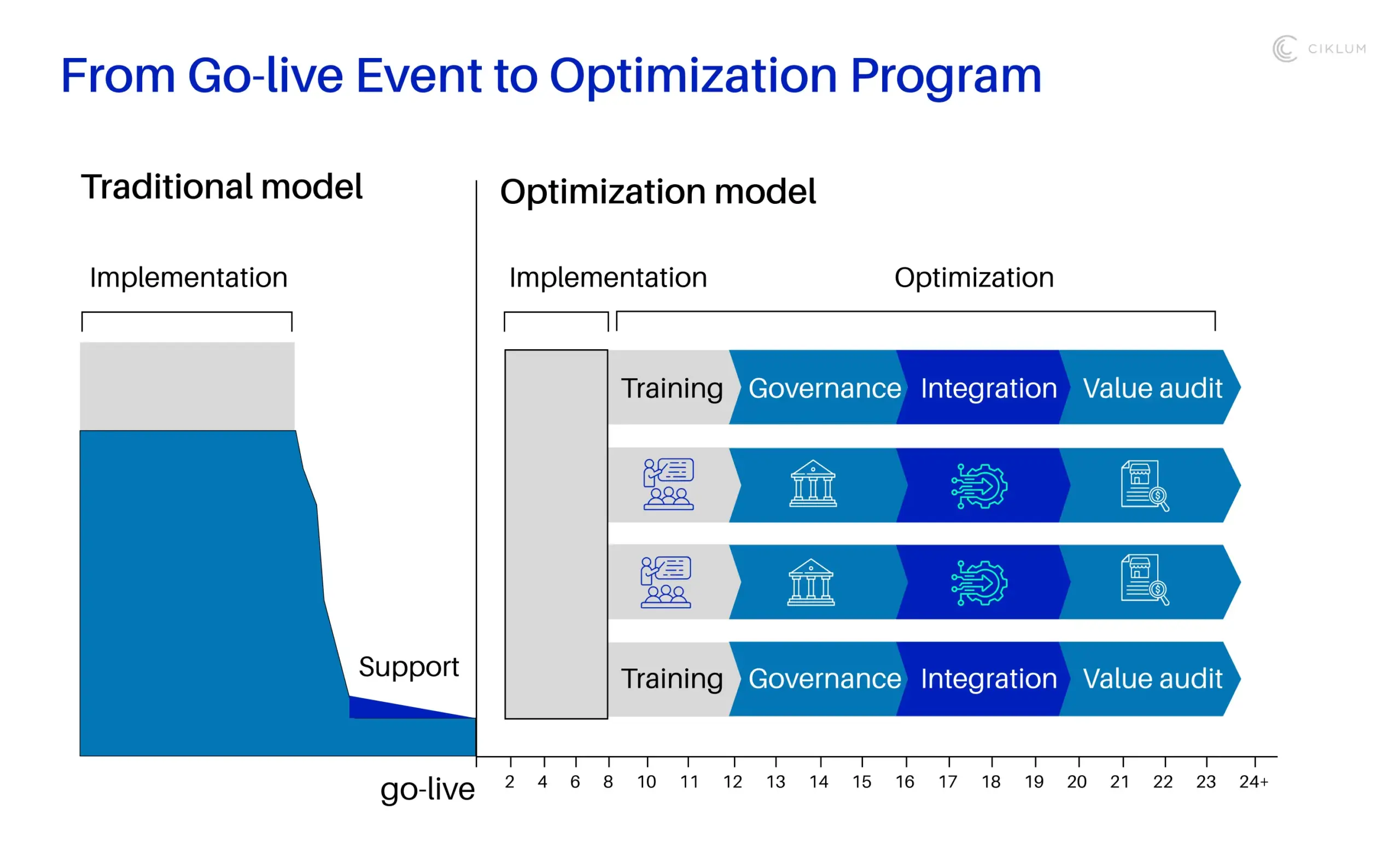
The 27% of providers who land above the Arch Collaborative satisfaction line after go-live share a recognizable operating pattern. None of it is about picking a better vendor.
They fund a separate optimization program that runs for at least 24 months after cutover, staffed with a named executive sponsor, a clinical governance board, and a working-level team. They keep training role-specific and ongoing. They adopt a value taxonomy that covers financial, clinical, consumer, and workforce outcomes, with explicit owners and quarterly reviews. They treat integration, interoperability, and compliance engineering as first-class workstreams rather than deferred scope.
The published examples are concrete. University of Oklahoma (OU) Health executed a big-bang Epic go-live in 2023 and treated it as the start of a three-year change program called Project Apollo, not the end of an implementation. By sustaining education, governance, and clinician engagement past cutover, OU Health reached the 84th percentile of Net EHR Experience Score. UTHealth Houston went live in May 2021 and, within three years, ranked in the 94th percentile of NEES, emphasizing both technical foundation and human support in equal measure.
The same operating pattern appears in engineering-led transformations outside the US: a global pharmaceutical company partnering with Ciklum automated the categorization of 400,000 audit findings as part of a long-running optimization program rather than a single rollout. That is the structural difference between programs that compound value and programs that stall.
Soon, this 24-month optimization posture will be the default operating model rather than the exception. Providers already on that trajectory are taking market share, in part because the same operating discipline is what lets AI agents start rewiring how clinical and operational work actually gets done. Those still treating go-live as the finish line are widening the gap on themselves.
In Summary
Healthcare digital transformation has moved from a rollout conversation to a post-implementation engineering conversation. Agentic support, sustained clinician education, value-based governance, and integration-first engineering are becoming the default components of the operating model that separates the 27% of providers who land above-average satisfaction from the 73% who do not.
With the right partner, providers can turn the post-implementation dip into a compounding optimization program. Ciklum's product engineering, data, and AI teams work with healthcare providers, payers, and life sciences organizations through exactly this phase. If you are ready to turn a recent go-live into measurable clinical and operational impact, our team is here to support your next step.
Frequently Asked Questions
1. How long does productivity stay below baseline after a healthcare digital transformation go-live?
Four to twelve months, depending on the workflow. Peer-reviewed studies show surgical case turnover time staying elevated for five months, on-time OR first starts taking four months to recover, and Intermountain's Cerner rollout showing most productivity measures returning to baseline within 1 to 12 months. Some quality and safety measures never fully recover. A program that has not budgeted for a full year below baseline has already mispriced its business case.
2. Is the main reason healthcare digital transformation fails the software itself?
No. The NHS three-program evaluation covering £13 billion concluded the most significant challenges were "not technological but sociotechnical." KLAS, Mayo Clinic Proceedings, and JAMA Network Open reach the same conclusion: training, team design, governance continuity, and EHR usability decide post-implementation outcomes. Replacing the vendor rarely fixes a program that is failing on those dimensions.
3. What is the single highest-ROI investment after go-live?
Sustained, role-specific clinician education paired with a governance structure that stays in place. KLAS case studies show double-digit satisfaction gains from structured post-go-live education. Mayo Clinic Proceedings data shows each 1-point improvement in EHR usability correlates with 3% lower odds of physician burnout.
4. When should a health system bring in external engineering support?
Two moments produce the highest ROI. The first is during post-implementation legacy integration, where the gap between reference architecture and the actual estate becomes visible. The second is when the organization adds an optimization layer (workflow automation, agentic AI, advanced interoperability) on top of the new core system without destabilizing it. Both require engineering bandwidth that in-house teams, still absorbing the rollout, usually do not have.
By Ciklum Editorial Team

Ciklum’s Editorial Board is a collective of experienced writers and industry experts, bringing together perspectives shaped by real-world engineering and delivery experience. Through collaborative insights, the team explores how technology, AI, and digital innovation move from concept to execution across industries.
Blogs
Discover Similar Insights

AI-Ready Data Infrastructure for Financial Services: A Practical Guide for UK Banks and Insurers
Learn More
The Buyer Shift: From AI Pilots to Agentic and AI-Enabled SDLC
Learn More
Designing Scalable Software Architecture for High-Growth Products
Learn More
The AI Operational Gap in BFSI: Why AI Strategies Are Failing To Deliver Business Value
Learn More