



Key Takeaways
Pilot purgatory is the dominant failure mode in enterprise AI: 88% of AI proofs of concept never reach production, 95% of generative AI pilots fail to deliver measurable ROI, and the share of organizations abandoning most of their AI initiatives rose from 17% to 42% in a single year. The buyer shift is a response to that failure rate, not a fashion cycle.
The new buyer wants governed agents, not another pilot: Roughly 42% of enterprises now have AI agents in production, 91% of CXOs plan to grow their agentic AI budgets in 2026, and Gartner forecasts 40% of enterprise applications will embed AI agents by the end of the year. The evaluation criterion has shifted from "AI capability" to "agent governance."
The SDLC is being reshaped, not just accelerated: Gartner predicts that by 2027, more than 65% of engineering teams using agentic coding will treat the IDE as optional, with governance and validation moving to automated platforms. The pattern shows up in productivity data too: AI coding tools produce 20% to 30% gains in well-bounded tasks, but only when the surrounding architecture, context, and review discipline are in place.
Procurement has rewritten its playbook: Year-one license fees are being replaced by 3-year TCO models that include inference costs, retraining, observability, and human-oversight labor. Buyers are negotiating exit rights, data portability, and self-serve sandboxes. Operational maturity now outweighs feature checklists on most vendor evaluation rubrics.
Most enterprise AI buyers in 2026 are not at the start of their AI journey. They are coming back to the table for the third or fourth conversation, looking at the pilots they ran in 2023 and 2024 that never reached production, and asking a very different set of questions. The vendors who keep selling like it is still 2023 are losing those deals. The ones who understand what changed are winning the deals that actually convert. This piece looks at what the buyer shift actually is, where it came from, and what it means for AI-enabled software development specifically.
The Pilot Purgatory Problem That Forced the Shift
The most useful place to start is the data on why so many enterprise AI programs failed to move past pilot. The numbers are not subtle. IDC's research with Lenovo, reported by CIO, found that 88% of AI proofs of concept never reach production, with only four out of every 33 pilots graduating to scale. MIT NANDA's analysis of generative AI puts the pilot failure rate at 95% on the same outcome measure. S&P Global Market Intelligence's 2025 survey, reported by CIO Dive, found that the share of organizations abandoning most of their AI initiatives jumped from 17% to 42% in a single year, with an average of 46% of proofs of concept scrapped before they reached production. RAND Corporation, in one of the more sobering assessments, found that over 80% of AI projects fail outright, roughly twice the failure rate of non-AI technology projects.
What forced the shift is that none of those failure modes were caused by the technology. MIT NANDA's own framing of the data is precise on this point: the divide between organizations that succeed and the ones that fail "does not seem to be driven by model quality or regulation, but seems to be determined by approach." Models perform well in the demo. They struggle the moment they meet real workflows, real data, real users, and real consequences. The pilot succeeds. The production deployment never happens.
McKinsey's State of AI research arrives at the same diagnosis from a different direction. McKinsey reports widespread enterprise use of AI, but only a small fraction of organizations have moved that use into production at scale. Only about 6% qualify as genuine AI high performers despite 88% claiming AI adoption. The high performers are not the organizations with the best models. They are the organizations with the operating discipline to take a model into production and keep it there.
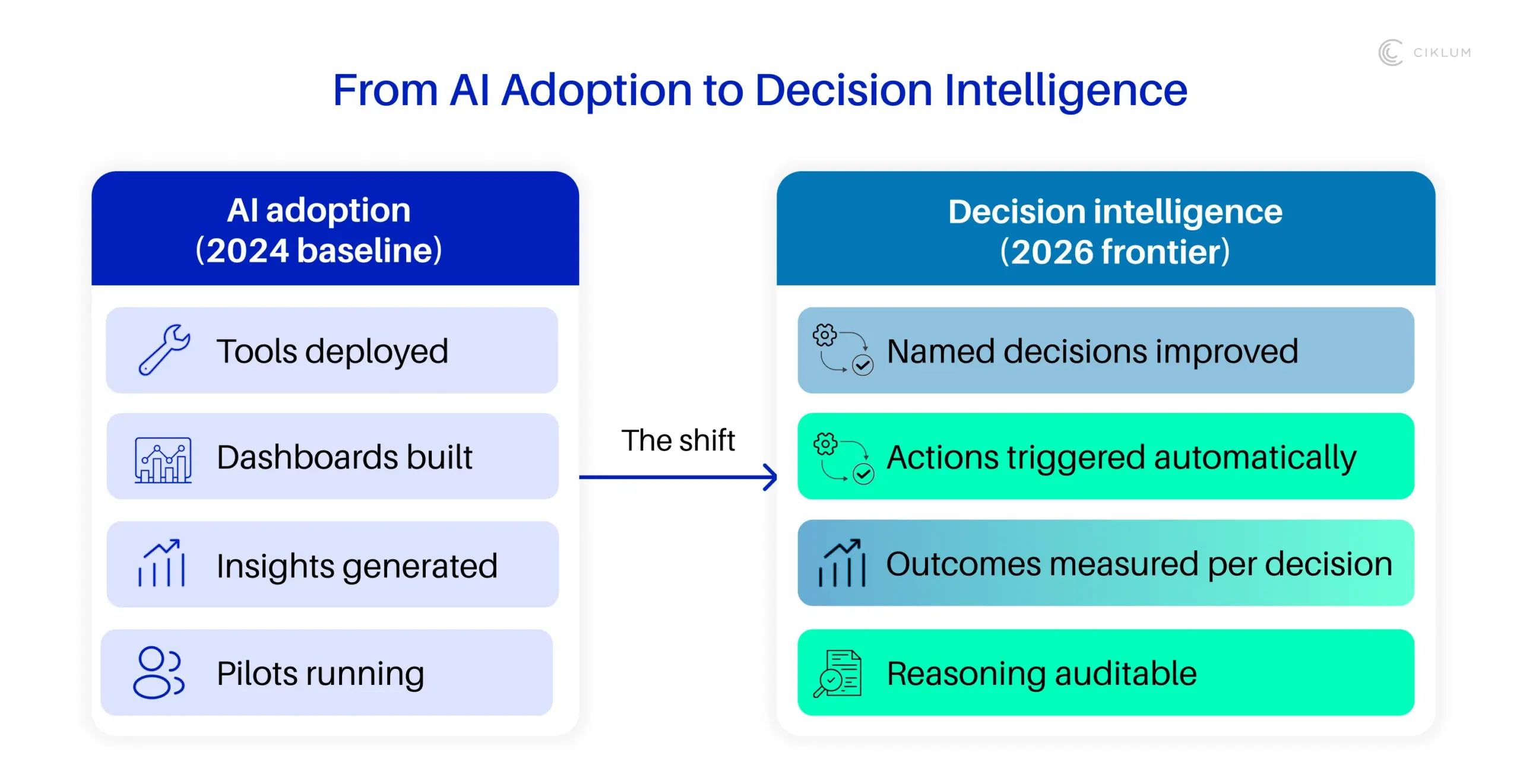
For buyers who lived through three rounds of this pattern, the lesson registered. The next conversation with a vendor is not about whether the AI can do something interesting. It is about whether the vendor can name a customer running the same capability in production, with measurable business outcomes, governed by something that looks like enterprise risk management. The buyer shift is a structural response to the 88% wall.
What the New Buyer Actually Wants
The shape of buyer expectations in 2026 has changed enough that the procurement playbook from two years ago no longer applies. Five things are now non-negotiable in serious enterprise AI evaluations.
The first is production references with measurable outcomes. A demo and a customer-logo slide are no longer sufficient. Buyers want to talk to a reference customer running the capability against real data, at scale, with a named business metric the system is moving. The bar is not "can it work." It is "is it working."
The second is a governance and control plane that is part of the product, not an afterthought. Buyers have lived through enough first-incident moments to know that the gap between "we have an agent in production" and "we have an agent we can defend in front of risk, legal, and the board" is wider than the gap between not having an agent at all and having one in production. Identity for every agent, deterministic guardrails, observable audit trails, kill switches, and human-in-the-loop on high-risk actions are no longer differentiators. They are entry requirements.
The third is total cost of ownership, modeled honestly over three years. Year-one license fees are no longer the headline number. Inference cost, retraining, observability, integration maintenance, and the human-oversight labor required to validate AI output add up to a multiple of the license fee over a credible time horizon. Buyers who skip that modeling discover the gap inside the first renewal cycle and lose budget credibility with finance.
The fourth is exit rights and data portability. Forward-looking AI agreements are being structured more like critical outsourced services than like software licenses, with defined transition periods, contractual transition assistance, run-off support, and export rights for training datasets, prompt libraries, evaluation sets, and configurations. The CIOs negotiating these terms have learned the hard way that walking away from an AI deal without portability is significantly more expensive than walking away from a SaaS deal.
The fifth is sandbox-first evaluation. The expectation now is that the buyer tests in their own environment, with their own data, before committing. Self-serve trials and dedicated proof environments have moved from "nice to have" to "required to be considered." Vendors without a sandbox are not in the deal.
From AI-Assisted to Agentic SDLC
The same shift is reshaping how AI shows up inside the software development lifecycle. The first wave of AI in the SDLC was assistive: an inline coding suggestion, a generated docstring, a unit-test scaffold. Useful, measurable, and bounded. The second wave is agentic: systems that operate across the lifecycle, take multi-step actions, use tools, call APIs, and produce outcomes the team verifies rather than line-by-line outputs the developer accepts or rejects.
Gartner's research on enterprise AI coding agents marks the moment the market is structurally changing. The report forecasts that by 2027, more than 65% of engineering teams using agentic coding will treat integrated development environments as optional, as governance, validation, and control increasingly move to automated platforms. The shift is from "tools that help developers write code" to "platforms that operate across the SDLC with developer oversight." Planning, coding, reviewing, testing, and deploying are all moving inside the same agentic surface, and the buying conversation is moving with them.
The productivity data on AI coding assistants gives a useful baseline for what to expect. A peer-reviewed series of randomized controlled trials published in Management Science, conducted by researchers from Microsoft, MIT, Princeton, and the Wharton School across 4,867 developers at Microsoft, Accenture, and a Fortune 100 manufacturer, found a 26% increase in completed tasks per unit time with AI assistance, with stronger gains for less experienced developers and in well-bounded tasks like boilerplate, scaffolding, refactoring, and test generation. That is the verifiable floor. The gains compound when the surrounding architecture, context, conventions, and review discipline are in place. They compress, or in some studies invert, when senior engineers use AI on complex tasks without rigorous review.
The agentic wave changes the math because the unit of work moves from "lines of code suggested" to "tasks completed end to end." That shift is what is forcing the SDLC question into the buyer conversation. An agent that opens a pull request, runs the test suite, evaluates the output, and only escalates to a human on exceptions is operating across what used to be six handoffs. The governance question follows immediately: how does the team know the agent did the right thing, how is its work auditable, and what is the rollback path when it does not.
Where AI-Enabled SDLC Actually Delivers in 2026
Once the buying lens shifts from feature checks to operating-model fit, the use cases that produce measurable value across the SDLC become recognizable. They are not the most ambitious. They are the ones with clean boundaries, low risk, and a reliable feedback loop.
AI-assisted execution on well-bounded tasks is the floor. Boilerplate generation, scaffolding new modules, scaffolding tests against existing code, refactoring within understood patterns, generating documentation, and translating between frameworks all show consistent 20% to 30% productivity gains in the published randomized controlled trial evidence and in subsequent vendor studies across team sizes. These gains are durable when the architecture is clean enough for the AI to operate on.
Agent-driven testing and quality engineering is where the productivity gains start to compound. Agents that read a pull request, generate the test cases the change should pass, run the suite, attribute failures to the right module, and only escalate the ambiguous cases to a human are operating across a stack of work that used to require three or four people. Test generation in particular has matured to the point where it is now a credible production capability rather than a research demo.
Observability and incident response is the next layer. Agents that watch dashboards, correlate signals across logs, traces, and metrics, draft a hypothesis when something breaks, and either fix it inside their guardrails or escalate to the on-call engineer with the analysis attached are starting to appear in mature SRE organizations. The economics are unusually clear here, because the alternative is paying senior engineers to do that work in the middle of the night.
Code review and architecture enforcement is increasingly part of the agentic surface. Architectural fitness functions, dependency boundary checks, and standards enforcement (the kind of work that used to require a senior engineer or a manual checklist) are running automatically on every PR. The agent does not replace the human reviewer. It catches the obvious violations so the reviewer's time goes to the parts that need judgment.
Knowledge transfer and onboarding is a quieter but high-leverage category. Agents trained on the team's codebase, conventions, and historical decisions can answer the questions that used to consume a senior engineer's afternoon every time a new hire joined. The retention benefit is hard to measure in a quarter. It shows up in delivery economics over a year.
The pattern across all of these is the same one that separates production agents from cancelled pilots: clear scope, clear handoff to a human on exception, clear instrumentation.
What Procurement Actually Looks Like Now
The procurement function has changed at least as much as the engineering function. CIOs and procurement leads who learned how to buy SaaS over the last decade are rewriting the playbook for AI, and the structural changes have implications for both buyers and vendors.
The total cost of the ownership model is being rebuilt. The 2026 enterprise procurement reality is that inference cost, retraining, observability, integration maintenance, and the human-oversight labor required to validate AI output add up to a multiple of the license fee. Procurement teams that arrive at the table with only the year-one fee modeled lose credibility with finance the first time the inference bill comes in higher than expected. The mature teams now require business units to model the three-year fully loaded cost before any AI contract is approved, including the labor cost of the people who will review and correct AI output.
Contract structure is changing in parallel. Consumption-based pricing with uncapped usage and automatic tier escalations is being replaced by negotiated tiers with clear escalation triggers, capped commitments, and renegotiation clauses tied to market conditions. Quarterly business reviews are being structured with teeth, so review outcomes drive pricing adjustments rather than slide presentations.
Exit rights have moved from a footnote to a first-class clause. The published guidance from law firms working on these deals is now explicit: AI agreements should be structured more like critical outsourced services than like software licenses, with defined transition periods, transition assistance as a contractual obligation, pre-agreed rates for migration support, run-off coverage, and clean export rights for training datasets, prompt libraries, evaluation sets, and configurations. CIOs negotiating these terms have learned that the cost of walking away from an AI deal without portability is significantly higher than walking away from a SaaS deal.
Build, buy, and the in-between are being weighed differently. The 2026 default for most enterprises is hybrid: buy the platform, own the data and the prompts, and keep the option to swap models. The build-versus-buy framing is being replaced by a build-the-governance, buy-the-capability framing. Even when the capability is bought, the evaluation, integration, and oversight layers are being built and held in-house, because the organizations who outsourced those layers in 2024 found themselves unable to evaluate, govern, or improve what they bought.
What Successful Buyers Do Differently
The organizations getting past the 88% wall in 2026 are not the ones with the largest AI budgets. They are the ones with a recognizable set of operating habits.
They run agent strategy as a decision inventory, not a tool roadmap. Every agent initiative has to name the specific business decision it improves, the metric it moves, and the cadence at which it is measured. Initiatives that fail that test do not get started. Initiatives that pass it are protected from the politics that usually kill agents in their first six months.
They invest in governance before scale. Every agent that goes into production has an identity, a policy boundary, an audit trail, a circuit breaker, and a kill switch. The control plane is built early, even when it feels disproportionate to the size of the first deployment, because the alternative is rebuilding it under pressure when the first incident happens.
They pick a single workflow and ship one production agent against it. The advice to "pick one workflow, not your most complex, not your most visible, but high-volume, well-understood, with clear success metrics" shows up in nearly every credible 2026 analysis of agent deployment, and it is the consistent first move of the organizations that come through the pilot stage successfully. A real production deployment with real users, real data, and real consequences teaches more in six weeks than a year of pilots does.
They embed agents in the SDLC the same way they embed any other production system. Source control, code review, environment promotion, observability, on-call rotation, incident response. The agent is not a magic appliance. It is software with probabilistic outputs that needs the same operating discipline the rest of the stack has.
They preserve exit optionality. Data, prompts, evaluation sets, and the institutional knowledge of how the agent was tuned all stay in-house, even when the platform and the model are bought. The capability debt that accumulates from outsourcing the understanding of what you bought is one of the most expensive forms of AI cost, and it is one of the easiest to avoid if it is planned for from the start. Ciklum's product engineering teams work with enterprises on exactly this layer, because the discipline that turns agentic AI into a durable operating capability is the same discipline that turns any platform investment into a durable operating capability.
Conclusion
The signature of a successful 2026 AI program is not a flagship launch. It is a quieter set of changes that the operating model now produces on its own. The roadmap stops being a list of pilots and starts being a list of governed agents in production. Each agent has a name, an owner, an outcome metric, and a published audit trail. Engineering throughput moves up while change failure rate stays flat. Procurement and finance can defend the TCO in front of the board without rehearsing. The line-of-business leaders who used to ask "when will AI actually do something for us" stop asking, because the answer is in the weekly numbers.
The pilot-to-production gap will not close on its own. The organizations that close it in 2026 are doing the unglamorous work of governance, evaluation, integration, and operating discipline that the 2024 generation of pilots skipped. The work itself is not new. It is what enterprise software engineering has always been, applied to a new class of probabilistic systems. The buyers who recognize that, and the vendors who can sell to it, are the ones building the businesses that will still be running these systems in five years.
Frequently Asked Questions
1. How is an "agentic" system different from an AI assistant or copilot?
Assistants and copilots suggest or generate outputs for users to accept step by step. Agents handle multi-step workflows, call tools, act in real systems, and deliver outcomes for humans to verify rather than directly edit. This shift means agentic AI is measured in completed outcomes, not tasks per hour, and demands higher governance.
2. How do enterprises move from pilot purgatory to production?
Select one well-defined workflow with clear success metrics. Build governance early (identity, policy, audit trail, kill switch, human oversight for high-risk actions). Instrument the workflow so metrics are observable on day one. Launch one real deployment. Six weeks of that usually teaches more than a year of pilots.
3. How has AI procurement changed in 2026?
Total cost of ownership now drives decisions, not just license fees. Contracts use negotiated tiers, exit rights, and clear data portability. Line-of-business leaders share or surpass CIOs/CTOs in influence, so vendors must address both technical and business outcomes.
4. Where does AI in the SDLC deliver value, and where does it add work?
Time savings are real in repeatable tasks: boilerplate, scaffolding, test creation, refactoring, docs, and code translation, especially for less experienced developers and in clean codebases. AI can create extra work in architectural changes or areas where validation takes longer than generating the output. Teams that see net gains invest in context, architecture, and discipline around the AI, not just the tool.
By Ciklum Editorial Team

Ciklum’s Editorial Board is a collective of experienced writers and industry experts, bringing together perspectives shaped by real-world engineering and delivery experience. Through collaborative insights, the team explores how technology, AI, and digital innovation move from concept to execution across industries.
Blogs
Discover Similar Insights

The AI Operational Gap in BFSI: Why AI Strategies Are Failing To Deliver Business Value
Learn More
AI Call Center for Banking: How Agentic Voice Is Transforming Financial Services Contact Centres
Explore the Banking Voice AI Guide
Inside PRODIGY: The Knowledge Engine Behind Enterprise AI
Explore How the Knowledge Engine Works
AI Governance in Practice: Why Enterprise AI Strategies Fail Before They Scale
Explore the Governance Guide