



- Key Takeaways
- The Productivity Problem Is Usually a Leak, Not a Talent Gap
- Leak 1: Work Enters Engineering Before It Is Ready
- Leak 2: Teams Wait for Decisions They Should Be Able to Make
- Leak 3: Engineers Repeat Work the Platform Should Absorb
- Leak 4: Testing Gives Feedback Too Late
- Leak 5: Releases Are Treated as Events
- Leak 6: Incidents Consume the People Needed for Product Work
- In Summary
- Frequently Asked Questions
Key Takeaways
- Productivity is a slow drain, not a sudden break. It leaks away through unclear work, avoidable waiting, duplicated effort, brittle testing, manual release control, and incidents that keep pulling senior engineers off planned work.
- Don't scale the leaks, audit first. More engineers added to a leaking system usually increase coordination cost faster than delivery capacity.
- Measure the flow, not just the frenzy. Lead time, deployment frequency, change failure rate, and time to restore service reveal more than sprint velocity or pull request count.
- Speed up a clean path, or clog the bottleneck. AI can accelerate parts of the software lifecycle, but only after the workflow is clean enough to absorb the speed. Otherwise, teams generate more code into the same bottlenecks.
The Productivity Problem Is Usually a Leak, Not a Talent Gap
When delivery slows, engineering leaders are often pushed toward visible fixes. Hire more developers. Buy an AI coding assistant. Add another agile ceremony. Bring in a new project management tool. Each move can help in the right context, but none solves the underlying problem if the system is leaking capacity.
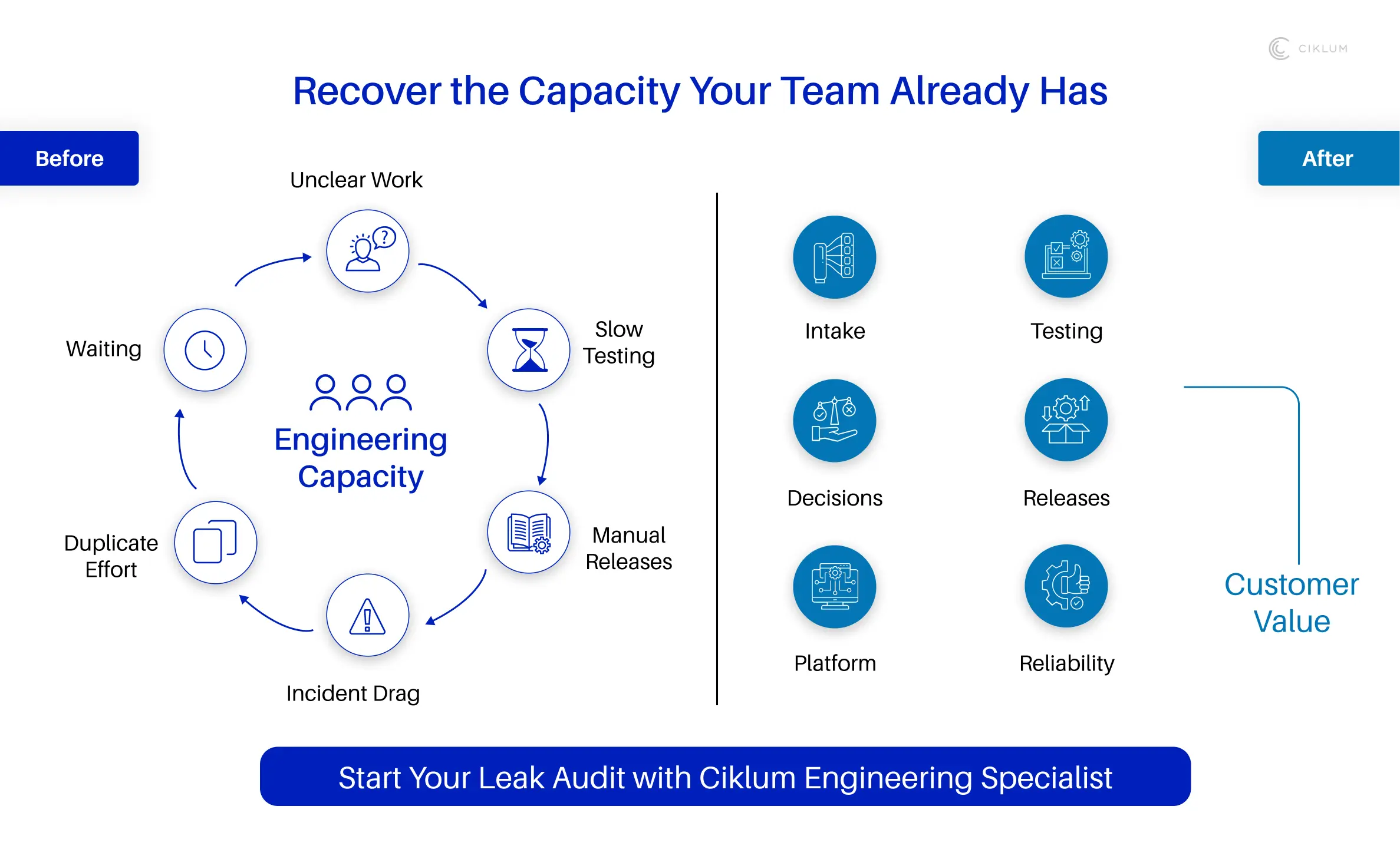
Capacity leakage is the difference between the engineering time a company pays for and the engineering time that reaches customer value. The gap is larger than most leaders expect. Some of it is visible: incidents, failed releases, meetings, rework. Much of it is not. A developer waits half a day for a clarification. A staff engineer answers the same deployment question for the fifth time this month. Two squads build overlapping functionality because ownership was unclear. A test suite takes long enough that engineers stop running it locally. None of those events looks like a crisis. Together, they become the operating model.
The DORA research program made this shift in measurement hard to ignore. High-performing software organizations are not defined by more visible activity. They are defined by faster, safer flow from change to production, measured through lead time, deployment frequency, change failure rate, and time to restore service. Those are not vanity metrics. They show whether capacity is reaching the customer or being absorbed by the system.
The productivity question, then, is not "how do we get engineers to do more?" It is "where is the system wasting the capacity they already have?"
Leak 1: Work Enters Engineering Before It Is Ready
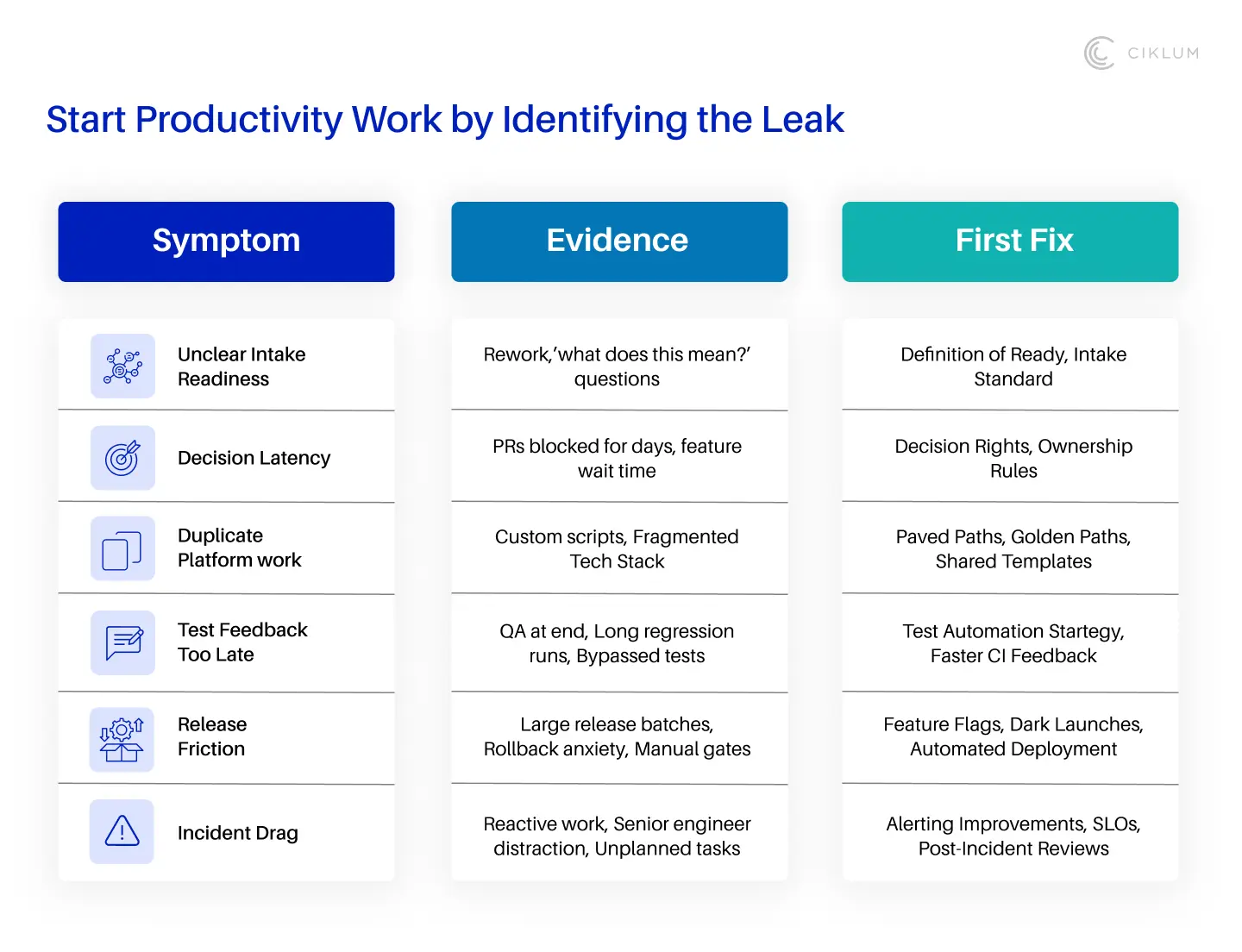
The first leak appears before development starts. Product ideas arrive as tickets, but the problem is underspecified, the acceptance criteria are vague, or the customer outcome is missing. Engineers make reasonable assumptions, ship against those assumptions, and discover later that the real need was different.
The fix is a readiness standard for engineering intake. Every meaningful work item should state the user or business problem, the constraints that matter, the acceptance criteria, the dependencies, and the metric that will prove the change worked. This does not require heavyweight documentation. It requires refusing to start work that has not yet earned engineering time.
This is where AI-assisted discovery can help, but only if leaders use it to clarify the problem rather than to generate tickets faster. Recent Ciklum analysis on AI across the software development lifecycle makes a useful distinction: AI creates the most durable productivity gains when it helps engineers reason about the "what" and the "why," not only when it accelerates the "how."
Leak 2: Teams Wait for Decisions They Should Be Able to Make
The second leak is waiting. Waiting for an architecture review. Waiting for a product decision. Waiting for another team to approve a dependency. Waiting for a senior engineer to resolve a disagreement that should have had an owner.
Decision latency is often hidden because it does not appear in source control. A pull request can look active while it sits blocked for three days. A feature can appear on track while the team waits for one unresolved trade-off. The cure is explicit decision rights. Teams need to know which decisions they own, which decisions require consultation, and which decisions require escalation. The rule should be written down, not stored in someone's memory.
This is one reason productivity work often overlaps with organizational design. The team topology has to make decisions cheaper. When every meaningful change crosses two or three team boundaries, productivity becomes a negotiation problem rather than an engineering problem.
Leak 3: Engineers Repeat Work the Platform Should Absorb
The third leak is duplicate effort. Every team writes its own deployment scripts, monitoring dashboards, authentication wrapper, data access pattern, or test harness. The work feels practical in the moment. Across an organization, it becomes an expensive tax.
The best engineering productivity investments often look boring: paved deployment paths, reusable CI templates, shared observability conventions, golden paths for new services, and documented patterns for common integrations. This is platform engineering at its most useful. It does not exist to centralize control. It exists to remove repeatable friction from product teams.
The platform should not abstract away engineering judgment. It should absorb the work that no product team should have to rediscover. When that line is drawn well, senior engineers spend more time on domain problems and less time answering the same operational questions.
Leak 4: Testing Gives Feedback Too Late
Testing is supposed to make work safer and faster. It becomes a productivity leak when it gives feedback too late to change behavior. A test suite that takes too long to run gets bypassed. Manual regression checks pile up before release. QA becomes a gate at the end of the process instead of a signal throughout it.
The remedy is not simply more automation. It is targeted automation around the riskiest and most repetitive checks. Seeking Alpha's work with Ciklum shows the impact clearly. The company needed to keep up with a growing product roadmap and rising user expectations. By implementing an automated testing framework, the team cut testing time by 50%, supported smoother releases, and strengthened security through mobile and web penetration testing. The productivity gain came from moving feedback earlier and making it cheaper to trust.
The lesson applies beyond financial services. A faster test suite changes engineering behavior. Engineers run checks more often. Reviewers trust the pipeline more. Release managers reduce manual verification. The whole system learns earlier.
Leak 5: Releases Are Treated as Events
The fifth leak appears when deployment becomes a special event. Large release windows, manual approvals, long coordination threads, and rollback anxiety all signal the same issue: the organization is packaging too much change into each release.
Large batches feel controlled because they are scheduled. In practice, they are harder to understand, harder to test, and harder to reverse. Smaller releases reduce blast radius and increase learning rate. They also force teams to improve the underlying release machinery: feature flags, automated deployment, smoke tests, rollback plans, and production monitoring.
The cultural shift matters as much as the technical one. Teams have to stop treating deployment as the finish line. Deployment is the moment the next feedback loop begins.
Leak 6: Incidents Consume the People Needed for Product Work
The final leak is incident drag. Every production issue pulls engineers out of planned work. The most damaging incidents pull senior engineers, because they are the people who understand the system well enough to recover it. If those engineers spend too much of the month in reactive work, the roadmap quietly loses its most important capacity.
Reliability work is therefore productivity work. Better alerting, clearer ownership, runbooks, SLOs, and post-incident learning all protect delivery capacity. They also prevent the same problem from being paid for twice: once during the incident and again during the delayed feature work.
In regulated or high-stakes environments, this matters even more. Ciklum's analysis of AI-driven engineering in healthcare shows how productivity gains have to be balanced with quality, compliance, and user trust. The same principle holds in every industry. Speed that increases operational fragility is not productivity. It is debt with a shorter fuse.
In Summary
The best ways to improve engineering team productivity begin with a leak audit - a deliberate investigation into where valuable capacity is being lost before it delivers customer value. Start by pinpointing the major places where capacity quietly drains out of the system: unclear engineering intake, waiting on decisions, repeat work that the platform should already provide, slow testing cycles, friction in the release process, and time lost to incidents and reactive work. By mapping these leaks, you can direct improvement efforts to the bottleneck closest to the flow of customer value, rather than dispersing energy on the latest trend or generic best practice. The aim isn’t to keep engineers busier for busywork’s sake; it’s to create a delivery pipeline where more of their problem-solving and engineering judgment actually reaches production reliably and safely.
To close these gaps, leverage targeted use of AI tools, mature platform engineering, focused test automation, improved observability, and thoughtful team design. However, none of these interventions should be rolled out as a one-size-fits-all “productivity solution.” Each should be aimed at a specific, identified leak, so that every investment translates to measurable improvements in flow, quality, and engineer morale. This disciplined, diagnosis-driven approach is how productivity work moves from vague aspiration to sustained, quantifiable throughput gains.

Frequently Asked Questions
1.What is the fastest way to identify the biggest productivity leak?
Measure elapsed time across the delivery path. Track when work is requested, when it becomes ready for development, when development starts, when CI passes, when review completes, when deployment happens, and when production feedback arrives. The longest wait usually points to the first leak worth fixing.
2.Should AI coding tools be the first productivity investment?
Not always. AI coding tools help most when the build phase is the bottleneck. If the bottleneck is unclear intake, slow decisions, weak tests, or manual releases, AI will generate work into the same constraint faster. Use AI where it shortens a named feedback loop, not as a blanket productivity answer.
3.How should leaders measure whether productivity is improving?
Use flow and reliability metrics together. Lead time and deployment frequency show whether work is moving faster. Change failure rate and time to restore service show whether speed is being achieved safely. Activity metrics can support the analysis, but they should not be the scoreboard.
By Ciklum Editorial Team

Ciklum’s Editorial Board is a collective of experienced writers and industry experts, bringing together perspectives shaped by real-world engineering and delivery experience. Through collaborative insights, the team explores how technology, AI, and digital innovation move from concept to execution across industries.
Blogs
Discover Similar Insights

Speed to Market: How to Accelerate Product Development Without Compromise
Learn More
How to Choose a Software Development Company in 2025
Learn More
Best Practices for Protecting Data on Connected Devices in Hitech
Learn More
The Impact of GIS Data on the Insurance Industry: A Strategic Framework
Learn More