



Key Takeaways
Speed is a system property, not a sprint: Hitting a launch date by working harder almost always pushes the cost into the next quarter as slower releases, more incidents, and team attrition. Durable acceleration comes from changes to the operating model that compound across releases, not from a one-time push.
Speed and quality are not a trade-off in the data: The most-cited evidence on this question, the State of DevOps research, shows elite performers deploying multiple times a day with sub-day lead times and recovering from failures in under an hour, while low performers move the other direction on every metric. The teams that ship fastest are also the ones that break things least.
The real speed leaks are queue time and discovery debt: Most launches that miss their date do not fail at execution. They fail at the handoffs, the work-in-progress pileups, and at the cost of building features that turn out not to be what customers wanted, which forces a second build pass to recover.
AI is a force multiplier, not the engine: 2026 data on AI-assisted development consistently lands at 20% to 30% productivity gains on specific tasks, concentrated in less senior developers and well-bounded work. The gains compound when the surrounding architecture, context, and review discipline are in place. Without them, AI accelerates the chaos.
The fastest product organizations in 2026 are not the ones that work the longest hours. They are the ones that have built an operating model where time spent waiting, redoing, and recovering has been engineered out of the work. That distinction matters because the conventional way of talking about speed to market still assumes a trade-off: ship faster, accept more risk; protect quality, accept a longer runway. The data has moved on from that framing. The product organizations pulling ahead are faster on every metric, including the ones that measure how often they break things. They got there by changing the system, not by squeezing the team.
The Speed Compromise That Isn't
The premise behind most speed-versus-quality conversations is that the two are inversely related: pulling one lever has to release the other. It is intuitively obvious. It is also, in practice, wrong at the level the conversation usually happens.
The 2024 State of DevOps report, now in its tenth year and drawing on more than 39,000 professionals globally, is the cleanest source on this. The elite performance cluster ships on demand, with change lead times under a day, change failure rates that stay in single digits or low double digits, and failed-deployment recovery times under an hour. The low cluster moves in the opposite direction on each of those metrics simultaneously. The two clusters are not making the same trade-off at different points along a line. They are operating on different systems entirely. The fast teams are also the stable teams.
What that means for product leadership is that "we cannot ship faster without breaking things" is usually a description of a particular operating model, not a law of nature. The teams that get faster while also getting more stable are doing something different at the level of how the workflows: smaller batches, faster feedback, automated checks at the points where humans used to be the bottleneck, and a discipline around what gets accepted as "done." None of that requires compromising on the things the conventional framing says must give. It requires compromising on the assumption that the current operating model is the only one available.
Where Speed Actually Leaks
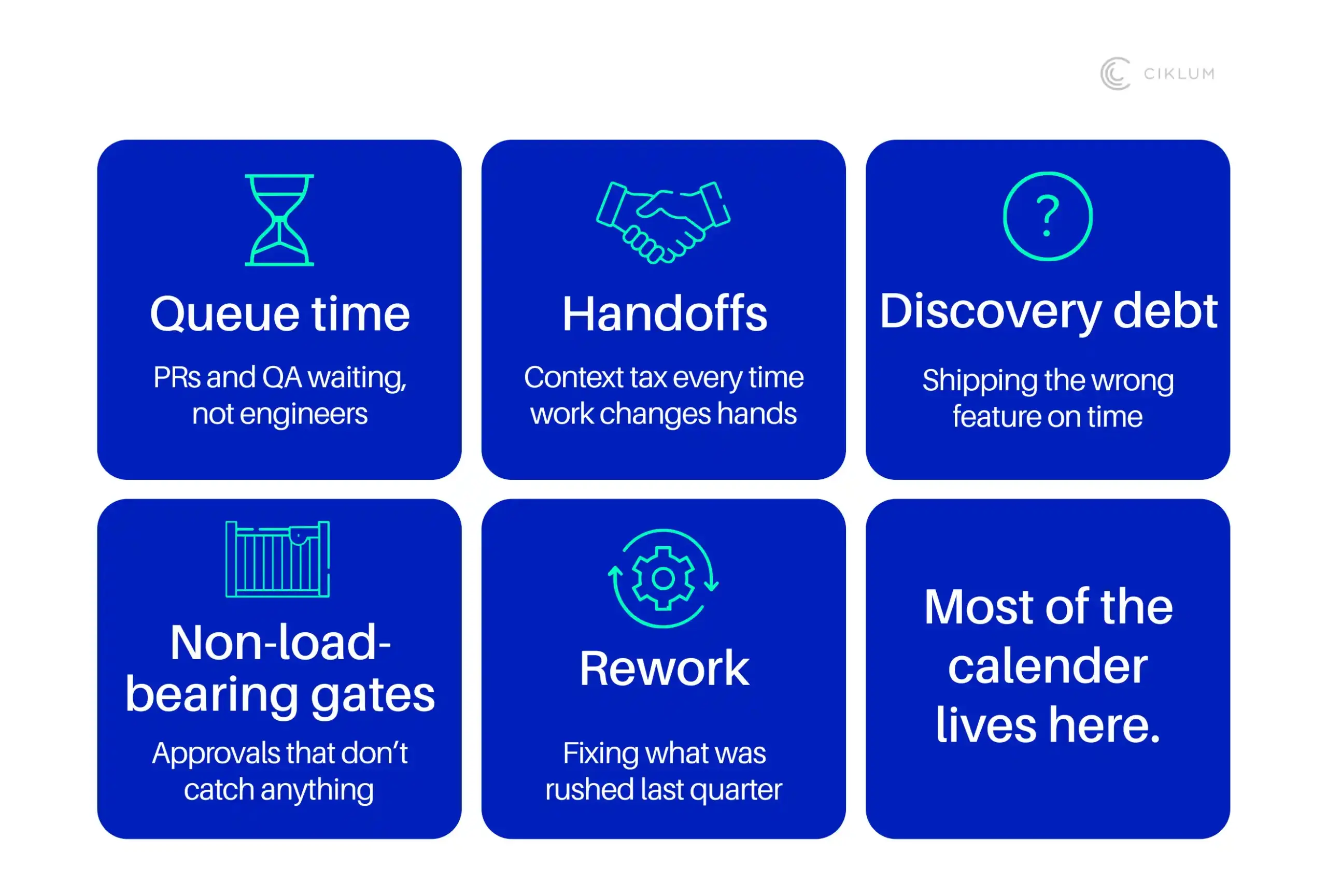
If the work itself is not the bottleneck, the next useful question is where the time goes. In most product organizations that have measured this carefully, the calendar gets eaten in five places, and almost none of them are in the writing of code.
The first is queue time between stages. A pull request waiting two days for review is two days the feature is not in front of customers. A QA queue that takes a sprint to clear is a sprint of work in progress that never becomes deployed work. The math here is the math of Little's Law: lead time equals work in progress divided by throughput, so the system with the most parallel work is the system with the longest waits, even if no individual stage takes longer than it should. Capping work in progress is the cheapest acceleration intervention available, and it is the one most teams skip.
The second is handoffs. Every time a feature passes between product, design, engineering, QA, security, and operations, there is a context tax on the receiving side and a re-explanation tax on the sending side. The compressed product development cycles described in modern dual-track operating models are designed almost entirely to attack this leak, by keeping a small trio (product, design, technical lead) inside the work from discovery through delivery rather than handing it off three times.
The third is discovery debt. This is the most expensive leak and the one that almost never shows up in delivery metrics. A team that ships a feature on time and then discovers the feature does not solve a real customer problem, has not actually shipped anything fast. It has just absorbed the cost of one launch and committed to absorbing the cost of a second one to fix the first. Continuous discovery, the practice of validating the next sprint's work while engineering ships the current one, is the systemic response. It costs around 15% to 30% of team capacity to operate properly, and the return is that the work entering the delivery track has evidence behind it rather than assumption.
The fourth is validation gates that are not load-bearing. Security reviews that take three weeks to confirm a result a tool could have produced in three minutes, release approvals that route through five people to sign off on a change none of them have technical context for, compliance checks that fire after the fact rather than as part of the build. Each of these started as a good idea. Each accumulates a tax that almost nobody recalibrates. The fastest teams audit their gates periodically and ask which ones are catching something.
The fifth is rework. Bug fixes for issues that escaped to production, refactors required to integrate something that was rushed in, the cleanup pass that happens when a release does not match what the customer expected. Rework time rarely appears on the original schedule, which is why the original schedule rarely holds. Teams that measure rework as a percentage of cycle time get a much more honest read on their actual delivery economics than teams that only measure new-feature throughput.
What Accelerates Without Compromising
Once the leaks are visible, the interventions that close them are well understood, even if they are not always politically easy to install. The teams that ship faster without trading quality use a recognizable handful of patterns, and very few of them have anything to do with new tools.
They run discovery and delivery in parallel rather than in sequence. The dual-track model keeps a small product trio one to two sprints ahead of engineering, running customer conversations, prototyping, and killing ideas that do not survive contact with evidence. By the time a feature enters the delivery backlog, it has a validated problem and a tested approach behind it. The delivery team builds without arguing about whether the feature is worth building, because that question was answered upstream.
They slice work vertically, not horizontally. A feature delivered as a thin end-to-end slice (front end, back end, instrumentation, deployment) goes to production in one batch and starts producing data within days. A feature delivered as a horizontal "do all the back-end work this sprint, do the front-end work next sprint" plan ships at the end of the second sprint at the earliest, and usually later than that once the integration surprises show up. Vertical slicing reduces both queue time and integration risk in the same move.
They commit to trunk-based development and feature flags. Long-lived branches are an integration debt machine. Trunk-based development with feature flags lets every change land in main quickly, while flags control which code paths are active for which users. Releases stop being release events and start being flag flips. The change failure rate drops because integration is continuous, and the recovery time drops because rollback is one flag change instead of a hotfix release.
They invest in the platform layer that makes the rest of this cheap. CI/CD pipelines, golden paths, internal developer platforms, and shared observability are not productivity perks. They are the difference between a stream-aligned team that can ship in a day and one that has to choreograph a release across half the company. Ciklum's cloud and DevOps engineering teams work with high-growth organizations on this layer specifically, because the platform investment is the leverage point that decides whether each new feature compounds the delivery economics or weighs them down.
They limit work in progress on purpose. Hard limits, not aspirational ones. Most teams that adopt actual WIP caps see lead time fall within four to eight weeks, without adding a single engineer, because queueing time was the dominant component of the original lead-time number.

The AI Question in 2026
No honest article on speed in 2026 can avoid the AI question, but it is also worth being precise about what AI is and is not doing inside delivery organizations.
The current data, drawn from multiple studies across Microsoft, MIT, Princeton, Accenture, and GitHub, lands consistently around a 20% to 30% productivity gain on specific coding tasks for teams using AI assistants competently. The gains are concentrated in less experienced developers, in well-bounded tasks like boilerplate, scaffolding, refactoring, and test generation, and in environments where the AI has good codebase context. The gains shrink, or in some studies invert, when senior engineers use AI on complex tasks without rigorous review, because the cost of validating AI output on hard problems is often larger than the time saved generating it.
The implication for speed to market is that AI is a useful accelerator inside a well-designed system and a noise generator inside a poorly designed one. The teams that get the most out of it have invested in the boring infrastructure first: clean module boundaries, documented conventions, a design system the AI can extend, instrumentation that lets reviewers verify what the AI produced. The teams that adopt AI as a shortcut around those investments end up shipping more code per developer and the same amount of working software per release, which is not the same thing as moving faster.
A working pattern shows up in the agentic field-engineering platform Ciklum built with a global automotive manufacturer. The platform put decades of vehicle knowledge behind an AI agent that diagnoses problems and recommends fixes on-site for field technicians. Diagnoses that used to take several days now take under an hour, support runs around the clock instead of inside UK business hours, and the program has saved more than $100 million. The acceleration came from a redesigned workflow with AI in the right place inside it, not from layering AI onto an existing process. Ciklum's AI agents and autonomous orchestration practice sits exactly where that combination matters: where the agent is a structural part of the operating model rather than a feature stapled on the side.
How to Build the Operating Layer That Sustains Speed
A one-quarter push to ship faster is not the same thing as a durable speed-to-market advantage. The companies that hold the advantage over years rather than months tend to share a few habits at the operating layer.
They invest in the infrastructure that lets every other speed intervention work. Infrastructure as Code, automated CI/CD, continuous monitoring, and HIPAA-grade or PCI-grade compliance controls built into the pipeline rather than bolted on at the end.
They measure speed honestly. Deployment frequency, change lead time, change failure rate, and time to restore service are the four numbers that move together if the operating model is healthy and diverge if it is not. Teams that track these continuously catch the operating-layer drag well before the roadmap surfaces it. Teams that only track features-shipped-per-quarter notice the problem when the next release slips by two months.
They preserve quality investment as a continuous allocation. Most product organizations that fall into a speed-versus-quality trade-off are running a quarterly rescue model: ship for three months, "stabilize" for one, repeat. The pattern produces consistent slips on both sides. The alternative, allocating roughly 15% to 25% of capacity to quality work every cycle (test coverage, deployment automation, observability, structural debt), is more boring and the data underneath it is clear: it produces faster lead times, lower failure rates, and a roadmap that holds. Ciklum's product engineering teams see the difference this allocation makes in delivery economics within a single quarter when organizations adopt it.
They tie product decisions to customer outcomes rather than to feature lists. The fastest way to ship the wrong thing is to commit a roadmap of features to stakeholders, then defend that list against the evidence as it emerges. Teams that commit to outcomes (a measurable customer-visible result, a regulatory deadline, a specific reduction in support volume) keep the flexibility to flex scope intelligently while protecting the date and the quality bar.
Summary: What Effective Acceleration Looks Like
The signature of a well-tuned speed-to-market operating model is not a dramatic launch. It is a steady cadence of unremarkable releases that produce measurable outcomes. Features ship multiple times a week. Change failure rate stays flat as throughput rises. New engineers contribute their first production change within their first two weeks because the module boundaries and the pipeline make the system legible. Customer-visible incidents stay scoped to the team that owns the service. Roadmap commitments stop slipping by default, because the system underneath them is no longer the variable holding the schedule together.
None of that requires sacrificing quality, cost, or scope. It requires accepting that the operating model is the product surface that decides everything else. The companies that get this right ship more, spend less per unit of working software, and build customer expectations they do not have to apologize for in the next quarter. That is what people usually mean when they describe a product organization as fast, even when they cannot articulate the operating model underneath.
Frequently Asked Questions
Q1: Is the speed-versus-quality trade-off real, or a myth?
The trade-off is real in individual decisions (cut a corner now, pay later), but mostly a myth at the operating model level. Organizations that ship frequently and with low failure rates do both because their system supports both. Most teams feeling trapped by the trade-off are really limited by their current process. Change the process, and new decisions become possible.
Q2: Where should a team start if they want to accelerate without rushing?
Begin by addressing work in progress and queue time. Both can be surfaced in a sprint, require no new tools, and quickly reveal the next bottleneck. Tackling these first makes every next step more targeted. Avoid overhauling everything at once - teams that do usually revert within a quarter.
Q3: How does AI fit into a speed-to-market strategy without introducing new risk?
In 2026, AI accelerates work best on well-defined coding tasks (like boilerplate and test generation) but is less reliable for architecture or multi-system changes. Teams seeing real gains combine AI with strong architecture, good context, and disciplined review. AI accelerates a clean system but can’t fix a messy one.
Q4: When does external engineering support compress the timeline?
Biggest impact comes from two places: platform engineering (where outside experts in CI/CD and Infrastructure as Code speed up what would otherwise take much longer) and the shift to dual-track delivery (where external perspective on WIP, slicing, and delivery cuts through internal friction faster). Bringing in help is often what unlocks the rest of the program for teams stretched thin.
By Ciklum Editorial Team

Ciklum’s Editorial Board is a collective of experienced writers and industry experts, bringing together perspectives shaped by real-world engineering and delivery experience. Through collaborative insights, the team explores how technology, AI, and digital innovation move from concept to execution across industries.
Blogs
Discover Similar Insights

Do More With Less: Boost Engineering Efficiency Without Adding Headcount
Learn More
Engineering Bottlenecks: How to Spot What’s Slowing You Down (and Fix It Fast)
Learn More
The Engineering Capacity Leak Audit: Where Productive Time Actually Disappears
Learn More
Understanding the True Impact of Technical Debt on Product Development Success
Learn More