



Key Takeaways
A bottleneck is one constraint, not ten problems: At any moment, one stage in your delivery flow sets the pace for everything else. Spreading effort across every team feels productive and rarely moves the date. Finding the single constraint and relieving it does.
The bottleneck is almost never where people are busiest: Busy engineers are a poor signal. The real constraint shows up as work piling up in a queue, waiting on a review, an environment, a decision, or one person who is the only one who knows.
You can see most bottlenecks in the flow, not the org chart: Lead time, where work waits, and how much is "almost done" expose the constraint before a slipping roadmap makes it obvious. The data is usually already in your tools.
The fastest solutions to engineering bottlenecks are straightforward: Cap work in progress, automate the gate that is not catching anything, shrink batch size, and break the single-person dependency. None of it needs a new platform purchase, and most of it shows results in weeks.
Every engineering organization has a bottleneck. That is not a sign of dysfunction. It is just how systems with multiple stages work. At any given moment, one part of the flow is slower than the rest, and that part decides how fast anything reaches customers. The dysfunction is not having a bottleneck. It is not knowing where it is.
Most teams respond to slow delivery by pushing harder everywhere. More sprints, more standups, more pressure on people who are already busy. It feels like progress and it usually changes nothing, because effort spent anywhere other than the actual constraint does not make the system faster. The useful skill is not working harder. It is spotting the one place that is slowing everything down and relieving it before moving on to the next one.
This article is a practical guide to doing exactly that. How to spot engineering bottlenecks quickly, where they tend to hide, and the engineering bottlenecks solutions that fix them fast without a six-month reorganization.
A Bottleneck Is One Constraint, Not Ten Problems
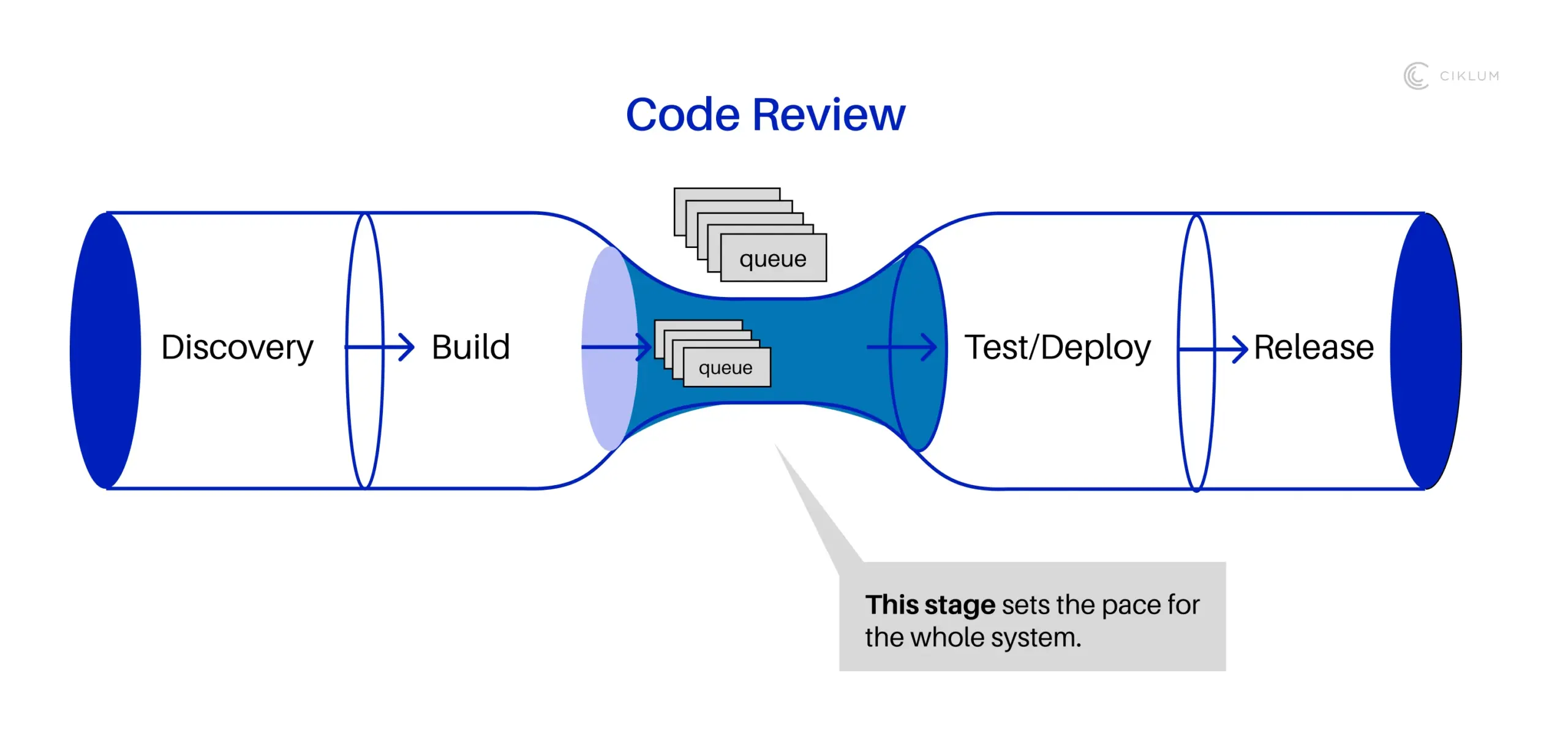
The most useful idea here is decades old and still ignored in most planning meetings. In any flow of work, throughput is set by a single constraint at a time. Improving any step that is not the constraint produces a local improvement that the system cannot use, because the work just waits longer at the real bottleneck instead.
That has a sharp practical implication. When a team lists fifteen things slowing it down and tries to fix them all at once, it spreads attention thin and the date barely moves. When it finds the one stage that paces the whole flow and focuses there, the whole system speeds up from a single fix. The work is not to optimize everything. It is to find the constraint, relieve it, and then look for the next one, because once you fix it, the bottleneck moves somewhere else. That is success, not failure. It means you are now limited by a faster stage than before.
This reframing also explains why busy does not mean blocking. The team writing the most code may feel like the hardest-working group in the building and still not be the constraint. If their output sits in a review queue for two days, the bottleneck is the review, not the writing. Effort is easy to see. Constraints are easy to miss. The whole skill is learning to look at the flow instead of the people.
How to Spot Engineering Bottlenecks Fast
You do not need a long study to find the constraint. You need to look at where work waits, not where people are busy. A few signals find it quickly.
Follow the Queue, Not the Effort
The fastest diagnostic is to walk a real piece of work from idea to production and mark how long it spent being worked on versus waiting. In most organizations the waiting dwarfs the working. A change that took two days to build sat four days in review, three days waiting for a test environment, and two more for a release window. The build was never the problem. The queues were. Wherever work stacks up and waits is your bottleneck, and it is usually obvious the moment you measure waiting separately from working.
Read the Flow Metrics You Already Have
The four delivery signals worth watching are lead time, deployment frequency, change failure rate, and time to restore. The DORA State of DevOps research has shown for years that these four move together in healthy systems and diverge in unhealthy ones, and the gap between top and bottom performers is enormous. You do not need elite tooling to read them. A rising lead time with flat deployment frequency points straight at a queue somewhere in the middle. The numbers are usually already sitting in your version control and CI tools, waiting to be looked at.
Find the "Almost Done" Pile
A reliable symptom of a bottleneck is a board full of items that are all ninety percent finished and none shipped. That pattern means too much work is in flight relative to what the constraint can absorb. When everything is almost done and nothing is done, the team is starting faster than the bottleneck can finish, and the items just queue. The pile points at the constraint directly. Whatever stage all those items are waiting to clear is the one slowing you down.
Spot the Single-Person Dependency
Some bottlenecks are people, not stages. If every meaningful change has to route through one architect, one reviewer, or the one engineer who understands the payments module, that person is the constraint no matter how fast everyone else moves. The signal is a calendar full of "waiting for X" and a recurring name in every blocked ticket. Knowledge concentrated in one head is one of the most common and least discussed engineering bottlenecks, precisely because it looks like that person being valuable rather than the system being fragile.
Where Engineering Bottlenecks Usually Hide
The specific stage varies, but the constraint tends to show up in a handful of familiar places. Knowing the usual suspects makes spotting faster.
Code review is the most common. Pull requests wait for attention because reviewers are busy building their own work, and the queue quietly becomes the longest stage in the pipeline. The work is done. It just is not reviewed.
Test and deployment environments are the next. When teams share a small number of staging environments, or when the path to production is a manual, multi-step ritual only a few people can run, every release queues behind it regardless of how fast the code was written.
Decision latency is a quieter constraint. When ownership is ambiguous and no one is sure who decides, work stalls in a "waiting for alignment" state that never shows up as a technical blocker but eats more calendar than any of them.
Cross-team dependencies are the bottleneck that hides between teams. A feature that looks like a two-week build sits behind another team's backlog, a security review, or a data change nobody scheduled. The dependency does not appear on one team's board, so it stays invisible until it slips the date.
Knowledge silos complete the list. When only one person can safely touch a system, that system becomes a bottleneck on every change that crosses it, and the organization mistakes the risk for seniority.
Engineering Bottlenecks Solutions That Fix Things Fast
Once the constraint is visible, the fixes are usually well understood and quick to apply. The point is to aim them at the actual bottleneck rather than spraying effort across the whole system. These engineering bottleneck solutions tend to show results in weeks, not quarters.
Cap Work in Progress on Purpose
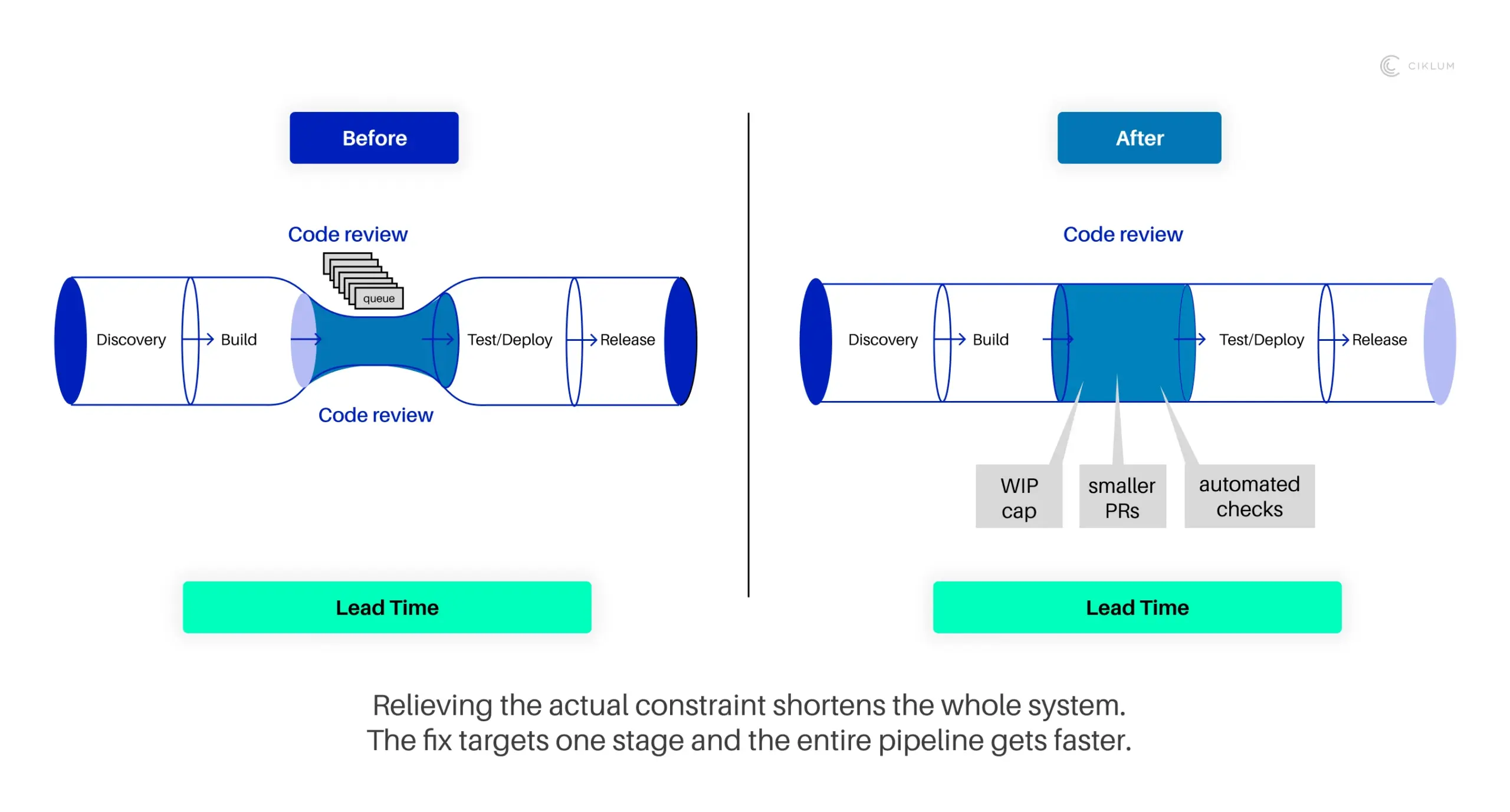
The single fastest intervention is also the least intuitive. Limit how much work is in flight at once. When a team starts fewer things, each one moves through the constraint faster, and the "almost done" pile shrinks because work is finished before new work is pulled in. Lead time usually drops within a few weeks of a hard work-in-progress cap, without adding a single person, because queue time was the dominant part of the delay all along. Most teams resist this because starting work feels like progress. Finishing work is the progress that actually counts.
Relieve the Review Queue
If code review is the constraint, attack the queue directly. Set an expectation that reviewing waiting work comes before starting new work. Make pull requests smaller so each review is faster and less daunting. Use automated checks to catch the mechanical issues so human reviewers spend their time on the judgment calls only they can make. Small batches and fast review feedback shrink the most common bottleneck in software delivery faster than almost anything else.
Automate the Gate That Is Not Catching Anything
Many bottlenecks are gates that made sense once and were never recalibrated. A security review that takes three weeks to confirm what a tool produces in minutes. A release approval routed through five people with no technical context. A manual deployment only two people can run. Automate the mechanical parts of these gates and reserve human attention for the cases that genuinely need it. Ciklum's cloud and DevOps engineering teams work with organizations on exactly this layer, because a paved, automated path to production removes the deployment bottleneck that quietly throttles otherwise fast teams.
Shrink the Batch
Large batches create bottlenecks by forcing everything to move together. A feature built as one giant change waits for one giant review, one risky deploy, and one slow integration. The same feature sliced into thin end-to-end pieces flows through every stage faster and surfaces problems early. Smaller batches reduce queue time and integration risk in the same move, and they make the bottleneck easier to see because work stops hiding inside oversized chunks.
Break the Single-Person Dependency
When a person is the constraint, the fix is to spread the knowledge, not to lean harder on them. Pair them with others on the critical system. Document the decisions that currently live only in their head. Broaden review and ownership so more than one person can safely make changes. This feels slower in the moment and pays off almost immediately, because the queue waiting on that one person disappears.
What Fixing the Right Bottleneck Looks Like
When the constraint is found and relieved, the change shows up fast and in the numbers, not just in the mood of the team. Lead time falls. Work that used to sit in a queue starts moving. The roadmap stops slipping by default because the system underneath it can actually absorb the work.
The same pattern shows up in engineering-led transformations. A global automotive manufacturer working with Ciklum restructured field engineering around stream-aligned teams supported by a shared platform. Diagnoses that previously took several days now take under an hour, support expanded from UK business hours to around-the-clock coverage, and the program saved a substantial sum. The constraint there was not effort. It was a workflow that funneled every diagnosis through a slow, specialist-dependent path. Relieving that one constraint changed the economics of the whole operation.
That is the lesson worth holding onto. The slowdown is rarely that people are not trying hard enough. It is almost always that one stage is throttling the rest, and the fastest path to faster delivery is finding that stage and fixing it, then doing it again when the bottleneck moves.
In Summary
Every delivery system has a bottleneck, and speed comes from finding the real one rather than working harder everywhere. The constraint is almost never where people look first, because busy is not the same as blocking. It hides in queues, in review, in environments, in decisions, in cross-team dependencies, and in the one person who knows the system nobody else can touch.
Spotting it is mostly a matter of watching where work waits instead of where people are busy. Fixing it is usually a matter of capping work in progress, relieving the review queue, automating the gate that is not catching anything, shrinking the batch, and breaking single-person dependencies. None of these engineering bottleneck solutions require a reorganization or a new platform, and most can deliver measurable improvements within weeks.
Ciklum's product engineering and DevOps teams work with organizations to read their delivery flow, find the constraint that is actually setting the pace, and relieve it without disrupting the work in progress. If delivery feels slow and the cause is not obvious, talk to our specialists about finding the real bottleneck before throwing more effort at the wrong one.
Frequently Asked Questions
1. What is an engineering bottleneck?
An engineering bottleneck is the single stage in a delivery flow that sets the pace for everything else. Because that stage is slower than the rest, work piles up behind it and improvements made anywhere else do not speed up delivery. There is always one constraint at any given time. When you relieve it, the bottleneck moves to the next slowest stage, which is a sign of progress rather than failure.
2. How do I find the bottleneck in my engineering team?
Follow a real piece of work from idea to production and measure how long it spent being worked on versus waiting in a queue. The waiting time usually points straight at the constraint. Flow metrics like lead time and deployment frequency confirm it, and an "almost done" pile of unfinished work is a reliable symptom of too much in-flight relative to what the constraint can absorb.
3. Why does adding more engineers not fix a bottleneck?
Because more people upstream of the constraint just produce more work that waits at the constraint. Adding engineers to a team blocked on code review, a shared environment, or a single decision-maker increases the queue rather than the throughput. The fix is to relieve the specific constraint, not to add capacity around it.
4. What is the fastest engineering bottleneck to fix?
Usually work in progress. Capping how much work is started at once forces the team to finish before starting more, which shrinks queues and lowers lead time within weeks, without adding headcount. It is also the cheapest intervention, since it requires a behavior change rather than new tooling.
5. When should we bring in external engineering support?
Two moments produce the highest return. The first is the diagnosis itself, where an outside read on the delivery flow cuts through the internal assumption that the busy team is the blocked team. The second is when the fix involves platform or pipeline work, such as automating the path to production, where engineers with prior experience can compress months of build time into weeks. Both need bandwidth that delivery-stretched in-house teams rarely have spare.

By Ciklum Editorial Team

Ciklum’s Editorial Board is a collective of experienced writers and industry experts, bringing together perspectives shaped by real-world engineering and delivery experience. Through collaborative insights, the team explores how technology, AI, and digital innovation move from concept to execution across industries.
Blogs
Discover Similar Insights

Speed to Market: How to Accelerate Product Development Without Compromise
Learn More
Exploring Chatbots in DevOps: The Future of Agile Workflows
Learn More
AI influence on the daily job of DevOps engineers
Learn More
Understanding DevOps services to Debunk Myths
Learn More