



Key Takeaways
Most teams do not need more people, they need their capacity back: The instinct when delivery feels slow is to hire. But a large share of every engineering team's capacity is already lost to toil, context switching, rework, and waiting. Reclaiming it is faster and cheaper than recruiting.
Adding headcount can make efficiency worse before it makes it better: New hires add coordination cost and onboarding load to a system that is already leaking capacity. Hiring into an inefficient operating model scales the inefficiency, not the output.
The biggest efficiency gains are tedious: Real engineering efficiency improvement comes from automating manual work, limiting work in progress, protecting focus time, and killing low-value tasks. None of it is exciting and all of it compounds.
Leverage beats labor: The teams that do more with less invest in platform, automation, and reuse, so each engineer's effort goes further. The goal is not harder work. It is higher leverage on the work already being done.
When delivery feels slow, the reflex in most organizations is the same. Ask for more engineers. It feels like the obvious lever, and it is the one most budgets are built to pull. The problem is that it is usually the most expensive answer to the wrong question, because the team is rarely short on people. It is short on the capacity those people already have, which is quietly leaking away into work that creates no value.
That is the uncomfortable but useful starting point for any real engineering efficiency improvement. A large share of every team's time goes to toil, context switching, meetings, rework, and waiting. Those losses do not show up on the roadmap, so the natural conclusion is that the team is too small. More often the team is the right size and the operating model around it is wasting a third or more of what it can do. Fix that, and you get the equivalent of several new hires without adding anyone.
This article looks at where engineering capacity actually goes, why adding headcount often fails to fix the problem, and the practical moves that let a team do more with the people it already has.
More People Is the Expensive Answer to the Wrong Question
Adding engineers feels like adding output. In a system that is already running cleanly, it can be. In a system that is leaking capacity, it usually is not, because the new people inherit the same inefficiencies as everyone else and add coordination cost on top.
Every new hire increases the number of communication paths, the onboarding load on senior engineers, and the contention for the same review queues, shared environments, and decision-makers that were already constrained. If those constraints are what is actually slowing the team down, more people make them worse, not better. The team grows, the cost grows, and the output barely moves. This is the trap organizations walk into when they treat a structural efficiency problem as a staffing problem.
The more honest question is not "how many more engineers do we need" but "how much of our current capacity are we losing, and where." That question is uncomfortable because the answer implicates how the work is organized rather than how many people are doing it. It is also the question that leads to durable engineering efficiency improvement, because reclaimed capacity arrives immediately, costs almost nothing, and does not add the coordination overhead that hiring does. Our view on the role of product engineering in supporting business growth makes the same point from the business side. Engineering value comes from how the work is structured, not simply from how many people are doing it.
Where Engineering Capacity Actually Goes
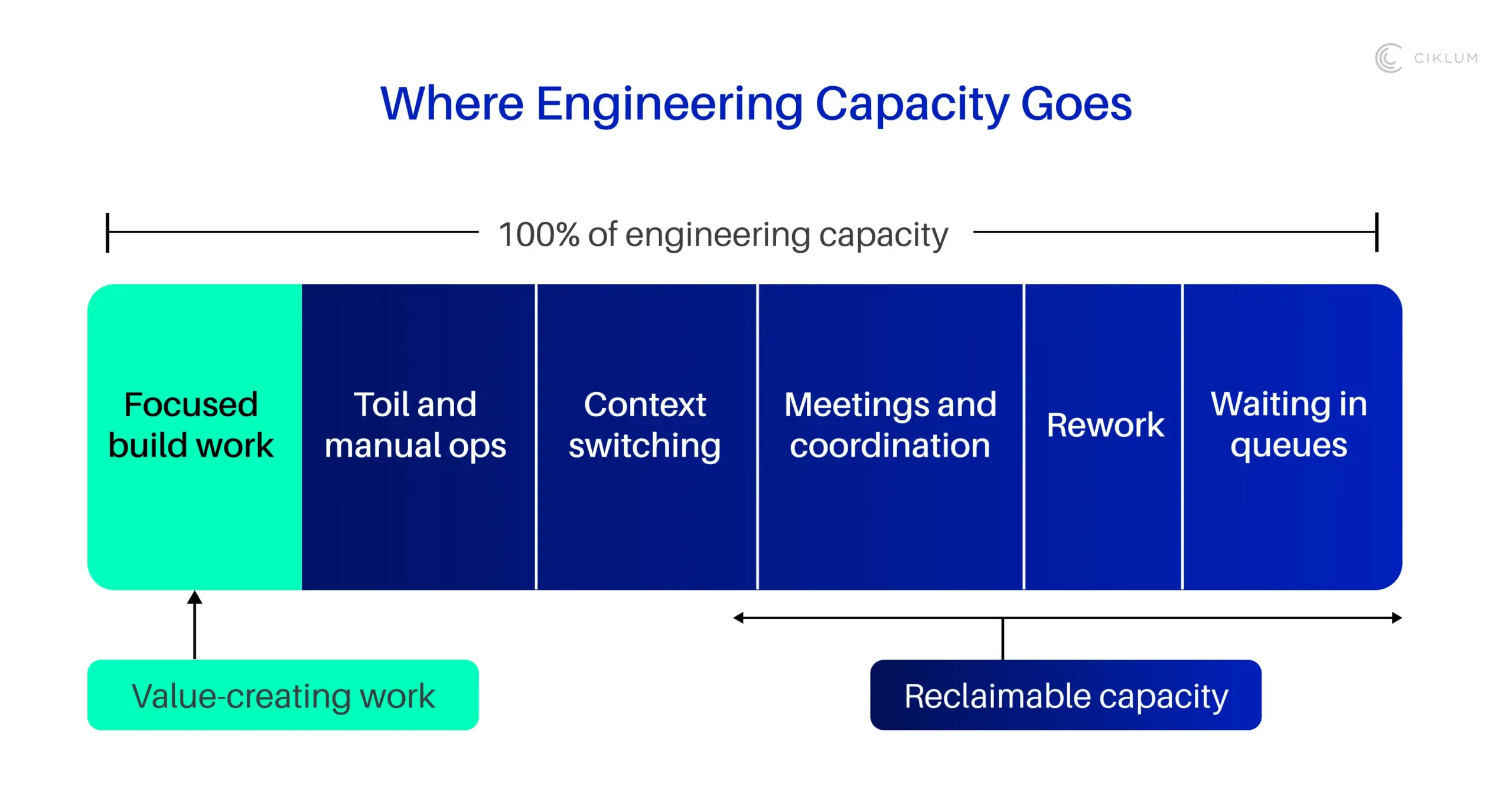
The capacity leaks are consistent across teams. They cluster in a few places, and once you know where to look they are not hard to find.
Toil and Manual Operations
Engineers spend a surprising amount of time on repetitive manual work that a machine should handle. Provisioning environments by hand. Running manual deployment steps. Cutting releases through a checklist only a few people understand. Chasing the same recurring incidents. This toil feels like real work because it is effortful, but it produces nothing durable and it scales linearly with the team. Every hour spent on it is an hour not spent building.
Context Switching and Too Much Work in Progress
When engineers juggle several things at once, the switching cost is enormous and invisible. Each switch carries a reload tax as the brain rebuilds context, and a team running too much work in parallel pays that tax constantly. The result is a team that is always busy and rarely finishing, where everything is in progress and little is done. The capacity is not missing. It is being shredded across too many simultaneous threads.
Meetings and Coordination Overhead
Some coordination is necessary. Most teams have far more than they need. Status meetings that could be a message. Standing calls that outlived their purpose. Decisions that stall because no one is sure who owns them, so they get re-litigated across multiple meetings. Coordination overhead grows quietly as the organization grows, and it eats the contiguous focus time that real engineering requires.
Rework From Quality and Clarity Gaps
Work that has to be redone is pure capacity loss. Bugs that escaped to production. Features built from ambiguous requirements that missed what was actually needed. Refactors forced by something rushed in the last quarter. Rework rarely appears on the plan, which is why plans slip, and it consumes capacity that looks like new work but produces nothing new.
Waiting in Queues
A great deal of engineering time is spent not working but waiting. Waiting for a code review. Waiting for a shared test environment. Waiting for another team, a security sign-off, or a decision. The engineer is available and the work is blocked, so the capacity simply evaporates. Queue time is one of the largest and least visible drains, because it does not look like anyone is doing anything wrong.
Why the Drains Stay Invisible
The reason these leaks persist is that none of them look like waste in the moment. Toil looks like diligence. Context switching looks like responsiveness. Meetings look like collaboration. Rework looks like new work. Waiting looks like a normal process. Each one is individually defensible, which is exactly why they accumulate unchallenged.
The aggregate effect is a team that feels fully utilized and is mostly busy doing things other than building. That is the gap between headcount and output, and it is why adding more people rarely closes it. The capacity was never missing. It was being spent on work that does not count, and no amount of hiring recovers capacity that the operating model keeps draining.
How to Boost Engineering Efficiency Without Adding Headcount
Once the leaks are visible, the moves that close them are well understood. None of them require recruiting, and most of them show results within weeks.
Automate the Toil
The highest-leverage move is to take the repetitive manual work off engineers entirely. A paved, automated path to production, reproducible environments, and self-service tooling remove the toil that scales linearly with the team and free that capacity for work that compounds. Ciklum's cloud and DevOps engineering teams work with organizations on exactly this layer, because automating the deployment, environment, and operational toil is often the single biggest source of reclaimed capacity available to a team. For teams weighing where to start, our breakdown of the common myths and facts about DevOps is a useful reality check on what automation actually delivers and what it does not.
Limit Work in Progress
Cap how much work is active at once. Counterintuitively, doing fewer things at a time gets more done, because the team stops paying the constant context-switching tax and starts finishing work before pulling in more. A hard work-in-progress limit usually shows up as faster delivery within a few weeks, with no change to headcount. It is the cheapest efficiency intervention available, because it costs only a change in habit.
Protect Focus Time
Real engineering requires uninterrupted blocks of concentration. Audit the meeting load and cut the coordination that does not earn its place. Clarify decision rights so decisions get made once instead of re-litigated across calls. Defend contiguous focus time as a first-class resource, because fragmented time produces a fraction of the output that focused time does.
Kill Low-Value Work
Some of the most effective efficiency gains come from stopping work entirely. Features nobody uses but everyone maintains. Reports no one reads. Processes that outlived their reason. Every piece of low-value work consumes capacity that could go to something that matters. The discipline of regularly asking what the team can stop doing is one of the most underused levers in engineering.
Use AI Where It Compounds, Not Where It Distracts
AI assistance can be a genuine efficiency multiplier on well-bounded work, scaffolding, boilerplate, test generation, and documentation, especially when the codebase is clean enough for the tooling to work with good context. The gains are real where the surrounding system is well-designed and shrink where it is not. The teams that benefit treat AI as leverage on a clean foundation rather than a shortcut around a messy one. Ciklum's AI agents and autonomous orchestration practice focuses on putting automation where it structurally raises throughput rather than where it just adds noise, and our primer on how AI agents are reshaping task automation and productivity is a good starting point for teams deciding where agentic automation actually earns its place.
Reuse Instead of Rebuild
Teams quietly lose capacity rebuilding things that already exist. Shared libraries, internal platforms, common services, and golden paths let engineers reuse solved problems instead of solving them again. Investing in reuse means each new piece of work starts further along, which raises the leverage of every engineer without adding any.
What Doing More With Less Looks Like
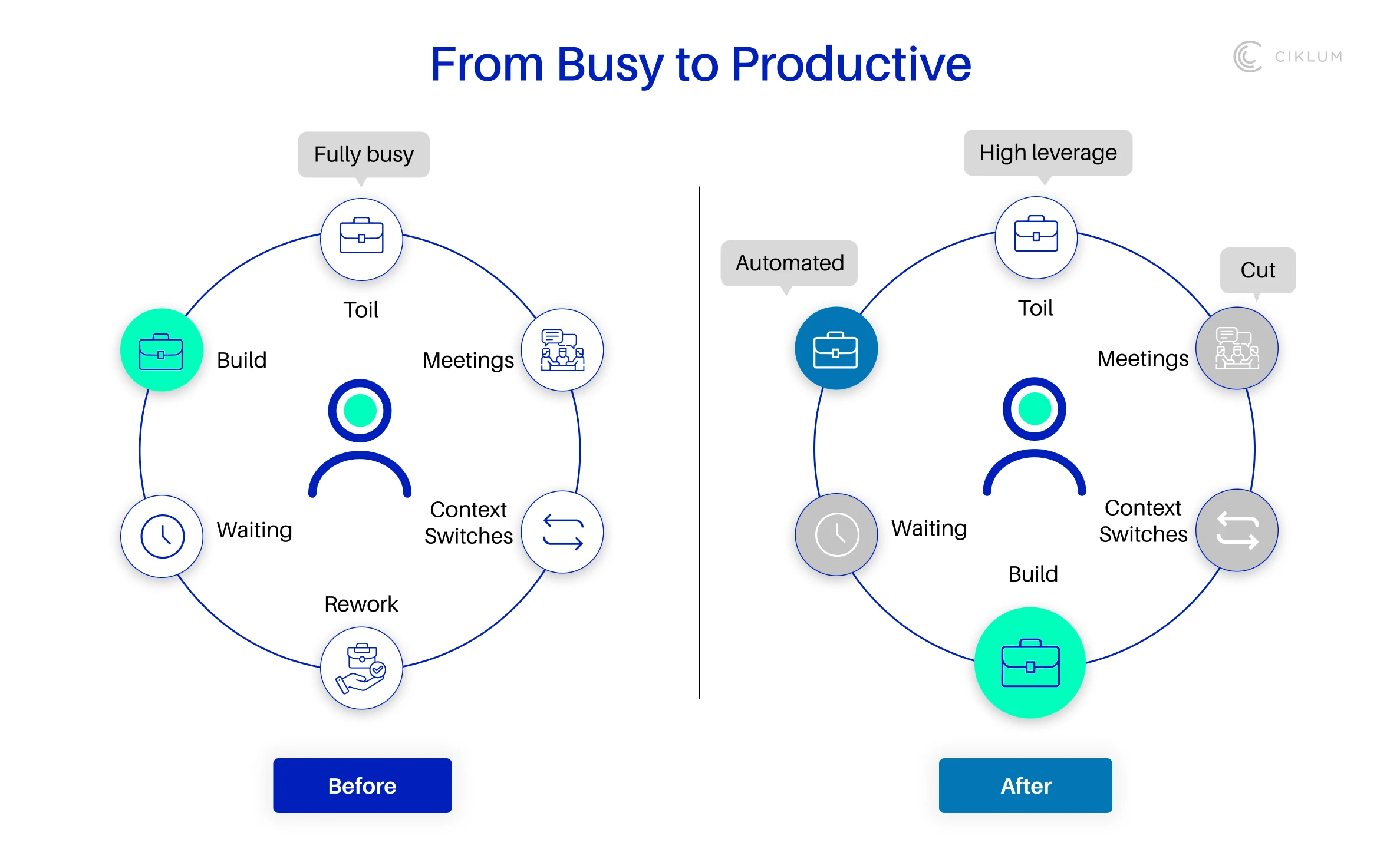
When a team reclaims its capacity, the change is visible quickly and without a single new hire. Work that used to wait starts moving. Engineers spend more of their week building and less of it on toil, coordination, and rework. The same team ships noticeably more, not because anyone is working harder but because the operating model stopped draining what they could already do.
The pattern shows up clearly in engineering-led transformations. A global automotive manufacturer working with Ciklum restructured field engineering around stream-aligned teams supported by a shared platform. Diagnoses that previously took several days now take under an hour, support expanded from UK business hours to around-the-clock coverage, and the program saved a substantial sum. The headcount was not the lever. The lever was removing the slow, manual, specialist-dependent steps that were consuming the team's capacity, which freed the same people to deliver far more.
That is the whole idea behind doing more with less. The capacity is almost always already there, trapped in work that does not create value. Reclaiming it is faster, cheaper, and more durable than hiring around the problem, and it is what genuine engineering efficiency improvement actually looks like.
In Summary
When delivery feels slow, more headcount is the expensive answer to the wrong question. Most teams are not short on people. They are short on the capacity those people already have, which leaks away into toil, context switching, meetings, rework, and waiting. Adding engineers to that system scales the inefficiency rather than the output.
The way to do more with less is to reclaim that capacity. Automate the toil. Limit work in progress. Protect focus time. Kill low-value work. Use AI where it compounds. Reuse instead of rebuild. None of these require recruiting, all of them raise the leverage of the team you already have, and together they deliver the kind of engineering efficiency improvement that hiring rarely does.
Ciklum's product engineering and DevOps teams work with organizations to find where capacity is leaking and rebuild the operating model that recovers it. If the pressure is to deliver more without growing the team, talk to our specialists about doing more with the engineers you already have.
Frequently Asked Questions
1. How can we improve engineering efficiency without hiring more people?
By reclaiming the capacity the team already has. Most engineering time leaks into toil, context switching, meetings, rework, and waiting. Automating manual work, capping work in progress, protecting focus time, and killing low-value tasks recover that capacity immediately, without the cost and coordination overhead of recruiting. The team effectively gains capacity it was losing all along.
2. Why do adding engineers often fail to speed up delivery?
Because new people inherit the same inefficiencies and add coordination and onboarding cost on top. If the real constraint is a review queue, a manual release process, or unclear decision rights, more engineers increase contention for those constraints rather than relieving them. Hiring into an inefficient operating model scales the inefficiency, not the output.
3. What is the single highest-leverage efficiency change?
For most teams, automating toil or capping work in progress. Automating the deployment, environment, and operational work removes effort that scales with the team and frees capacity for building. Capping work in progress removes the constant context-switching tax. Both show results within weeks and neither requires a new headcount.
4. Does AI let us do more with fewer engineers?
AI is a real efficiency multiplier on well-bounded work like scaffolding, boilerplate, and test generation, especially on a clean, well-documented codebase. The gains are largest where the surrounding system is well-designed and smaller where it is messy. AI raises the leverage of a healthy engineering system rather than substituting for one, so it works best alongside the other efficiency moves, not instead of them.
5. When should we bring in external engineering support?
Two moments produce the highest return. The first is diagnosing where capacity is leaking, where an outside view cuts through the assumption that a busy team is a fully productive one. The second is the automation and platform work that reclaims capacity, where engineers with prior experience can stand up the paved paths and tooling far faster than a stretched in-house team. Both add leverage without adding permanent headcount.

By Ciklum Editorial Team

Ciklum’s Editorial Board is a collective of experienced writers and industry experts, bringing together perspectives shaped by real-world engineering and delivery experience. Through collaborative insights, the team explores how technology, AI, and digital innovation move from concept to execution across industries.
Blogs
Discover Similar Insights

Engineering Bottlenecks: How to Spot What’s Slowing You Down (and Fix It Fast)
Learn More
Speed to Market: How to Accelerate Product Development Without Compromise
Learn More
Exploring Chatbots in DevOps: The Future of Agile Workflows
Learn More
AI influence on the daily job of DevOps engineers
Learn More