


Key Takeaways
- AI-native products are replacing legacy software at remarkable speed.
- Hyperpersonalization becomes an always-on intelligence layer.
- Cross-functional teams evolve as AI workers collaborate alongside humans.
- Automation maturity shifts from task-level to workflow-level execution.
The Beginning of AI as the Enterprise Operating Layer
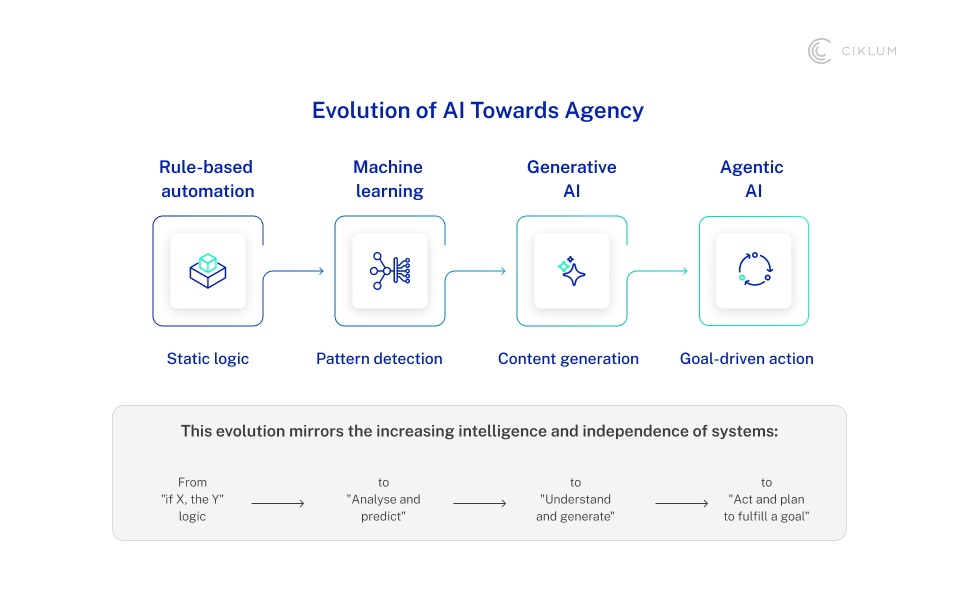
Over the past few years, enterprises have steadily explored the possibilities of Generative AI through pilots and controlled experiments. That exploratory phase is coming to an end as AI begins to operate as a core part of the entire workflow process. The conversation is now shifting from where AI could be tested to where it should already be running.
This shift is happening faster than many enterprises expected. Model cycles are compressing, operational expectations are rising, and AI is moving from a supporting tool to a system that actively participates in how work gets done - for instance, by answering customer questions on its own, sorting incoming requests, or moving tasks to the right team without waiting for human prompts.
AI-native products are emerging that rely on intelligence at their core rather than as add-on features. And enterprise memory, once a conceptual idea, is becoming essential for delivering consistent and explainable outcomes.
The urgency behind this shift is hard to ignore. According to Gartner, worldwide AI spending will exceed two trillion dollars in 2026, and it’s expected to continue increasing in the coming years. The organizations that succeed will be the ones that approach AI with clarity, discipline, and strong engineering foundations instead of experimentation alone.
The Five Trends Redefining AI in 2026
The trends ahead signal how AI is taking its place at the center of enterprise operations.
Agentic AI Leaves the Prototype Stage
Agentic AI has moved beyond the proof-of-concept phase into day-to-day operations. These systems now perform work with autonomy and consistency, and increasingly manage full workflow chains with error-handling and self-correction built in.
At DSW, a large North American footwear retailer, an AI-driven customer service agent now handles authentication, returns, and exchanges. These workflows previously required multiple human interventions and created delays. After adopting agentic automation, DSW realized around $1.5M in annual savings and a significant rise in shopper engagement.
Similar patterns are appearing in logistics, banking, and customer support, where agents handle exception-heavy tasks that once sat in queues. Agentic AI is becoming a workforce model that sits alongside human teams, where it continuously learns and recovers from errors in real time.
AI-Native Products Replace AI-Enabled Ones
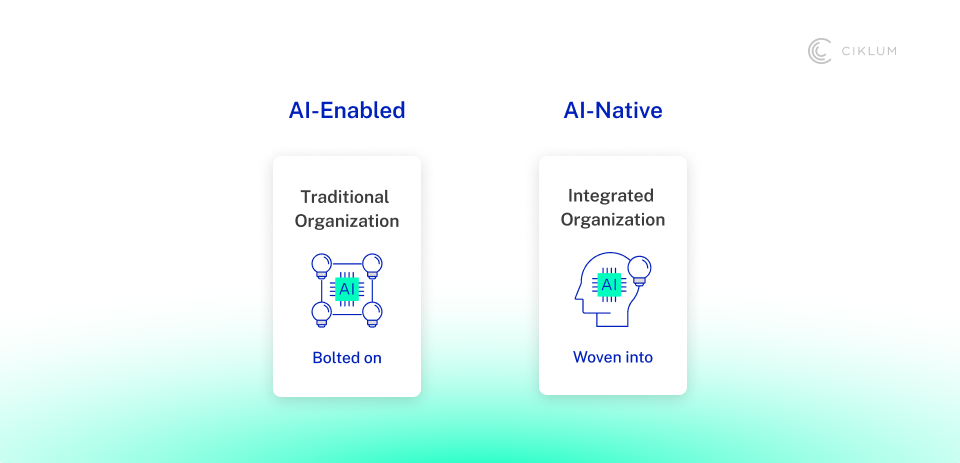
The first wave of AI adoption looked a lot like the early days of mobile apps, when companies took legacy interfaces and simply wrapped them in something ‘new’. Over the past couple of years, most software followed that same pattern by adding AI as a feature rather than rethinking the product itself.
In practice, this means AI-enabled tools simply use AI to speed up existing tasks - like an email client that just helps you write faster - while AI-native products are redesigned from the ground up, like communication platforms that organize everything around your intent instead of traditional inboxes
Now we are entering the phase where products stop adding AI and start being built entirely around it. Instead of relying on rules or manual workflows, these AI-native models will place a reasoning model at the core, allowing the system to interpret context, make decisions, and shape the workflow itself.
Hyperpersonalization Becomes Invisible Infrastructure
Teams have spent countless hours designing segmentation models and configuring customer journeys, only to find the outcomes fragile and hard to maintain. Going forward, hyperpersonalization becomes something very different.
Instead of being manually engineered, it becomes a natural byproduct of AI systems that interpret preferences, behaviors, and context in real time. Hyperpersonalization no longer feels like a feature layered on top of a product. It functions as an invisible infrastructure that shapes every interaction, often powered by agentic systems that adjust journeys, content, and recommendations without waiting for human configuration.
A good example of this shift is Starbucks, whose Deep Brew AI platform personalizes offers for millions of customers every day by analyzing purchase history, time of day, weather patterns, and store-level insights. The personalization runs silently in the background and continuously adapts without manual rule-setting.
See how Agentic AI is already elevating customer experience in our related blog here.
Enterprise Memory Becomes the Next Competitive Moat
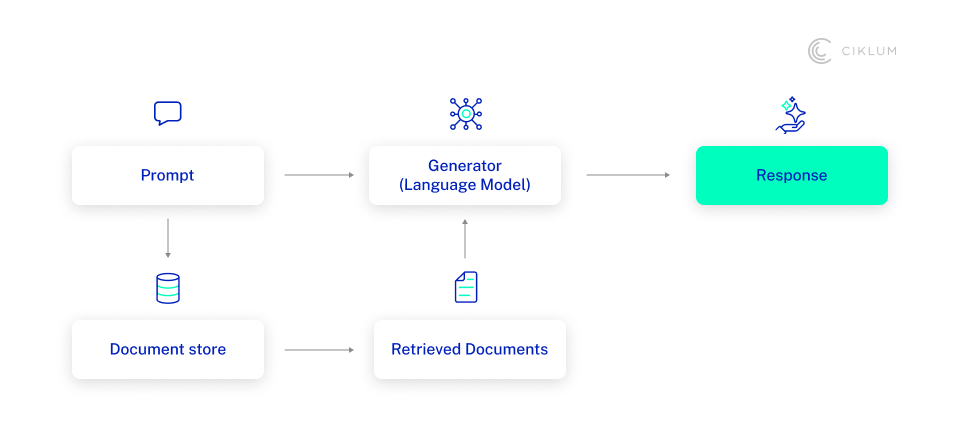
As AI systems grow more capable, their limitations become visible. They can reason and generate solutions, but they often forget. Enterprises cannot rely on systems that lack continuity and context, which is why 2026 marks the rise of enterprise memory as a central design priority.
BCG reports that 70% of AI failures occur because of missing context and process issues, not model quality. To address this, organizations are building memory layers that connect documents, decisions, past interactions, and domain knowledge into a single, searchable foundation for every AI worker. And unlike traditional knowledge bases, this memory stays up-to-date automatically. It learns from every new conversation, task, or decision, instead of remaining static.
A telecom operator, for example, deployed an AI assistant that recalls a customer’s previous issues, device type, troubleshooting steps, and likelihood of resolution. The assistant solves most cases without asking customers to repeat themselves or escalating unnecessarily.
AI Workers Join the Org Chart
Departments across industries are assigning clear responsibilities to AI workers and measuring their performance the same way they evaluate human teams. Deloitte’s 2025 workforce analysis indicates that nearly one-third of enterprises will assign formal roles to AI workers by the end of 2026.
These systems follow procedures, capture reasoning, escalate appropriately, and integrate into cross-functional workflows. Klarna’s AI customer service agent already handles tasks equivalent to more than 700 human agents, complete with performance metrics, audit logs, and measurable SLAs. A clear example of AI workers entering formal operational roles. In many organizations, AI workers now appear on internal dashboards with defined KPIs, SLAs, and audit trails, allowing leaders to benchmark their performance alongside human teams.
Want to learn more about Generative AI? Read our blog on Understanding Generative AI and its Examples.
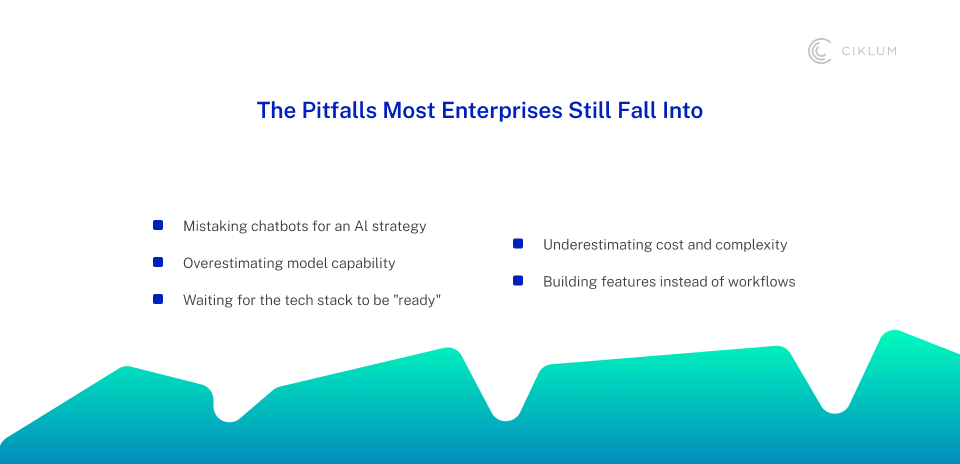
The Pitfalls Most Enterprises Still Fall Into
But even with these advancements taking shape, many enterprises still struggle to translate potential into performance. Several familiar pitfalls continue to slow down progress.
Mistaking Chatbots for an AI Strategy
Many teams deploy chatbots as proof of progress, but chatbots only improve surface-level responses. When deeper workflows stay untouched, leaders often conclude that AI is overrated, when the real issue is that the implementation was never designed to deliver meaningful value.
Waiting for the Tech Stack to Be “Ready”
Teams often delay AI work until their infrastructure or data feels modern enough. In reality, most AI can run effectively on top of legacy systems and still create a measurable impact. Waiting for perfect conditions simply delays progress and the learning curve every enterprise must eventually navigate.
Building Features Instead of Workflows
Adding isolated AI features produces small wins but rarely changes operations. Real value comes from redesigning workflows — mapping decisions, improving handoffs, and letting AI agents take on the operational load. Without this, AI remains scattered and shallow.
Overestimating Model Capability
Enterprises sometimes assume a strong model can handle end-to-end tasks. When the system runs into ambiguity or missing context, expectations collapse quickly. AI performs best with clear boundaries, structured workflows, and the right support systems.
Underestimating Cost and Complexity
AI isn’t a one-time deployment. It requires ongoing evaluation, retraining, quality checks, and orchestration. Many teams overlook these operational needs and face friction when pilots succeed technically but stall financially or organizationally.
The New Direction of the AI-First Enterprise
AI systems now evolve weekly, not annually. Organizations should begin with one high-impact workflow and redesign it using agentic principles, treating AI systems as active contributors to operations rather than side experiments. They should build enterprise memory early to ensure continuity and predictable outcomes, and treat AI workers as part of the institutional structure, complete with oversight, measurement, and governance.
Soon, autonomous agents will manage a significant share of workflows. Products will be born with AI at their core. Teams will consist of both humans and AI workers acting in concert. Workflows will adapt continuously based on memory, context, and real-time performance signals, rather than waiting for quarterly redesigns.
One global automotive manufacturer partnering with Ciklum is already showing what this shift looks like in practice. Their field technicians now use an agentic support system trained on decades of vehicle knowledge to diagnose issues and recommend fixes on-site. What once took several days now takes under an hour, support is available 24/7 instead of limited UK hours, and the organization has saved more than £1 million.
Organizations that take action today are creating environments where humans focus on judgment, creativity, and complex decision-making while AI agents manage the operational load.
In Summary
2026 marks the moment when Generative AI shifts from experimentation to execution. Agentic systems, AI-native products, enterprise memory, and AI workers are becoming essential components of modern operations, which is why now is the time to act with precision and purpose.
With the right guidance and partnership, enterprises can move from possibility to performance. Ciklum’s team of AI specialists is ready to help you make that transition. If you are prepared to turn these trends into measurable impact for your business, our team is here to support your next step.

By Enver Cetin

Intelligent Automation Principal Lead
Enver specializes in Intelligent Automation and AI, leading transformative projects that enhance business efficiency. With expertise in Generative AI and digital management, he integrates cutting-edge AI solutions into business strategies. Enver holds advanced degrees in Business Consulting and Computer Science, driving Ciklum’s mission of industry innovation.
Blogs
Discover Similar Insights

Enterprise AI Automation: A Practical Guide to GenAI, AI Agents and Intelligent Workflows
Learn More
Connecting AI to Your Business: A Complete Guide to MCP Servers
Learn More
From Copilot to Operating Model: What Agentic AI Changes in 2026
Learn More
Choosing the Right AI Partner: 5 Essentials for Scaling with Confidence
Learn More