
Key Takeaways
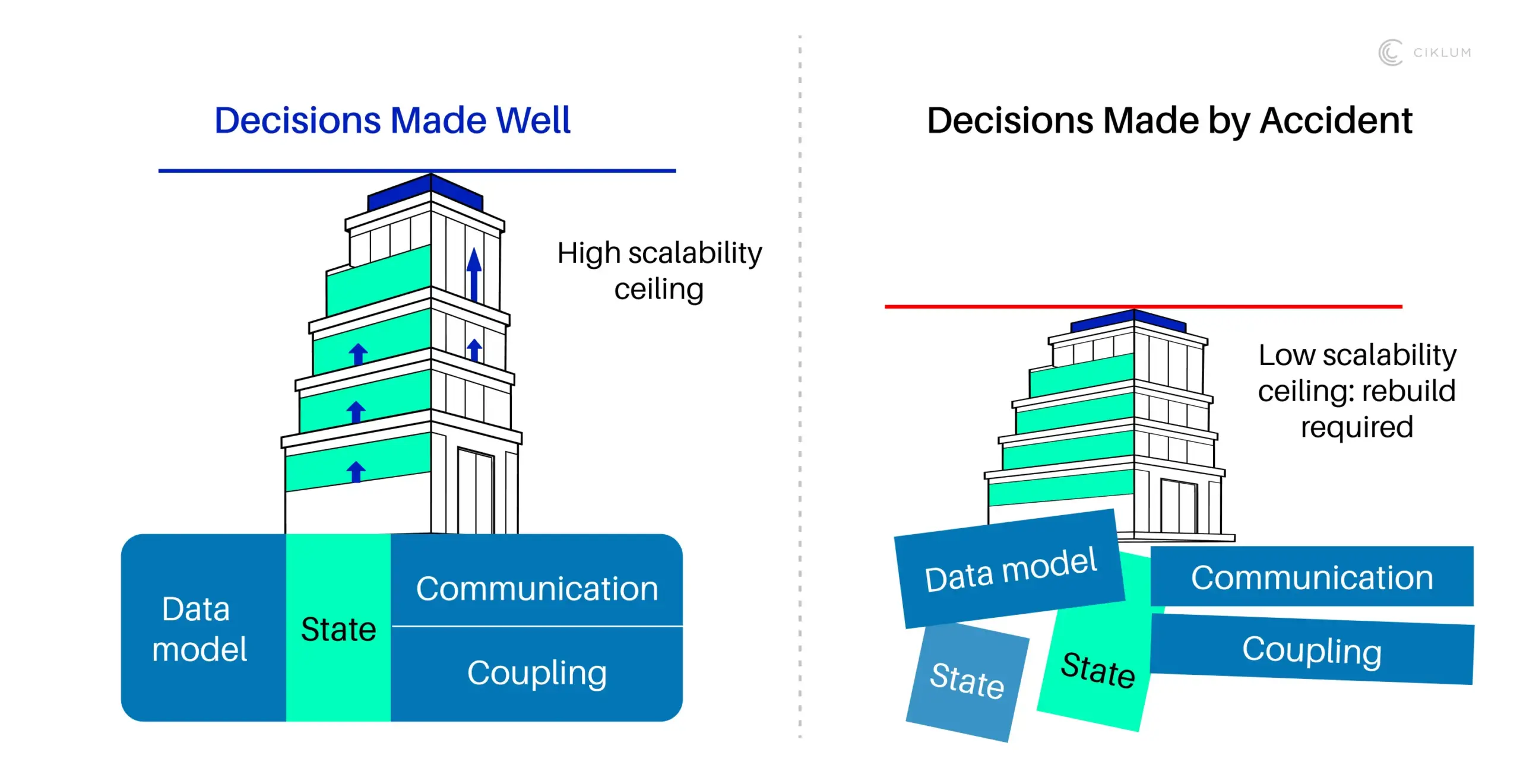
Scalability is decided early and inherited later: A handful of foundational architecture choices, made when the product is small, quietly sets the ceiling the product will hit when it grows. By the time scale exposes them, they are the most expensive things to change.
The decisions that matter are not the flashy ones: Software architecture scalability rarely turns on the framework or the cloud provider. It turns on how you model data, where you put state, how components talk to each other, and whether you can see inside the system when it strains.
Most scaling pain is self-inflicted coupling: The system slows down not because the load is impossible but because changes ripple further than they should. Clean boundaries and loose coupling are what let a product grow without every change becoming a coordination project.
Design for reversibility, not for an imagined scale: The goal is not to build for a hundred million users on day one. It is to make the early decisions cheap to change later, so the architecture can evolve as the real constraints arrive.
Most products do not fail to scale because the load becomes impossible. They fail because a few decisions made early, when the system was small and the team could hold all of it in their heads, quietly became the constraint that everything else had to work around. The framework was fine. The cloud bill was manageable. But the data model could not stretch into the next market, or every feature had to touch the same shared component, or nobody could see why latency spiked because the system was never built to be observed.
That is the uncomfortable truth about software architecture scalability. The decisions that decide it are made long before scale arrives, often by people optimizing for shipping fast rather than growing big, and they are inherited by everyone who comes after. The good news is that these decisions are knowable. You can make them deliberately instead of by accident.
This article walks through the specific architecture decisions that make or break a product's ability to scale, why they matter more than the choices teams usually agonize over, and how to make them in a way that leaves room to grow.
Scalability Is Decided Early, Then Inherited
There is a comfortable myth that scalability is something you add later, once the product has proven itself and the budget appears. In practice, the ceiling is set much earlier than that. The architecture that ships at launch is optimized for a specific situation, a small team, an unproven domain, the need to learn quickly. Those are the right priorities at the start. The problem is that the decisions made under them do not expire when the situation changes. They keep running, quietly shaping the cost of every change that comes after.
This is why scalability cannot be treated as a feature on the roadmap. By the time slow response times and stalled releases make scalability a board-level topic, the cheap window has closed. Reworking a data model that every service depends on, or untangling components that were never meant to be separated, is slow and risky work that competes directly with the roadmap. To scale well, you must make a few foundational choices carefully while they are still cheap to change.
None of this means over-building for a scale the product has not reached. That mistake is just as expensive in the other direction. It means understanding which early decisions are hard to reverse and giving those the attention they deserve, while keeping everything else simple enough to change when the evidence arrives.
The Architecture Decisions That Make or Break Scalability
A short list of decisions accounts for most of the difference between products that scale smoothly and products that hit a wall. None of them are exotic. All of them are easy to get wrong when the system is small.
How You Model the Data
The data model is the decision that outlives almost everything else. Code gets rewritten, frameworks get swapped, services get split, but the data and its shape tend to persist for the life of the product. A schema designed tightly around the first version of the product fits the first version perfectly and fights every expansion after it. New geography, new payment method, new customer type, and suddenly the model is absorbing repurposed columns, awkward workarounds, and migration scripts that grow riskier each release.
Data model decisions deserve the most care precisely because they are the hardest to undo. The practical discipline is to model around the stable concepts of the business rather than the current feature set, and to avoid baking assumptions into the schema that the business has not actually committed to forever.
Where You Put State
State is what makes scaling hard. A stateless component can be cloned across as many machines as demand requires, because any instance can handle any request. A component that holds state in memory, in a local session, or in a file on its own disk cannot, because requests now have to find the one instance that knows about them. The decision of where state lives, and how much of it sits inside the application versus in a shared data store built to handle it, is one of the biggest determinants of whether a system scales horizontally or hits a wall.
The pattern that scales is to push state out of the application tier and into stores designed for it, keeping the services themselves stateless and disposable. The pattern that does not is convenient early and painful later, when scaling means wrestling with sticky sessions and machines that cannot be replaced without losing something.
How Components Talk to Each Other
The choice between synchronous and asynchronous communication shapes how the system behaves under stress. When every component calls every other component directly and waits for an answer, the slowest component sets the pace and a single failure can cascade through the whole chain. When components communicate through events and queues where the work allows it, they can absorb spikes, fail independently, and recover without taking everything else down.
Not everything should be asynchronous. Some operations genuinely need an immediate answer. But defaulting to synchronous calls everywhere couples the availability of every component to every other one, and that coupling is one of the most common reasons a system that worked fine at moderate load falls over when traffic surges.
How Tightly Components Are Coupled
Most scaling pain is coupling pain. When components share a database, reach into each other's internals, or depend on each other's implementation details, a change in one ripples into many. The system slows down not because the work is hard but because every change becomes a negotiation across the parts it touches. Clean boundaries, where each component owns its data and exposes a defined interface, are what let a product grow without every feature turning into a coordination project.
This is the decision that determines whether the architecture can later be split, scaled, or replaced one piece at a time. Loose coupling keeps options open. Tight coupling closes them, and the closing is rarely noticed until something needs to change and cannot.
Whether You Can See Inside the System
Observability is the decision teams skip and regret. A system you cannot see inside is a system you cannot scale with confidence, because when latency rises or errors spike, the team is debugging blind. Structured logs, metrics, and tracing built into the architecture from the start mean the bottleneck becomes visible before it becomes a customer-facing problem. Bolted on after the fact, observability is always partial and always too late for the incident that needed it.
Scalable systems are ones where the next constraint shows up on a dashboard before it shows up in a support ticket. That property is a design decision, not an afterthought.

How to Make These Decisions Well
Knowing which decisions matter is half the work. Making them well is the other half, and the approach matters more than any single technology choice.
Match the Decision to the Constraint You Actually Have
The most common architecture mistake is solving a problem the product does not have yet. Designing for a hundred million users while serving ten thousand pays the full operational cost of that design every day, for a future that may never arrive in the shape you imagined. The discipline is to build for the constraint in front of you while keeping the foundational decisions, the data model, the boundaries, the placement of state, clean enough that scaling them later is an evolution rather than a rebuild.
Design for Reversibility
Since you cannot predict exactly how the product will grow, the most valuable property in an early architecture is the ability to change it cheaply. Clean boundaries make it possible to replace one component without touching the rest. A well-modeled data layer makes it possible to extend without rewriting. Reversibility is what lets a team make a reasonable decision now and a better one later, instead of being locked into the first guess.
Measure the System as It Grows
Architecture drifts. The boundaries that were clean at launch erode as features get added under deadline pressure. The teams that scale well watch for that drift deliberately, tracking the signals that matter, latency, coupling, deployment friction, cost per user, so erosion is caught the quarter it begins rather than the quarter it becomes a crisis. Ciklum's cloud and DevOps engineering teams work with organizations on exactly this instrumentation, because an architecture you measure is one you can keep scalable as it changes.
Evolve Incrementally Instead of Rewriting
When the architecture does need to change, the incremental path beats the heroic rewrite almost every time. Building the new capability alongside the old one, moving a slice of traffic to it, and expanding as it proves out keeps the product running throughout and retires risk one step at a time. Ciklum's legacy modernization practice favors this approach precisely because the big-bang rewrite has a long track record of failing for reasons that have nothing to do with the destination.
What Scalable Architecture Looks Like When It Works
A well-founded architecture does not announce itself. It shows up as the absence of drama. Capacity grows with demand without an emergency project to add it. Releases ship in small batches without a coordination meeting across half the company. New engineers become productive quickly because the boundaries make the system legible. The next bottleneck appears on a dashboard before it appears in a customer complaint.
Ciklum demonstrated the impact of this approach by partnering with a telehealth platform to scale its operations to over a million clinicians. Rather than prioritizing new features during the early phases, the engineering team focused on building a scalable foundation, including full Infrastructure as Code and continuous monitoring. This ensured the platform could deliver capabilities at speed on reliable infrastructure, proving that scalability comes from foundational decisions made deliberately and early, not from heroic late-stage rewrites.
That is the whole lesson. Scalability is not a phase you reach. It is a set of decisions you make at the start and keep making as the product grows, and the products that scale are the ones where those decisions were treated as the foundation they actually are.
In Summary
Scalability starts at the foundation, in a handful of architecture decisions that are easy to make casually and expensive to undo. How you model the data, where you put state, how components communicate, how tightly they are coupled, and whether you can see inside the system decide far more about software architecture scalability than the framework or the cloud provider ever will.
The way to get them right is not to over-build for an imagined future. It is to make the hard-to-reverse decisions carefully, design everything else to be cheap to change, measure the system as it grows, and evolve it incrementally when the real constraints arrive. Those habits turn architecture from the ceiling on growth into the foundation under it.
Ciklum's product engineering and modernization teams work with organizations to make these foundational decisions well, whether that means designing the architecture for a new product or evolving an existing one that has started to strain. If scalability is on the horizon and the foundation is the part that worries you, talk to our specialists about building it to grow.
Frequently Asked Questions
1. What architecture decisions have the biggest impact on scalability?
The data model, where state lives, how components communicate, and how tightly they are coupled. These are foundational because they are hard to reverse once the product depends on them. The data model in particular tends to outlive every other choice, which is why it deserves the most care. Framework and cloud-provider choices matter far less to scalability than teams usually assume.
2. Should we design for a massive scale from the start?
No. Designing for a scale the product has not reached pays a heavy operational cost every day for a future that may never arrive in the shape you imagined. The better approach is to build for the constraint you actually have while keeping the foundational decisions clean enough that scaling them later is an evolution rather than a rebuild. Reversibility matters more than premature scale.
3. Why does coupling cause so many scaling problems?
Because tight coupling means a change in one component ripples into many. When components share a database or depend on each other's internals, the system slows down not because the load is hard but because every change becomes a negotiation across everything it touches. Clean boundaries and loose coupling let a product grow without each feature turning into a coordination project, and they keep the option open to scale or replace one piece at a time.
4. How do we know if our architecture is reaching its scalability ceiling?
The signals are consistent. Response times rise under load that used to be fine. Releases slow down because changes touch more of the system. Incidents cluster in the same components. Cost per user trends up instead of down as you grow. Catching these early depends on observability built into the architecture, so the constraint shows up on a dashboard before it shows up in customer complaints.
5. When should we bring in external engineering support?
Two moments produce the highest return. The first is during foundational design, when decisions about the data model, boundaries, and state placement set the ceiling for everything that follows. The second is when an existing architecture has started to strain and needs to evolve without a risky rewrite. Both benefit from engineers who have seen how these decisions play out at scale, and both need bandwidth that delivery-stretched in-house teams rarely have spare.

By Ciklum Editorial Team

Ciklum’s Editorial Board is a collective of experienced writers and industry experts, bringing together perspectives shaped by real-world engineering and delivery experience. Through collaborative insights, the team explores how technology, AI, and digital innovation move from concept to execution across industries.
Blogs
Discover Similar Insights

The Impact of Unified Commerce on Retail Growth and Efficiency
Learn More
How to Solve Interoperability Challenges in Healthcare Systems
Learn More
AI in Retail: Why Omnichannel Breaks Down — and How Agentic AI Fixes It
Learn More
What’s Holding Back Healthcare Software Innovation and How to Accelerate It
Learn More