
Key Takeaways
Unified commerce is an operating model, not a storefront upgrade: It replaces disconnected channel stacks with one real-time source of truth for inventory, orders, pricing, and customer data. Growth and efficiency both depend on that foundation, not on adding another sales channel.
The gap between leaders and laggards is widening: Retailers that have moved from fragmented omnichannel to a genuinely connected model are pulling ahead on growth, not because they spend more on marketing, but because they stop losing sales and margin at the seams.
Efficiency is the underrated half of the story: Unified commerce is usually sold on customer experience. The quieter win is inventory that turns faster, fulfillment that costs less, and teams that stop reconciling the same data in three systems.
AI only compounds what is already connected: Personalization, agentic shopping, and automated fulfillment all assume one shared data layer underneath. Unify first, automate second. The reverse order just produces more expensive fragmentation.
Omnichannel Was Never Enough
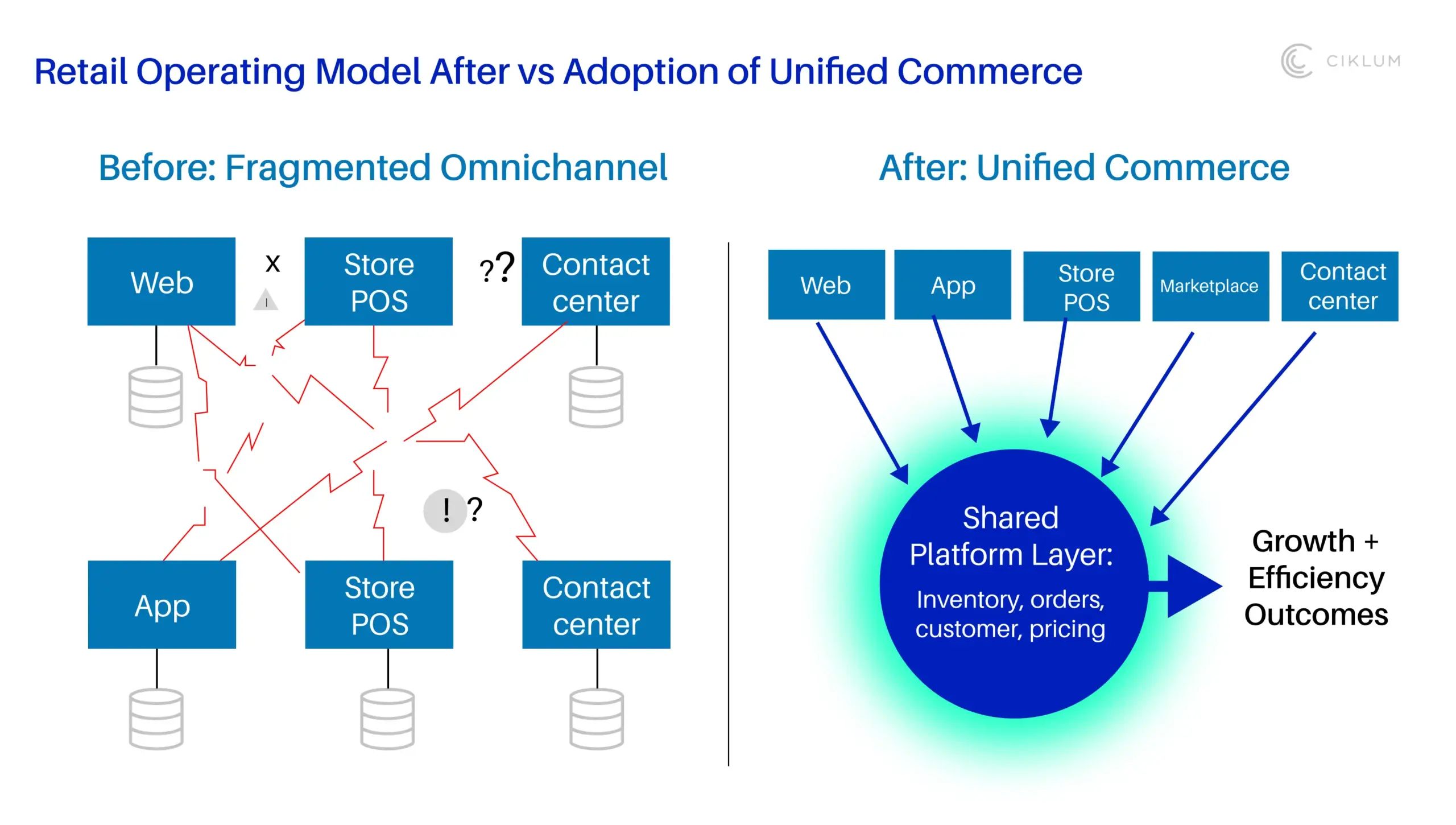
Here is the opinion that tends to get pushback in the room, and it is still true. Most retailers believe they solved cross-channel retail years ago. They have a site, an app, stores, marketplaces, and loyalty. The label says omnichannel. The customer experience often says something else.
Omnichannel, done well, aligns what the customer sees. Unified commerce aligns what the business runs. Same inventory record. Same order engine. Same customer profile. Same price logic. Every channel reads from and writes to the same place, in real time. Gartner's framing of unified commerce platforms as composable, experience-led hubs with real-time data exchange captures the architecture, but the practical test is simpler. Is the item actually in the store the customer selected for pickup? Does the price on the app match the register? Can a return started on mobile finish in store without someone retyping the order?
If the answer is no, the growth leak is not mysterious. It is structural. And no amount of front-end polish fixes a back end that still reconciles by hand.
Where Growth Actually Shows Up
Unified commerce is not a growth story because consultants put it on a maturity chart. It is a growth story because customers stop hitting dead ends.
The moment that matters is checkout, or just before it. A shopper who sees accurate availability, consistent pricing, and a fulfillment option that actually works completes the purchase. One who discovers at the last step that the item cannot ship, cannot be picked up, or costs differently on another device does not care how many channels the brand operates. They leave. Recent specialty retail benchmark research from Incisiv puts numbers on what many operators already feel. Retailers at leading maturity grow at roughly twice the rate of basic-tier peers. That gap is not magic. It is fewer abandoned carts, better cross-sell because the business can actually fulfill what it recommends, and inventory that sells because every channel can see it.
Average order value follows the same logic. When the system can fulfill from the best location rather than the default warehouse, basket size can rise without leaning on markdowns. Repeat purchase follows trust.
The store network is part of the growth story too, and it is underrated. Unified commerce lets online demand pull through slow-moving store stock, turns ship-from-store and buy-online-pickup-in-store into revenue tools instead of exceptions, and makes the physical estate productive rather than purely defensive. Retailers still treating stores as separate from digital are leaving growth in the back room.
Where Efficiency Shows Up (and Why It Is Easy to Miss)
Growth commands attention in the boardroom, while efficiency is often reduced to a footnote. That perspective should be flipped.
Unified commerce does not only help retailers sell more. It helps them spend less to sell, by making inventory, fulfillment, and labor work as one system instead of three competing ones. The surprise for many operators is how much waste was hiding inside disconnected channels all along.
Inventory is the biggest lever. When every channel shares one view of stock, the business can move product to demand instead of explaining why it sat in one location while another went out of stock.
Fulfillment is where the store network pays for itself. Using stores as nodes close to the customer shortens the last mile and improves economics. The benchmark cites meaningful last-mile savings for leaders running store-based fulfillment well. McKinsey's work on omnichannel delivery has made the same argument for years from a network-design angle. Proximity and visibility beat brute-force distribution spending. The exact percentage varies by category. The direction does not.
Labor and operating costs are the quiet third. Fragmented stacks hide duplicated work. Teams reconcile inventory by hand, re-enter orders that already exist somewhere else, and manage exceptions caused by data that should never have diverged. One platform with one data model costs less to run, less to change, and less to govern than a dozen systems stitched together with custom middleware that breaks every time a vendor ships an update.
All of that efficiency evaporates if promise accuracy lags capability. BOPIS, ship-from-store, and cross-channel returns save money only when the operational truth matches the customer promise. A pickup that is not ready, a pick that fails, a return policy that changes by channel, and the savings turn into refunds, support load, and lost repeat purchase. In unified commerce, efficiency and trust are the same KPI seen from different angles.

What Has to Be True Underneath
Unified commerce is not a platform purchase. It is four things working together, and most programs fail because they do one or two and call it done.
One inventory truth at item level, updated in real time across stores, warehouses, marketplaces, and digital. Without it, every fulfillment promise is a gamble.
One order and fulfillment engine that routes to the best location based on availability, proximity, cost, and service level, not based on which system received the order first.
One customer and pricing record that every channel reads and writes, so promotions, personalization, and service reflect what actually happened.
One operational layer in store and in support, with standard workflows for pickup, pack, return, and exceptions, so volume spikes do not turn into chaos.
That is the core. It is also the part that separates programs that move numbers from programs that move slides.
Ciklum's engineering partnership with Just Eat shows the same discipline in a high-velocity marketplace. Routing, onboarding, dispatch, and customer operations only work when they share low-latency data. Retailers do not need food-delivery speed to learn from that. They need the same insistence on one operational truth driving many customer-facing decisions.
AI Changes the Urgency, Not the Sequence
Retail conversation in 2026 eventually turns to AI. Fair enough. But unified commerce is the variable that decides whether AI shows up in the P&L or only in pilot decks.
Deloitte's 2026 Global Retail Industry Outlook, based on a survey of 330 retail executives worldwide, captures how fast expectations are shifting. Most expect AI to reshape how customers discover and buy. That only works if the machine-readable layer underneath is clean. Agents need accurate inventory, consistent pricing, reliable fulfillment promises, and returns logic they can explain. Personalization needs one customer record, not five partial ones. Allocation needs inventory truth, not three versions of it.
The retailers getting this right are not starting with the agent. They are starting with the unified layer the agent will act on. That matches the pattern across mature retail programs and what Ciklum has written about in intelligent automation in retail. After years of stacking one-off tools, simplification is winning. AI becomes useful when it connects systems, not when it sits inside each channel separately.
The decision layer is where unified commerce turns into compounding value. Which orders to route from which stores. Which customers get which offer. Which SKUs to reposition before a stockout. Which promotions to suppress when inventory is thin. Ciklum's data and analytics and generative AI and decision science teams work at that intersection, because those decisions only scale when the data is unified and the action layer can execute without manual handoffs.
What the Retailers Pulling Ahead Actually Do
The pattern is recognizable once you have seen enough programs up close. None of it requires the biggest software budget.
They treat promise accuracy as a commercial metric. Same-day pickup means same-day pickup. App price means register price. Online return means in-store completion without a debate.
They invest in inventory truth before personalization. The board wants the shiny feature. Fulfillment economics wants boring sync work.
They use stores as network assets, not only selling floors. Pickup, ship-from-store, curbside, and returns are designed into labor plans and backroom flow, not bolted on as an e-commerce checkbox.
They resist stack sprawl. New capability earns its place in the platform or it waits.
They sequence AI after unity. Personalization and agentic workflows come after inventory, orders, and customer data share one source of truth.
They watch both sides of the ledger. Conversion and average order value alongside inventory turns, fulfillment cost per order, and promise-accuracy rate. Growth without efficiency bloats. Efficiency without growth damages the customer.
In Summary
Unified commerce is how retail stops choosing between better customer promises and lower operating cost. Fragmented omnichannel forces that tradeoff because every new capability adds integration work, exception handling, and reconciliation labor. A connected platform inverts it. Accurate inventory helps conversion and reduces markdowns. Smarter fulfillment helps delivery economics and satisfaction. One customer record helps personalization and support. The same wiring helps the customer and the P&L.
The gap between leaders and laggards is widening, and delay is not neutral. Capabilities that felt advanced two years ago are becoming baseline. Meanwhile the work itself stays unglamorous. Inventory sync. Order routing. Identity resolution. Store discipline. Platform governance. That is the work that determines whether the next AI investment compounds or stalls.
If that sounds familiar, the next step is usually not another channel. It is making the existing ones run on one truth. Ciklum's product engineering teams work with retailers through that transition, from unified data and commerce foundations to the decision and fulfillment layers that turn connection into growth and efficiency you can actually measure.
Frequently Asked Questions
1. What is the difference between omnichannel and unified commerce?
Omnichannel is about consistent customer experience across channels. Unified commerce is about running those channels on one connected back end for inventory, orders, customer data, and pricing in real time. You can look omnichannel on the surface and still be fragmented underneath. Unified commerce closes that gap.
2. How does unified commerce improve retail efficiency?
It cuts duplicated work and inventory trapped in the wrong channel. Real-time stock visibility improves turns and lowers markdown risk. Store-based fulfillment can reduce last-mile cost when the network is designed for it. One platform lowers total cost of ownership compared with maintaining many systems and custom integrations. All of that depends on keeping promises accurate. Broken pickup or return experiences erase the benefit fast.
3. Does unified commerce only matter for large retailers?
The principles apply at any scale. A mid-size retailer with ten stores and a growing e-commerce channel hits the same failure mode if inventory, orders, and customer data live in separate systems. Platform choices differ. The mechanics do not.
4. Where should a retailer start if unified commerce feels overwhelming?
Start with inventory truth and order routing. Most growth and efficiency leaks trace back there. Accurate availability drives conversion. Intelligent routing drives fulfillment economics. Customer identity and pricing can follow once the backbone is stable. AI and personalization should come after the unified layer is in place, not before.
By Ciklum Editorial Team

Ciklum’s Editorial Board is a collective of experienced writers and industry experts, bringing together perspectives shaped by real-world engineering and delivery experience. Through collaborative insights, the team explores how technology, AI, and digital innovation move from concept to execution across industries.
Blogs
Discover Similar Insights

How to Solve Interoperability Challenges in Healthcare Systems
Learn More
AI in Retail: Why Omnichannel Breaks Down — and How Agentic AI Fixes It
Learn More
What’s Holding Back Healthcare Software Innovation and How to Accelerate It
Learn More
How to Make Omnichannel Strategies Truly Improve Customer Experience
Learn More