



- Key Takeaways
- The Slow Death of the Static Journey Map
- The Emergence of the Living Customer Journey Map
- How a Living Customer Journey Map Improves Decisions Across Teams
- From Customer Sentiment to Moments of Need
- The Business Case for Customer Journey Mapping ROI
- Turn Your Journey Map into a Decision-Making System
Static customer journey maps are losing value across large organisations because the business keeps changing while the map stays the same. A living customer journey map gives your teams a current, shared view of the customer, connects insight to day-to-day decisions, and makes the wider customer journey map investment easier to justify.
Key Takeaways
- Static customer journey maps can become outdated within months.
- A dynamic customer journey map shows teams where the experience is improving or breaking down
- Connecting the map to behavioural data, CRM systems, customer feedback, and product analytics turns it into an ongoing business tool.
- Product, engineering, marketing, design, support, operations, and analytics teams all gain clear value from the same map.
The Slow Death of the Static Journey Map
Your customer journey map may have started life in a productive workshop, surrounded by sticky notes, coffee cups, and people agreeing that someone should definitely update it later.
But after some time, products changed, new features launched, customer expectations moved on, and support teams began hearing about problems that did not exist before. The map, however, often stays in the same shared drive while becoming less connected to the experience customers are having now.
Static maps lose relevance because their ownership becomes unclear and the format is difficult to use in daily decisions. The CX or design team may lead the original work, but without a named owner or regular review process, the map quickly falls behind.
This is why customer journey mapping matters beyond the initial project. A useful map should help teams understand what is happening now, decide what needs to change, and measure whether those changes improved the journey.
Forrester describes this as the difference between journey mapping and journey management. Many organisations create maps as one-time outputs, while more mature programmes use them to guide priorities, assign ownership, and connect customer insight to measurable action.
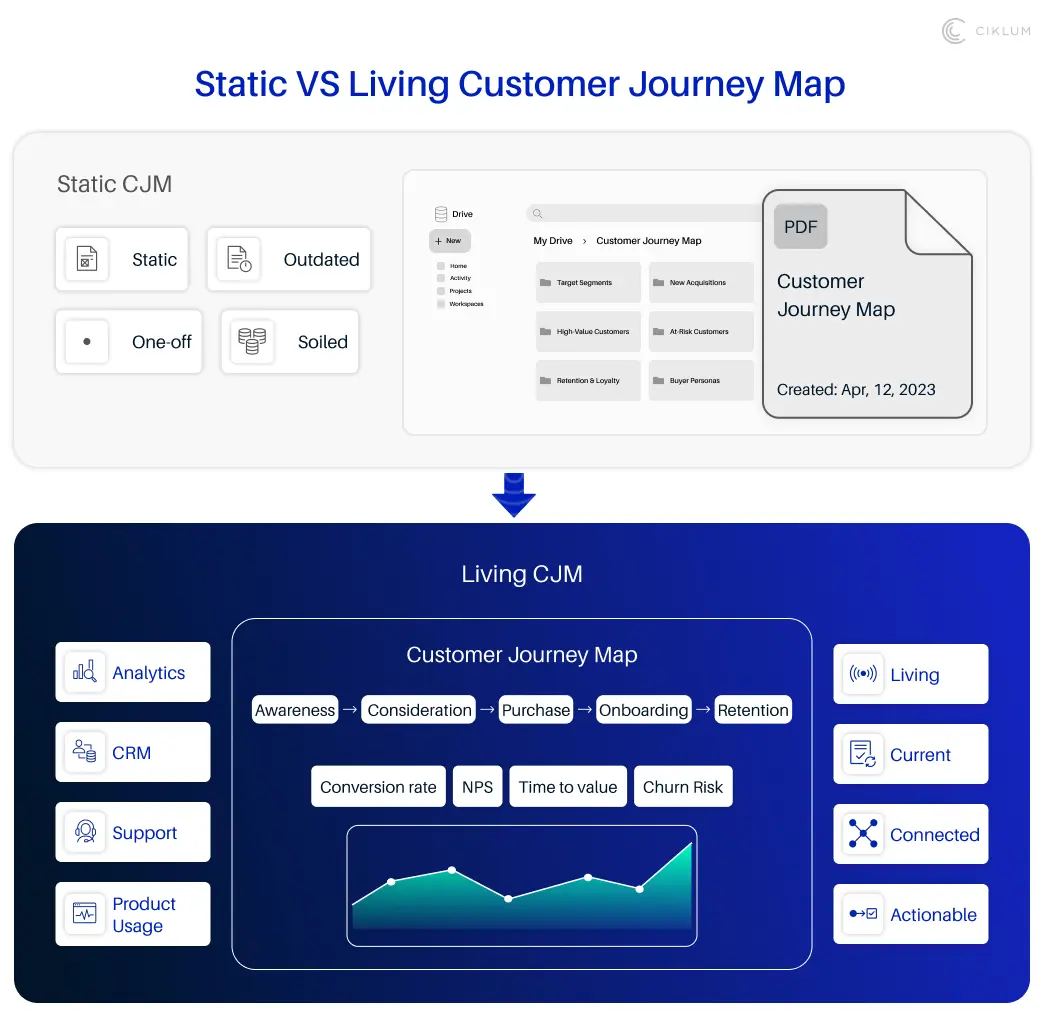
A living customer journey map supports that shift by bringing behavioural data, feedback, product usage, and operational evidence into one shared view that changes as the experience changes.
The Cost of Working from an Outdated Journey
When teams stop trusting the map, they return to their own reports and assumptions. This creates duplicated research, inconsistent priorities, and customer problems that are discovered later than they should be.
Product may invest in the wrong features, marketing may target an assumed journey stage, and support may keep handling problems that began much earlier.
Those gaps create measurable costs through rework, higher support demand, slower decisions, wasted acquisition spend, and avoidable customer loss. One 2026 industry analysis found that organisations without mapped journeys face customer acquisition costs around 20% higher because targeting and messaging remain disconnected.
For a UK enterprise, a customer journey map must also help leaders monitor customer outcomes and respond when journeys create avoidable harm. This is especially important in financial services, where the FCA’s Consumer Duty requires firms to identify poor outcomes and show what they are doing to address them.
The Emergence of the Living Customer Journey Map
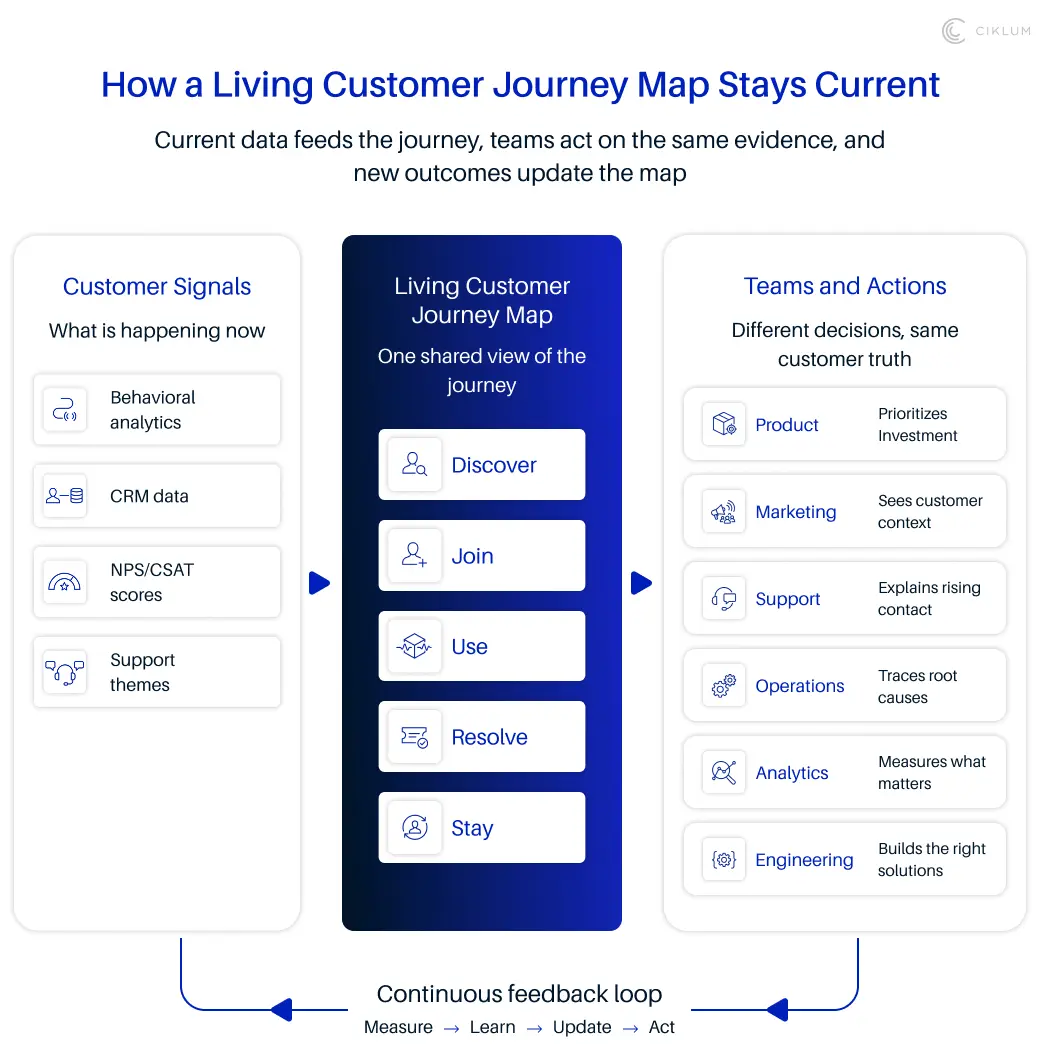
A living customer journey map stays connected to the evidence that shows what customers are experiencing now, bringing together behavioural analytics, CRM information, NPS and CSAT scores, support themes, product usage, research findings, and operational data within one shared view of the journey.
Think of the difference between a photograph and a control panel. A photograph shows what was true at one point, while a control panel shows what is happening now and where attention may be needed.
That current view becomes more valuable when every team works from the same journey stages, evidence, priorities, and measures. Product leaders can use it to decide which friction points deserve investment, while support teams can see why contact volumes are rising and where the underlying problem began.
Teams do not need to use the map in the same way, but they should work from the same customer evidence. This reduces duplicated research, conflicting views, and the risk of different departments solving different versions of the same problem.
How Current Data Keeps the Map Useful
A dynamic customer journey map becomes more useful when it draws from the data teams already collect rather than waiting for another large research project.
Connecting journey maps with analytics helps teams see where customers leave a process, where conversion slows, and which stages create the most support demand. CRM records can add relationship context, support data can expose recurring problems, and research can explain why the behaviour is happening. When those signals change, the map can be updated before old assumptions shape another quarter of decisions.
Agentic AI systems can monitor signals across these sources, group recurring themes, and flag journey stages that may need attention. They do not replace research or human judgement, but they reduce the time teams spend manually joining the dots.
The goal is not to give the journey map a mind of its own. It is to stop experienced teams spending days connecting evidence that is already sitting in front of them.
How a Living Customer Journey Map Improves Decisions Across Teams
A living CJM earns its budget when it improves decisions across the organisation.
Product and Engineering Can Prioritise with Evidence
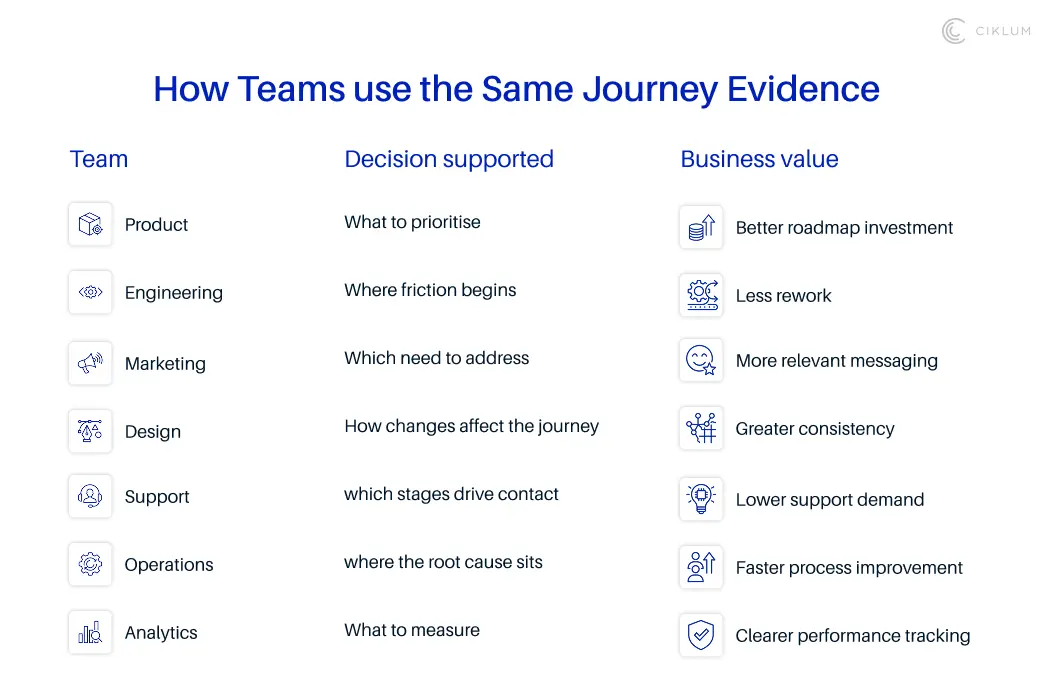
A customer journey map for product teams links roadmap decisions to clear customer friction, business impact, and measurable outcomes.
Instead of prioritising based on internal pressure or whoever speaks most confidently in the meeting, product leaders can see where customers abandon a journey or experience unnecessary effort.
Engineering teams gain context around where the problem appears and which system, process, or component may contribute to it.
Suppose onboarding abandonment rises after a release. The living map can show product leaders where the drop-off began, while giving engineering teams enough context to investigate the cause before it becomes a larger support issue.
Marketing and Design Can Respond to Real Needs
Marketing teams gain a clearer view of the customer’s situation instead of relying only on broad funnel stages or old personas. Campaigns and messages can respond to specific needs and barriers, while performance can be assessed beyond the final click.
For UI and UX teams, the map connects research and behavioural evidence to the wider experience, helping designers understand how a change to one interaction affects what happens before and after it.
Support, Operations, and Analytics Can Fix Root Causes Earlier
Support teams know where customers struggle because they see the calls, complaints, and repeated questions, but those signals often arrive after the experience has failed.
A CJM for operations teams is most useful when it shows what happened earlier in the journey and which process created the customer problem. Operations can trace a complaint back to a delayed approval, unclear message, or broken hand-off rather than treating every case as an isolated failure.
From Customer Sentiment to Moments of Need
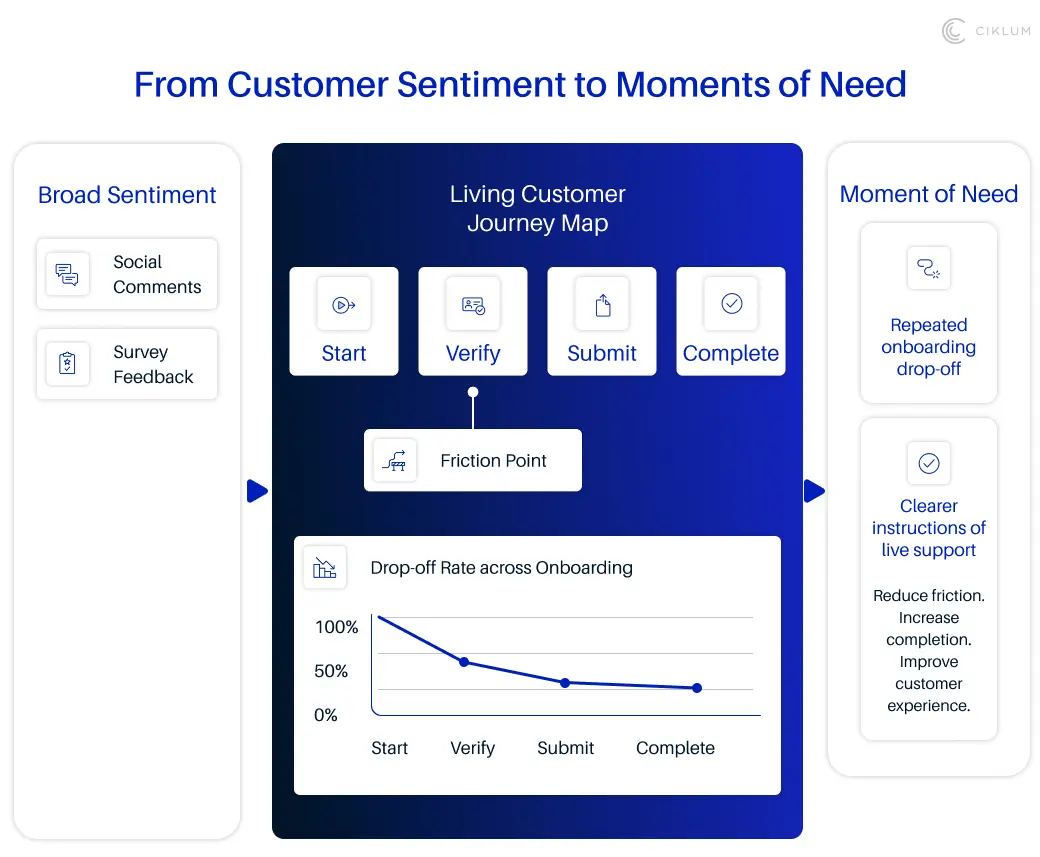
Social media comments, public reviews, and broad sentiment data can tell you how people feel about a brand in general. But they rarely explain what a particular customer needs during an active journey.
A living CJM combines direct feedback with behavioural and transactional evidence. If customers repeatedly leave an onboarding process at the same point, they may need clearer instructions, fewer steps, or access to support rather than another reminder message.
Similarly, if contact volumes rise after a policy or service change, the contact centre may not be the cause. A missing update or unclear message earlier in the journey may have created the demand.
A living map connects what customers say with what they did and where the problem occurred, giving the right team stronger evidence about what may need to change.
The Business Case for Customer Journey Mapping ROI
Customer journey mapping ROI does not come from producing the map itself. It comes from the decisions the map improves and the costs it helps the business avoid.
McKinsey has previously found that improving customer journeys can increase revenue by 10% to 15% while reducing cost to serve by 15% to 20%.
A living CJM can support those outcomes by reducing duplicated research, identifying experience problems before release, lowering avoidable support demand, improving conversion, and helping teams respond to friction before it leads to churn.
Measure the Cost of Keeping the Map Static
The investment case should begin with the cost of the current approach.
Leadership needs to understand how much time teams spend repeating research, how often experience problems appear after launch, which journey failures drive support demand, and where poor insight affects conversion or retention.
Instead of asking whether the organisation should update its map, leaders can ask what the business is already paying because it cannot see the current journey clearly.
The living customer journey map should therefore be positioned as a shared decision system that helps leaders direct investment, assign ownership, and measure whether changes improve customer and business outcomes.
Turn Your Journey Map into a Decision-Making System
Strong customer experience programmes do not abandon journey maps. They keep them current, connect them to the evidence teams already use, and make them part of how the business prioritises work.
You do not need to connect every platform or redesign the entire organisation to begin. Start with one important journey, one accountable owner, and a few trusted measures that show where customer friction affects revenue, cost, compliance, or delivery.
Explore Ciklum’s living customer journey map programme to replace outdated assumptions with current evidence, align teams around the same customer view, and focus investment on the improvements most likely to deliver measurable value.
Find out where your existing journey maps are slowing decisions, increasing costs, or hiding customer friction. Speak to the Ciklum team about turning your journey maps into a practical tool for better decisions.

By Eli McKenzie

Experience & Growth Consultant
Eli McKenzie is a customer experience leader focused on helping organisations understand their customers and turn insight into meaningful business change. Her work spans CX strategy, customer research, journey design and go-to-market strategy, bringing together customer needs, market dynamics and commercial priorities. She works closely with senior and C-suite leaders to shape experiences across digital and physical touchpoints, translating complex insights into practical actions that strengthen customer engagement and drive business impact.
Blogs
Discover Similar Insights

The $17B Contact Centre Opportunity: 5 Conversational AI Trends Reshaping UK CCaaS
Explore the 5 CCaaS Trends
Proven Strategies: How Leading Banks Leverage Analytics to Drive Success
Learn More
How Can You Create a Seamless Customer Journey Across Different Touchpoints to Improve Speed-to-Purchase?
Learn More
Future of Retail: The Role of Digital Twins in Shaping Consumer Choices
Learn More