



- Innovation Has Raised Expectations. It Has Also Raised Risk.
- The Market Gap Is Confidence Engineering
- What Confidence Looks Like In Payments
- AI Makes The Confidence Gap More Urgent
- Technology Enables Confidence. It Is Not The Story.
- How Ciklum Fits
- The Future Belongs To Institutions That Engineer Confidence
Payment institutions have spent years investing in faster rails, new payment methods, cloud platforms, embedded finance, open banking, AI, tokenisation and richer digital experiences.
The direction of travel is clear: payments are becoming faster, more connected and more programmable. In Europe, for example, the Instant Payments Regulation has created new obligations for payment service providers, with the first set applying from January 2025. The ECB has also argued that instant payment-based retail solutions can strengthen resilience and support trust in digital payments.
But speed alone is no longer enough.
The next competitive gap in payments is not only about who can move money faster, launch products quicker or adopt the newest technology first. It is about who can create confidence.
Confidence that payments will work when customers need them.
Confidence that fraud and scams are being actively managed.
Confidence that critical services can withstand disruption.
Confidence that AI, automation and third-party technology are governed properly.
Confidence that customers, regulators and partners can trust the institution behind the transaction.
The Bank for International Settlements made this point clearly in its 2026 work on the next-generation monetary and financial system: digital innovation can improve competition and efficiency, but the future of the system depends on safeguarding trust in money.
That is the confidence gap.
Innovation Has Raised Expectations. It Has Also Raised Risk.
Payments innovation has changed what customers and businesses expect. Transactions are expected to be instant, invisible and always available. Merchants want higher authorisation rates, lower cost, better routing and smoother checkout. Corporates want real-time visibility and stronger control. Consumers want payments that feel effortless, but also safe.
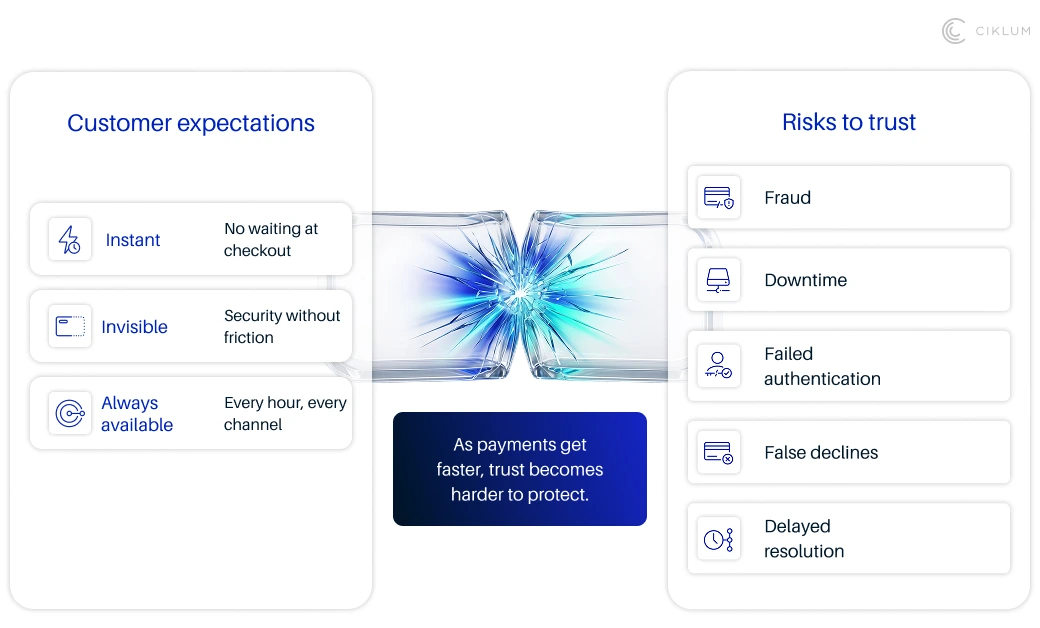
This creates a difficult strategic tension for banks, schemes, PSPs and market infrastructures.
The more payment experiences become real time, the less tolerance there is for delay, downtime, fraud, failed authentication or unclear communication. A slow process used to be frustrating. In a real-time payment environment, the same weakness can become a trust issue.
Fraud shows how high the stakes have become. UK Finance’s 2026 Annual Fraud Report found that criminals stole £1.28 billion through payment fraud in 2025, while authorised push payment fraud rose 19% to £576.4 million.
That is not just a financial loss problem. It is a confidence problem.
Every scam, false decline, failed payment, unclear transaction descriptor or delayed resolution can weaken trust. And in payments, trust is not a soft measure. It directly affects adoption, customer retention, merchant performance, regulatory scrutiny and brand credibility.
The Market Gap Is Confidence Engineering
For a long time, the payments industry has treated innovation as the main story. Faster rails. Better UX. More data. More automation. More AI.
All of that still matters.
But the executive question is changing from:
“What can we launch next?”
to:
“Can we operate this safely, securely and consistently at scale?”
That is where confidence becomes a strategic capability.
The FCA defines operational resilience as the ability to prevent, adapt, respond to, recover from and learn from disruption. It also warns that disruption to important business services can cause wide-reaching consumer harm and threaten confidence in the financial system.
This is particularly important in payments because the service is both critical and emotional. Customers may not think about the infrastructure behind a payment, but they immediately feel the impact when it fails.
A payment institution can have a modern platform and still lose confidence if customers cannot complete transactions, merchants cannot reconcile settlement, operations teams cannot explain failures, or regulators cannot see that risks are being managed.
The gap is not innovation capacity.
It is confidence engineering.
What Confidence Looks Like In Payments
Confidence is not created by one tool, platform or control. It is engineered across the operating model.
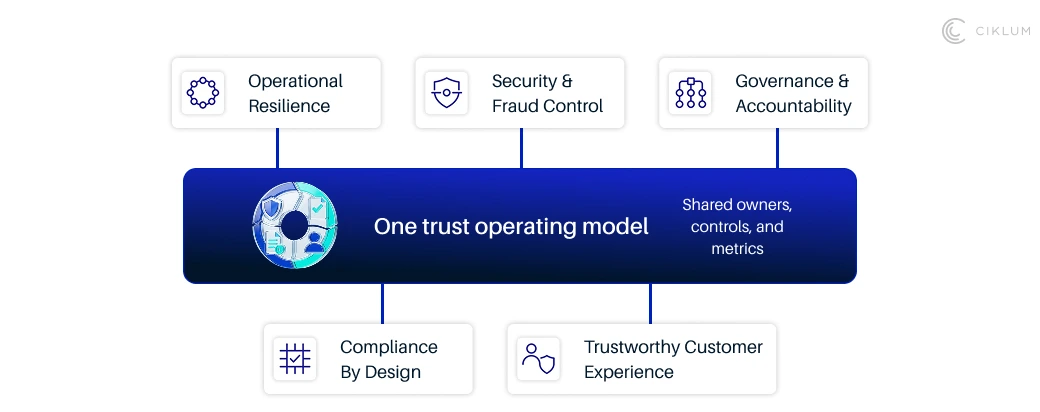
For payment institutions, that means five things.
- Operational resilience
Critical services need to remain available through disruption. That requires mapping important services, understanding dependencies, testing failure scenarios, setting impact tolerances and investing in recovery. The FCA’s operational resilience guidance focuses on important business services, impact tolerances and the ability to remain resilient through disruption. - Security and fraud control
As payments become faster, fraud decisioning has to become smarter without creating unnecessary friction. The goal is not simply to block more transactions. It is to reduce fraud exposure while protecting genuine customers and merchants. - Governance and accountability
AI, automation, cloud, outsourcing and data partnerships all create new accountability questions. DORA, which applies from January 2025, was designed to strengthen ICT security and digital operational resilience across financial entities, including rules on ICT risk management, incident reporting, resilience testing and third-party risk. - Compliance by design
Regulation cannot sit at the end of transformation. It has to shape product design, data flows, customer consent, authentication, reporting, incident response and operational controls from the start. - Trustworthy customer experience
Confidence is also built in the moments customers actually see: clear payment journeys, accurate transaction information, low-friction authentication, fast dispute handling, transparent communication and consistent service recovery.
This is the real executive challenge. Payments transformation is no longer just about creating better digital experiences. It is about making those experiences dependable.
AI Makes The Confidence Gap More Urgent
AI is becoming part of the payments conversation, from fraud detection and customer operations to reconciliation, liquidity forecasting, payment exception handling and risk monitoring.
But AI also raises the bar for governance.
The World Economic Forum’s 2026 AI Playbook for Financial Services argues that as financial institutions move from AI experimentation to scaled use, trust, governance and human oversight become central tests. It also notes that differentiation will come from the quality of customer relationships, transparency and confidence in how AI is used.
That matters in payments because AI is not operating in a low-risk environment. A poor recommendation can delay a payment, block a genuine customer, miss a fraud signal, create a compliance issue or damage customer trust.
So the executive question should not be:
“How much AI can we introduce?”
It should be:
“Where can AI improve confidence?”
That might mean using AI to detect suspicious patterns earlier, prioritise exception queues, reduce manual investigation, improve customer communication, identify operational weak spots or support faster incident response.
But the technology only creates value if it is integrated into controlled workflows, with clear ownership, explainability, escalation routes and measurable outcomes.
Technology Enables Confidence. It Is Not The Story.
This is the central shift payment leaders need to make.
Technology is essential, but it should not become the story itself.
A cloud migration is not the outcome. The outcome is stronger resilience, faster recovery and scalable operations.
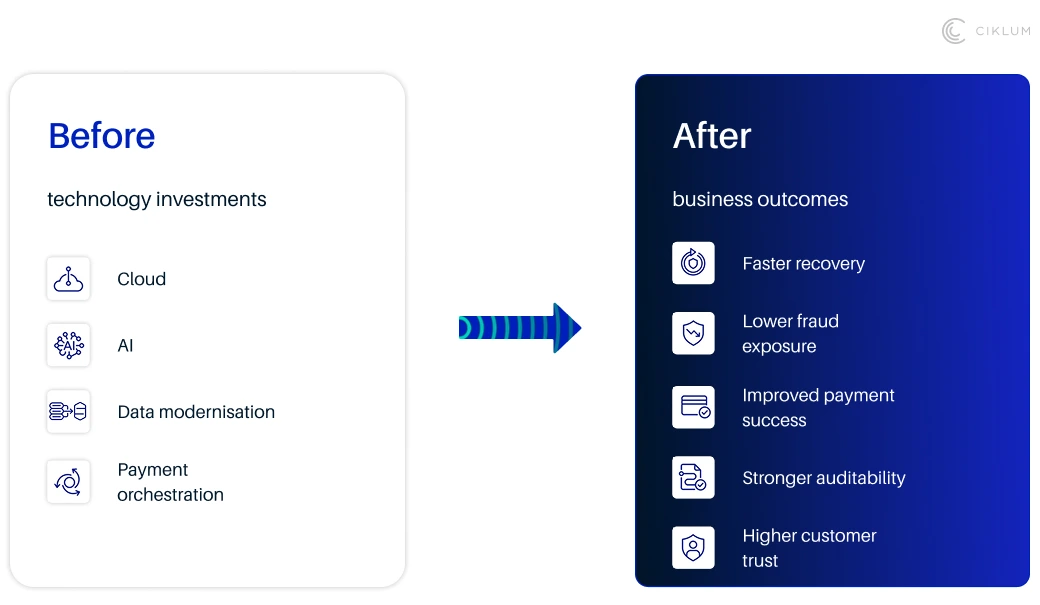
AI is not the outcome. The outcome is better fraud detection, faster investigation and lower customer friction.
Data modernisation is not the outcome. The outcome is better decision-making, stronger risk visibility and more personalised, trusted experiences. Payment orchestration is not the outcome. The outcome is higher payment success, lower cost, better routing and stronger continuity.
The organisations that win will be the ones that connect technology investment to board-level confidence metrics:
- fewer critical incidents;
- faster recovery from disruption;
- lower fraud exposure;
- fewer false declines;
- improved payment success rates;
- stronger auditability;
- better regulatory readiness;
- clearer third-party risk visibility;
- faster operational decision-making;
- higher customer and merchant trust.
That is how payment transformation becomes commercially meaningful.
How Ciklum Fits
For Ciklum, the opportunity is to support payment institutions in building trusted, resilient and well-governed digital payment operations.
That means helping clients move beyond isolated technology delivery and towards confidence-led transformation: modernising platforms, improving orchestration, strengthening integration, embedding governance, and ensuring payment operations are built for scale.
Ciklum’s BFSI expertise includes designing and scaling secure payment ecosystems across orchestration, gateway consolidation, open banking connectivity and complex multi-provider integrations.
This is important because payment confidence depends on how well the ecosystem works together. Banks, PSPs and schemes rarely operate in simple environments. They depend on multiple providers, legacy systems, fraud tools, data platforms, regulatory controls, internal operations teams and customer-facing channels.
Ciklum’s AI Strategy Leadership Clinics also focus on establishing AI leadership and ownership, defining governance, prioritising initiatives that deliver measurable business value, and creating board-ready execution plans.
That is where Ciklum’s role becomes valuable: not presenting technology as the answer, but engineering the operating environment that allows technology to deliver business confidence.
The Future Belongs To Institutions That Engineer Confidence
Payments will continue to innovate. Faster rails, richer data, AI-led operations, embedded payments, tokenisation and new customer experiences will all shape the next phase of the market.
But innovation will not be enough on its own.
The institutions that lead will be the ones that can make innovation dependable. They will be able to prove that their payment operations are resilient, secure, governed, compliant and trusted.
That is what customers need.
That is what regulators expect.
That is what merchants and partners depend on.
And that is what boards should measure.
The next phase of payments transformation will not be defined only by who moves fastest.
It will be defined by who earns the most confidence.

By Mark Westbrook

Global Head of Architecture
18+ Exp
Mark brings 18+ years of payments expertise, spanning POS, Open Banking, and Core Payment Rails. As Global Solutioning Director, he crafts innovative strategies that drive operational excellence across payments and banking.
Blogs
Discover Similar Insights

AI Agent Orchestration: Types, Architecture, and Production Checklist
Learn More
A Practical Enterprise Architecture for Intelligent Automation
Explore the Reference Architecture