



Key Takeaways
- Complexity is the enemy of production deployment: A single AI tool call achieves 85–90% accuracy. Chain four or five together in a multi-agent architecture and success becomes a coin flip. Most enterprises are over-engineering problems that need simpler, tiered solutions.
- Match the automation tier to the problem: Rules handle pattern matching. Workflows handle sequencing. AI handles judgment. The architecture should make it easy to use the right tool at the right layer and not force everything through the most advanced one.
- Four components, not forty: A practical intelligent automation architecture needs a data layer, a decision layer, an execution layer, and a governance layer. Everything else is implementation detail.
- Start with what you have: Organizations do not need perfect infrastructure to begin. They need a clear operating model that defines who owns what, how each layer connects, and where humans stay in the loop.
Search for "enterprise intelligent automation architecture" and you will likely encounter diagrams featuring numerous components, interconnecting arrows, and multiple layers of frameworks and acronyms. While these blueprints can be technically comprehensive, they may not always translate directly into practical solutions for teams implementing real-world systems.
This scenario appears in many industries. Teams often design multi-agent architectures with various orchestration layers, memory systems, and complex routing logic. Such designs may function well in demonstration environments but encounter difficulties in production if necessary data foundations, governance processes, or operational maturity are not in place.
In many cases, adopting a simpler, more practical blueprint for intelligent automation can be more effective for successful implementation.
Why Simpler Architectures Win
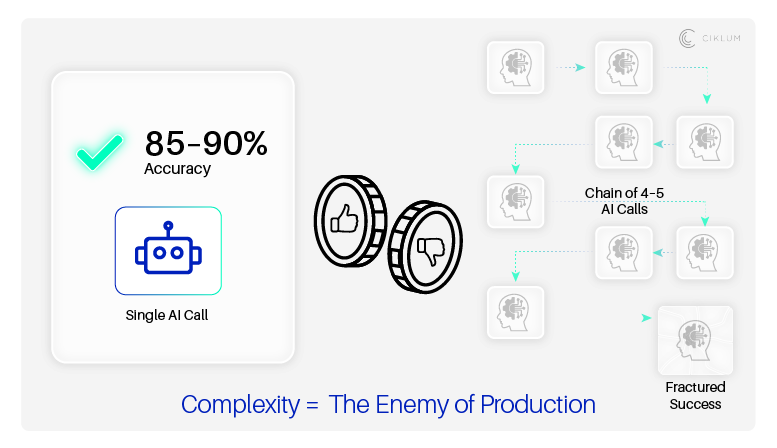
There is a well-documented relationship between architectural complexity and reliability in AI systems. Each step in a multi-agent chain introduces latency, cost, and compounding error. A single LLM call is relatively reliable; add several sequential calls (each depending on the previous output) and cumulative reliability falls sharply.
This does not mean AI agents have no place in enterprise architecture. It means the architecture should direct each task to the appropriate tier of complexity.
Tier 0: Rules and deterministic logic - Pattern matching, keyword-based routing, decision trees, and validation checks are highly effective for handling high-volume, well-defined tasks at virtually zero marginal cost. In production benchmarks, rule-based systems can achieve up to 68% accuracy on classification tasks - areas where many teams often default to using LLMs.
Tier 1: Structured workflows with conditional logic - Process orchestration, approval chains, exception routing, system-to-system handoffs. This is where traditional workflow automation and RPA operate, sequencing deterministic steps across systems reliably.
Tier 2: AI-assisted decisions within bounded workflows - Classification, extraction, summarization, and recommendation - these are discrete AI capabilities embedded at key decision points within an otherwise deterministic workflow. The AI makes the judgment calls, while the workflow manages everything around it.
Tier 3: Autonomous agents with multi-step reasoning - End-to-end task execution involves planning, tool usage, error handling, and continuous adaptation. This is where agentic AI operates - and where demands for reliability, cost efficiency, and governance are at their highest.
A practical architecture makes it easy to apply the right tier to each task, while an overcomplicated blueprint defaults everything to Tier 3.
Four Layers, Not Forty
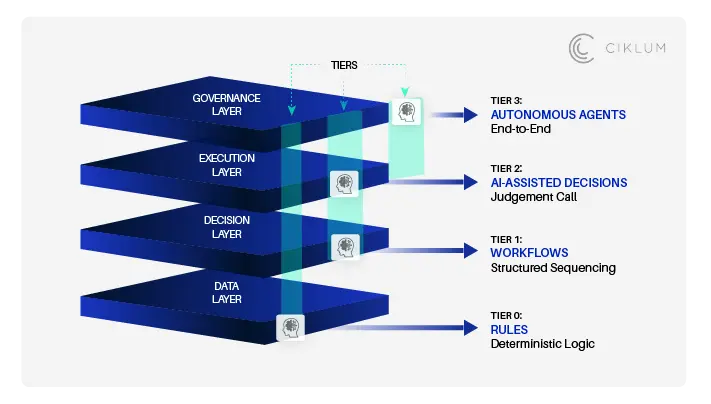
Set aside the vendor-specific terminology and framework acronyms, and every intelligent automation architecture reduces to four layers.
The Data Layer
Automation systems need access to operational data such as customer records, order status, inventory levels, transaction history, policy documents. The data layer provides consistent, timely access to this information regardless of where it lives.
This doesn’t require a unified data lake or a multi-year migration. It requires clarity on which data sources each automation workflow depends on and ensuring those sources are accessible via APIs with sufficient freshness. Start with the data your highest-priority workflow needs, build access around that, and expand from there.

The Decision Layer
This is where intelligence lives. The logic that determines what happens next. At the simplest level, it is a rules engine. At the most advanced, it is an AI agent that reasons through ambiguous situations.
The critical design principle is separation. Decision logic should not be embedded inside execution code or hardwired into integration scripts. It should sit in its own layer where it can be tested, monitored, updated, and swapped without rebuilding the entire workflow.
This separation is what allows organizations to start simple and add intelligence incrementally. A customer service workflow can begin with rule-based routing, add an LLM-based classification step when the volume of edge cases justifies it, and eventually incorporate an autonomous agent for end-to-end resolution without redesigning the surrounding architecture.
The Execution Layer
Decisions without execution are recommendations. The execution layer is what gives automation systems write access to the enterprise, e.g., processing transactions, updating records, triggering workflows, sending notifications, calling external APIs.
For deterministic tasks, this is RPA or direct system integration. For agent-driven tasks, it is function calling and tool use through well-defined interfaces. Either way, the execution layer must enforce boundaries: which actions are permitted, which require human approval, and what happens when an action fails.
For example, an automotive manufacturer partnered with Ciklum to scale this approach in practice. They started with over 200 RPA automations handling structured back-office tasks, and then incrementally introduced intelligent document processing, conversational AI, and process mining. Each addition extended the execution layer’s capabilities without disrupting what already worked - ultimately delivering more than £1 million in savings.
The Governance Layer
Governance is not a compliance checkbox. It is the layer that determines whether the other three layers can operate safely at scale.
At minimum, it covers: who authorized each automated action (audit trail), what data the system accessed and why (lineage), whether the system is performing within expected parameters (monitoring), and what happens when it drifts outside them (alerting and escalation).
For rule-based automation, governance is straightforward. The rules are the documentation. For AI-driven decisions, governance requires more: explainability of outputs, drift detection on model performance, and clear escalation paths when the system encounters situations outside its training distribution. Building compounding AI systems that learn and improve over time depends on governance that can track what changed, why, and with what effect.
The organizations that embed governance from day one scale faster than those that retrofit it after the first incident.
The Operating Model Matters More Than the Technology
Architecture diagrams describe the system. Operating models describe how people work with it.
An intelligent automation operating model answers practical questions: Who owns each automation workflow? Who approves changes to decision logic? How are new use cases prioritized and resourced? What metrics define success?
Without clear answers, automation initiatives fragment. Different teams build overlapping solutions on different platforms. Governance is inconsistent. Nobody can answer the question, "How many automated decisions did we make last month, and how many were correct?"
The operating model does not need to be elaborate. It needs to exist, be documented, and be enforced. KPMG's 2026 AI Pulse survey found that 78% of Fortune 500 companies will deploy agentic AI this year. The ones that succeed will not be the ones with the most advanced models. They will be the ones with operating models that keep pace with what they deploy.
Conclusion
The gap between intelligent automation ambition and production reality isn’t a failure of technology - it’s a failure of alignment. The organizations that close this gap are the ones that match automation tiers to problem complexity, keep their architecture intentionally simple, and define a clear operating model before they scale.
In practice, success comes from discipline over sophistication. It’s about building systems that can be deployed quickly, governed reliably, and extended without friction - not ones that look impressive on paper but stall before reaching production.
The most effective architectures aren’t the most elaborate - they’re the ones that work.

By Ciklum Editorial Team

Ciklum’s Editorial Board is a collective of experienced writers and industry experts, bringing together perspectives shaped by real-world engineering and delivery experience. Through collaborative insights, the team explores how technology, AI, and digital innovation move from concept to execution across industries.
Blogs
Discover Similar Insights

Monolith vs Microservices: Which Architecture Works Best at Scale
Learn More
AI Agent Orchestration: Types, Architecture, and Production Checklist
Learn More
Why Enterprise AI Automation Programs Fail, and How to Make Sure Yours Doesn’t
Learn More
Inside Intelligent Automation: How It Works in Real Enterprise Environments
Explore How It Works in Production