



Key Takeaways
- The scaling gap is real: 40% of enterprise applications will embed AI agents by the end of 2026, but only 2% of organizations have deployed agents at full scale. The bottleneck is not AI capability, but architecture.
- Automation layers are collapsing into one: RPA, workflow orchestration, and AI agents used to be separate systems with separate teams. They are converging into a single automation architecture, and most enterprises still manage them in silos.
- Legacy infrastructure cannot support agentic workloads: Over 40% of agentic AI projects risk abandonment by 2027 because the underlying systems lack real-time APIs, modular design, and the governance frameworks that autonomous agents require.
- Readiness is an architecture problem, not a model problem: The organizations pulling ahead are redesigning how automation flows through the enterprise, not just picking better AI models.
Over the last two years, the rise of generative and agentic AI has fundamentally changed what’s possible for enterprise automation. Organizations are seeing proof-of-concept AI agents capable of handling customer requests, orchestrating complex workflows, or making real-time decisions previously reserved for human teams. Yet, for most enterprises, these breakthroughs remain stuck in isolated pilots rather than driving transformation at scale.
Why is this the case? The reality is that technical capability is outpacing enterprise readiness. The vast majority of organizations are unprepared for the demands that true AI-driven automation brings, from real-time data access and API-first integration, to non-human identity management and governance at machine speed.
This blog unpacks the architectural shifts required to unlock agentic AI at scale, the pitfalls keeping companies stalled at the pilot stage, and practical steps to get your business ready for the next wave of autonomous automation.
The $30 Billion Lesson
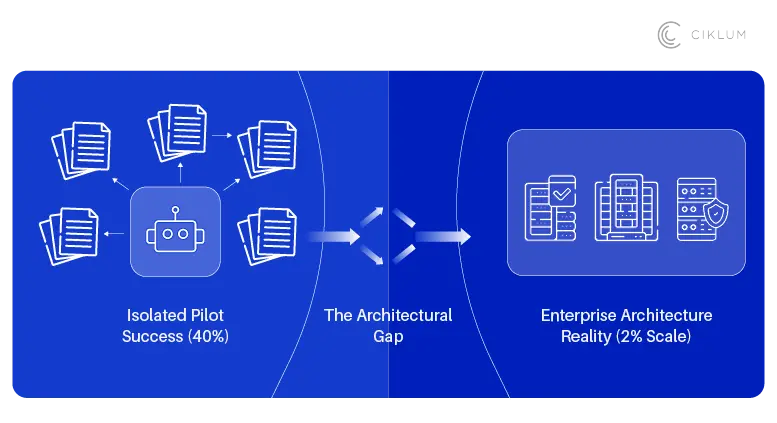
Enterprises have now invested an estimated $30–40 billion in generative AI initiatives globally. Yet according to Consulting Magazine, 90–95% report little to no measurable financial return. That is not a technology failure. It is an architecture failure.
The pattern is familiar: a team builds a successful AI pilot, be it a customer service bot, a document classifier, an internal knowledge assistant. It works well in isolation. Then it hits the rest of the organization. The data it needs is locked in a system it cannot access. The workflow it should trigger runs on a platform it was never designed to talk to. The governance model that covers manual processes has no framework for autonomous decisions.
This is the gap between AI capability and enterprise readiness. And in 2026, it is widening.
Gartner predicts that 40% of enterprise applications will have embedded AI agents by the end of this year, an eightfold increase from 2025. Meanwhile, Camunda's State of Agentic Orchestration report found that only 27% of decision-makers believe their agentic AI vision aligns with current reality. The ambition is there. The architecture is not.
Three Automation Layers, Once Separate, Now Unified
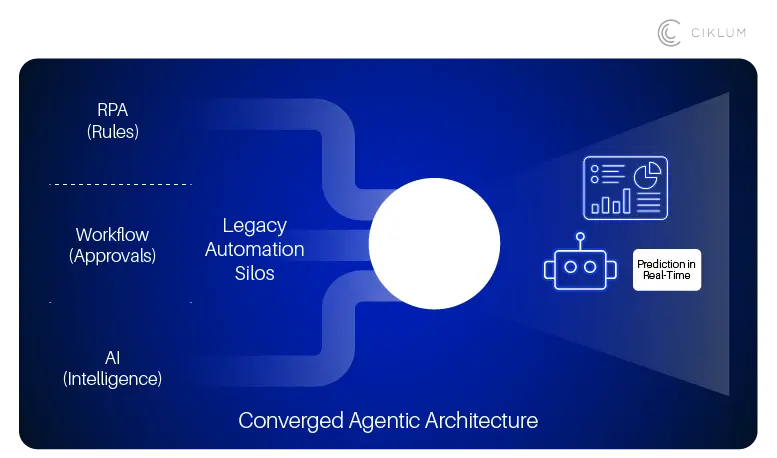
For the past decade, enterprise automation has been organized into distinct layers, each with its own tools, teams, and governance.
1.Rule-based automation (RPA) handles structured, repetitive tasks, moving data between systems, processing forms, and validating records. It is fast, cheap, and deterministic. It does exactly what you tell it to do.
2.Workflow orchestration manages process flows across systems and teams such as approvals, handoffs, escalations, exception routing. Tools like Temporal, Airflow, and Camunda handle the sequencing.
3.AI and machine learning adds intelligence, classification, prediction, natural language understanding, anomaly detection. Historically, these capabilities were embedded as features within existing workflows rather than driving them.
What is changing is that these layers are collapsing. Agentic AI systems do not fit neatly into any one layer. An AI agent that handles customer disputes needs to read unstructured data (AI), follow a defined resolution process (orchestration), and execute transactions in backend systems (RPA-level execution). It needs all three capabilities in a single workflow, coordinated in real time.
Most enterprises still manage these as separate technology stacks with separate teams and separate budgets. That organizational structure worked when automation was task-level. It breaks down when automation becomes workflow-level, and it breaks down completely when agents start making decisions across systems.

Why Legacy Architecture Cannot Support Agentic Workloads
The architectural requirements for agentic AI are fundamentally different from what most enterprise systems were designed to deliver.
Real-time data access: Agents query information continuously. An inventory agent making pricing decisions needs current stock levels, not yesterday's export. A customer service agent resolving a dispute needs the latest order status, payment history, and return policy in the same call. Most enterprise data architectures were built around periodic synchronization, not real-time retrieval.
Modular, API-first interfaces: Agents interact with systems through APIs, not through user interfaces. If your ERP, CRM, or WMS only exposes functionality through screen-based workflows, an agent cannot reach it. Legacy modernization efforts that stop at re-platforming without exposing clean APIs leave the same bottleneck in place just on newer infrastructure.
Secure identity and permissions for non-human actors: When an agent processes a refund, adjusts a price, or reroutes a shipment, who authorized the action? Existing access control models were built for human users with human roles. Agents need their own identity layer with granular permissions, audit trails, and escalation rules that define exactly what they can and cannot do autonomously.
Governance that operates at machine speed. Compliance and approval workflows designed for human review cycles (hours, days) cannot govern systems that make thousands of decisions per minute. The shift from copilot to operating model requires governance frameworks that are embedded in the architecture, not layered on top after deployment.
Deloitte's 2026 agentic AI analysis warns that over 40% of agentic AI projects could be abandoned by 2027 because organizations have not addressed these architectural prerequisites. The failure mode is not that the AI does not work, it is that the organization cannot safely let it operate.
What a Modern Enterprise Automation Architecture Looks Like
Organizations that are successfully scaling AI automation share a common architectural pattern, regardless of industry.
A unified data layer that agents can query in real time: This is not a data lake, it is a data fabric that connects operational systems (ERP, POS, CRM, WMS) into a single, consistent layer with real-time access. Without this, agents operate on stale or incomplete information and make decisions that do not reflect reality. A global consumer goods company that Ciklum worked with replaced fragmented manual reporting across 22+ sources with a unified Snowflake and Azure-based data platform eliminating the data gaps that would have made agent deployment impossible.
An orchestration layer that coordinates human and AI work: Agents do not operate alone. They work alongside human teams, other agents, and existing automated processes. The orchestration layer manages this: routing tasks, handling exceptions, enforcing sequencing, and escalating when needed. This is where the old distinctions between RPA, workflow, and AI converge into a single automation architecture.
An action layer with clear boundaries: Agents need write access, the ability to execute transactions, update records, trigger workflows. But that access must be bounded. Which actions can the agent perform autonomously? Which requires human approval? What happens when the agent encounters a scenario outside its boundaries? These rules must be defined in the architecture, not improvised during deployment.
Continuous governance, not periodic review: Audit trails, explainability, compliance checks, and performance monitoring must run at the same speed as the agents themselves. A compounding AI system that learns from every interaction also needs oversight that learns from every interaction catching drift, bias, or policy violations before they scale.
Where to Start
The enterprises that are making progress are not trying to redesign everything at once. They start with the architectural prerequisites that unlock the highest-value use cases.
Assess data readiness first: Data quality and accessibility are cited as the primary blocker. Before selecting AI models or building agents, audit where critical operational data lives, how it flows between systems, and what it takes to access it in real time. This is the foundation everything else depends on.
Pick one high-friction workflow and redesign it end to end: Do not automate the existing process. Redesign it with the assumption that an agent will handle the operational load, a human will handle the exceptions, and an orchestration layer will manage the handoff between them. An automotive manufacturer Ciklum partnered with started with 200+ RPA automations and then layered in AI agents (conversational AI, intelligent document processing, and process mining) delivering over £1 million in savings by building each capability on top of a solid automation foundation.
Build the governance framework before scaling: Define agent permissions, escalation rules, audit requirements, and compliance boundaries while the scope is small. Retrofitting governance onto a scaled system is significantly harder and riskier than embedding it from the start.
Conclusion
The defining challenge of enterprise automation in 2026 is not selecting the right AI model. It is building the architecture that lets AI operate safely, reliably, and at scale across the organization.
That means unified data layers, modular APIs, real-time orchestration, and governance frameworks designed for autonomous systems. The organizations that treat this as an architecture problem rather than an AI procurement problem are the ones that will close the gap between pilot and production.
The technology is ready. The question is whether the infrastructure underneath it is ready too.

By Ciklum Editorial Team

Ciklum’s Editorial Board is a collective of experienced writers and industry experts, bringing together perspectives shaped by real-world engineering and delivery experience. Through collaborative insights, the team explores how technology, AI, and digital innovation move from concept to execution across industries.
Blogs
Discover Similar Insights

Retail Reinvented: How AI Automation Drives Personalization and Inventory Decisions
Learn More
AI Automation in Healthcare: Transforming Patient Data and Operations
Learn More
Monolith vs Microservices: Which Architecture Works Best at Scale
Learn More
AI Agent Orchestration: Types, Architecture, and Production Checklist
Learn More