



- RPA, chatbots, and AI agents solve different problems. Treating them as interchangeable leads to mismatched implementations that either break on exceptions or cost far more than they should.
- RPA automates clearly defined, rule-based tasks with speed and cost efficiency. Chatbots handle the conversation layer. AI agents handle the judgment calls, exceptions, and multi-system coordination that the other two cannot. Most enterprise processes need all three working together.
- The key question isn't "which tool to buy," but "which workflow parts need structured execution, a conversational UI, or adaptive reasoning?" Matching the right tech to each task boosts savings, speed, and reliability.
The enterprise automation market is full of overlapping terminology. RPA vendors are adding "AI" to their platforms. Chatbot vendors are calling their products "agents." Agent frameworks are absorbing capabilities that used to belong to RPA. The sense of bewilderment is palpable for engineering and business leaders tasked with making this decision. And it leads to a common mistake: picking one tool and trying to force every workflow through it.
Each of these technologies does something specific well. The useful question is not "which one is best" but "which part of this workflow needs which capability." This article breaks down the practical differences between RPA, chatbots, and AI agents, where each fits, and how production systems typically combine them.
RPA: The Hands
RPA does exactly what you tell it to do, in exactly the order you specify. It clicks buttons, fills forms, copies data between systems, and follows deterministic scripts. If the process is well-defined, high-volume, and rarely changes, RPA is fast to deploy and reliable.
The limitation is that RPA has zero tolerance for ambiguity. If a form layout changes, the bot breaks. If an input arrives in an unexpected format, the bot breaks. If a step requires judgment (should this invoice be routed to compliance or to finance?), the bot cannot help.
RPA works best for data migration between legacy systems, repetitive data entry where inputs are structured, scheduled report generation, and processes where the steps are identical every time.
We’ve seen this in action with a UK-based automotive manufacturer that partnered with Ciklum.
The company had already built 200+ process automations using RPA, with bots effectively handling structured, repetitive tasks.
However, their ambition extended beyond automation. They aimed to reduce operational costs across every business function while progressing toward truly touchless operations. Achieving this required more than execution alone - it called for a layer of intelligence on top of existing systems. That’s where AI agents come into play (something we’ll dive into next).
Chatbots: The Voice
Chatbots provide a conversational interface. A user asks a question or makes a request, and the chatbot responds. Traditional chatbots follow scripted conversation trees. LLM-powered chatbots can handle more flexible language, but the underlying pattern is the same: one question, one response.
Chatbots work well for customer service deflection (answering FAQs, checking order status), employee self-service (IT help desk, HR policy questions), and any scenario where a user needs information and a conversation is the natural way to get it. In automotive, AI-powered chatbots now handle up to 80% of customer inquiries, with roughly 90% of those resolved without human escalation.
The limitation is that a chatbot responds. It does not plan. It does not chain actions together across systems. If a customer says "cancel my subscription, refund the last payment, and send me a confirmation email," a chatbot can handle that only if someone has pre-built each step as a separate integration. It cannot reason through the sequence on its own or adapt when one step fails.
AI Agents: The Brain
An AI agent takes a goal and works toward it. It reads the goal, examines its available tools (APIs, databases, services), decides which to call first, reads the result, and decides what to do next. If a step fails, it reasons about the failure and tries a different approach.
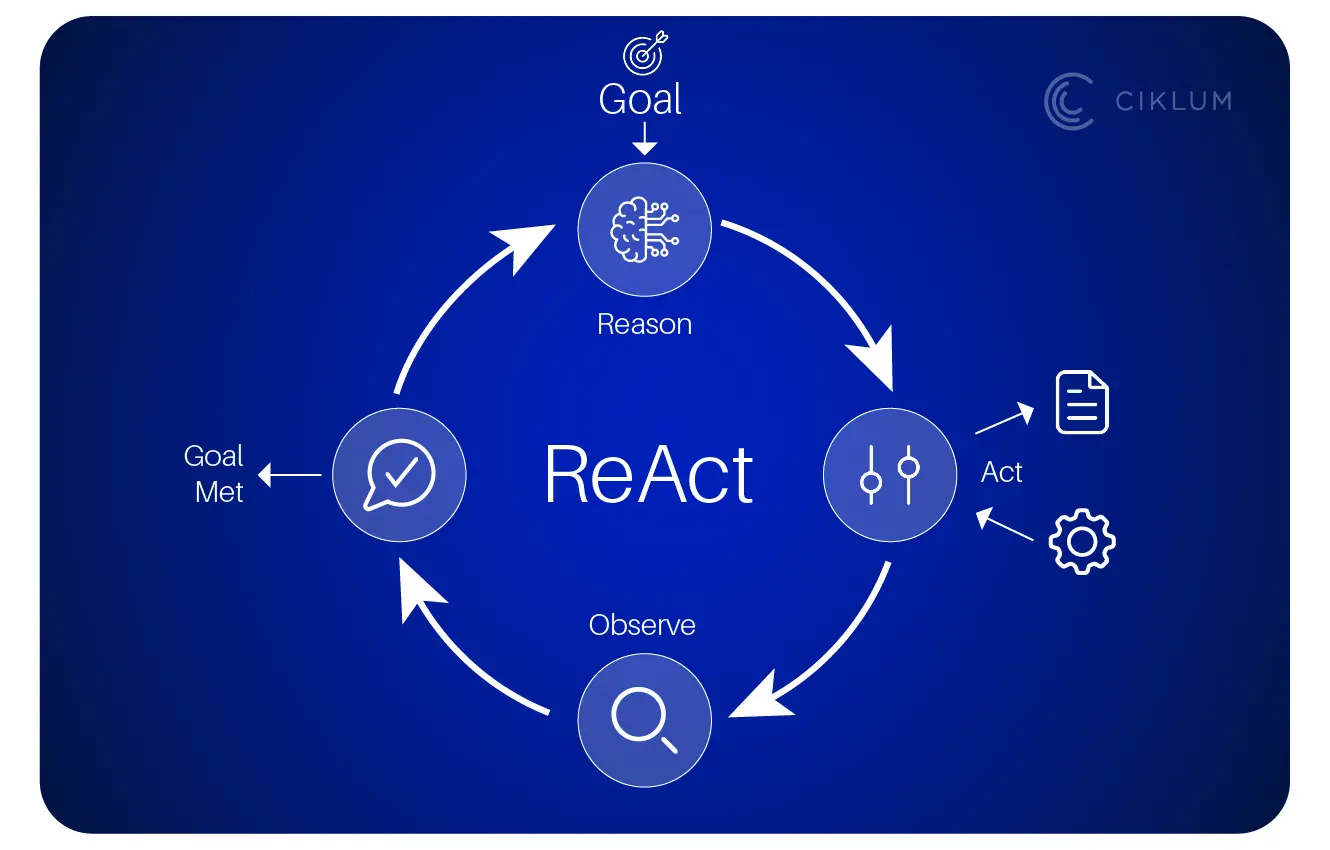
The agent pattern (called ReAct: Reason + Act) runs in a loop:
Goal received
→ Agent reasons about first step
→ Calls a tool
→ Reads the result
→ Decides next step (or adjusts if something failed)
→ Repeats until goal is met or step limit is reached
This makes agents suited for workflows that require multiple steps across multiple systems, judgment calls in the middle of a process, handling of exceptions and edge cases, and adaptation when inputs are messy or incomplete.
In our recent enterprise AI automation guide, this distinction is framed clearly as a cognitive spectrum: RPA is the "hands" (deterministic execution on structured data), intelligent automation is the "brain" (adaptive processing of mixed data), and agentic AI is the "conductor" (context-aware orchestration that plans and adjusts).
The diagram below illustrates the cyclical "ReAct" reasoning loop that is characteristic of AI agents.
Why the Answer is Usually "All Three"
In practice, enterprise workflows rarely fit neatly into one category. A lead-to-cash process has structured data entry (RPA territory), customer-facing interactions (chatbot territory), and exception handling with multi-system reasoning (agent territory).
Ciklum helped a cloud computing company with 100,000+ enterprise customers redesign its entire lead-to-cash operation using this layered approach. The system combined 40+ UiPath bots for structured process automation, ABBYY for intelligent document processing, conversational AI for real-time interaction, and Celonis process mining for end-to-end visibility. RPA handled the repetitive steps. Conversational AI handled the interaction layer. Intelligent automation handled document processing that required interpretation. And an orchestrated pipeline coordinated everything from demand-to-quote through invoice-to-cash.
A similar layered approach emerged when the UK automotive manufacturer moved beyond its 200+ RPA bots. Ciklum introduced conversational AI to manage procurement and customer service interactions, process mining to surface bottlenecks, and intelligent document processing to streamline regulatory compliance. The outcome: over £1M in savings, £10M in procurement inefficiencies identified, and an 80% reduction in regulatory document processing costs. No single technology delivered these results - the impact came from combining them.
How to Decide What Goes Where
When evaluating a workflow for automation, ask three questions about each step:
Is this step identical every time, with structured inputs and no judgment required? That is RPA. Automate it with a bot. It will be fast, cheap, and reliable as long as the inputs stay consistent.
Does this step involve a user asking questions or making requests through a conversational interface? That is a chatbot. Build or buy a conversational layer. If the queries are predictable, scripted flows work fine. If they are open-ended, use an LLM-powered chatbot.
Does this step require reading unstructured inputs, making a judgment call, coordinating across systems, or handling exceptions? That is an agent. Build a reasoning loop with typed tool interfaces, schema validation, and step limits.
Most enterprise workflows span all three layers. The real mistake isn’t in the tools themselves - it’s in trying to force a single technology to handle everything. When an RPA bot hits an exception, it should escalate to an agent, not fail silently. And when a request involves multi-step execution, a chatbot should hand it off to an agent - not mimic capability through brittle, hardcoded integrations.
Today, technology is no longer the limitation. These layers can work together seamlessly. The real challenge and opportunity lie in design: mapping workflows end to end, assigning each step to the right layer, and building clean, reliable handoffs between them. That’s what separates isolated automation from systems that scale.

By Ciklum Editorial Team

Ciklum’s Editorial Board is a collective of experienced writers and industry experts, bringing together perspectives shaped by real-world engineering and delivery experience. Through collaborative insights, the team explores how technology, AI, and digital innovation move from concept to execution across industries.
Blogs
Discover Similar Insights

Beyond Cost Savings: The Real Value of AI Automation for Enterprises
Learn More
How Enterprises Use Generative AI to Automate Knowledge-Heavy Workflows
Learn More
Rewrite Your PDLC: Why AI‑Driven Prototyping is the New Standard in FinTech
Learn More
AI Agents in the Enterprise: Hype, Reality, and Where They Actually Deliver Value
Learn More