



Key Takeaways
- Cost reduction is often where many business cases begin, but it is perhaps the least compelling benefit that AI automation brings to an enterprise.
- The most meaningful gains emerge in speed, where decisions that once took weeks can now be made in hours, along with improved decision quality through fewer errors and better data, and more strategic use of your team’s time.
- Organizations that measure AI only by headcount reduction miss the compounding effects that create long-term competitive separation.
Every AI automation pitch starts with cost savings. It is the easiest metric to model and the easiest to get approved. But the organizations getting the most from AI automation rarely talk about cost when describing what actually changed. They talk about speed. They talk about decisions they could not have made before. They talk about what their people stopped doing and what they started doing instead.
Cost reduction matters. It is real. But treating it as the primary goal often leads to a narrow implementation while leaving the higher-value opportunities untouched.
Speed Matters More Than Savings
The most overlooked benefit of AI automation is compression of time.
When a private equity firm approached Ciklum to help them quickly surface startup recommendations from a 600-company portfolio during live enterprise meetings, their existing process required nearly five hours of preparation for every session. Together, we designed and implemented an AI-powered search platform featuring natural language queries and intelligent matching. As a result, what once took hours dropped to under 10 seconds. While the cost savings were modest, the real transformation lay in enabling the firm’s teams to answer critical business questions in real time - eliminating the need for follow-up meetings and dramatically increasing their speed to insight.
This dynamic shows up consistently when organizations embrace AI automation. While many discussions focus on the time saved for workers, the more transformative impact is in how quickly teams can move from idea to action. Instead of waiting on slow processes, product teams explore and validate customer needs with far greater agility, often adjusting direction before significant resources are committed. Entire discovery and development cycles that once dragged on can now happen within the rhythm of day-to-day work.
Speed, in this sense, enables new capabilities rather than just making old processes a bit quicker. When an organization can experiment, learn, and adapt with greater agility than its peers, it builds a foundation for ongoing growth and improvement.
When Flawed Data Drives Decisions Unchecked
Cost savings are easy to count. Decision quality is harder to quantify, which is why it gets overlooked in most business cases.
Ciklum worked with a billion-dollar pharmaceutical company that was struggling with manual audit categorization, a process riddled with errors that were quietly undermining leadership decisions about lab training, drug prescriptions, and compliance priorities. Ciklum built an ML pipeline that analyzed 400,000+ audit findings using unsupervised learning. The cost story was straightforward: fewer hours on manual classification. But the bigger story was that leadership decisions improved because the underlying data became accurate for the first time. The AI did not just do the work faster. It did the work better, and every decision downstream benefited.
Ciklum has also seen this play out in financial services, where a global payments provider reduced fraud decision times from days to minutes with higher accuracy. The financial savings mattered, but the real gain was in trust. Merchants and consumers stayed on the platform because the fraud detection was faster and more reliable. That is a revenue retention story, not a cost story.
Teams Do Different Work, Not Just Less Work
The workforce narrative around AI automation tends to split into two camps: "AI will replace jobs" or "AI will augment workers." Both framings miss what is actually happening in enterprises that have deployed automation at scale.
What changes is the mix of work. The administrative, repetitive, error-prone tasks shrink. The tasks that require judgment, creativity, and relationship management expand.
HR teams report a 75% improvement in employee engagement after AI adoption. Not because AI made people's existing jobs easier, but because it removed the parts of those jobs that nobody wanted to do in the first place. In healthcare, where 1 in 4 providers are considering leaving due to burnout, AI that handles documentation, scheduling, and claims routing is directly tied to retention. The cost saving from reduced turnover is real, but it is a downstream effect of improving the quality of work itself.
This matters for talent strategy. The organizations that frame AI as a headcount reduction tool will attract people who are anxious about automation. The organizations that frame it as a way to do more interesting work will attract people who want to grow. Over five years, those two talent pools produce very different companies.
The Compounding Effect That Gets Overlooked
AI systems that are designed well do something traditional automation never could: they get better with use.
Every interaction generates data. That data improves the model. The improved model produces better outcomes. Better outcomes drive more adoption, which generates more data. This compounding loop is what separates a one-time efficiency gain from a durable competitive advantage.
A pharmaceutical company that continuously trains its models on real-world patient data does not just get faster at analysis, it gets better at predicting outcomes, which produces better products, which generates more data, which accelerates the next iteration. A competitor starting from scratch two years later is not just behind. They are behind and falling further behind.
This is the argument that cost-only business cases completely miss. Saving 20% on a process is static. Building a system that learns from every transaction is dynamic. The value curves look completely different over a five-year horizon.
Reframing the Business Case
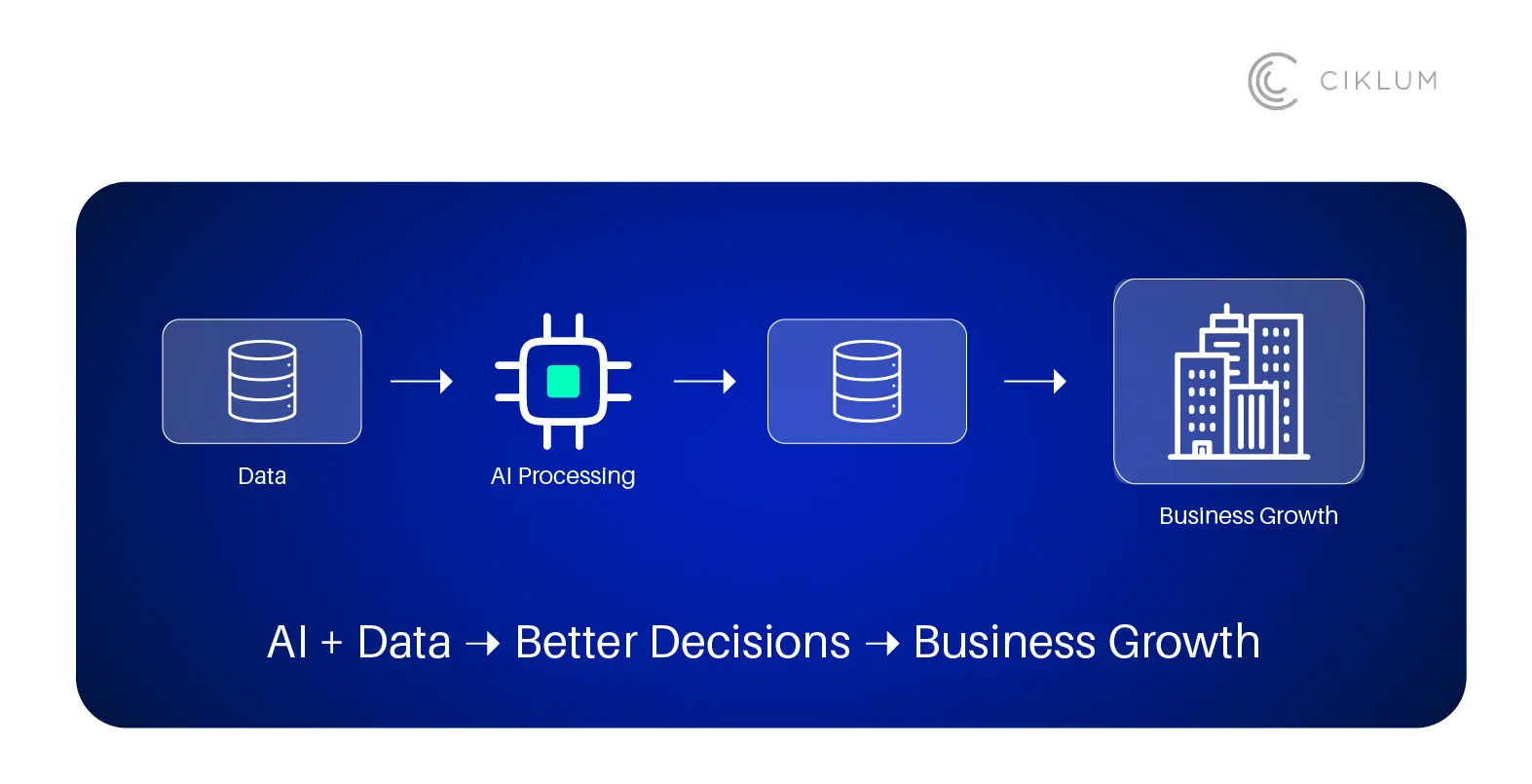
If you are building a business case for AI automation, cost savings should be in the model. But it should not be the headline.
Frame the case around four dimensions:
1.First, time compression. What decisions or processes get faster, and what becomes possible at that speed?
2.Second, decision quality. Where are errors, inconsistencies, or blind spots currently degrading outcomes?
3.Third, workforce evolution. What work shifts from repetitive to judgment-based, and how does that affect retention and capability?
4.Fourth, compounding potential. Does the system get smarter with use, and does that create defensibility?
The organizations that treat AI automation as a cost play get cost savings. The organizations that treat it as an operating model shift get something much harder to replicate.
In other words, the strength of your AI business case lies in how clearly it connects automation to strategic advantage. When the focus expands beyond efficiency to speed, quality, workforce transformation, and long-term defensibility, AI stops being a line item and becomes a lever for reinvention.
Cost savings may justify the investment, but operating model transformation is what truly differentiates the leaders from the followers.

By Ciklum Editorial Team

Ciklum’s Editorial Board is a collective of experienced writers and industry experts, bringing together perspectives shaped by real-world engineering and delivery experience. Through collaborative insights, the team explores how technology, AI, and digital innovation move from concept to execution across industries.
Blogs
Discover Similar Insights
Inside PRODIGY: The Knowledge Engine Behind Enterprise AI
Learn More
How Enterprises Use Generative AI to Automate Knowledge-Heavy Workflows
Learn More
Rewrite Your PDLC: Why AI‑Driven Prototyping is the New Standard in FinTech
Learn More
Why AI Automation Fails Without Modern Enterprise Data Platforms
Learn More