



Key Takeaways
- Mind the Impact Gap: Enterprise AI adoption has crossed 80%, yet only 6% of organizations report material EBIT impact. The gap is about operating models, not technology.
- Proven Task Efficiency: Controlled studies show real productivity gains at the task level: 14% in customer support, 55% on discrete coding tasks, and roughly 5% of total work hours saved across knowledge work.
- Workflow First, Tools Second: High performers are three times more likely to have redesigned workflows before introducing AI. Tool choice is a distant second predictor of business impact.
- Depth Over Breadth: Deep deployment on a small number of high-volume workflows, measured against operational metrics defined before go-live, consistently beats broad rollouts of generic copilots.
Introduction
The enterprise AI conversation has a measurement problem. Headlines announce 85% productivity lifts and hundreds of agents replaced, while peer-reviewed research tracking the same category of deployment finds smaller and more uneven effects. Both pictures are accurate, depending on what is measured and where. The productivity is real. The question worth asking is why most organizations cannot convert it into bottom-line results, and what the narrow band of companies that do are getting right.
This blog walks through that arc using the enterprise AI rollout itself as the subject of the case study.
The Baseline: What Enterprise AI Looked Like Before 2025
The dominant pattern from 2022 to 2024 was broad, shallow deployment. Enterprises stood up ChatGPT subscriptions, added a vendor copilot to the IDE, plugged a chatbot onto the customer service page, and declared the AI strategy complete. Underlying workflows went untouched. A support ticket still routed through the same queue, the same siloed knowledge base, and the same escalation rules. The billing platform still aggregated from five legacy sources. The data warehouse still lagged operations by 24 hours. This is the same tool-first rollout pattern that intelligent automation programs have been repeating for a decade, only now with a generative interface on top.
By the end of 2024, most large organizations had several such deployments running in parallel, almost none of them tied to measurable financial outcomes. According to the Stanford AI Index Report 2025, 78% of organizations had adopted AI in at least one function, up from 55% the prior year. Where firms reported cost savings, they were typically under 10% within specific functions such as service operations and software engineering. Adoption had gone vertical; impact had not.
The Bottleneck: Why Most AI Projects Stalled
Two independent research programs landed on similar numbers. The RAND Corporation study "The Root Causes of Failure for Artificial Intelligence Projects" found that more than 80% of AI projects failed to reach production, roughly twice the failure rate of non-AI IT projects. The MIT NANDA "GenAI Divide: State of AI in Business 2025" report reported that 95% of generative AI pilots delivered no measurable impact on profit and loss (P&L), with only 5% of integrated pilots extracting significant business value.
The root causes were remarkably consistent across both studies. Pilots were selected for executive visibility rather than throughput. Teams optimized model output quality instead of end-to-end workflow time. Data foundations were never fixed before AI was layered on top, the precondition that 6 key challenges in AI engineering consistently surface as the gap between demo and production. Governance was treated as a post-launch checklist rather than designed into the architecture. Most importantly, the process around the AI was left intact, which meant that whatever the model saved at one step was absorbed by the friction at the next.
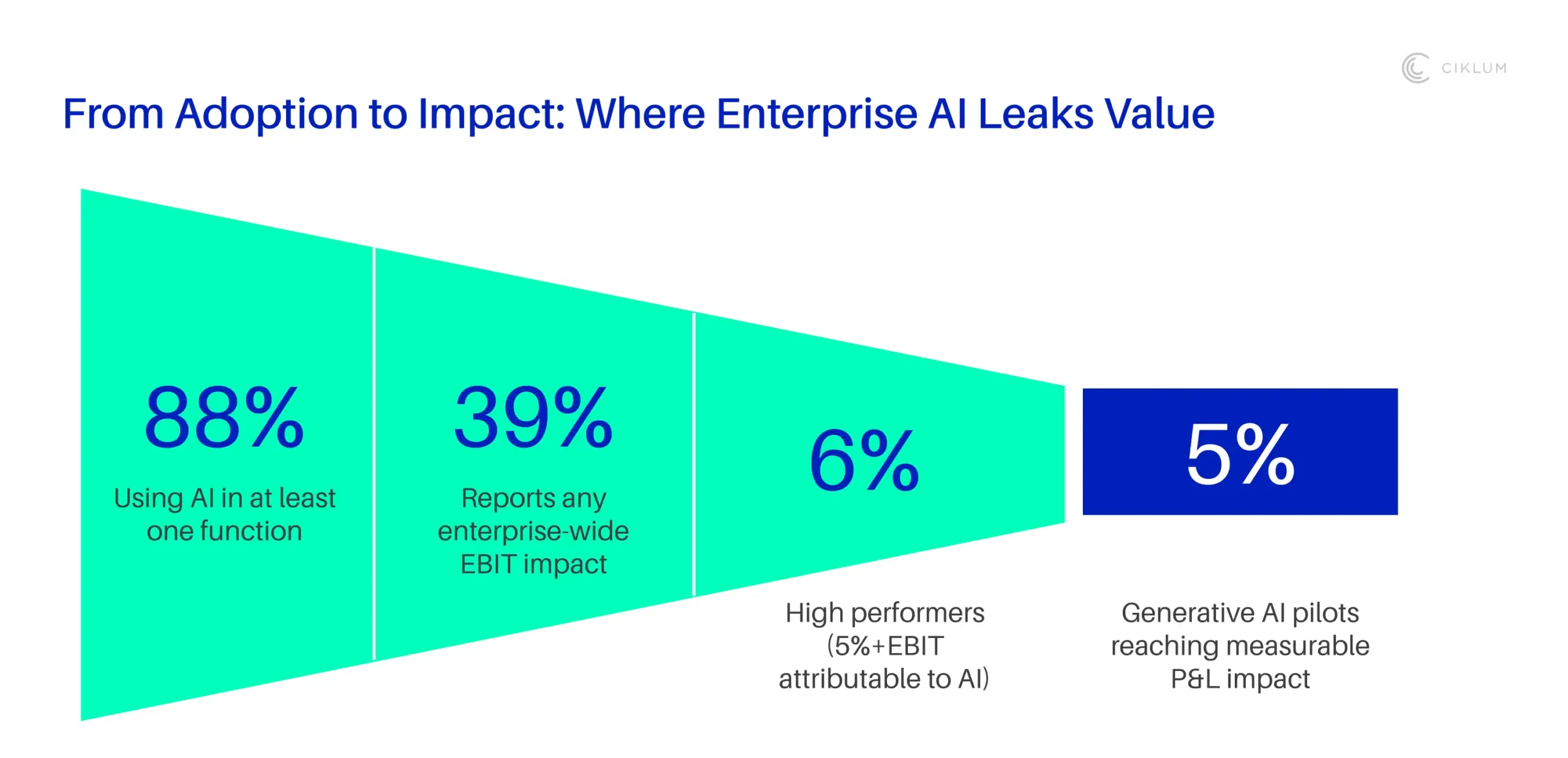
McKinsey's State of AI 2025 survey quantified the business-side of the bottleneck. While 88% of organizations use AI in at least one function, only 39% report any enterprise-wide EBIT impact, and only 6% qualify as high performers with 5% or more of their EBIT attributable to AI. Adoption without operating model change produces exactly the outcome one would expect: activity without arithmetic.
Klarna's 2024 announcement is the most public illustration. The company said its AI agent was doing the work of 700 full-time agents. In May 2025, CEO Sebastian Siemiatkowski acknowledged that the cost-cutting had gone too far and that the company was resuming human hiring. The AI had absorbed volume; it had not absorbed judgment.
The Intervention: Workflow Redesign, Then Tools
What separates the 6% from the rest is not the model they use. It is the order in which they change things. The McKinsey 2025 survey found that high performers were three times more likely to have redesigned workflows before introducing AI. The MIT NANDA research found that organizations succeeding with generative AI were twice as likely to have rebuilt end-to-end processes before selecting model architectures.
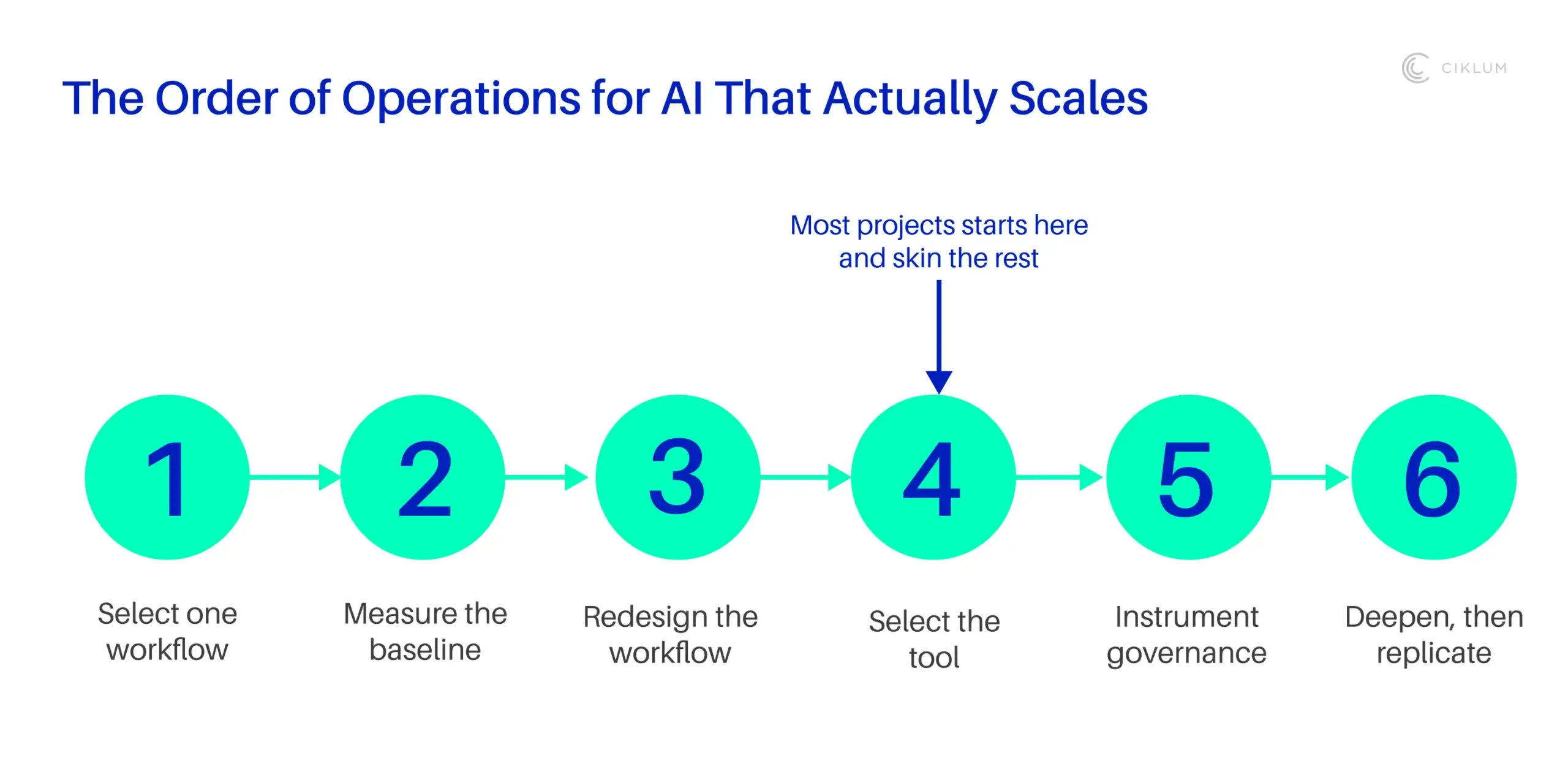
The intervention pattern has four components. First, a small number of workflows get selected on the basis of transaction volume, manual effort, and outcome measurability, rather than executive visibility. Second, each selected workflow is mapped end-to-end, typically with process mining, which surfaces where time actually goes and where handoffs leak value. Third, the workflow is redesigned with AI as a participant rather than a bolt-on, so decision points, data access, human review, and governance are specified together. Only at the fourth step does tool selection happen. MIT's data shows that buying from specialized vendors succeeds roughly twice as often as internal builds, so the default choice for most enterprises should be partnership, not construction
This sequence also changes the governance model. Instead of reviewing AI outputs quarterly, high performers instrument the workflow for continuous observation: latency, hallucination rate, escalation rate, quality sampling, and cost per transaction. Metrics run alongside the AI, not behind it. The same responsible AI operating model that regulated enterprises are now building into production architectures rather than treating as a post-launch audit.

The Results: What the High Performers Actually Measure
The hard numbers come from controlled studies and firm-level surveys, not vendor case studies.
Brynjolfsson, Li, and Raymond's paper "Generative AI at Work," published in The Quarterly Journal of Economics in 2025, analyzed 5,179 customer support agents using a conversational AI assistant. Issues resolved per hour rose 14% on average, with a 34% gain for novice and low-skilled workers and minimal effect on the most experienced staff. The AI primarily diffused the practices of top performers to the rest of the team.
In software engineering, a controlled experiment by Peng, Kalliamvakou, Cihon, and Demirer found that developers using GitHub Copilot completed a defined task 55.8% faster than a control group (71 minutes versus 161 minutes). Field evidence is more conservative: a larger deployment study published through MIT GenAI reported throughput gains ranging from 7.5% to 21.8%, depending on task type and developer experience.
At the macro level, economists at the St. Louis Fed estimated that generative AI contributed roughly 1.1 percentage points to U.S. labor productivity through the end of 2024. Workers reported saving 5.4% of their work hours on average, about 2.2 hours per week, with daily users of generative AI tools saving closer to four hours per week.
Firm-level data tells the sharpest story. In the McKinsey 2025 survey, workflow redesign was the single strongest predictor of EBIT impact among high performers, outweighing model choice, training spend, and compute budget. Over half of generative AI spending went to sales and marketing, yet the highest returns consistently came from back-office automation: invoice processing, reconciliation, document review, and compliance reporting.
Taken together, the pattern is consistent. Task-level gains are real and replicable, typically falling between 10% and 30% in well-defined work. Translating those into firm-level EBIT requires redesigning the work around AI, not simply accelerating a step inside it.
How You Can Do It
- Pick one workflow, not ten: Choose on three criteria: transaction volume of at least 10,000 per year, current cycle time long enough that compression will be visible in monthly reporting, and an outcome metric the finance team already trusts. Back-office operations (accounts payable, reconciliation, document review, regulatory reporting) tend to meet these criteria more often than marketing or sales.
- Measure the baseline before touching the tooling. Capture end-to-end cycle time, cost per transaction, error rate, and SLA compliance across at least one full cycle. Process mining is the most reliable way to establish these numbers, because self-reported operational data is almost always wrong. Ciklum's transformation of Santander Portugal's mortgage transfer process (Appian, RPA, and intelligent document processing applied to more than 100 daily transfer requests) shows what baseline measurement and workflow mapping unlock before any AI layer is added.
- Redesign the workflow before selecting a model: Map every decision point, handoff, and data dependency. Decide where AI will act, where a human will review, and where the data needs to come from. Write the target-state operating model down on one page.
- Buy before you build: MIT's research indicates that vendor partnerships succeed about twice as often as internal builds. Internal builds make sense for genuine differentiation; they do not make sense for table-stakes capability.
- Instrument governance into the architecture: Define continuous monitoring metrics before launch: output-quality sampling rate, escalation rate, hallucination rate, unit economics. Each metric gets a named owner and a weekly review, not an annual audit.
- Deepen before you broaden: Once one workflow is producing verifiable impact, use it as the template for the next. The organizations attempting twelve simultaneous AI transformations typically finish none of them. The ones that finish the first one quickly finish several more.
Conclusion
Enterprise AI productivity is no longer primarily a technology problem. The models are capable enough, the cost is manageable, and the integration patterns are documented. What separates the 6% of organizations capturing measurable EBIT impact from the 94% that are not is whether they approached AI adoption as an operating-model change or as a tool rollout.
The productivity gain is there to be captured. It shows up in peer-reviewed research, in firm-level surveys, and in the financials of the few enterprises that have rebuilt their workflows around AI rather than on top of it. Closing the distance between adoption and impact is the work of the next twenty-four months.
Frequently Asked Questions
Q: Why do most organizations with high AI adoption rates (80%+) still report minimal EBIT impact (6%)?
A: The gap is not technological, but operational. Most organizations fail to convert task-level productivity gains into bottom-line results because underlying workflows and operating models are left intact. The friction at subsequent steps of an unaltered process absorbs any time saved by the AI tool.
Q: What is the most common reason AI projects fail to reach production or deliver measurable impact?
A: A consistent root cause is that the process around the AI is left intact. Other factors include selecting pilots for executive visibility instead of throughput, layering AI onto unfixed data foundations, and prioritizing model output quality over end-to-end workflow time.
Q: What separates high-performing organizations from the rest?
A: High performers (the 6% attributing 5%+ of EBIT to AI) are three times more likely to have redesigned workflows before introducing AI. Their sequence is workflow redesign first, tool selection second. They focus on deep deployment on a small number of high-volume workflows, measured against operational metrics, rather than broad rollouts of generic copilots.
Q: What are the typical productivity gains seen at the task level?
A: Task-level gains are real and replicable, typically falling between 10% and 30% in well-defined work. Specific controlled studies show a 14% increase in issues resolved per hour for customer support agents and a 55.8% faster completion rate for developers on discrete coding tasks.

By Ciklum Editorial Team

Ciklum’s Editorial Board is a collective of experienced writers and industry experts, bringing together perspectives shaped by real-world engineering and delivery experience. Through collaborative insights, the team explores how technology, AI, and digital innovation move from concept to execution across industries.
Blogs
Discover Similar Insights

AI-Ready Data Infrastructure for Financial Services: A Practical Guide for UK Banks and Insurers
Learn More
Designing Scalable Software Architecture for High-Growth Products
Learn More
Understanding the True Impact of Technical Debt on Product Development Success
Learn More
Why Software Teams Miss Deadlines and How to Build a Predictable Roadmap
Learn More