



Key Takeaways
Agile is a tool, not a cure-all: Following Agile ceremonies like daily stand-ups doesn't automatically guarantee on-time delivery. Most projects still struggle with budget and time because the underlying issues are often overlooked.
Problems start before the work begins: Most delays aren't caused during the "sprint." They are the result of over-optimistic estimates, hidden dependencies between teams, and unclear goals that exist before a single line of code is written.
Focus on flow, not just "points": Successful teams don't just track velocity; they manage the amount of work they have in progress at any one time. Smaller batches of work lead to faster and more reliable results.
Predictability is about discipline: Fixing deadlines requires realistic forecasting based on past performance, mapping out blockers early, and committing to business results rather than just a long list of features.
The Reality of Software Project Deadlines
Despite decades of software evolution and the widespread adoption of modern frameworks, the industry still faces a massive problem: projects rarely finish when they say they will. Research consistently shows that large IT projects frequently run over budget and take longer than expected, often delivering less value than originally promised. The issue isn't a lack of effort. It's that our methods for planning and managing work often fail to account for how complex software development really is.
Four Main Reasons Software Projects Fall Behind
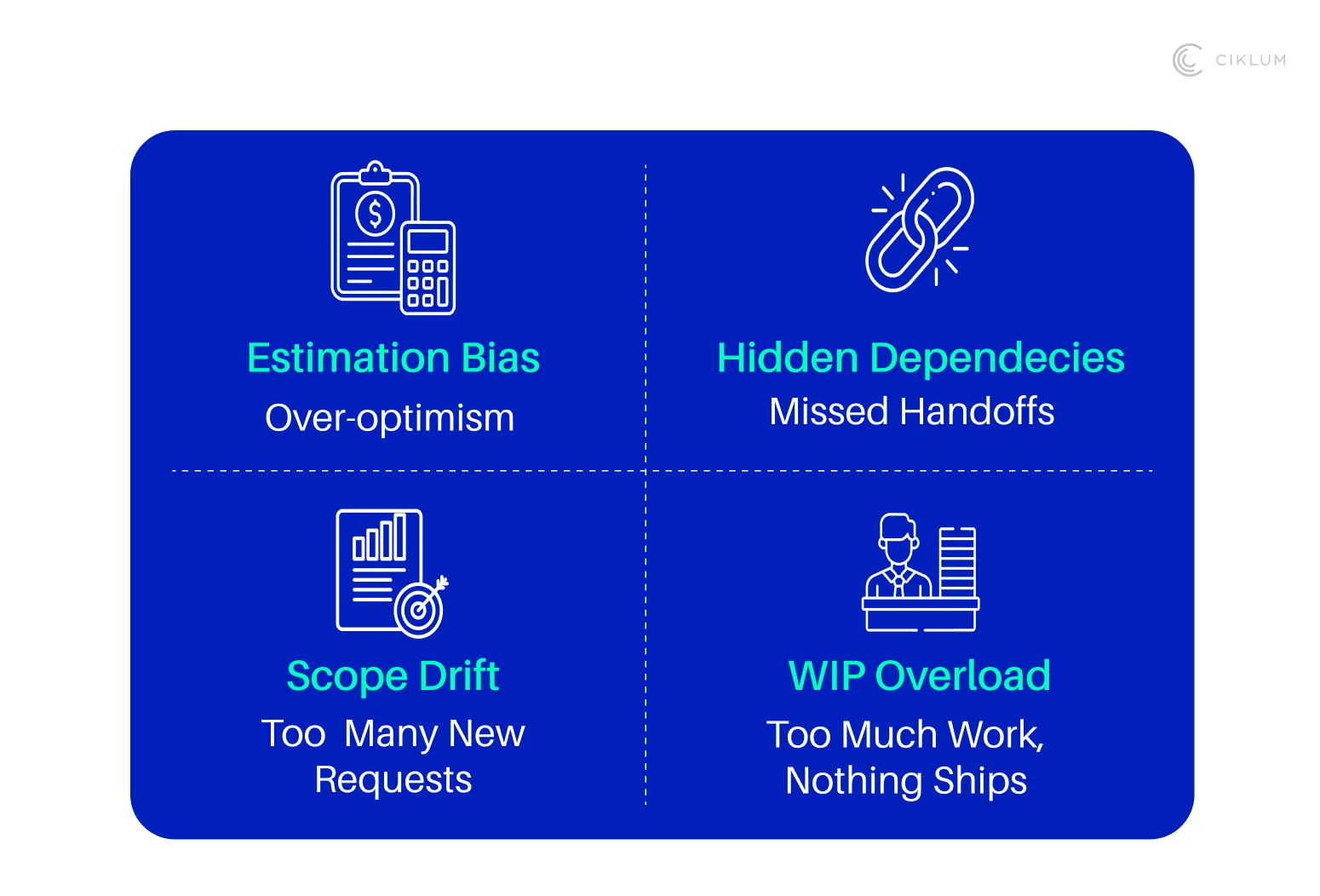
While every project is different, the reasons for delays usually fall into four specific categories that stack up to create a major slip.
1. We are naturally over-optimistic
Human beings are prone to the "planning fallacy", a tendency to underestimate how long a task will take, even when we know similar tasks have taken longer in the past. In software, this means engineers often estimate based on the "best-case scenario" rather than reality. When teams estimate by "gut feel," those numbers become optimistic guesses rather than reliable commitments.
2. Hidden dependencies block progress
A feature might look like it takes two weeks to build, but it may actually be stuck behind a six-week wait for another team to update an API, a security review, or a vendor contract. These blockers are often invisible on a team's daily task board, but they are the primary reason deadlines slip once work is underway.
3. Scope grows while dates stay the same
Agile encourages flexibility, but many organizations use this as an excuse to keep adding features after a deadline has been set. If the scope keeps expanding but the delivery date stays fixed, the math simply stops working. True agility is about discovering the right scope, not hiding inflation behind a process.
4. Too much work is happening at once
When a team tries to work on too many things simultaneously, everything slows down. This is called "Work in Progress" (WIP). When WIP is too high, items spend more time waiting than being worked on. Most teams that miss deadlines are trying to juggle 2 to 3 times more work than they can actually handle, leading to a situation where many things are "almost done" but nothing is actually finished.
The Business Impact of Missed Deadlines
The cost of a delay isn't just the extra engineering hours. It cascades through the whole company. Sales teams lose confidence, customers lose trust, and roadmap credibility disappears. Over time, repeated slips lead to burnout and attrition among top talent. Ultimately, every month spent missing a delivery date is a month where competitors are gaining an advantage.

How to Fix Deadlines and Build Predictability
You don't need a new management framework to hit your dates. You need to focus on the mechanics of how work flows through your team.
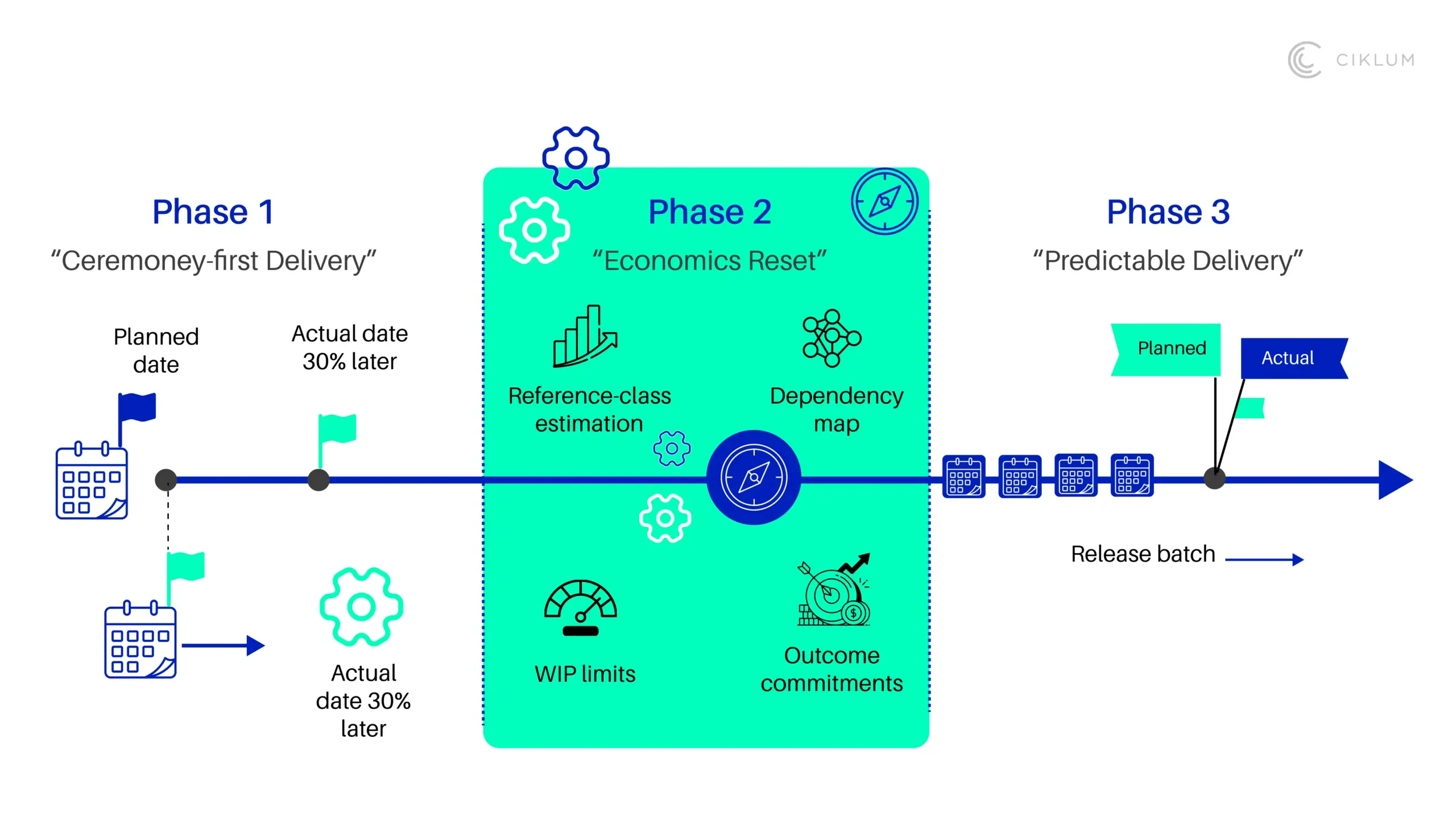
Forecast Based on History, Not Guesses
Instead of asking the team for a "best guess," look at how long similar features took over the last year. This historical data provides a much more realistic picture of what is possible. Data-driven forecasting removes the emotional pressure of estimation and provides a target based on reality.
Find the Blockers Before You Commit
Before finalizing a date, map out exactly which other teams or external factors need to be involved. Identifying a single missing dependency early can save months of delays later. Making this a routine part of planning ensures that you only commit to dates that are actually achievable.
Commit to Goals, Not Just Features
A hard date should be tied to a business outcome like a product launch or a new customer capability, not a rigid list of every possible sub-feature. This allows the team to adjust the scope intelligently while still hitting the most important milestone on time.
Stop Starting, Start Finishing
Limit how much work can be active at once. By forcing the team to finish current tasks before starting new ones, you increase the speed at which work actually reaches the customer. This "small batch" approach makes progress visible and makes deadlines much easier to predict.
Examples of Success
The most successful organizations don't just buy better tools; they change how they work. Leading tech companies have shown that by automating testing, reducing the size of their projects, and giving teams end-to-end ownership, they can go from missing every deadline to deploying thousands of times per year. The common thread is always the same: they managed their work in progress and removed the friction that causes delays.
Summary
Software projects don't miss deadlines because of a lack of meetings. They miss them because of optimistic bias, hidden blockers, and unmanaged workloads. By switching focus to delivery economics through realistic forecasting, dependency mapping, and limiting work in progress, teams can turn delivery dates from stressful guesses into reliable commitments.
With the right partner, software project deadlines move from aspirational to predictable. Ciklum's product engineering, platform, and AI teams work with organizations through exactly this transition. If you are ready to turn delivery dates into commitments your customers and your board can rely on, our team is here to support your next step.
Frequently Asked Questions
1. Why does Agile not, on its own, fix missed deadlines?
Agile is a framework for managing change inside delivery, not a substitute for delivery economics. Sprints, stand-ups, and retros do not correct planning-fallacy bias, surface hidden dependencies, limit WIP, or constrain scope drift. McKinsey-Oxford and Standish Group data span the entire Agile era and still show the majority of large software projects missing budget, time, or scope. The framework is not the variable.
2. What is the single highest-leverage change a team can make to start hitting deadlines?
Limit work in progress. Little's Law guarantees that lead time falls as WIP falls, assuming throughput stays constant. Most teams that miss software project deadlines are running 2 to 3 times more concurrent work than they can sustain, and a hard WIP limit produces visible improvement in DORA metrics within 4 to 8 weeks.
3. How do we estimate dates when leadership wants commitments and the team wants flexibility?
Use reference class forecasting and commit to outcomes rather than feature lists. Tell leadership the date by which a customer-visible outcome will ship, derived from the actual distribution of comparable past work, and keep scope flexible inside that envelope. This is the version of the Agile contract that holds in practice.
4. When should an organization bring in external engineering support to fix delivery?
Two windows produce the highest ROI. The first is during the operating model reset, where outside perspective on dependency mapping, decision rights, and WIP limits cuts through political friction faster than internal facilitation. The second is during continuous delivery investment, where engineers with prior platform and CI/CD experience compress build time from years to quarters. Both require bandwidth that delivery-stretched in-house teams rarely have spare.

By Ciklum Editorial Team

Ciklum’s Editorial Board is a collective of experienced writers and industry experts, bringing together perspectives shaped by real-world engineering and delivery experience. Through collaborative insights, the team explores how technology, AI, and digital innovation move from concept to execution across industries.
Blogs
Discover Similar Insights

Healthcare Digital Transformation Challenges: Why Programs Fall Short Post-Implementation
Learn More
AI-Ready Data Infrastructure for Financial Services: A Practical Guide for UK Banks and Insurers
Learn More
Designing Scalable Software Architecture for High-Growth Products
Learn More
Understanding the True Impact of Technical Debt on Product Development Success
Learn More