
- Why Healthcare Modernization Cannot Be Treated Like an IT Cutover
- Start With the Care Pathway, Not the Application Inventory
- Build the Bridge Before Moving the Traffic
- Treat Compliance as a Migration Control
- Rehearse the Failure Path Before the Cutover
- Use Automation Where It Reduces Transition Risk
- In Summary
Key Takeaways
- Protect the pulse of care: Modernize the system without disrupting the clinical workflows patients and care teams depend on.
- Map the care pathway first: Identify critical workflows, data dependencies, and fallback paths before the technology roadmap takes over.
- Switch traffic only after trust is earned: Use parallel run, feature flags, replicated data, and rehearsed rollback plans before moving users to the modern system.
- Make compliance part of the migration engine: Build HIPAA controls, audit logging, backup, interoperability, and emergency-mode operations into every phase.
Why Healthcare Modernization Cannot Be Treated Like an IT Cutover
In many industries, a system migration is judged by cost, speed, and technical completeness. Healthcare adds a harder condition: care must continue while the system changes. Appointment scheduling, patient records, diagnostic workflows, claims, pharmacy coordination, clinician documentation, and reporting all depend on systems that cannot simply be paused while a new platform is introduced.
That is why the phrase "modernization without downtime" needs to mean more than a weekend migration window. A hospital or healthcare provider can experience no formal outage and still create operational downtime if clinicians cannot find the right patient record, if a data interface lags, if a fallback process is unclear, or if staff do not know which system is the source of truth during transition.
Start With the Care Pathway, Not the Application Inventory
Most modernization programs begin with an inventory of applications, databases, integrations, and infrastructure. That inventory is necessary, but it is not sufficient in healthcare. The more important first artifact is a care-pathway continuity map.
This map answers practical questions. Which workflows directly affect patient access or clinical decision-making? Which roles depend on each workflow: clinicians, nurses, schedulers, billing teams, pharmacists, lab staff, or contact center agents? Which data elements must be current for the workflow to remain safe? Which integrations are synchronous and which can tolerate delay? Which manual fallback process exists if the digital path degrades?
The map changes modernization sequencing. A reporting workflow that tolerates a one-day delay can be migrated early. A medication reconciliation workflow cannot. A patient portal feature may be less critical than the identity and access layer underneath it. By ranking workflows by clinical criticality, dependency density, and fallback maturity, leaders can modernize in the order that creates learning without putting the care pathway under unnecessary stress.
The Office of the National Coordinator for Health Information Technology has documented strong progress in certified health IT adoption and information exchange, while also noting persistent gaps across provider types and settings. For modernization teams, this matters because interoperability is not an abstract policy goal. It is the difference between a workflow that keeps moving during transition and one that stops because a receiving system cannot use the data it gets.
Build the Bridge Before Moving the Traffic
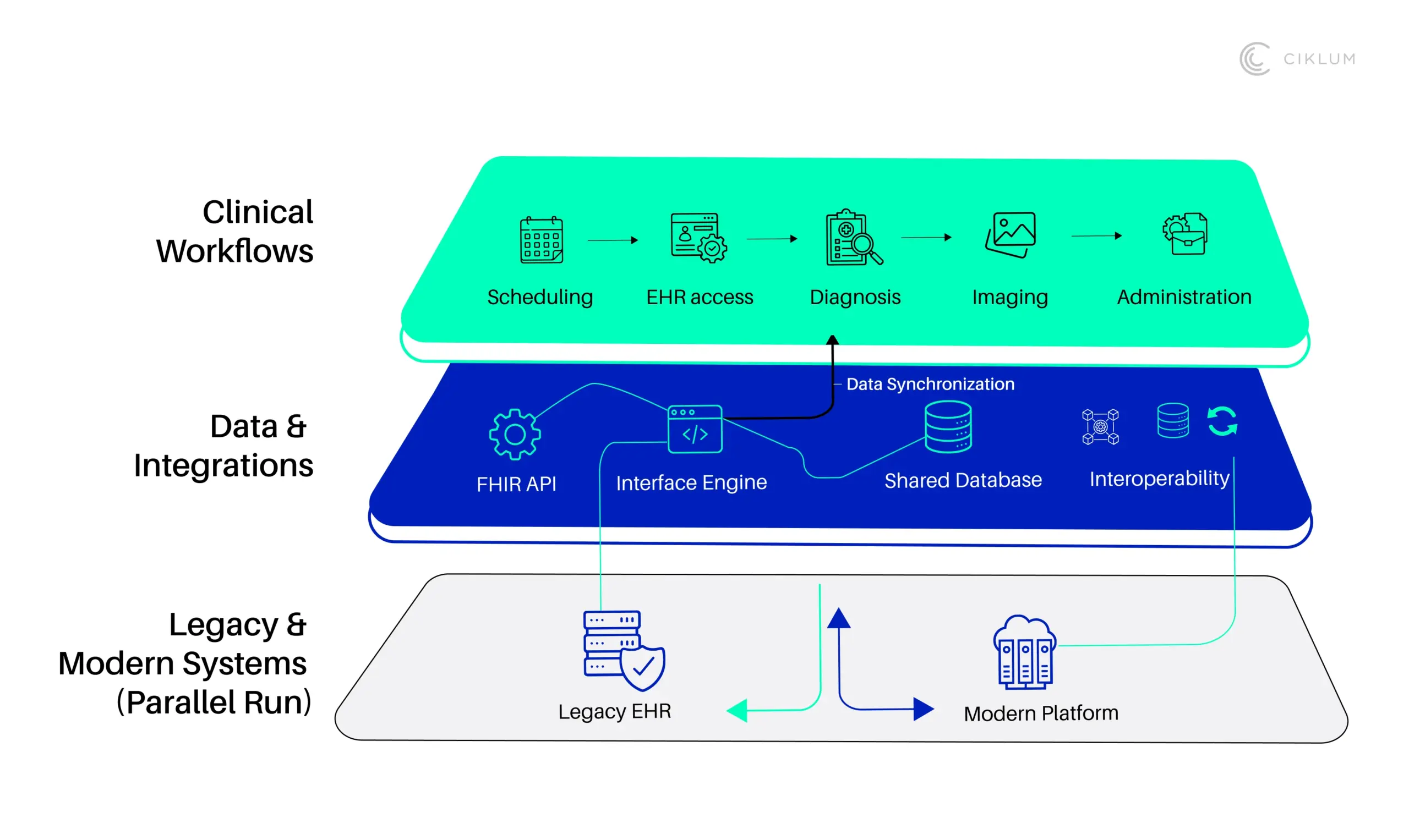
Healthcare modernization without downtime depends on coexistence. The old and new systems must run together long enough for teams to validate data, user behavior, integration stability, and rollback options in real conditions.
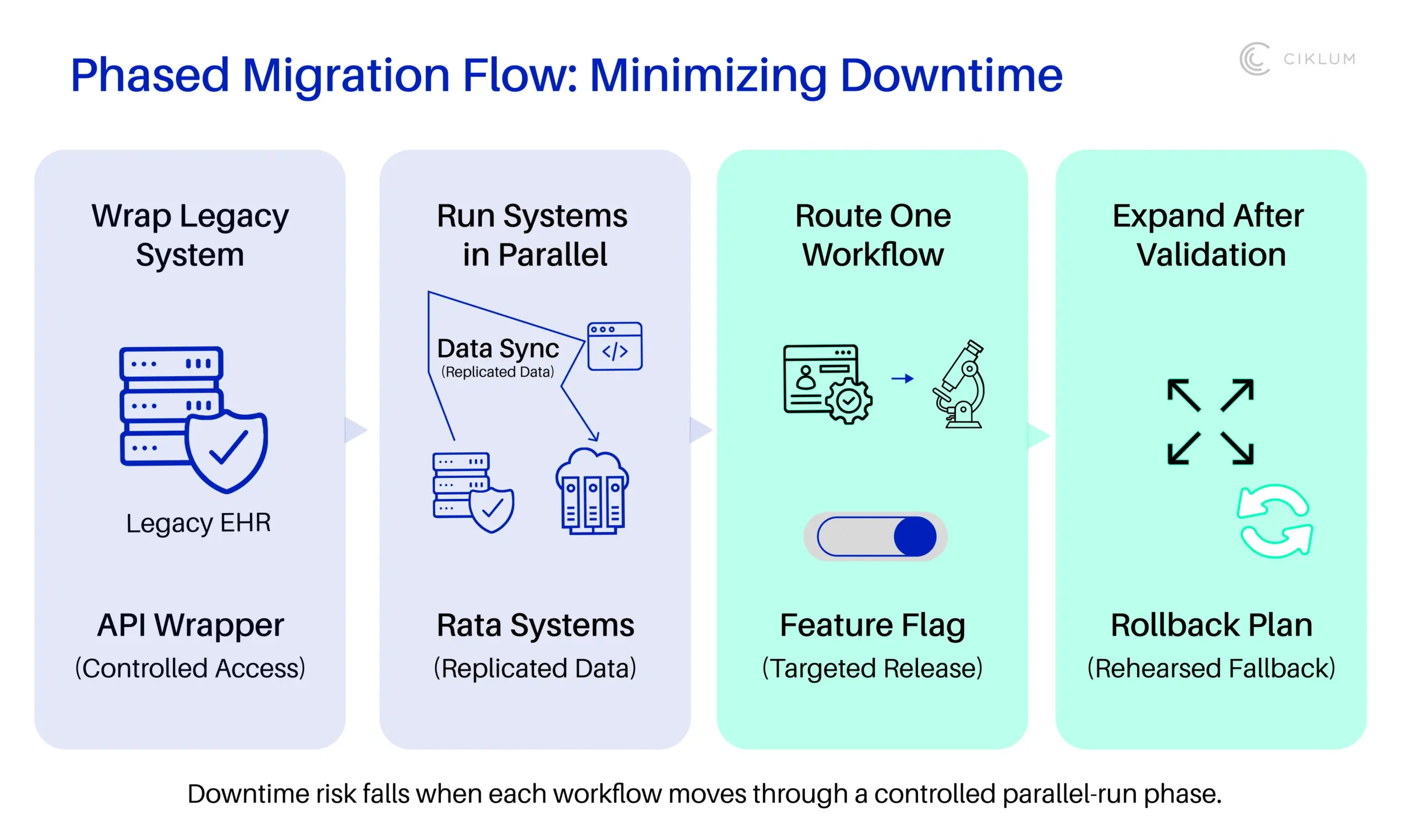
This is where the strangler pattern becomes useful. Rather than replacing the entire legacy system at once, teams wrap the old system with APIs, route one bounded workflow to the modern layer, validate it, then expand. In healthcare, the pattern has an additional benefit: it lets clinical teams keep using familiar workflows while the modernization team gradually moves specific capabilities behind the scenes.
The bridge usually includes five technical controls. API wrappers expose legacy functionality without forcing all consumers to change at once. Data replication keeps the modern system aligned with the legacy source of truth. Feature flags make it possible to enable or disable the new path for specific user groups or locations. Observability shows whether the new path is behaving as expected. Rollback procedures define how to return traffic to the old path without improvisation.
Treat Compliance as a Migration Control
Healthcare modernization is also a compliance event. Patient data moves across systems, integrations change, access paths shift, logs are created in new places, and backup procedures need to be validated again. Treating compliance as a final review is risky because the migration itself changes the control environment.
The HHS HIPAA Security Rule requires administrative, physical, and technical safeguards for electronic protected health information. Its contingency planning expectations include backup, disaster recovery, and emergency-mode operations. Those requirements align directly with downtime-free modernization. Backup and recovery are not separate from migration. They are part of how the migration is allowed to proceed.
Our analysis on HIPAA-secure cloud migration makes the same operational point: phased execution, secure data transfer, continuous testing, access control, encryption, audit logging, and disaster recovery planning need to be built into the migration plan itself. In practice, that means every phase should have a compliance checklist before traffic moves. Are role-based access controls correct? Are audit logs complete? Is encryption applied in transit and at rest? Has emergency-mode access been tested? Can the team prove what happened if an incident occurs?
The practical benefit is speed. When compliance controls are embedded in the migration factory, teams do not stop after each release to reconstruct evidence. Evidence is generated as part of the work.
Rehearse the Failure Path Before the Cutover
No-downtime modernization is not a claim that nothing will fail. It is a claim that the team knows what to do when something does. That knowledge has to be rehearsed.
Before each meaningful cutover, the team should run a failure-path rehearsal. Simulate an integration lag. Simulate a user permission mismatch. Simulate incorrect data in the new workflow. Simulate a slow response from a dependent system. Then measure whether the team can detect the issue, understand clinical impact, communicate to affected users, and roll back or route around the failure within the agreed window.
The rehearsal should include clinical and operational users, not only IT. A rollback that is technically correct but confusing to clinicians is not a safe rollback. A downtime procedure that exists in a document but has not been practiced is not a continuity plan. The safest modernization teams make failure rehearsal part of the release process, especially for workflows that affect care delivery, patient access, or protected health information.
Use Automation Where It Reduces Transition Risk
Automation can accelerate modernization, but only when it reduces the right kind of risk. AI-assisted analysis can help map dependencies in legacy code, generate test cases, identify duplicated business rules, and accelerate documentation. Automated testing can validate regression risk across old and new workflows. Infrastructure automation can make environments reproducible, which reduces configuration drift between staging and production.
Our analysis on cutting development time frames AI as a workflow enabler. Productivity gains only matter if they preserve quality, compliance, and patient trust. Faster modernization that increases ambiguity is not progress. Faster modernization that improves test coverage, documentation, and dependency visibility is.
Our healthcare engagement in regenerative medicine operations shows the same principle in a narrower workflow. By automating reporting workflows and enabling real-time data access, the organization standardized document creation and reduced latency for sales representatives by two hours per opportunity. The broader lesson is not that every healthcare system needs the same platform. It is that modernization creates operational value when fragmented processes become reliable, visible, and easier to act on.
In Summary
Modernizing healthcare systems without downtime requires a relentless focus on operational continuity and patient safety. The first priority is mapping the care pathway: understanding how clinical workflows, data flows, and system dependencies connect to patient outcomes. Sequencing modernization by workflow criticality, dependency density, and fallback maturity (rather than by application inventory) ensures any change builds confidence and learning without exposing patients to risk.
A phased, coexistence-based approach is essential: legacy and modern systems should run in parallel so teams can validate accurate data flow, user experience, integration stability, and rollback procedures in live conditions. Every migration step must embed compliance controls from the outset. HIPAA safeguards, auditable logs, robust backup, and disaster recovery are not end-of-project checks but embedded features of the migration factory.
Throughout, automation should be deployed only where it reduces transition risk such as dependency analysis, automated testing, and reproducible infrastructure. Rehearsing failure scenarios with both technical and clinical staff establishes confidence that issues can be detected, communicated, and resolved without endangering care. Ultimately, the most successful modernization programs prioritize the experience and safety of clinicians and patients, ensuring every system advance is validated by evidence, not assumptions, and never shifting risk to the frontline.
Frequently Asked Questions
1. Is zero-downtime modernization realistic for healthcare systems?
It is realistic when "zero downtime" means no interruption to critical care workflows, not that every system changes live without fallback. The practical model is coexistence: legacy and modern systems run in parallel, data is synchronized, traffic moves gradually, and rollback procedures are rehearsed before each cutover.
2. Which healthcare systems should be modernized first?
Start with workflows that are important enough to create value but not so clinically critical that a first migration would create unnecessary risk. Reporting, administrative automation, patient communication, or limited integration services are often better early candidates than medication, emergency, or identity workflows. The care-pathway continuity map should drive the sequence.
3. How should compliance teams be involved?
Compliance teams should be involved from the assessment phase. Each migration stage changes access, data movement, logging, backup, and recovery assumptions. Bringing compliance in only at the end slows the program and increases risk. The better approach is to make compliance evidence part of each phase's definition of done.
4. What is the biggest mistake in healthcare modernization?
The biggest mistake is treating modernization as a technical replacement rather than an operational transition. Healthcare systems support people, workflows, and decisions. If the migration plan does not show how those workflows continue during failure, rollback, and partial adoption, the plan is incomplete.
By Ciklum Editorial Team

Ciklum’s Editorial Board is a collective of experienced writers and industry experts, bringing together perspectives shaped by real-world engineering and delivery experience. Through collaborative insights, the team explores how technology, AI, and digital innovation move from concept to execution across industries.
Blogs
Discover Similar Insights

AI Automation in Healthcare: Transforming Patient Data and Operations
Learn More
Healthcare AI Done Right: Why Workflow Designs Beat Models Every Time
Learn More
Building Trustworthy and Scalable AI Models for US FinTech Compliance
Learn More
From Diagnosis to Claims: Where AI Actually Works in Healthcare
Learn More