



Key Takeaways
-
Administrative waste remains healthcare's most stubborn challenge: A staggering share of U.S. healthcare resources is consumed by administrative processes. AI automation is now emerging as a direct approach to address this inefficiency, with revenue cycle solutions showing the potential to substantially lower operational costs.
-
Clinical documentation is leading with tangible progress: Nurses using AI-powered documentation tools spend much less time on note-taking. Recent pilots in major health systems have meaningfully reduced administrative tasks for frontline clinicians. These are genuine results in live production, not just test-phase achievements.
-
The interoperability gap is the main technical challenge: Clinical data continues to be scattered across electronic health records, claims solutions, and departmental systems, with inconsistent formats and slow updates. AI automation often excels in demonstrations but falls short in real-use scenarios because current data foundations were not built for real-time, integrated access.
-
Healthcare AI automation is a multi-layered journey, not a single project: The organizations seeing real benefits are starting with highly structured administrative operations (like scheduling, billing, or prior authorization) then adding layers for document understanding and later, expanding into clinical support, all while strengthening data infrastructure at each step.
Introduction
Healthcare has an administrative problem that technology has failed to solve for decades. Despite billions invested in EHR systems, practice management platforms, and revenue cycle tools, the administrative burden on clinicians and operations teams has grown, not shrunk. Physicians spend nearly two hours on paperwork for every hour of patient care. Nurses lose significant portions of their shifts to documentation.
The cumulative cost is staggering. McKinsey estimates that U.S. health systems spend 3–4% of annual revenue on revenue cycle processes alone, collectively exceeding $140 billion per year. The broader administrative waste across the system reaches up to $935 billion annually.
AI automation is now reaching the point where it can meaningfully address this. Not through a single platform or a chatbot on the patient portal, but through a coordinated set of capabilities applied systematically to the operational workflows that consume the most time and generate the most cost.
Where Is AI Automation Making an Impact in Healthcare Right Now?
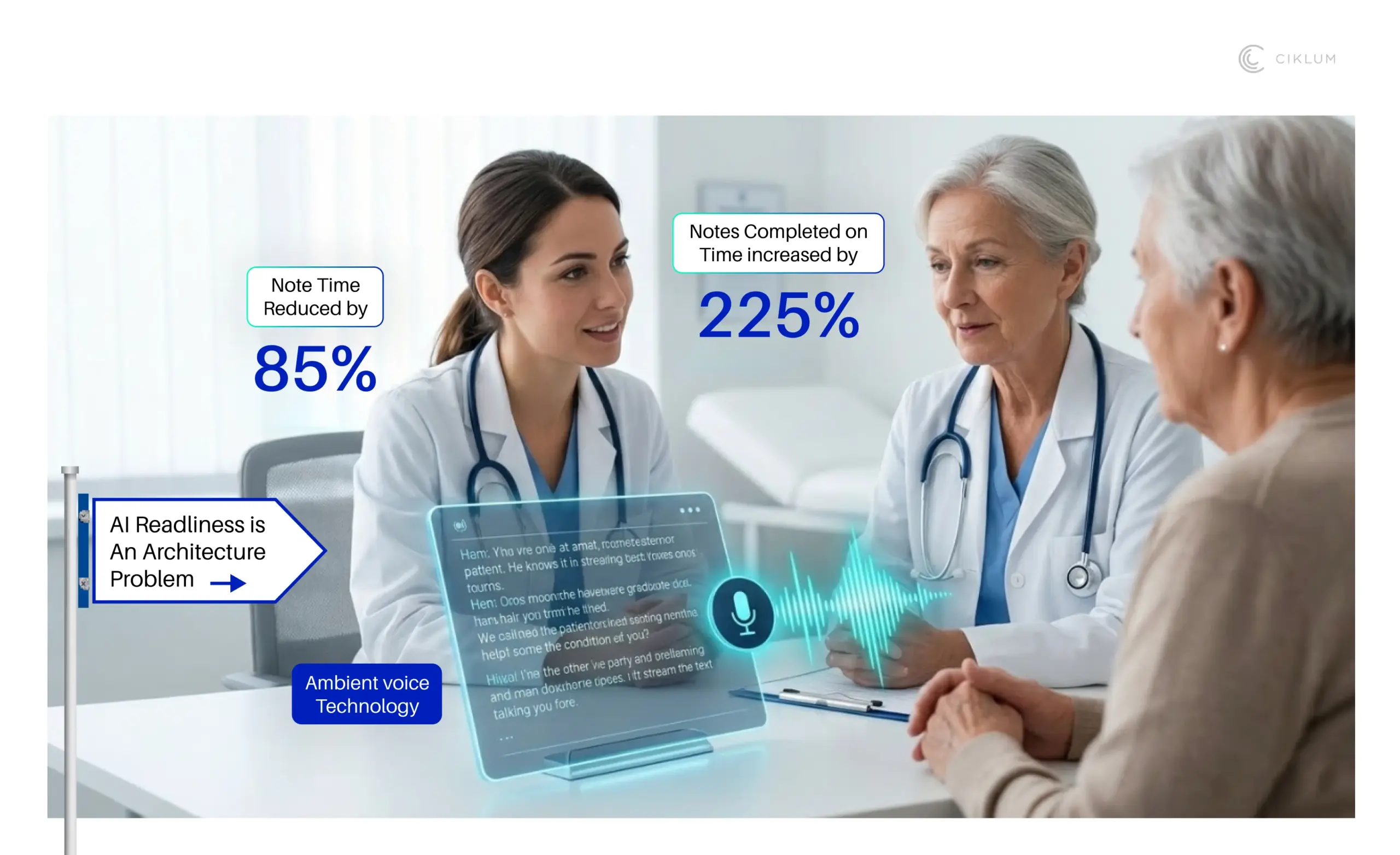
AI automation is no longer a distant promise or pilot project. It is actively transforming how healthcare organizations operate. The most significant gains are happening in areas with the heaviest administrative burdens, from clinical documentation to billing, coding, and compliance. Real-world deployments are demonstrating measurable improvements in speed, accuracy, and cost reduction, providing proof that AI can meaningfully relieve staff workloads and streamline essential operations.
Below, we break down where AI automation is already delivering real value for healthcare providers and patients.
Clinical Documentation
Clinical documentation has become the first area where AI automation is producing measurable, production-scale outcomes.
At Mercy Health System, nurses using Epic's AI documentation tools reduced end-of-shift note writing time from 3.5 minutes to 32 seconds, an 85% reduction. Notes completed fully and on time increased by 225%. At Oxford University Hospitals, an NHS pilot of ambient voice technology reduced administrative tasks for 87% of users, with most clinicians saving 1–10 minutes per patient interaction. Documentation quality remained comparable or improved, with 81.5% of encounters producing accurate records needing only minor edits.
These are not marginal improvements. For a health system with thousands of clinicians, reclaiming even five minutes per patient encounter per shift translates to tens of thousands of hours returned to direct care annually.
Revenue Cycle and Administrative Workflows
The revenue cycle is the operational backbone of every health system. It is also where administrative waste concentrates most heavily.
AI automation is targeting each step. Authorization agents verify coverage and submit requests autonomously, cutting processing time. Coding agents review clinical documentation and suggest appropriate codes, reducing denials and rework. Claims processing agents identify errors before submission, improving first-pass acceptance rates.
McKinsey projects that agentic AI in revenue cycle management could reduce cost-to-collect by 30–60% while accelerating cash realization. For a health system spending $140 million annually on revenue cycle operations, a 30% reduction represents $42 million freed for patient care.
Hospital administration extends well beyond the revenue cycle. Scheduling, records management, prescription handling, and claims adjudication all involve repetitive, rule-based workflows that RPA and intelligent automation can handle, reducing staff burnout while improving accuracy and throughput.
Audit and Compliance
Healthcare organizations operate under extensive regulatory requirements, HIPAA, CMS conditions of participation, Joint Commission standards, and an expanding set of state and federal mandates. Compliance monitoring is largely manual, reactive, and labor-intensive.
AI automation is changing this. A billion-dollar pharmaceutical company Ciklum worked with needed to categorize over 400,000 audit events, a task previously done manually with significant inconsistency. Ciklum built an ML-based audit analytics pipeline using unsupervised learning to assign context-driven category tags with semantic clustering and coherence modeling for explainability. The system replaced error-prone manual categorization with a continuous, improving pipeline.
The pattern applies broadly. Anywhere healthcare organizations review large volumes of records for regulatory compliance (quality audits, adverse event reporting, credentialing), AI can handle the classification and flagging, while humans focus on investigation and resolution.
The Interoperability Problem Underneath Everything
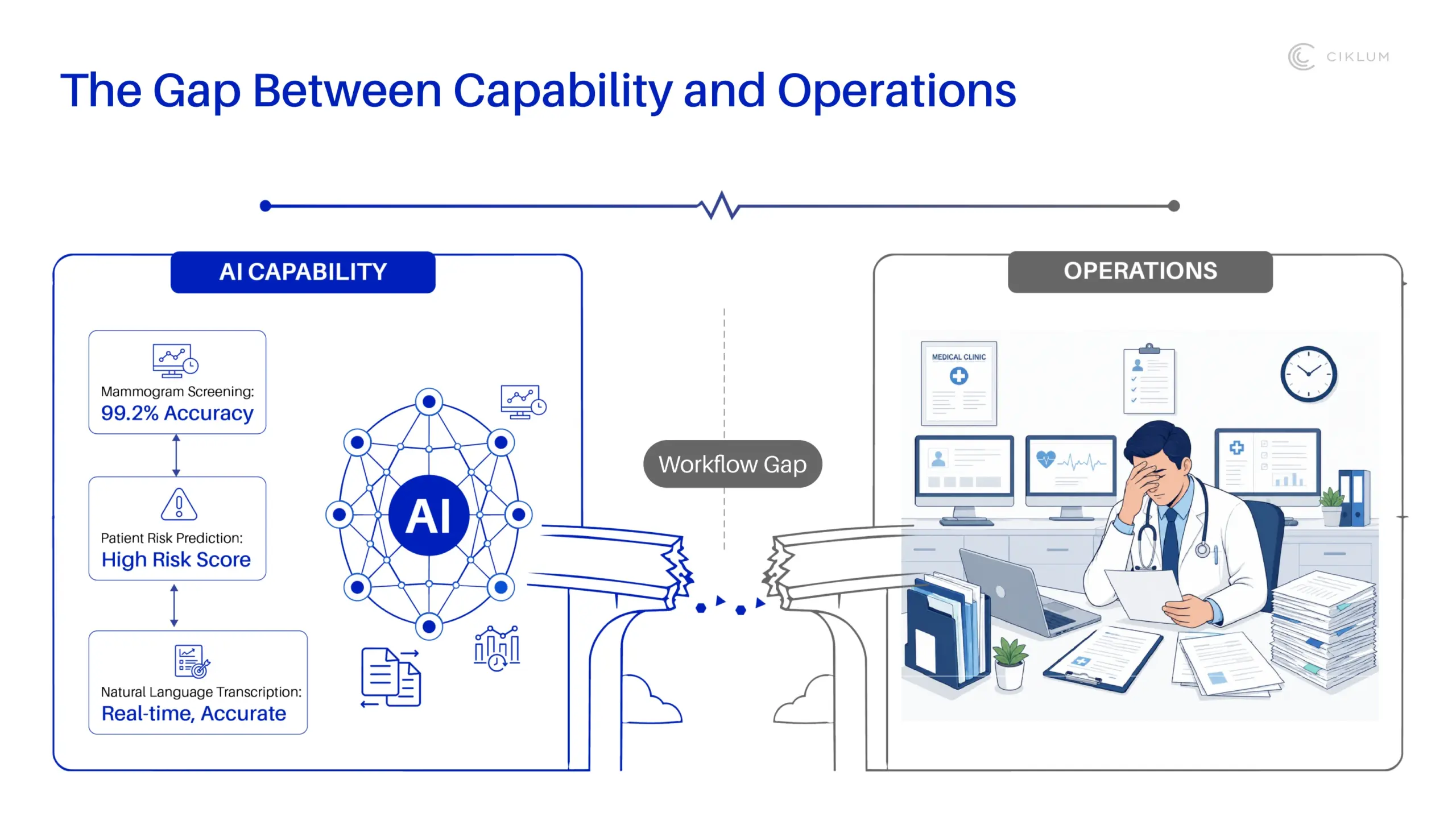
Every healthcare AI automation initiative eventually hits the same wall: fragmented, inconsistent, and inaccessible data.
Clinical data lives across EHR systems, claims platforms, lab information systems, imaging archives, pharmacy systems, and departmental databases. Each system has its own data model, update cadence, and access method. FHIR APIs are mandated but unevenly implemented. Batch update cycles mean that "real-time" data is often hours or days old.
This fragmentation is why AI pilots succeed in controlled environments and fail in production. An AI agent that needs current medication lists, lab results, and insurance status to process a prior authorization request cannot function if those data points come from three systems that update on different schedules and define "current" differently.
The organizations making progress treat interoperability as an engineering problem, not a standards compliance checkbox. That means building data integration layers that normalize across systems, implementing real-time data access where batch processes currently exist, and establishing semantic consistency so that AI systems interpret clinical data reliably.
Ciklum's work advancing telemedicine infrastructure for Doxy.me illustrates the principle: HIPAA-compliant AWS infrastructure with automated CI/CD pipelines, designed from the ground up for the security, reliability, and scalability that healthcare workloads demand. The same infrastructure-first approach applies to AI automation. The clinical capabilities are only as reliable as the data and platform foundations beneath them.
A Practical Sequence for Healthcare AI Automation
Healthcare AI automation works best when deployed in layers, not as a single transformation program.
Layer 1: Structured administrative workflows - Begin by automating processes such as scheduling, patient intake, insurance checks, and billing, workflows that are repetitive, rules-driven, and extensively documented. Robotic Process Automation (RPA) and workflow automation have already shown quantifiable benefits in these areas, reducing both costs and administrative workload with minimal risk. Tackling these tasks first also strengthens core operational capabilities like governance, monitoring, and exception handling, paving the way for more sophisticated automation down the line.
Layer 2: Document intelligence - Introduce intelligent document processing to automate clinical documentation, prior authorization, claims management, and healthcare correspondence. At this stage, AI systems move beyond structured data to interpret and extract critical information from unstructured sources such as faxes, scanned forms, free-text clinical notes, and regulatory documents. Success in this layer relies on the synergy between robust AI models and solid engineering practices: while the AI must deliver high accuracy, equally important are the supporting pipelines that manage exceptions, handle diverse document types, and uphold strict compliance across workflows.
Layer 3: Agentic workflows - Once administrative automation and document intelligence are well established, the next step is deploying agentic workflows, intelligent agents that autonomously handle complex, multi-step processes. These can include managing prior authorization from start to finish, orchestrating care transitions between providers, or independently adjudicating complicated insurance claims. Achieving this level of automation depends on having robust data infrastructure, governance, and operational maturity developed in the earlier layers.
Layer 4: Clinical decision support - This is the most advanced and high-stakes phase: AI technologies that help clinicians with diagnosis, treatment recommendations, and optimizing care pathways. Implementing AI at this level demands the most robust data infrastructure, stringent governance protocols, and transparent oversight by clinicians. While this represents the future direction of healthcare AI, it is not the point of entry. Organizations should only pursue it after mastering the foundational layers.
Conclusion
Healthcare AI automation is not a future promise. Clinical documentation tools are saving 85% of documentation time in production. Revenue cycle agents are projected to cut collection costs by 30–60%. Audit automation is replacing manual categorization of hundreds of thousands of records.
The limiting factor is not AI capability. It is whether the data infrastructure, interoperability layers, and governance frameworks are in place to support autonomous systems in one of the most regulated and highest-stakes environments in the economy. The organizations that treat those foundations as the first investment and not the last are the ones reaching production.
By Ciklum Editorial Team

Ciklum’s Editorial Board is a collective of experienced writers and industry experts, bringing together perspectives shaped by real-world engineering and delivery experience. Through collaborative insights, the team explores how technology, AI, and digital innovation move from concept to execution across industries.
Blogs
Discover Similar Insights

Why Enterprise AI Automation Programs Fail, and How to Make Sure Yours Doesn’t
Learn More
Before Building Enterprise AI Automation: A Practical Data Readiness Checklist for Teams
Assess Your Data Readiness
Inside Intelligent Automation: How It Works in Real Enterprise Environments
Explore How It Works in Production
How AI Is Changing Enterprise Automation Architectures And Why Most Companies Aren’t Ready
Explore the Architecture Shift