



Key Takeaways
- The 95% problem: Most enterprise AI initiatives (95%) fail to deliver measurable financial impact, with a rising trend of companies abandoning projects before production.
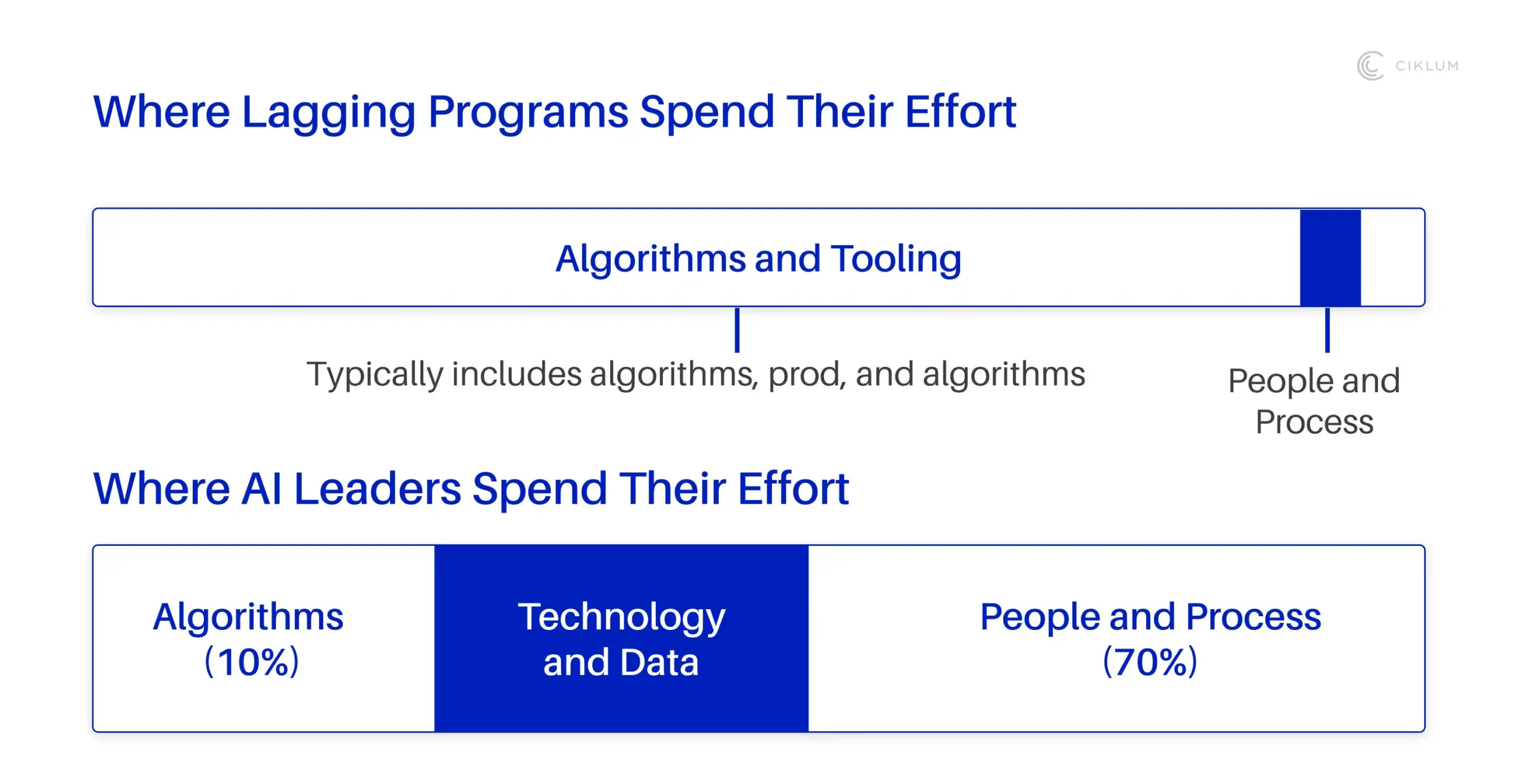
- It's a people problem, not a model problem: AI failures are driven primarily by people (70%) and process issues, not by the quality of the AI model itself (only 10% of challenges).
- The five ways programs die: Most failed programs fall into one of five critical failure archetypes: misaligned tools, sandboxed pilots, unfunded operations, governance gaps, or outdated roadmaps.
- The 5% success formula: Successful programs focus on named workflows, build governance early, prioritize data readiness, and measure operational results over mere adoption.
- The right diagnostic question: Program leaders should stop focusing on 'which model?' and instead ask, 'which of the five failure archetypes does our current plan resemble?'
The Numbers That Refuse to Improve
Enterprise AI automation has a credibility problem. Not because the technology has stopped working. The problem is that the programs wrapped around it keep failing at a rate that would be unacceptable in any other category of enterprise investment.
MIT's Project NANDA, in a July 2025 study based on 52 executive interviews, 153 surveys, and more than 300 implementation reviews, found that despite $30 to $40 billion of global enterprise investment in generative AI, 95% of organizations have captured zero measurable return. Only 5% of custom enterprise AI tools reach production. S&P Global Market Intelligence, surveying more than 1,000 senior IT and business leaders across North America and Europe for its 2025 Voice of the Enterprise report, found that 42% of companies abandoned the majority of their AI initiatives before production, up from 17% the year before (S&P Global, 2025; CFO Dive, 2025).
These are not growing pains on an immature technology. They are the durable signature of organizations trying to deploy a working technology inside a broken delivery model. BCG's 2024 study of more than a thousand enterprises, titled Where's the value in AI?, isolated the pattern: About 70% of the challenges in scaling AI sit in people and process, roughly 20% in technology and data, and only 10% in the model itself (BCG, 2024).
Where the Story Usually Begins
Most failed programs share a biography. A senior executive attends a conference. A vendor demo lands in an inbox. An "AI task force" stands up, quickly, reporting to the CTO or the innovation office. The team builds a proof of concept on a clean dataset in a sandbox, shows it to stakeholders, and wins the budget for a pilot. Nine months later, the pilot ends. Nothing ships.
What the biography describes is a program optimized for the wrong outcome. It is optimized for the demo. The engineering challenges that actually decide whether a program reaches production, which include data quality at scale, integration with systems of record, compliance sign-off, and operability, are not the ones the demo was scored against. When the team hits them, the failure looks technical, but it usually is not.
Five Autopsies
The same five failure archetypes appear, in some combination, in almost every post-mortem.
The Tool Looking for a Problem
A team commits to a platform before anyone has written down the business problem it is meant to solve. The pilot works, because a capable tool can produce a plausible output on almost any task. The pilot does not scale, because the organization never defined what "good" meant in operational terms. There is no error budget, no throughput target, no named process owner, and no cost-per-transaction baseline. When the pilot ends, there is no workflow to hand it back to.
The Sandboxed Pilot
The second archetype is a pilot that was never going to survive contact with production. Clean data, dedicated infrastructure, no integration with systems of record, no security review, no compliance pass. The AI model works on the test set. The model then encounters production data, which is out of distribution, inconsistently tagged, and missing the fields the pilot assumed were always present. Nearly 70% of AI initiatives stall because the data foundation under them was never fit for the workload. This is the category where most of the 95% failure rate lives.
The Unbudgeted Second Act
Many programs allocate budget for development, but neglect to adequately fund ongoing operations. Critical functions like monitoring, retraining schedules, model drift detection, evaluation tooling, data pipeline upkeep, security updates, and compliance checks often become afterthoughts that surface only after launch. Initial business cases tend to treat integration as a one-off expense, when in reality, maintaining the system is a continuous engineering effort. For example, a fintech’s project to consolidate five billing apps into one platform succeeded because data pipelines, reconciliation, and observability were planned and funded in parallel with the AI work, not tacked on afterward. When programs skip this up-front investment, they’re eventually overwhelmed by operational costs.
The Decision With No Author
The AI makes a call. Someone asks who approved it. Nobody has an answer. Governance on most failed programs was designed for the cadence of human decisions: quarterly reviews, a risk committee, manual access approvals. Agentic and automated systems make hundreds of decisions an hour, and the governance layer cannot operate at that tempo. The failure shows up as a compliance incident, a reversed customer action, or a regulatory request that the audit log cannot satisfy.

The 24-Month Roadmap
A program scoped against Q1 priorities ships into a Q7 business. Strategy has shifted, the executive sponsor has moved, the target process has been reorganized, or the underlying system has been replaced. The result is technically a working system that now solves a problem nobody is measuring. The operational excellence programs that actually hold up, such as the one we ran with a European sportswear brand where SLA compliance moved from 92% to 98% in six months, ship in scoped increments and rebaseline often. Programs that commit two years forward to a fixed scope almost always miss.
What the 5% Actually Share
The organizations that reach production and hold P&L impact do a small number of specific things. They are not better at prompt engineering. They have better delivery models.
They start with back-office workflows, not customer-facing showpieces. MIT's NANDA research found that back-office automation, not front-office sales and marketing use cases, delivers the largest measurable ROI. A luxury vehicle manufacturer, we work with layered AI on top of a foundation of more than 200 RPA process automations across procurement, compliance, and supply chain, then added process mining, intelligent document processing, and conversational AI. The program cleared £1 million in savings, built incrementally on operational automation that already worked.
They scope to one named workflow with one named owner. Not "apply AI to customer service," but "reduce average handling time on refund cases by 40% in 90 days, owned by the head of support operations." That specificity forces honesty about data, integration, success criteria, and accountability before the first model is trained.
They build for production from the very beginning. Monitoring, audit logging, compliance controls, rollback paths, and evaluation harnesses are all included in the initial architecture. The upfront investment is meaningfully higher, but it prevents the costly failures that otherwise surface later when programs are abandoned before reaching operational impact.
They treat data readiness as the precondition, not the phase two. The 5% do not run multi-year enterprise data transformations before they start. They do targeted data-readiness work on the specific workflow in scope, in parallel with the model work, and they do not start the model work before it is done.
They measure operational outcomes. Processing time, cost per transaction, error rate, SLA compliance, hours reclaimed. Model accuracy is a means. So is adoption. Neither sustains budget conversations after the first quarterly review.
A Six-Question Diagnostic for Your Own Program
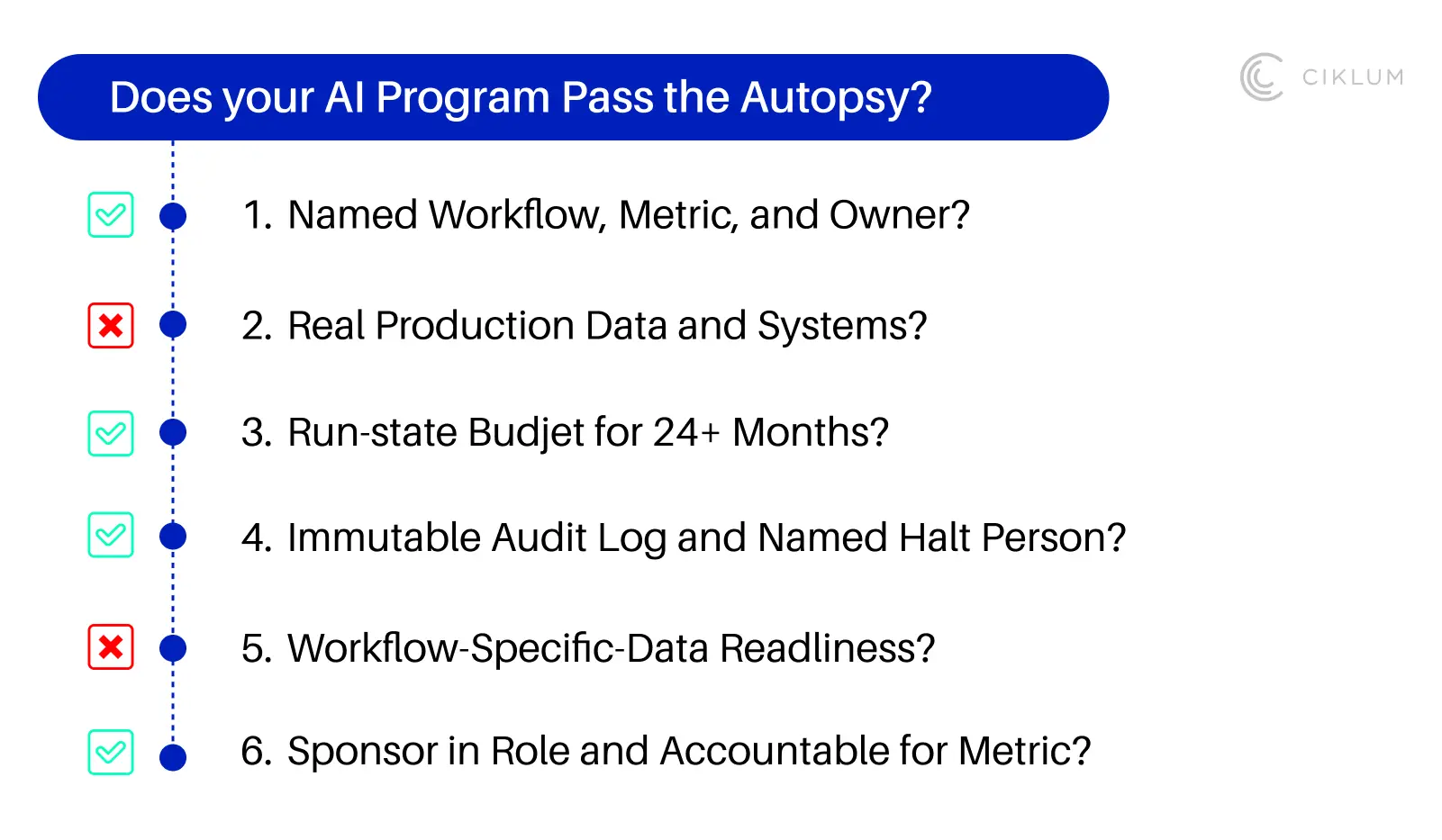
For leaders who want to know where their program sits before the next budget review, six questions separate a program on a trajectory to ship from one on a trajectory to be abandoned.
- Can you name the single workflow the program will change, the operational metric it will move, and the individual who owns that metric today? If the answer uses the phrase "across the organization," the scope is too broad.
- Is the pilot running against real production data, inside real production systems, under real authorization boundaries, at real volume? A pilot on synthetic data is a demo.
- Does the program budget include run-state engineering, monitoring, retraining, evaluation, and compliance, for at least 24 months past go-live? If the budget ends at launch, so will the program.
- Does every automated action write to an immutable audit log, and is there a single named person who can halt the system within minutes?
- Is data readiness work scoped against the specific workflow in motion, rather than deferred to a generic enterprise data transformation program?
- Is the executive sponsor still in role, still accountable for the same operational metric, and still scheduled to review the program on the same cadence as the rest of their operating KPIs?
If a program can’t answer yes to all six, it may not be ready to launch or, if already underway, might be at risk of stalling before it reaches its goals.
Conclusion
The overwhelming majority of Enterprise AI automation programs do not fail because the underlying models are inadequate; they fail because of a broken delivery model. With 70% of scaling challenges rooted in people and process issues, the often-cited 95% failure rate is a direct consequence of falling into five critical archetypes: pursuing tools without defined problems, running sandboxed pilots that can't survive production, neglecting the budget for long-term operations, operating without clear governance, or scoping rigid 24-month roadmaps that miss shifting business priorities.
In contrast, the successful 5% reach production by treating AI as an engineering discipline rather than an experiment. These leaders prioritize production-grade architecture including monitoring, compliance, and data readiness from day one. By focusing on named workflows and measuring rigorous operational outcomes like cost-per-transaction and SLA compliance, they ensure their programs deliver sustained financial impact where others merely stall.
Frequently Asked Questions
Why are enterprise AI failure rates still this high when the models keep getting better?
Because the model is almost never the limiting factor. BCG's research across more than a thousand enterprises found that roughly 70% of the challenges in scaling AI are people and process problems, 20% are technology and data, and only 10% involve the algorithm itself. Upgrading to a more capable model does not solve a scope, governance, or data-readiness failure. It usually accelerates the discovery of one.
Is it safer to wait another year before starting a new program?
No. The gap between the 5% that have reached production and the rest is widening, not closing. MIT's Project NANDA research shows that the 5% are extracting millions in value from integrated workflows, while organizations still in evaluation are stacking sunk costs on abandoned pilots. Waiting produces neither safety nor savings. It produces a larger catch-up cost against competitors already operating inside a defined perimeter.
Is this a problem we can solve by hiring more AI engineers?
Not on its own. The 70-20-10 breakdown from BCG means that adding algorithmic talent to a program bottlenecked on scope, data readiness, or governance amplifies the underlying problem rather than fixing it. The higher-leverage hires for a stalled program are usually a named business owner for the target workflow, a delivery lead who can scope a production-grade pilot in weeks, and a governance engineer who can design the audit and rollback layer before the first model ships.

By Ciklum Editorial Team

Ciklum’s Editorial Board is a collective of experienced writers and industry experts, bringing together perspectives shaped by real-world engineering and delivery experience. Through collaborative insights, the team explores how technology, AI, and digital innovation move from concept to execution across industries.
Blogs
Discover Similar Insights

AI Automation in Healthcare: Transforming Patient Data and Operations
Learn More
Before Building Enterprise AI Automation: A Practical Data Readiness Checklist for Teams
Assess Your Data Readiness
Inside Intelligent Automation: How It Works in Real Enterprise Environments
Explore How It Works in Production
AI Governance in Practice: Why Enterprise AI Strategies Fail Before They Scale
Explore the Governance Guide