



Key Takeaways
- Data readiness is the most common reason AI automation projects fail: Gartner warns that 60% of AI projects will be abandoned through 2026 specifically because of inadequate data foundations.
- Readiness is not a binary state: You do not need perfect enterprise-wide data quality to start. You need the right data, at the right freshness, with the right access, for the specific workflow you are automating first.
- Most teams underinvest in assessment and over-invest in tooling: Organizations that allocate at least 50% of their project timeline to data readiness before building outperform those that rush to model selection and technology procurement.
- This is an operational checklist, not just a technical one: The real questions are about business reality, not infrastructure specs. Does the data your automation needs genuinely exist? Is it programmatically accessible? Can it be trusted? And when there’s a gap, who is responsible for resolving it?
Introduction
Every enterprise AI automation initiative starts with the same assumption: the data is ready, or close enough. It almost never is.
According to Gartner, 63% of organizations either do not have or are unsure whether they have the necessary data management practices for AI. As a result, 60% of AI projects are at risk of being abandoned due to insufficient data foundations.
The financial stakes are real. Failed AI projects can result in substantial costs for enterprises, once you factor in direct expenditures, lost opportunities, and organizational disruption. And the failure mode is predictable: a team builds a working prototype on clean test data, then discovers that production data is fragmented, inconsistent, stale, or inaccessible through the interfaces the automation needs.
This checklist exists to catch those problems before they become expensive. It is not a maturity model or a multi-year roadmap. It is a practical set of questions that any AI automation team should answer before writing the first line of code.
The Checklist
1. Have You Mapped the Data Dependencies for Your Specific Use Case?
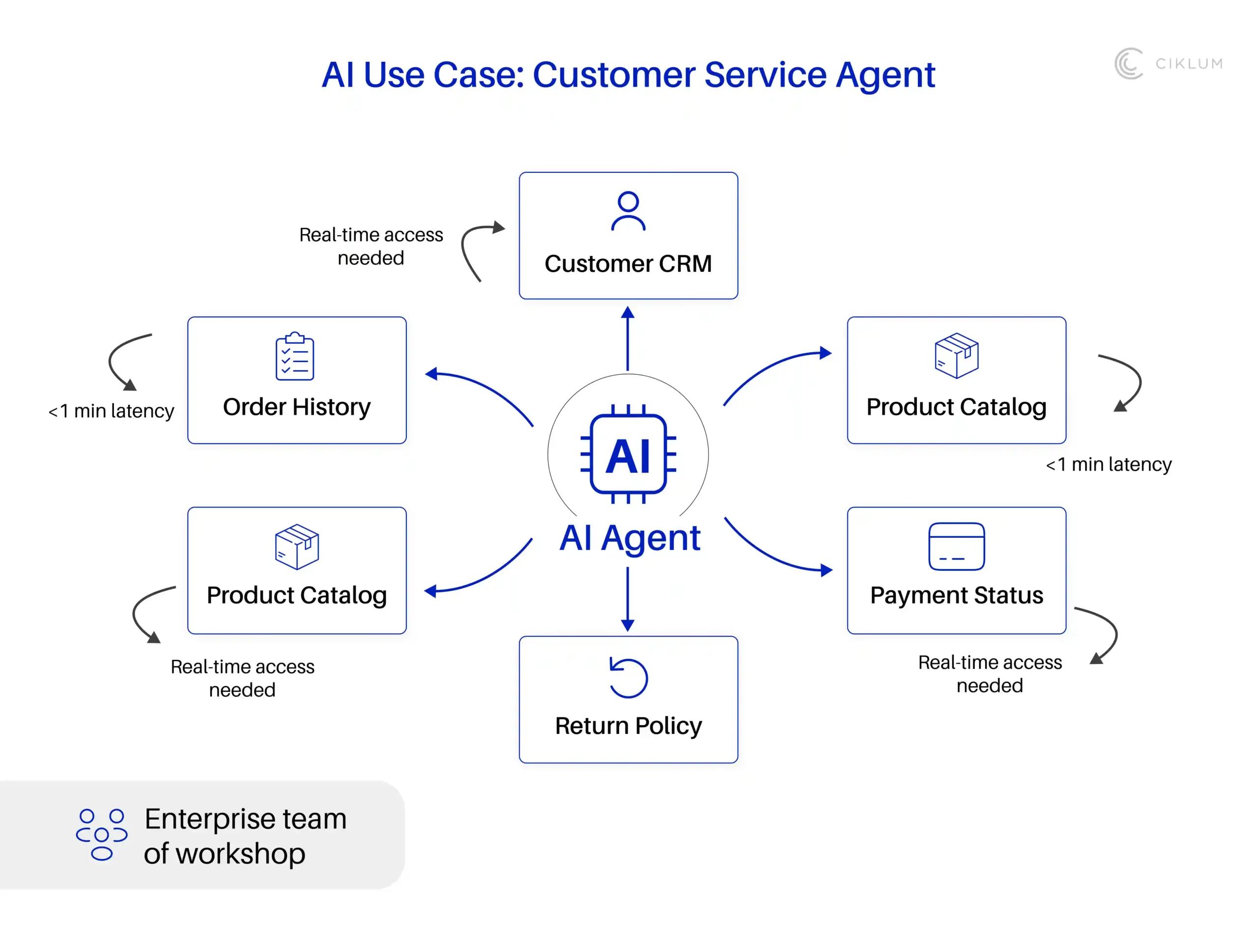
Not all enterprise data needs to be AI-ready. The data that matters is the data your specific automation workflow will consume, transform, and act on.
Before building anything, document exactly which data sources the automation requires. For a customer service agent, that might be order history, return policy, payment status, and product catalog. For a supply chain forecasting model, it might be sales history, inventory levels, weather data, and supplier lead times.
For each source, answer three questions: Where does this data live? How current does it need to be? And what happens if it is unavailable?
The teams that clearly documented their key processes and data dependencies first avoid the most common failure pattern, which is building an automation that works in isolation and breaks when it meets real data.
2. Can Your Systems Deliver Data at the Speed Your Automation Needs?
Most enterprise data architectures were built for batch processing, nightly ETL jobs, weekly exports, periodic synchronization between systems. AI automation systems, particularly agentic ones, need data in real time or near real time.
Audit the latency of each data source your automation depends on. If your pricing agent needs current inventory levels but the inventory system only syncs every four hours, the agent will make pricing decisions based on stale data. If your customer service bot needs order status but the OMS updates in batch overnight, the bot will give customers wrong answers.
The fix is not always a full infrastructure overhaul. Sometimes it is an API endpoint on top of an existing system. Sometimes it is a change of data capture stream. Sometimes it is accepting a known delay and designing the automation to account for it. The important thing is knowing the gap before you build, not discovering it after deployment. Building AI-ready data pipelines starts with understanding what "ready" means for each specific use case.
3. Is Your Data Consistent Across Systems?
Enterprise data is rarely wrong in one place. It is wrong differently in multiple places. The CRM says a customer is "active". The billing system says they are "suspended". The support platform has no record of them at all.
For human analysts, these inconsistencies are manageable. They know which source to trust. For AI automation, they are catastrophic. An agent that queries two systems and gets two different answers for the same customer will either pick one arbitrarily, average them, or fail. None of these outcomes are acceptable in production.
4. Can Your Automation Access the Data Programmatically?
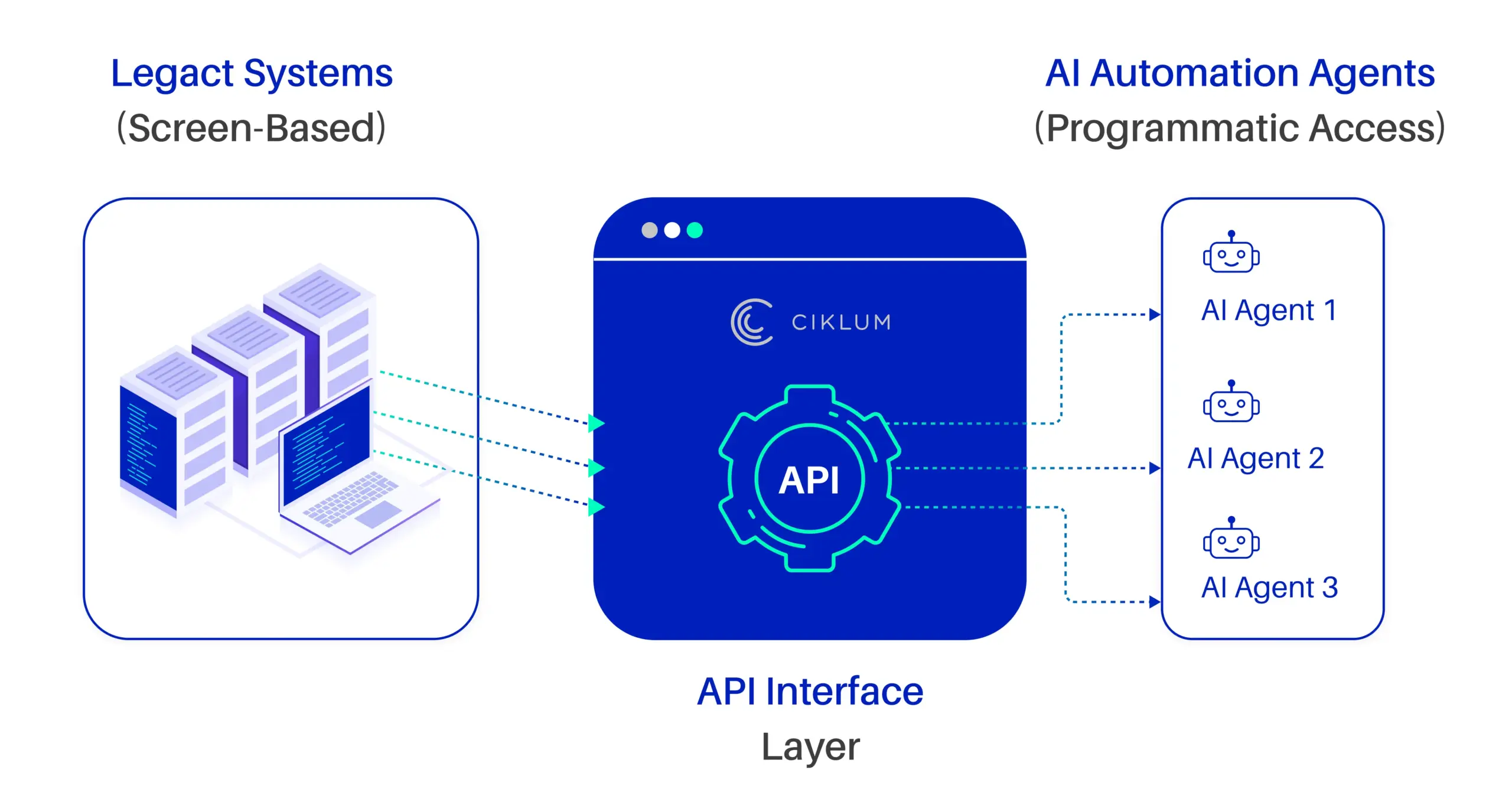
Data that exists in a dashboard, a spreadsheet export, or a screen-based application might as well not exist for AI automation purposes. Automation systems need programmatic access, APIs, database connections, or structured data feeds.
Audit each data source for machine accessibility. If the only way to get inventory data is by logging into a WMS and running a manual report, that is a blocker. If customer records are locked behind a CRM interface without an API, that is a blocker.
This is one of the most common gaps in legacy environments. The data exists. The systems work. But they were built for human users interacting through screens, not for autonomous systems interacting through APIs. Closing this gap (sometimes with a lightweight API layer, sometimes with a data virtualisation tool) is prerequisite work, not optional.

5. Do You Know Your Data Quality Baseline?
You cannot improve what you do not measure. Before building automation, establish a baseline for data quality across your critical sources: completeness (what percentage of fields are populated?), accuracy (how often does the data reflect reality?), timeliness (how current is it?), and consistency (does it match across systems?).
Set a threshold for each metric that your automation requires. A demand forecasting model might tolerate 5% missing values in historical sales data. A regulatory compliance agent might tolerate zero. Define these thresholds before you build, and instrument monitoring to alert when data quality drops below them.
Ciklum's work with a global consumer goods company illustrates the payoff: replacing 22+ fragmented data sources with a unified platform eliminated the inconsistencies that would have made any automation built on top unreliable. The data foundation came first. The automation capabilities came second.
6. Who Owns Data Quality And What Happens When It Degrades?
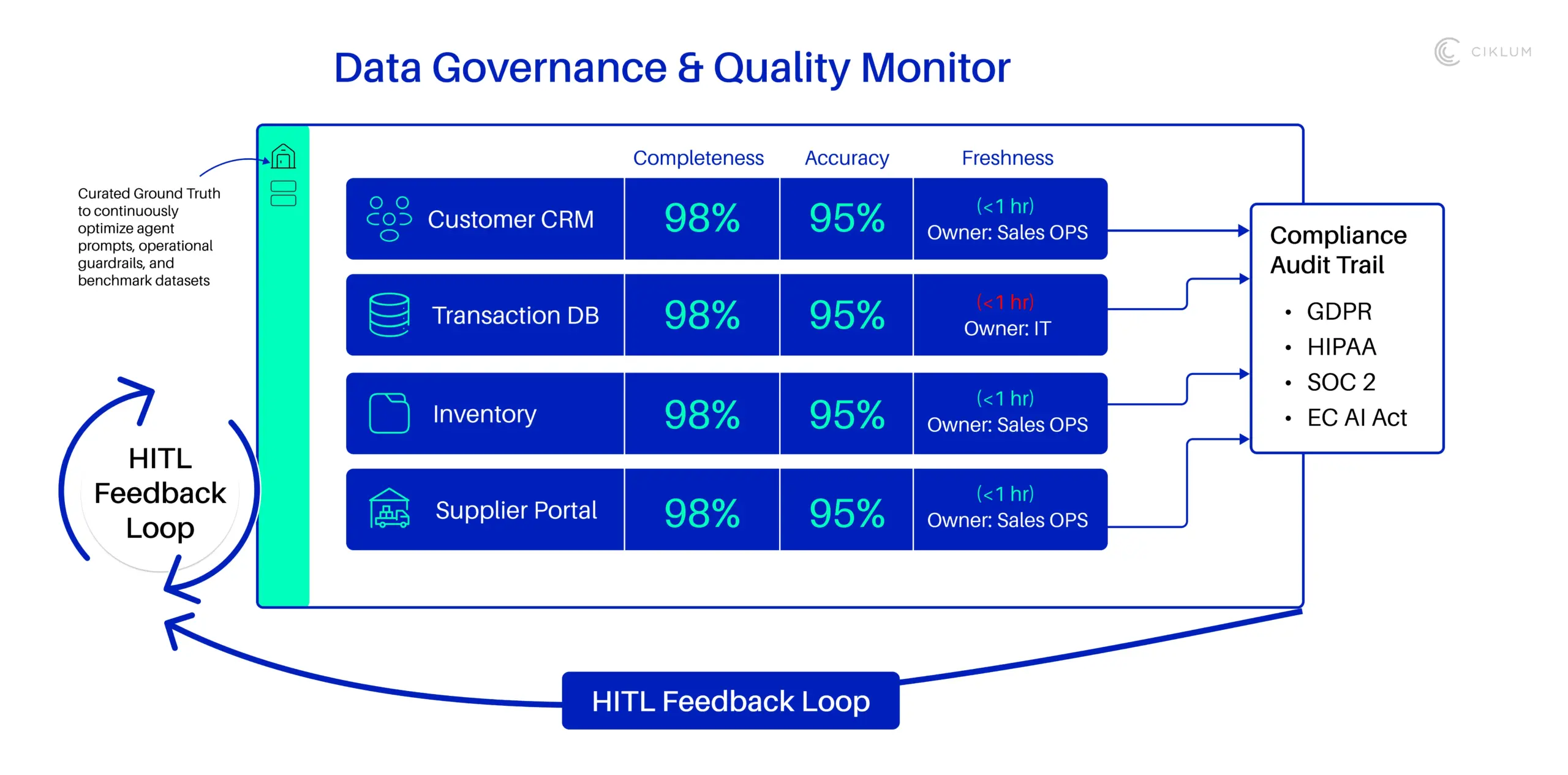
Data quality is not a project. It is an ongoing operational responsibility. Before deploying automation, define who owns the quality of each data source, what monitoring is in place, and what the remediation process is when quality degrades.
In most enterprises, this ownership is ambiguous. The IT team manages the systems. The business team generates the data. Nobody is accountable for the accuracy of what flows between them. When an AI agent makes a bad decision because the underlying data was wrong, the root cause investigation often reveals that no one was watching.
Establish data stewardship for every source your automation consumes. Define SLAs for quality and freshness. Build alerting that triggers when those SLAs are breached. This is governance, and it needs to be operational.
7. Have You Addressed Security, Privacy, and Compliance?
AI automation systems access, process, and often act on sensitive data. Before building, confirm that your data handling meets regulatory requirements: GDPR, HIPAA, SOC 2, the EU AI Act, or whatever applies to your industry and geography.
Specific questions to answer: Does automation need access to PII? If so, is that access minimized to what is necessary? Are there audit trails for every data access and automated decision? Can you explain to a regulator how the automation reached a specific conclusion? If the automation makes an error that affects a customer, how quickly can you trace the root cause?
A fintech client Ciklum worked with consolidated five legacy billing systems into a single platform with automated ETL, cutting processing time by 74% and raising efficiency by 87%. But the consolidation also created a single, auditable data path that made compliance reporting straightforward. The automation benefit and the compliance benefit came from the same architectural decision.
Conclusion
The checklist is intentionally simple - but its impact is not. Mapping dependencies, validating latency, testing consistency, and ensuring access are not just technical steps; they form the foundation of whether your automation efforts succeed or stall. When teams take the time to measure data quality, establish ownership, and address compliance early, they remove the friction that typically derails AI initiatives later.
What sets successful organizations apart is not just their ambition to adopt AI, but their discipline in preparing for it. They understand that data readiness is not a preliminary task to rush through - it is the first and most critical phase of the entire automation journey. Without it, even the most advanced models struggle to deliver meaningful outcomes.
This checklist is more than a starting point - it’s a reality check. It forces teams to identify gaps, align stakeholders, and scope efforts with clarity and honesty. In doing so, it turns AI automation from a high-risk experiment into a structured, scalable capability.
If you want your automation initiatives to move beyond pilots and into production, this is where the work begins - not with models, but with the data that powers them.
By Ciklum Editorial Team

Ciklum’s Editorial Board is a collective of experienced writers and industry experts, bringing together perspectives shaped by real-world engineering and delivery experience. Through collaborative insights, the team explores how technology, AI, and digital innovation move from concept to execution across industries.
Blogs
Discover Similar Insights

Why Enterprise AI Automation Programs Fail, and How to Make Sure Yours Doesn’t
Learn More
Inside Intelligent Automation: How It Works in Real Enterprise Environments
Explore How It Works in Production
How AI Is Changing Enterprise Automation Architectures And Why Most Companies Aren’t Ready
Explore the Architecture Shift
AI Agents vs Chatbots vs RPA: Choosing the Right Tool for Enterprise Automation
Learn More