



Key Takeaways
- Most IA deployments never leave the lab: 71% of organizations claim to use AI agents, but only 11% have moved use cases into production. The gap between pilot and production is where most intelligent automation investments stall.
- Real IA is not one technology, it is a coordinated stack: Production-grade intelligent automation combines RPA, process mining, intelligent document processing, conversational AI, and machine learning. The value comes from how these components connect, not from any one of them alone.
- The work that matters is invisible: The highest-impact automation often runs in back-office processes that no customer ever sees, e.g., mortgage transfers, audit categorization, billing consolidation, procurement analysis. These are not glamorous, but they are where the ROI lives.
- Starting small and layering capabilities beats big-bang deployments: Enterprises that begin with structured RPA and add intelligence incrementally outperform those that attempt end-to-end agentic automation from day one.
The Gap Between the Brochure and the Build
Intelligent automation is one of the most oversold and undershipped categories in enterprise technology. The vendor pitch is compelling: AI-powered systems that handle complex workflows end to end, learn from experience, and free human teams for higher-value work. The production reality is more nuanced.
Camunda's 2026 State of Agentic Orchestration report found that 73% of organizations acknowledge a significant gap between their automation vision and current reality. Nearly half (48%) operate AI agents in silos rather than integrated into end-to-end processes. And 80% of the AI agents actually deployed are chatbots or assistants, not the mission-critical automation systems the strategy decks describe.
This does not mean intelligent automation fails. It means the way it gets sold as "a single platform purchase that transforms operations overnight" does not match how it actually gets built. In real enterprise environments, intelligent automation is assembled, not installed. It is a stack of coordinated capabilities deployed incrementally against specific operational problems.
Understanding what that looks like in practice matters more than understanding what it looks like in a demo.
What the Stack Actually Contains
In production, intelligent automation is rarely a single technology. It is a combination of capabilities, each handling a different aspect of the work.
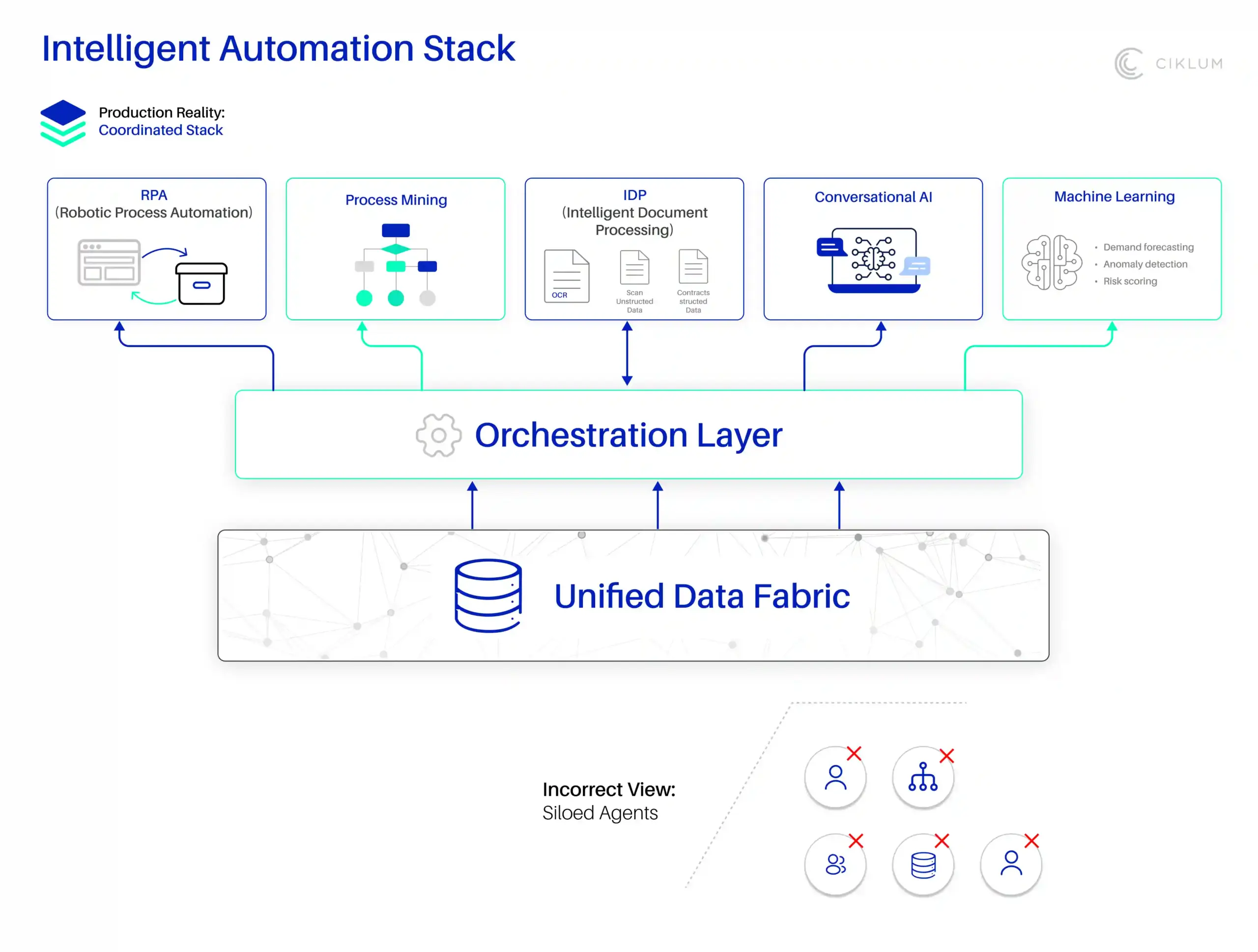
Robotic Process Automation (RPA) handles structured, repetitive execution, moving data between systems, filling forms, validating records & triggering transactions. It is deterministic, reliable, and fast.
Process mining maps how work actually flows through the organization, as opposed to how process documents say it flows. The difference is usually substantial. Process mining identifies bottlenecks, rework loops, compliance deviations, and automation opportunities that would otherwise remain invisible.
Intelligent Document Processing (IDP) extracts structured data from unstructured documents such as invoices, contracts, regulatory filings, medical records. This is where AI earns its keep in back-office automation: handling the variability that rule-based systems cannot.
Conversational AI provides natural language interfaces for internal and external users: answering questions, routing requests, and executing simple transactions through chat or voice.
Machine learning adds prediction and classification, e.g., demand forecasting, anomaly detection, risk scoring, categorization at scale.
Enterprise AI automation brings these components together - while each delivers incremental value on its own, connecting them through orchestration, shared data, and governance drives compounding impact.
What This Looks Like in Practice
Theory is useful. Specifics are more useful. Here is what intelligent automation services look like when they are actually running inside enterprise operations.
Manufacturing and Supply Chain
A UK automotive manufacturer with 40,000+ employees had already built 200+ RPA automations across manufacturing, supply chain, procurement, and compliance. The next step was layering intelligence on top.
Ciklum deployed Celonis Process Mining across the procure-to-pay cycle, uncovering over £10 million in maverick buying and cutting process rework by more than 50%. Intelligent Document Processing was applied to regulatory reporting, delivering roughly 80% cost savings on document handling. Conversational AI was introduced for procurement and supply chain queries. Total savings exceeded £1 million, and the engagement became the client's first GenAI implementation.
The pattern matters: RPA first, then process mining to find the real opportunities, then AI capabilities layered on top where they add measurable value.
Financial Services
Santander Portugal needed to automate mortgage transfer requests to comply with Banking Association SLAs. The process involved complex document extraction, batch handling, and tight regulatory deadlines.
Ciklum built the solution in 11 months using RPA with Appian, IDP for document extraction, and batch processing for volume handling. The bank now consistently meets its 8-day transfer SLA, while significantly reducing manual effort and minimizing document errors. No agentic AI. No multi-model orchestration - just the right automation applied to a clearly defined operational challenge.
Lead-to-Cash Operations
An American cloud computing company needed to modernize its entire Lead-to-Cash process from demand-to-quote through order-to-fulfill and invoice-to-cash.
Ciklum built 40 UiPath bots to automate manual steps, migrated 200+ existing bots to the cloud, integrated ABBYY for intelligent document processing, and established a Celonis Process Mining Center of Excellence with end-to-end order-to-cash visibility. The result was measurably higher deal velocity and significant hours saved across the value stream.
Pharmaceutical Audit Analytics
A billion-dollar UK pharmaceutical company needed to categorize over 400,000 audit events, a task previously done manually and prone to inconsistency.
Ciklum built an ML-powered audit analytics pipeline using unsupervised learning to generate context-based category tags, enhanced by semantic clustering and coherence modeling - replacing manual categorization with a continuously improving system.
What Separates Deployments That Scale from Those That Stall
Across these examples and the broader market, a consistent pattern emerges.
Deployments that scale start with process understanding, not technology selection: Process mining or detailed operational mapping comes before tool procurement. The organizations that skip this step automate the wrong things or automate broken processes, which just produces broken outcomes faster.
They layer capabilities incrementally: RPA manages structured execution at the core, with IDP, ML, and conversational AI layered in at key decision points that require intelligence. This creates a compounding automation model, where each capability builds on the data and governance foundation of the last.
They define governance before scaling: Who approves changes to automation logic? How are exceptions handled? What audit trail exists for automated decisions? These questions are easier to answer when the scope is small. Organizations that wait until they have 200+ automations running to establish governance find it significantly harder.
They measure operational outcomes, not technology metrics: Processing time, error rate, SLA compliance, cost per transaction, hours reclaimed. These are the metrics that sustain executive sponsorship and justify the next phase of investment. Model accuracy and automation count are means to those ends, not ends in themselves.
Conclusion
In real enterprise environments, intelligent automation does not emerge as a single, autonomous AI platform - it takes shape as a coordinated stack of capabilities, each applied with intent to solve specific operational challenges. From RPA and process mining to IDP, ML, and conversational AI, value is created not through isolated deployment, but through orchestration, governance, and a relentless focus on measurable business outcomes.
What ultimately separates experimentation from enterprise-scale success is discipline. Organizations that close the gap between vision and production treat intelligent automation as an engineering function - one that begins with deep process understanding, evolves through structured, layered capability building, and scales only when the underlying foundation is robust enough to support it. This approach transforms automation from a collection of tools into a cohesive, adaptive system - capable of compounding value over time and driving sustained operational advantage.
By Ciklum Editorial Team

Ciklum’s Editorial Board is a collective of experienced writers and industry experts, bringing together perspectives shaped by real-world engineering and delivery experience. Through collaborative insights, the team explores how technology, AI, and digital innovation move from concept to execution across industries.
Blogs
Discover Similar Insights

Why Enterprise AI Automation Programs Fail, and How to Make Sure Yours Doesn’t
Learn More
Before Building Enterprise AI Automation: A Practical Data Readiness Checklist for Teams
Assess Your Data Readiness
A Practical Enterprise Architecture for Intelligent Automation
Explore the Reference Architecture
How AI Is Changing Enterprise Automation Architectures And Why Most Companies Aren’t Ready
Explore the Architecture Shift