



Key Takeaways
Most healthcare modernization risks are organizational, not technical: The platform usually works. What fails is the data migration, the clinical workflow, the integration map, and the governance around them. Buying better software does not remove those risks.
The expensive failures are the quiet ones: A modernization program rarely collapses on go-live day. It erodes over the following year through data that does not reconcile, clinicians who route around the new system, and integrations that break in production.
Compliance and security risk moves during the migration itself: Patient data crosses systems, access paths change, and logs land in new places. Treating compliance as a final review instead of a migration control is one of the most common ways modernization goes wrong.
The fix is sequencing and continuity, not ambition: Incremental migration, mapped dependencies, embedded compliance, and a real fallback plan turn a high-risk rewrite into a controlled transition.
Healthcare providers are under real pressure to modernize. Aging core systems are expensive to run, hard to secure, and slow to change. Boards approve the budget, vendors are selected, and a multi-year program kicks off with a clean reference architecture and an optimistic timeline.
Then reality arrives. The honest truth about healthcare modernization risks is that technology is rarely the thing that fails. The new platform usually works as advertised. What goes wrong sits around it, in the data that has to move, the workflows clinicians depend on, the integrations nobody fully documented, and the governance that quietly dissolves once the contract is signed. Those failures are harder to see than an outage, which is exactly why they are so expensive.
This article looks at where healthcare modernization actually goes wrong, why the worst risks stay hidden until they are costly to fix, and the practical moves that keep a modernization program from becoming a cautionary tale.
Why Healthcare Modernization Risks Are Different
In most industries, a failed migration is a business problem. In healthcare, it is a patient-safety problem first and a business problem second. A scheduling system that drops appointments, a record that shows the wrong medication history, or an interface that lags during a handoff does not just cost money. It puts care at risk.
That raises the stakes on every decision. It also changes what "done" means. A migration can finish on time, on budget, and technically complete, and still be a failure if clinicians cannot trust the data or find what they need at the point of care. The Office of the National Coordinator for Health IT has tracked strong gains in electronic record adoption alongside persistent gaps in how well systems actually exchange usable information. That gap is where modernization risk lives. It is the difference between a system that is technically modern and one that keeps care moving.
The other complication is that healthcare cannot pause while it modernizes. Care continues every hour of the migration. That removes the easiest risk-reduction tool other industries rely on, the clean cutover window, and forces a harder discipline of running old and new together until the new path has earned trust.
The Five Places Healthcare Modernization Goes Wrong
The failure patterns are consistent across providers and program types. Five risks account for most of the damage.
Data Migration That Looks Done but Is Not
Data is where modernization quietly breaks most often. Decades of patient records, coded in formats that changed over time, entered by thousands of people with inconsistent conventions, rarely move cleanly into a new model. The migration script runs, the record counts match, and the project marks the milestone complete. The problem surfaces weeks later when a clinician notices an allergy that did not carry over or a lab result attached to the wrong encounter.
The risk is not usually catastrophic data loss. It is silent data degradation. Fields that mapped imperfectly. History that truncated. Duplicates that merged the wrong two patients. None of it shows up in a row count. All of it shows up in clinical trust, and once clinicians stop trusting the data, they start keeping their own shadow records, which defeats the entire program.
Clinical Workflow Disruption That Nobody Modeled
A modernization program that optimizes the technology and ignores the workflow tends to deliver a system that is objectively better and operationally worse. Clinicians do not experience architecture. They experience clicks, screens, and the number of steps between a patient and a decision. When the new system adds friction to a high-frequency workflow, the productivity hit is immediate and the dissatisfaction compounds.
The deeper issue is that workflow disruption is often designed in by accident. The program maps applications and data but never maps how a nurse actually moves through a shift or how a physician documents between patients. The result is a system that satisfies the requirements document and frustrates the people who use it forty times a day.
Compliance and Security Gaps Opened by the Migration
Modernization is a compliance event, not just an engineering one. The migration itself changes the control environment. Patient data moves across systems, integration points multiply, access paths shift, and audit logs start landing in new places. The HHS HIPAA Security Rule expects safeguards for protected health information to hold continuously, including during transition, and its contingency-planning requirements cover exactly the backup and recovery scenarios a migration stresses.
The common mistake is treating compliance as a gate at the end rather than a control throughout. By the time a final security review runs, the risky data movements have already happened, often without complete logging. A program that cannot prove who accessed what during the migration has a problem that is much harder to fix after the fact than before.
Integration and Interoperability That Breaks in Production
Every healthcare estate runs on integrations, many of them old, undocumented, and load-bearing. The reference architecture in the business case assumes clean interfaces. The real estate is held together by point-to-point connections, custom feeds, and a few scripts only one person understands. Modernization that underestimates this integration debt discovers it in production, when a downstream system stops receiving data it silently depended on.
Interoperability failure is especially dangerous because it is often invisible at go-live. The new core works. The problem appears when a pharmacy system, a lab feed, or a reporting pipeline that was never fully tested starts returning stale or malformed data. The further that broken interface sits from the modernization team's attention, the longer it takes to notice and the more decisions get made on bad data in the meantime.
Cost Overruns and Value That Never Materializes
The financial risk in healthcare modernization is rarely the headline capital number. It is the slow leak. McKinsey's analysis of large technology programs has long shown big efforts running over budget and under their predicted value, and healthcare is a particularly expensive instance of that pattern. The overrun usually comes from the work that was deferred to "phase two," the integration cleanup, the workflow redesign, the training that got cut when the rollout budget closed.
The quieter cost is an unrealized value. The business case promised efficiency, better data, and lower run cost. When the program stops at technical go-live, those benefits never get measured, let alone delivered. The system becomes a line item rather than an advantage, and the next modernization is harder to fund because the last one did not visibly pay off.
Why the Worst Risks Stay Hidden
The pattern across all five is the same. The visible part of modernization, the platform, tends to succeed. The invisible parts, data quality, workflow fit, compliance evidence, integration health, and value realization, are where it fails, and those parts are easy to defer and hard to measure.
That is what makes healthcare modernization risks so dangerous. They do not announce themselves on go-live day with a clear failure the board can see. They accumulate over the following twelve to twenty-four months as quiet drag. By the time the drag is undeniable, the program structure that could have fixed it has usually been disbanded and the budget has moved on.
How to Avoid the Hidden Risks
The providers that modernize without a disaster are not the ones with the best vendor. They are the ones that treat modernization as a controlled transition rather than a heroic replacement. The moves below are unglamorous, and that is the point.
Replace the Big-Bang Rewrite With Incremental Migration
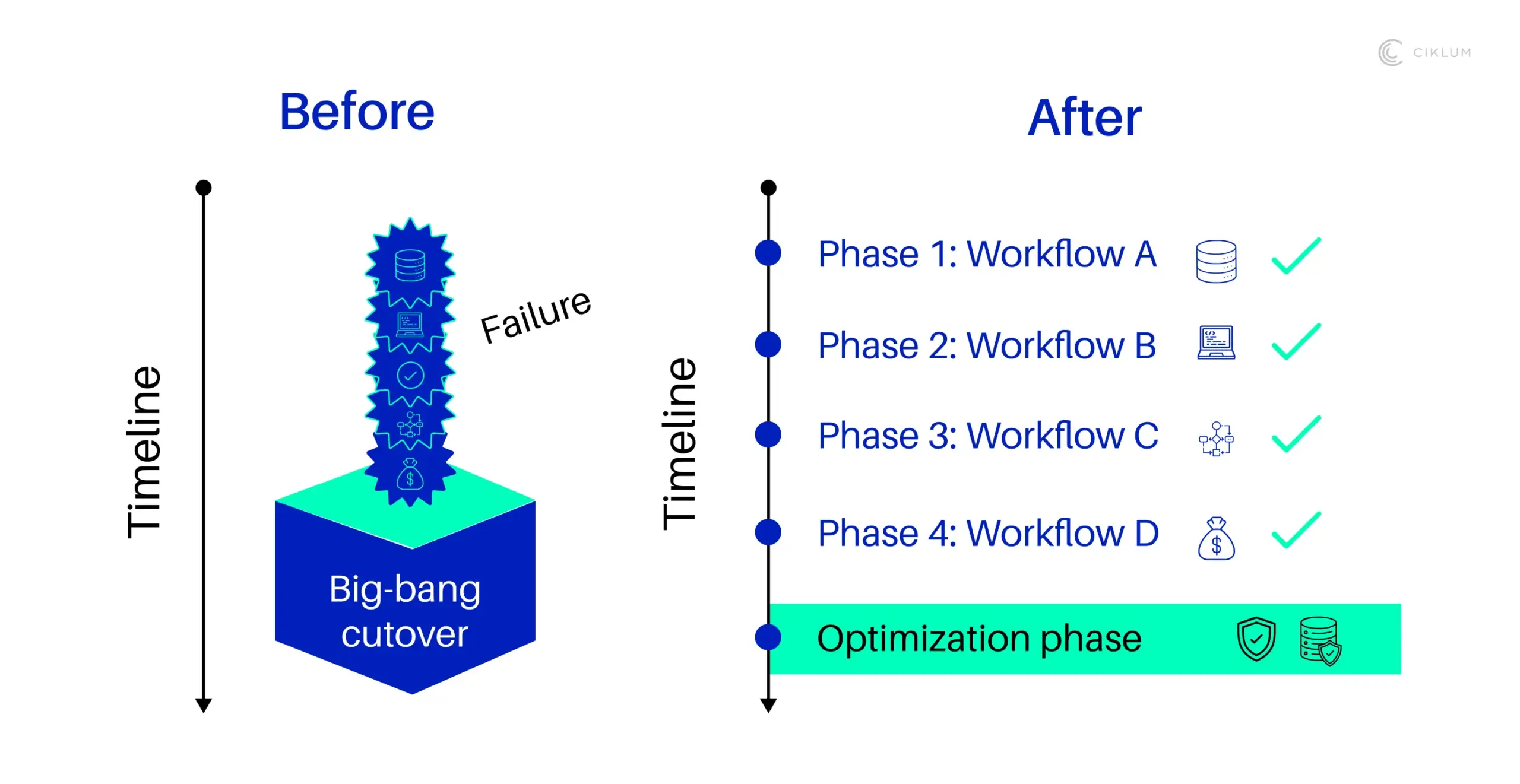
The single highest-leverage decision is to avoid replacing everything at once. The big-bang rewrite concentrates every risk into one moment, which is exactly when a healthcare organization can least afford surprises. The incremental alternative wraps the legacy system, moves one bounded workflow to the modern path, validates it in live conditions, and expands from there. Ciklum's legacy modernization practice favors this strangler-style approach precisely because it keeps the system in production throughout and lets risk be retired one slice at a time instead of all at once.
The benefit in healthcare is twofold. Clinicians keep using familiar workflows while capabilities move behind the scenes, and the team learns where the real risks are on a small workflow before they touch a critical one.
Map Dependencies and Workflows Before You Commit
Most hidden modernization risks trace back to something that was assumed rather than mapped. Before any date becomes a commitment, chart two things. First, the technical dependency graph, which systems, feeds, integrations, and data flows have to keep working for each workflow to stay safe. Second, the clinical workflow itself, how each role actually moves through the system day to day. The exercise takes time the program always feels it does not have. It costs far less than discovering the same dependency in production.
Protect Data Integrity as a First-Class Workstream
Data migration deserves more than a script and a row count. Treat it as a validated workstream with clinical sign-off. Profile the source data before moving it, so the team knows where the inconsistencies are. Reconcile on meaning, not just volume, by checking that allergies, medications, problem lists, and encounters carry over correctly on a representative sample. Run old and new in parallel long enough for clinicians to confirm the data they see matches what they trust. AI-assisted analysis can accelerate the parts of this, and Ciklum's view on AI-driven engineering in healthcare is consistent on the principle that automation should reduce risk and increase visibility, not just speed.
Make Compliance a Migration Control, Not a Final Gate
Build compliance into every phase instead of saving it for the end. Each migration step should carry its own checklist before traffic moves. Are role-based access controls correct in the new path? Are audit logs complete and capturing the migration itself? Is encryption applied in transit and at rest? Has emergency-mode access been tested? Ciklum's analysis of HIPAA-secure cloud migration makes the operational case that secure transfer, access control, audit logging, and recovery planning belong inside the migration plan, so evidence is generated as part of the work rather than reconstructed afterward.
Rehearse the Fallback Before You Need It
A modernization plan that has no rehearsed rollback is a plan that assumes nothing will go wrong, which is the one assumption healthcare cannot make. Before each meaningful cutover, simulate the failures that matter. An integration that lags. A permission mismatch. Bad data in the new workflow. Then confirm the team can detect the issue, understand the clinical impact, communicate to affected users, and roll back within the agreed window. A rollback that is technically correct but confusing to clinicians is not a safe rollback. The rehearsal has to include clinical staff, not only IT.
Fund the Optimization Phase, Not Just the Go-Live
The value of modernization is realized after go-live, not at it. Keep a named owner, a governance structure, and a measurement framework in place for the months that follow, and track the outcomes the business case promised rather than only the capital spend. Providers that treat the period after go-live as an ongoing engineering program rather than a handoff are the ones that actually capture the efficiency and data benefits they paid for.
What Getting It Right Looks Like
Done well, healthcare modernization stops feeling like a bet. A provider that maps its care pathways, migrates one workflow at a time, validates data with clinical sign-off, embeds compliance, and rehearses fallback does not eliminate risk. It contains it, and it learns where the real risks are on low-stakes workflows before touching critical ones.
The same discipline shows up in engineering-led healthcare work. A Ciklum engagement in regenerative medicine operations automated fragmented reporting workflows and enabled real-time data access, standardizing document creation and cutting latency for the team by hours per opportunity. The lesson is not that every provider needs the same platform. It is that modernization creates value when fragmented, brittle processes become reliable, visible, and easier to act on, and that only happens when the risks are managed deliberately rather than hoped away.
In Summary
Healthcare modernization goes wrong far more often through the things around the technology than through the technology itself. Data degrades quietly. Workflows get disrupted by accident. Compliance gaps open during the migration. Integrations break in production. Promised value never gets measured. None of these announce themselves on go-live day, which is exactly why they are the risks worth taking seriously.
The way to avoid them is not more ambition. It is more discipline. Migrate incrementally. Map dependencies and workflows first. Protect data integrity as its own workstream. Treat compliance as a control, not a final gate. Rehearse the fallback. Fund the optimization phase. Those moves turn a high-risk rewrite into a transition a clinical organization can trust.
Ciklum's healthcare engineering, data, and modernization teams work with providers, payers, and life sciences organizations through exactly this kind of transition. If a modernization program is on the horizon and the hidden risks are the part that worries you, talk to our specialists about de-risking it before the work begins.
Frequently Asked Questions
1. What is the biggest risk in healthcare modernization?
Treating it as a technical replacement rather than an operational transition. The platform usually works. The damage comes from data that does not reconcile, workflows that get disrupted, compliance gaps opened during the migration, and integrations that break in production. A plan that does not show how care continues during failure, rollback, and partial adoption is incomplete.
2. Why do healthcare modernization risks stay hidden until late?
Because the visible part of the program, the new system, tends to succeed, while the parts that fail are easy to defer and hard to measure. Data quality, workflow fit, integration health, and value realization accumulate as quiet drag over twelve to twenty-four months rather than failing loudly on go-live day. By the time the drag is obvious, the program structure that could fix it has often been disbanded.
3. How can a provider reduce data migration risk?
Treat data migration as a validated workstream, not a one-time script. Profile the source data first, reconcile on clinical meaning rather than only record counts, run old and new systems in parallel, and get clinical sign-off on a representative sample before moving traffic. The goal is that clinicians trust the data, because the moment they do not, they create shadow records and the program loses its value.
4. Should healthcare modernization be a big-bang cutover or phased?
Phased, in almost every case. A big-bang cutover concentrates every risk into one moment a healthcare organization can least afford. An incremental, strangler-style approach keeps the system in production, moves one workflow at a time, and retires risk gradually while clinicians keep using familiar tools.
5. When should a provider bring in external engineering support?
Two moments produce the highest return. The first is during planning, when dependency mapping, data profiling, and compliance design set up the whole program to succeed or fail. The second is during integration and post-go-live optimization, when the gap between the reference architecture and the real estate becomes visible. Both need engineering bandwidth that in-house teams, still running daily care operations, rarely have spare.
By Ciklum Editorial Team

Ciklum’s Editorial Board is a collective of experienced writers and industry experts, bringing together perspectives shaped by real-world engineering and delivery experience. Through collaborative insights, the team explores how technology, AI, and digital innovation move from concept to execution across industries.
Blogs
Discover Similar Insights

A Practical Approach to Healthcare System Modernization Without Downtime
Learn More
AI Automation in Healthcare: Transforming Patient Data and Operations
Learn More
Healthcare AI Done Right: Why Workflow Designs Beat Models Every Time
Learn More
Why AI Automation Fails Without Modern Enterprise Data Platforms
Learn More