



Key Takeaways
Rebuild is the seductive answer and usually the wrong one: A full rewrite feels like a clean start, but the refactor vs rebuild software decision goes wrong most often when teams underestimate how much working knowledge is buried in the system they want to throw away.
Refactoring wins more often than teams expect: Most systems that feel beyond saving are suffering from accumulated mess, not fundamental wrongness. Incremental refactoring keeps the business running while the system improves, and it carries a fraction of the risk of a rewrite.
Rebuild only when the foundation itself is the problem: A genuine rebuild case exists when the core technology, architecture, or data model can no longer support where the business needs to go, not merely when the code is ugly or unfamiliar.
The safest path is usually neither pure option: Incremental replacement, building the new alongside the old and migrating piece by piece, captures most of the benefit of a rebuild without the all-or-nothing risk. It is the option most teams forget exists.
Sooner or later, almost every system reaches the point where someone asks the question. Do we keep fixing this, or do we start over? The code has grown tangled, changes take longer than they should, and the original architects have moved on. A rewrite starts to look like the obvious escape. A clean codebase, modern tools, none of the old baggage. It is one of the most tempting decisions in software, and also one of the most dangerous.
The refactor vs rebuild software decision can save a system or sink it, and the stakes are not just technical. A rebuild that runs long, loses institutional knowledge, or stalls halfway can cost a business years and millions while the old system it was meant to replace keeps running anyway. A refactor that should have been a rebuild can mean pouring effort into a foundation that was never going to hold. Getting the call right matters more than almost any other architectural decision a team makes.
This article looks at why the decision is so high-stakes, when refactoring is the right call, when rebuilding genuinely is, and the third path most teams overlook.
Why the Decision Is So High-Stakes
The reason this decision sinks so many systems is that the rebuild option is emotionally appealing and statistically risky. Engineers are drawn to the clean start because the existing system is painful to work in, and pain is a poor guide to strategy. The mess is visible. The value buried inside the messy system, the edge cases it handles, the business rules encoded over years, the quiet fixes for problems everyone has forgotten, is invisible until it is gone.
That is the trap at the heart of the rewrite. A working system, however ugly, represents years of accumulated knowledge and battle-tested behavior. A rewrite starts from zero and has to rediscover all of it, usually under a deadline, usually while the old system still has to be maintained in parallel. Big rewrites have a long and well-documented history of running over time, missing the behaviors of the system they replaced, and being quietly abandoned. The clean start is rarely as clean as it looked from the outside.
This does not mean rebuilds are always wrong. It means the bar for choosing one should be high, and the decision should be made on evidence about the foundation rather than on frustration with the code. The cost of getting it wrong runs in both directions, an expensive rewrite that fails, or a doomed refactor of something that genuinely needed replacing. The skill is telling those situations apart.
When Refactoring Is the Right Call
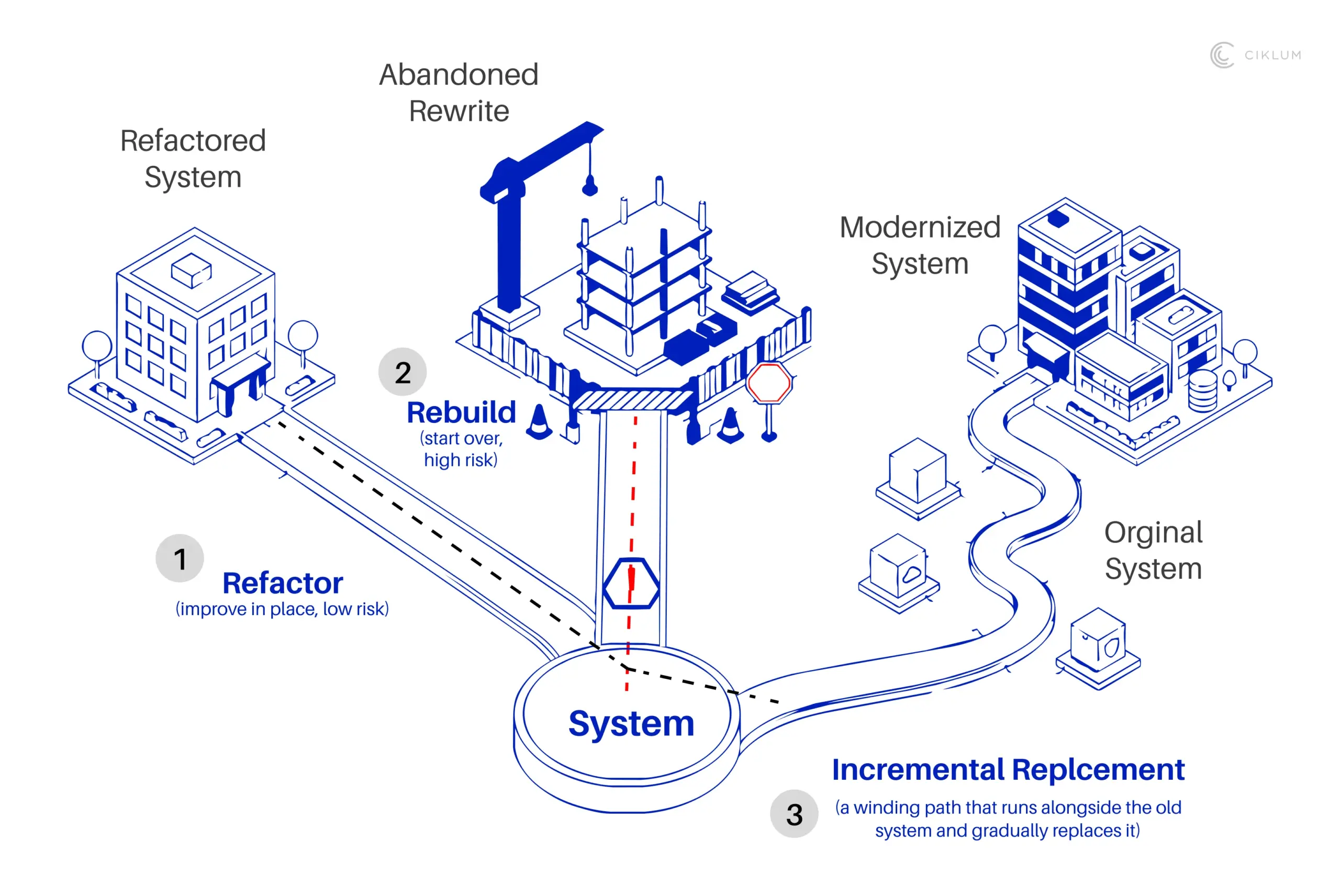
Refactoring wins more often than teams expect, because most systems that feel beyond saving are suffering from accumulated mess rather than fundamental wrongness. A few signals point clearly toward refactoring.
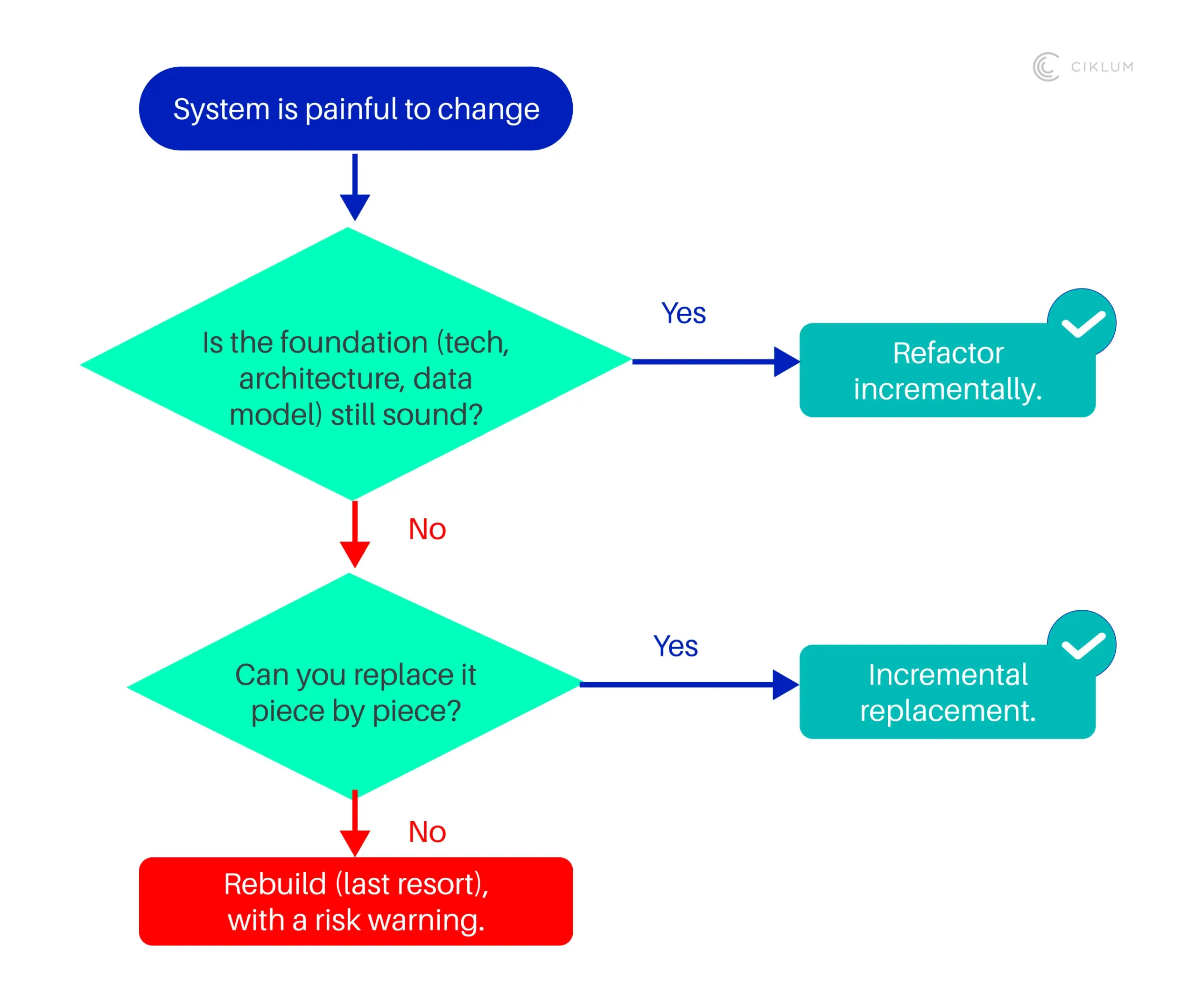
The core architecture and technology are still sound: If the underlying stack is supported, the data model is workable, and the architecture can still support where the business is going, the problem is a mess, not foundation. Mess can be cleaned incrementally.
The system works and the business depends on it: A system actively serving customers is a system whose behavior matters in detail. Refactoring preserves that behavior while improving the code underneath it, which is far safer than trying to reproduce it from scratch.
The pain is localized: When the trouble concentrates in specific modules, the slow parts, the bug-prone areas, the hard-to-change corners, those can be improved in place without touching the parts that work fine. Targeted refactoring delivers most of the benefit for a fraction of the risk.
The knowledge lives in the code, not in people's heads: When the system is the most reliable record of how the business actually works, throwing it away throws away the documentation. Refactoring keeps that knowledge while making it easier to work with.
Refactoring also has a quiet advantage that rarely makes the business case. It keeps delivering value throughout. The system stays in production, customers stay served, and the improvement compounds gradually rather than arriving in one risky release that may never come.
When Rebuilding Is Genuinely the Right Call
Sometimes a rebuild really is the right answer, and refusing to rebuild can sink a system just as surely as an unnecessary rewrite. The rebuild case rests on the foundation, not the surface.
The core technology is at a dead end: When the platform, language, or framework is unsupported, unhireable, or fundamentally incompatible with where the business needs to go, no amount of refactoring fixes that. The foundation itself has expired.
The architecture cannot support the future: If the system was built around assumptions that no longer hold, a load profile, a business model, a data shape that has fundamentally changed, and those assumptions are baked into the core, refactoring around them costs more than rebuilding on assumptions that fit.
The data model is the constraint and cannot evolve: When the data model itself blocks the business and cannot stretch to fit, that is one of the strongest rebuild signals, because the data model shapes the cost of every other change.
The cost of change has overtaken the cost of replacement: When even small changes take months, incidents cluster in the same places, and the system actively prevents the business from moving, the ongoing cost of keeping it may genuinely exceed the cost and risk of replacing it.
Even when the rebuild case is real, the way it is executed decides whether it saves or sinks the system. A big-bang rewrite, where the new system is built in isolation and switched on all at once, is where most rebuild failures happen. That is exactly why the third option matters.
The Third Option Most Teams Miss
The refactor-or-rebuild question is usually framed as a binary, and that framing is what gets teams into trouble. There is a third path that captures much of the upside of a rebuild with far less of the risk, and most teams forget it exists.
Incremental replacement builds the new system alongside the old one and migrates piece by piece. Rather than rewriting everything and switching over in one risky event, the team wraps the existing system and builds a modern capability for one bounded area. The team then routes a slice of traffic to it, validates it in real conditions, and repeats this process until the old system can be retired. The business keeps running throughout, risk is retired one step at a time, and the new architecture emerges one justified piece at a time instead of being bet on all at once.
This is the approach behind our legacy modernization practice, which favors incremental replacement over big-bang rewrites precisely because it keeps the system in production and lets the team learn the operational reality of the new system before committing to it fully. Running old and new side by side this way leans heavily on solid delivery foundations, and our breakdown of the myths and facts about DevOps is a useful primer on the automation and pipeline discipline that makes incremental migration safe. It turns the highest-risk version of a rebuild into a series of manageable steps, each of which delivers value and can be paused or adjusted if the evidence changes.
For many systems, incremental replacement is the honest answer to the refactor vs rebuild software question. It is not a compromise. It is usually the lowest-risk way to get a modern system without gambling the business on a single switchover.

How to Make the Decision Well
The decision should be made on evidence, not frustration. A few disciplines keep it honest.
Assess the foundation, not the surface. Separate the mess from the fundamentals. Ask whether the core technology, architecture, and data model can support where the business is going. If they can, the case is for refactoring. If they genuinely cannot, the case is for replacement. Ugly code is a refactoring problem. A dead foundation is a rebuild problem. Confusing the two is how the decision goes wrong. Our expert view on why architecture matters in software development is a useful lens here, because the strength of the foundation is what the whole decision turns on.
Quantify the cost of change. Measure how long changes actually take, where incidents cluster, and how much of the team's capacity goes to fighting the system rather than improving it. A system that is merely unpleasant is different from one that is actively blocking the business, and the numbers tell which one you have.
Default to incremental. Whether the answer leans refactor or rebuild, prefer the path that keeps the system in production and retires risk in steps. A big-bang rewrite should be the option of last resort, chosen only when incremental replacement is genuinely impossible.
Use modern tooling to lower the cost of both. AI-assisted analysis has changed the economics of this decision. Tools can now map dependencies in legacy code, surface duplicated business rules, and accelerate the unglamorous work of understanding and refactoring a system. Ciklum's AI-assisted legacy refactor service exists for exactly this reason, because reducing the cost and risk of understanding the old system often tips the decision toward a safer, more incremental path than a full rewrite. Ciklum's perspective on the future of AI in coding and software development goes deeper on how these tools are reshaping what is realistic to attempt with legacy code.
What the Right Call Looks Like in Practice
The right call is visible in the outcome. The system gets better, the business keeps running, and the risk never concentrates into a single make-or-break moment.
Ciklum's work with Bytes, a UK and Ireland B2B software reseller, is a good example of choosing the path deliberately rather than defaulting to a rewrite. The move toward a modern, service-based architecture was not driven by a desire to throw the old system away. It was justified by a specific, measurable problem, fast-changing parts of the system trapped behind slow-changing ones, which had pushed release cycles out to roughly twice a year. The modernization was targeted where it bought a real edge, taking releases to every two weeks and saving months of development effort by validating ideas before building them. The change was structured and incremental, not a big-bang gamble.
The same discipline shows up in larger consolidations, where acquired or aging platforms are unified behind a modern layer one capability at a time, with the business running throughout, rather than rewritten in one risky effort. The lesson across all of them is the same. The systems that come through this decision well are the ones where the team assessed the foundation honestly, preferred the incremental path, and reserved the full rebuild for the rare case where nothing else would do.
That is the difference between a decision that saves a system and one that sinks it. Not boldness, but judgment about the foundation and discipline about the risk.
In Summary
The refactor vs rebuild software decision is one of the highest-stakes calls in engineering, and the seductive option, the clean rewrite, is the one that sinks systems most often. A working system holds years of buried knowledge, and a big-bang rebuild has to rediscover all of it under pressure while the old system keeps running. Most systems that feel beyond saving need refactoring, not replacement, because the problem is an accumulated mess rather than a broken foundation.
Rebuild only when the foundation itself, the core technology, the architecture, or the data model, genuinely cannot support where the business is going. And whichever way the decision leans, default to the incremental path. Build the new alongside the old, migrate piece by piece, and keep the business running throughout. That third option captures most of the benefit of a rebuild with a fraction of the risk, and it is the one teams forget exists.
Frequently Asked Questions
1. Is it usually better to refactor or rebuild a legacy system?
Refactoring is the right call more often than teams expect, because most systems that feel beyond saving are suffering from accumulated mess rather than a broken foundation. If the core technology, architecture, and data model can still support where the business is going, refactoring improves the system while keeping it in production at a fraction of a rewrite's risk. Rebuilding is justified only when the foundation itself can no longer support the future.
2. Why do full rewrites fail so often?
Because a working system holds years of accumulated knowledge, edge cases, and business rules that are invisible until they are gone. A big-bang rewrite has to rediscover all of it from scratch, usually under a deadline, while the old system still has to be maintained in parallel. Rewrites commonly run over time, miss behaviors of the system they replaced, and stall halfway, which is why the bar for choosing one should be high.
3. What is incremental replacement and why is it safer?
Incremental replacement builds the new system alongside the old one and migrates piece by piece, rather than rewriting everything and switching over at once. The team wraps the existing system, modernizes one bounded area, routes some traffic to it, validates it, and repeats until the old system can be retired. The business keeps running throughout and risk is retired in steps, which makes it the lowest-risk way to get a modern system in most cases.
4. When is a full rebuild genuinely the right choice?
When the foundation has expired. That means the core technology is unsupported or unhireable, the architecture was built on assumptions that no longer hold and cannot be refactored around, or the data model itself blocks the business and cannot evolve. Even then, the rebuild should be executed incrementally wherever possible, with a big-bang switchover reserved as a last resort.
5. How does AI change the refactor versus rebuild decision?
AI-assisted analysis lowers the cost of understanding and improving legacy systems. It can map dependencies, surface duplicated business rules, and accelerate the work of refactoring, which often tips the decision toward a safer, more incremental path than a full rewrite. By reducing the cost and risk of working with the old system, modern tooling makes refactoring and incremental replacement viable for systems that might once have looked like rewrite candidates.

By Ciklum Editorial Team

Ciklum’s Editorial Board is a collective of experienced writers and industry experts, bringing together perspectives shaped by real-world engineering and delivery experience. Through collaborative insights, the team explores how technology, AI, and digital innovation move from concept to execution across industries.
Blogs
Discover Similar Insights

Monolith vs Microservices: Which Architecture Works Best at Scale
Learn More
Enterprise AI Automation: A Practical Guide to GenAI, AI Agents and Intelligent Workflows
Get the Automation Playbook
How to Choose a Software Development Company in 2025
Learn More
What is Custom Software Development?
Learn More