



Key Takeaways
- The best architecture at scale is rarely a pure monolith or a pure microservices estate. It is usually a portfolio of choices matched to the workload, team structure, failure tolerance, and release cadence of each part of the business.
- A modular monolith can scale when the domain is coherent and the release cadence is moderate. It becomes a constraint when independent teams need to change different parts of the system at different speeds.
- Microservices work best when the business needs independent scaling, isolated failure domains, and team-owned deployability. They become expensive when the organization has not built the platform, observability, and governance needed to run distributed systems well.
- The most reliable path is evolutionary. Keep what is stable inside a modular monolith, extract what changes independently, and treat each new service as an operating commitment, not just a code boundary.
Why the Binary Question Leads Teams Off Course
"Monolith vs microservices" sounds decisive. It gives architecture leaders two options, asks them to compare the trade-offs, and implies that one of them will be the right answer for the whole system. That is why the question is so common in boardrooms and architecture reviews. It is also why it misleads so many teams.
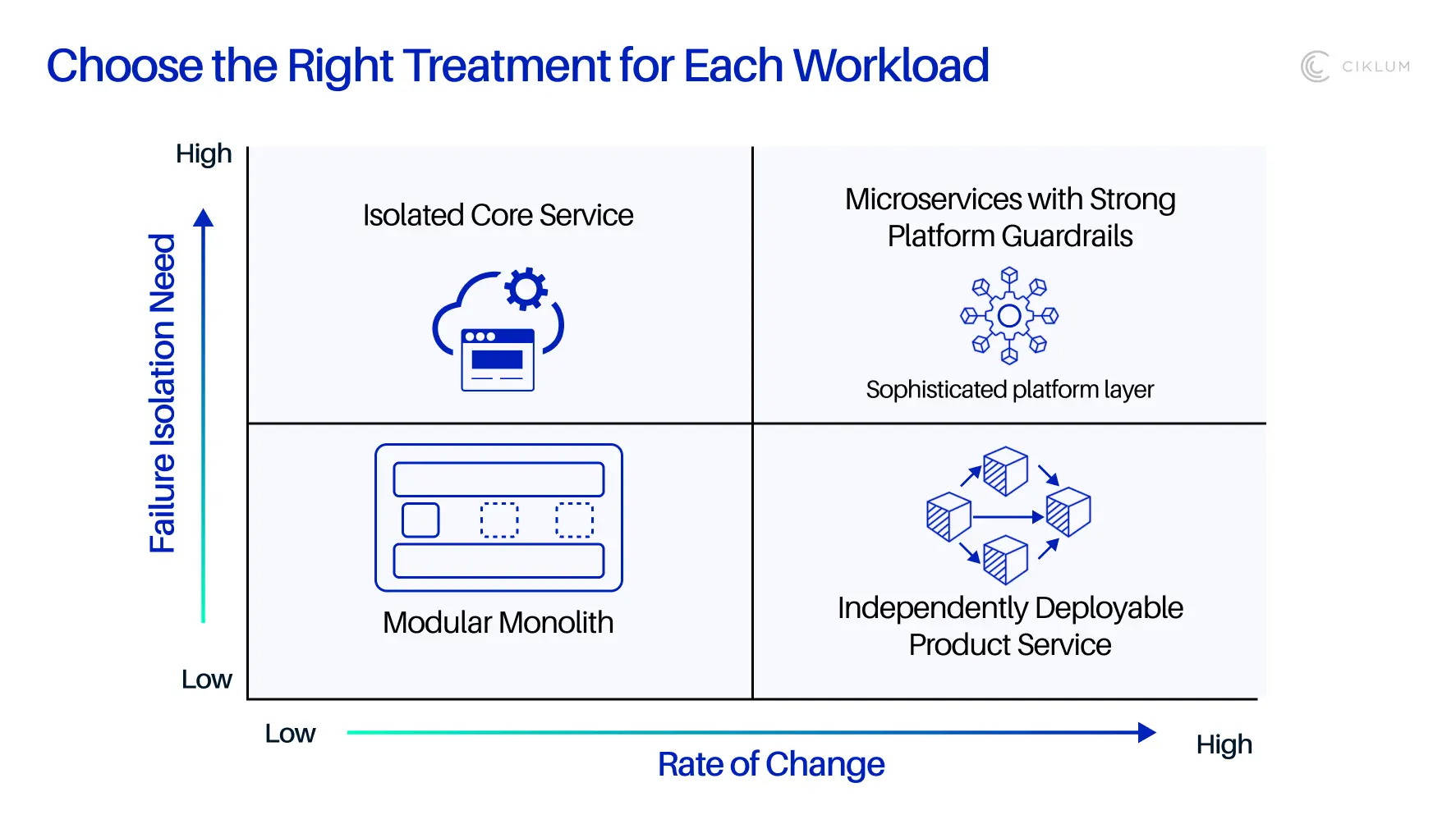
Scale is not one condition. A system can be large in users, small in engineering headcount, heavy in transactions, light in feature change, stable in its core domain, and volatile in its customer-facing layer. One architecture cannot serve all of those needs equally well. A monolith may be too restrictive for a rapidly changing digital product and perfectly sensible for a stable back-office workflow. A microservices architecture may be essential for isolating payment risk and wasteful for a reporting module that changes twice a year.
Martin Fowler's MonolithFirst guidance remains useful because it does not treat microservices as a destination. It treats them as an extraction decision made after the domain has shown where its boundaries really are. Sam Newman's Building Microservices makes the same point from the operating side: services are only useful when the team can absorb the deployment, observability, and ownership responsibilities that come with them.
The practical question is not which architecture works best at scale. It is which parts of the system should scale together and which parts should scale apart.
Four Workload Archetypes That Change the Answer
1.The Stable Core
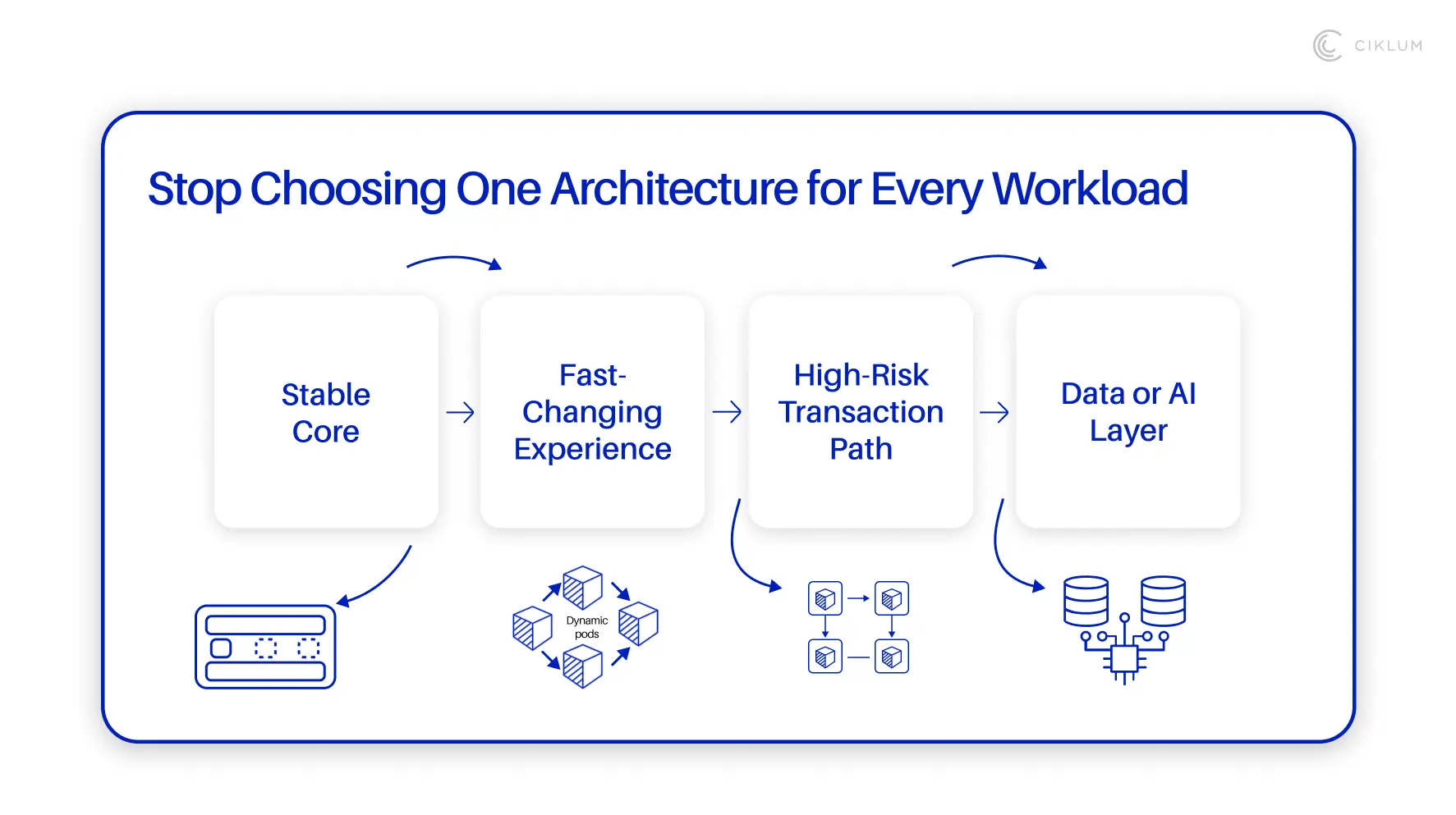
The stable core contains business logic that changes slowly, must remain consistent, and benefits from being reasoned about as a whole. Billing rules, administrative workflows, account structures, reference data, and many internal systems often belong here. For this workload, a modular monolith can be the strongest architecture. It keeps transactions local, reduces network overhead, simplifies debugging, and lowers the operational burden on the team.
The important word is modular. A healthy monolith has clear internal boundaries, explicit module ownership, and tests that protect those boundaries. An unhealthy monolith has shared tables, circular dependencies, and release fear. The former can scale for years. The latter becomes a constraint long before the company is large enough to justify a distributed system.
2.The Fast-Changing Experience Layer
Customer-facing products usually change at a different rhythm. Pricing experiments, checkout variations, personalization, search, content, loyalty, and recommendations often need faster release cycles than the core systems that support them. This is where microservices can pay for themselves.
The value is not architectural purity. The value is independent change. If the product team needs to test three checkout improvements this month, it should not wait for the same release train that carries quarterly finance logic. A separate service creates a boundary around that faster cadence. The boundary is worth paying for because it removes the stable core from the blast radius of every experiment.
3. The High-Risk Transaction Path
Payments, identity, fraud, inventory reservation, and regulated data paths need a different lens. These workloads demand isolated failure domains, careful observability, and strict ownership. A service boundary can be justified even when release cadence is not high, because the cost of failure is high.
Here, microservices are less about speed and more about containment. If search is unavailable, checkout should still complete. If reporting lags, payment authorization should not. The service boundary becomes a risk boundary. That boundary pays for itself only if the underlying operating model honors it with SLOs, on-call ownership, and a clear rollback path.
4.The Data and AI Layer
Analytics, machine learning, and AI-enabled workflows often cut across the rest of the system. They need events, context, and historical data from multiple domains. Forcing these workloads into the monolith slows learning. Turning every data dependency into a synchronous service call creates fragility.
The better pattern is often event-driven. Transactional systems publish reliable events. The data layer consumes them, enriches them, and makes them available for analytics, personalization, and automation. This keeps the core systems focused on correctness while giving the AI and insight layer room to evolve.
What the Operating Model Must Be Able to Support
Every service is an operating commitment. It needs a deploy pipeline, monitoring, logs, traces, alerts, ownership, documentation, versioned contracts, incident response, and a team that can explain its behavior under pressure. A company that cannot provide those basics should be cautious about extracting services, even if the domain boundary looks clean.
This is where many microservices migrations become slower than the monolith they replaced. The team decomposes code faster than it builds the platform underneath. Deployment pipelines multiply. Observability fragments. Data ownership becomes unclear. The architecture looks modern on a diagram and feels worse in production.
The reverse mistake also happens. A team keeps a monolith because it is operationally simpler, even after the release process has become a company-wide bottleneck. The system is easier to run but harder to change. The business pays for that choice in delayed features, slower experiments, and engineering attrition.
The architecture must match both the workload and the organization's ability to operate it.
What This Looks Like in Practice
Bytes, a leading UK and Ireland B2B software reseller, faced a platform constraint that made selective decomposition clear. A monolithic infrastructure was slowing vendor onboarding and feature delivery. The migration to microservices helped move release cycles from once or twice a year to every two weeks. The point was not that microservices were universally better. The point was that fast-changing commerce capabilities had been trapped inside an architecture built for a slower operating rhythm.
Ciklum's legacy modernization analysis points to the same method through the Strangler Fig pattern: extract one feature or capability, route traffic through an API gateway, validate the new boundary, then repeat. It is a migration pattern, but it is also a decision discipline. Each extraction must earn its place.

In Summary
At scale, the best architecture is usually a portfolio. Keep stable, coherent domains inside a modular monolith. Extract fast-changing capabilities when independent deploy ability matters. Isolate high-risk transaction paths when failure containment matters. Feed data and AI systems through reliable event streams rather than brittle synchronous dependencies. The goal is not to become a microservices company or to defend the monolith. The goal is to put each workload in the architecture whose trade-offs the business can afford.
Frequently Asked Questions
Q1: Is a modular monolith the same as a traditional monolith?
No. A modular monolith has internal boundaries, owned modules, clear contracts, and test coverage that protects the separation between domains. A traditional monolith often lacks those boundaries, which makes every change feel system wide. The modular monolith keeps the operational simplicity of one deployable while reducing the coupling that makes monoliths painful.
Q2: When should a team extract the first microservice?
Extract when a workload has clearly diverged from the rest of the system in rate of change, scaling need, ownership, or failure tolerance. Do not extract because the code is messy. Messy code becomes messier when distributed. Refactor the boundary first, then extract when the boundary is stable enough to operate independently.
Q3: What is the biggest risk in microservices migration?
The biggest risk is creating services faster than the organization can operate them. Without observability, contract management, deployment automation, and ownership discipline, microservices multiply coordination work instead of reducing it. The migration succeeds when platform maturity grows ahead of the service count.

By Ciklum Editorial Team

Ciklum’s Editorial Board is a collective of experienced writers and industry experts, bringing together perspectives shaped by real-world engineering and delivery experience. Through collaborative insights, the team explores how technology, AI, and digital innovation move from concept to execution across industries.
Blogs
Discover Similar Insights

Refactor or Rebuild? The Decision That Can Save (or Sink) Your System
Learn More
A Practical Enterprise Architecture for Intelligent Automation
Explore the Reference Architecture
How AI Is Changing Enterprise Automation Architectures And Why Most Companies Aren’t Ready
Explore the Architecture Shift
Enterprise AI Automation: A Practical Guide to GenAI, AI Agents and Intelligent Workflows
Get the Automation Playbook