
Key Takeaways
A slipping release is a pattern, not an event: When releases slip quarter after quarter, the cause is the system, not a string of bad luck. Fixing one late release without changing how releases work just sets up the next one.
The slip lives in the gap between "code complete" and "shippable": Most product release delays happen after the feature is built, in the long tail of hardening, integration, sign-off, and coordination that nobody scheduled.
Big, infrequent releases slip the most: The larger the batch, the more that has to line up at once, and the more likely something is not ready on the day. Small, frequent releases are not just faster. They are more predictable.
The permanent fix is making releasing routine: Decoupling deploy from release, defining what "done" actually means, and shipping in small batches turn the release from a high-stakes event into an unremarkable habit. That is what fixes the slipping for good.
Every product team knows the feeling. The release date was set with confidence. The team worked hard. The features got built. And the release still went out weeks later than promised, again. When it happens once, it looks like bad luck. When it happens every quarter, it is not luck. It is the system the team is running, doing exactly what it was built to do.
The frustrating part is that the slip rarely happens where people look for it. The build usually finishes close to plan. The schedule gets eaten afterward, in the stretch between "the code is written" and "this is actually safe to ship," where hardening, integration testing, sign-offs, and cross-team coordination pile up without ever appearing on the original plan. That gap is where most product release delays are born, and it is invisible until the date is already gone.
This article looks at why product releases keep slipping, why the usual responses make it worse, and how to fix the pattern for good rather than rescuing one release at a time.
The Slip Is a Pattern, Not an Accident
The first thing to accept is that a recurring slip is a property of the system, not a verdict on the team. Teams that miss release after release are usually working hard and genuinely trying. The dates keep moving anyway because the way releases are planned and shipped has a built-in gap between optimism and reality, and that gap reasserts itself every cycle no matter how much effort goes in.
This matters because of how organizations usually respond. When a release slips, the instinct is to add control. More status meetings. More detailed plans. More pressure on the team to hit the next date. None of that touches the actual cause, so the next release slips too, and now the team is both late and exhausted. Treating each slip as an isolated failure guarantees the pattern repeats, because the thing producing the slips was never changed.
The way out is to stop asking why this release slipped and start asking why releases keep slipping. The first question produces a post-mortem. The second produces a fix. Product release delays stop being a recurring surprise only when the team treats them as a systemic problem with a systemic solution.
Where Product Releases Actually Slip
The specific causes are consistent across teams. They cluster in a few places, and almost all of them sit in that gap after the build.
"Done" Was Never Actually Defined
A feature is called done when the code is written, but written is not the same as shippable. Tested, integrated, documented, performance-checked, and signed off are all still ahead, and if none of that was in the definition of done, none of it was in the schedule. The release slips by exactly the amount of work that "done" quietly excluded. When a team has no shared, explicit definition of what ready-to-ship means, every release rediscovers the missing work at the worst possible moment.
The Hardening Tail Was Not Scheduled
Most plans budget for building features and forget the tail of work that turns built features into a stable release. Bug fixing from integration. Edge cases found in QA. Performance tuning under realistic load. This work is real, recurring, and predictable, yet it is rarely on the plan because it does not map to a feature card. So the build finishes on time and the release does not, because the hardening nobody scheduled takes the weeks that pushed the date.
Scope Kept Moving Toward the Deadline
Releases slip when scope keeps growing after the date is set. A stakeholder adds "just one more thing." A feature grows in definition as it gets built. The team stays accommodating, the date stays fixed, and the arithmetic quietly becomes impossible. Late scope is especially damaging because it lands when there is the least time to absorb it, and it often arrives disguised as a small change that turns out to touch far more than expected.
The Release Itself Is a Big, Manual Event
When releasing is a large, infrequent, manual ritual, every release carries enormous risk and the pressure to get everything in before the next window makes batches even bigger. A release that bundles three months of changes has three months of things that can go wrong in one day. The bigger and rarer the release, the more has to line up perfectly, and the more likely that one unready piece slips the whole thing.
Cross-Team Dependencies Did Not Land in Time
A release that depends on another team's work, a shared service, a security review, or an external vendor is only as on-time as its slowest dependency. These hand-offs rarely appear on the releasing team's plan, so they stay invisible until the release is blocked waiting on something nobody tracked. The dependency did not slip loudly. It just was not ready when the release needed it.
Why the Usual Fixes Do Not Work
The common responses to slipping releases tend to address the symptom and leave the cause untouched. Adding more planning detail makes the same flawed assumptions more precise, not more accurate. Adding more oversight turns the team's attention toward reporting status instead of shipping. Pushing harder on the date borrows time from quality, which comes back as bugs and rework that slip the next release.
The deeper issue is that all of these treat the release date as a willpower problem. If the team just planned better or tried harder, the thinking goes, the date would hold. But the slip is a structural property of big-batch, loosely-defined, manually-released work. No amount of discipline overcomes a system designed to produce delays. Fixing product release delays for good means changing the system, not exhorting the people inside it.

How to Fix Slipping Releases for Good
The teams whose releases stop slipping do not have more discipline than everyone else. They have a system that makes shipping routine, so a slip becomes the exception rather than the default. The moves below are what change the pattern.
Make Releases Small and Frequent
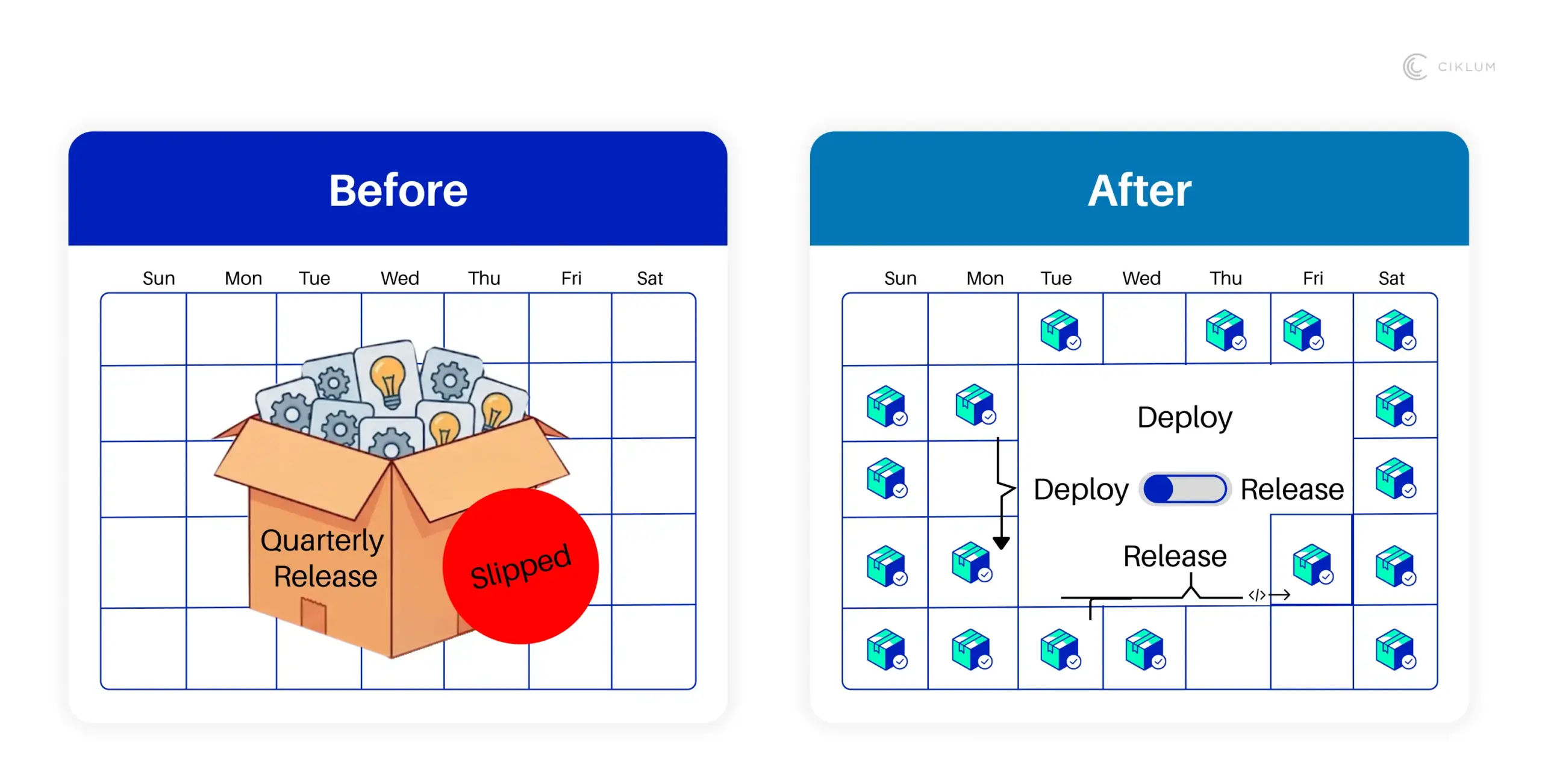
The single most effective change is to ship smaller batches more often. A release that goes out every week or every day cannot accumulate three months of risk, because there are only days of changes in it. Small releases are easier to test, easier to roll back, and far more predictable, because there is simply less that has to line up at once. Counterintuitively, releasing more often is what makes releases stop slipping, because each one is small enough to be boring.
Decouple Deploy From Release
Much of the pressure around a release comes from treating deploying code and releasing a feature as the same event. They do not have to be. With feature flags, code can ship to production continuously, switched off, and the feature can be turned on for users when it is actually ready, independent of any deployment. This removes the all-or-nothing release day entirely. The deployment becomes routine, and the release becomes a decision rather than a deadline the whole team races toward.
Define "Done" So It Includes Shipping
Write down what ready-to-ship actually means, and put every part of it into the plan. Tested, integrated, performance-checked, documented, signed off. When the definition of done includes the work that turns built code into a safe release, that work gets scheduled instead of discovered, and the hardening tail stops being a surprise that eats the date.
Automate the Path to Production
A manual release process is slow, risky, and a bottleneck that only a few people can operate. Automating the build, test, and deployment pipeline makes releasing fast, repeatable, and low-drama, which is what makes frequent releasing possible in the first place. Ciklum's cloud and DevOps engineering teams work with organizations on exactly this, because a paved, automated route to production is the foundation that turns releasing from an event into a habit.
Protect the Date by Flexing Scope, Not Quality
When a release is at risk, the safe variable to move is scope, not quality or the date. Commit to an outcome and a date, and let the specific features inside that envelope flex as reality arrives. Cutting corners on quality to hit a date just moves the slip into the next release as rework. Trimming scope intelligently protects both the date and the product.
What Reliable Releases Look Like
When the system changes, the experience of releasing changes with it. The release stops being a date the whole team dreads and becomes something that happens routinely, often without anyone outside the team noticing. Features go live when they are ready rather than when a window opens. Rollbacks are a flag flip rather than an emergency. The roadmap stops slipping by default, because the thing underneath it can actually ship on a predictable cadence.
We see this change in action frequently. Take Ciklum's work with Bytes, a UK and Ireland B2B software reseller. They successfully moved from roughly twice-yearly releases to a two-week cadence, saving months of development time by validating ideas before they were even built. This wasn't achieved through heroic effort, but by restructuring how they ship work making small, frequent releases the standard, rather than a stressful exception.
That is what fixing slipping releases for good actually looks like. Not a one-time rescue of a late release, but a system where shipping is small, frequent, automated, and routine, and where a slip is rare enough to be worth investigating when it happens.
In Summary
Product releases keep slipping because the system that produces them is built to slip. The build finishes roughly on time and the schedule gets eaten in the gap afterward, where undefined "done," unscheduled hardening, late scope, big manual releases, and untracked dependencies all collect. Adding more planning, oversight, or pressure does not help, because none of it changes the structure producing the delays.
The permanent fix is to make a releasing routine. Ship small batches frequently. Decouple deploy from release with feature flags. Define "done" to include the work of shipping. Automate the path to production. Protect the date by flexing scope rather than quality. Those changes turn the release from a high-stakes event into an unremarkable habit, which is the only thing that fixes product release delays for good.
At Ciklum, we work with organizations to make exactly this transition, from big, slipping releases to a fast, predictable cadence. If your release dates have stopped meaning anything, talk to our specialists about changing the system instead of rescuing the next release.
Frequently Asked Questions
1. Why do our product releases keep slipping even when the team works hard?
Because a recurring slip is a system problem, not an effort problem. The build usually finishes close to plan, and the delay comes from the unscheduled work between code complete and shippable, hardening, integration, sign-off, and coordination. Working harder does not close a gap that was never in the plan. Changing how releases are structured and shipped does.
2. What is the single most effective way to stop releases from slipping?
Ship smaller batches more often. A large, infrequent release accumulates risk and forces everything to line up on one day. Small, frequent releases contain only days of change, so they are easier to test, easier to roll back, and far more predictable. Releasing more often is counterintuitively what makes releases stop slipping.
3. How does decoupling deploy from release help?
It removes the all-or-nothing release day. With feature flags, code can be deployed to production continuously while switched off, and a feature can be turned on for users when it is genuinely ready, independent of any deployment. Deploying becomes routine and releasing becomes a decision rather than a deadline, which takes most of the pressure and risk out of the process.
4. Should we cut quality to hit a release date?
No. Cutting quality to hit a date moves the slip into the next release as bugs and rework, and usually makes the overall pattern worse. When a release is at risk, the safe variable to flex is scope. Commit to an outcome and a date, and let the specific features inside that envelope adjust as reality arrives, while protecting the quality bar.
5. When should we bring in external engineering support?
Two moments produce the highest return. The first is when automating the path to production, where engineers with prior continuous delivery and pipeline experience can compress months of build into weeks. The second is when shifting to a small-batch, frequent-release model, where an outside perspective on batch size, definition of done, and deploy-release decoupling cuts through internal habits faster than internal facilitation. Both need bandwidth that delivery-stretched teams rarely have spare.

By Ciklum Editorial Team

Ciklum’s Editorial Board is a collective of experienced writers and industry experts, bringing together perspectives shaped by real-world engineering and delivery experience. Through collaborative insights, the team explores how technology, AI, and digital innovation move from concept to execution across industries.
Blogs
Discover Similar Insights

Scalability Starts Here: Architecture Decisions That Make or Break Your Product
Learn More
The Impact of Unified Commerce on Retail Growth and Efficiency
Learn More
How to Solve Interoperability Challenges in Healthcare Systems
Learn More
AI in Retail: Why Omnichannel Breaks Down — and How Agentic AI Fixes It
Learn More