



- What Is Enterprise AI Automation?
- Why Enterprises Are Investing in AI Automation
- Generative AI Workflows in Enterprise Automation
- AI Agents for Enterprises
- Intelligent Automation Services and Architecture
- Data and Platforms Behind AI Automation
- Industry Use Cases of Enterprise AI Automation
- How to Get Started with Enterprise AI Automation
Key Takeaways
- Enterprise AI automation merges traditional execution (RPA) with cognitive capabilities (ML, NLP, LLMs) to manage complex, end-to-end business processes, not as a single tool but as a coordinated system.
- The cognitive spectrum runs from RPA (hands), to Intelligent Automation (brain), to Agentic AI (conductor); each layer adds adaptability and scope beyond rule-based logic.
- GenAI workflows follow a structured path such as triggers, context building (e.g. RAG), reasoning, and execution, and can adapt branch logic and routing over time without manual reprogramming.
- AI agents differ from chatbots and RPA: they plan multi-step workflows, use tools and APIs, and operate toward goals with minimal human direction; multi-agent systems tackle cross-departmental processes.
- Scale requires a three-layer stack: Workflow Engine (hands), Reasoning Layer (LLMs), and Vector Memory (context), plus an Orchestration Layer for safety and an AI Gateway for governance.
- Data readiness is the primary hurdle; unified, real-time, governed data access is essential for agents and models to perform effectively.
- Getting started means preparation (alignment, data audit), pilot (high-impact, low-risk use cases), then scale with Governance-as-Code and cross-functional teams from day one.
Enterprise AI automation represents a fundamental shift in how organizations operate. Rather than treating artificial intelligence as a standalone technology, enterprises are now orchestrating coordinated systems of generative AI models, intelligent agents, and automated workflows to transform how knowledge work gets done. This shift moves beyond experimentation into operational maturity, where AI systems autonomously manage complex business processes while maintaining the governance, compliance, and human oversight that enterprise environments demand.
The distinction between traditional automation and AI-driven automation is increasingly clear. Traditional robotic process automation (RPA) excels at executing rule-based tasks within structured, predictable environments. Enterprise AI automation, by contrast, handles unstructured data, makes contextual decisions, learns from outcomes, and adapts when conditions change. When combined with generative AI capabilities that create novel content and orchestration frameworks that coordinate multiple specialized agents, enterprises unlock efficiency gains that go far beyond simple task automation.
In 2026, enterprise leaders no longer ask "Should we implement AI automation?" The market has already answered that question. This guide addresses that question directly, providing enterprise decision-makers with practical frameworks for understanding, evaluating, and implementing enterprise AI automation across their organizations.
What Is Enterprise AI Automation?
Enterprise AI automation is a holistic paradigm that merges traditional execution layers with cognitive capabilities to manage complex, end-to-end business processes. It is not a single tool but a coordinated set of integrated technologies, including machine learning, natural language processing, and large language models, working together to reduce manual effort across multi-system environments.
Defining the Cognitive Spectrum
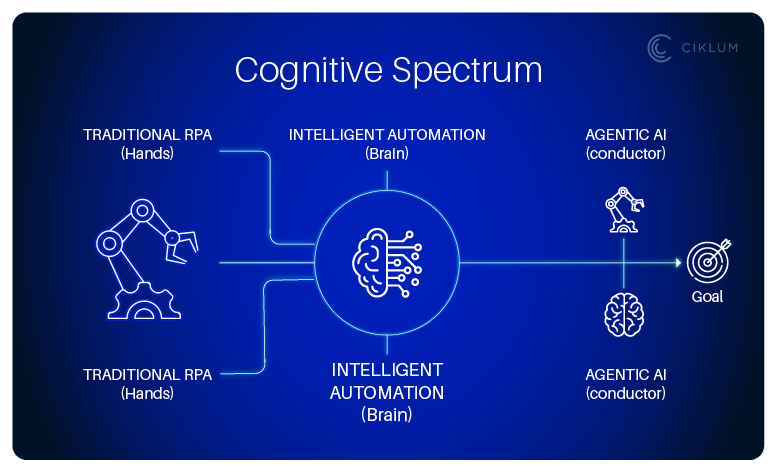
To understand the scope of enterprise AI automation, it helps to categorize the underlying technologies by their functional roles within a process:
- Traditional Automation (RPA) serves as the "hands," performing deterministic tasks like copying data or filling forms. It operates on structured data with static, if-then decision logic.
- Intelligent Automation acts as the "brain," providing adaptive, learning-enabled intelligence for tasks like document understanding or sentiment analysis. It handles mixed data types with probabilistic pattern matching.
- Agentic AI functions as the "conductor," interpreting context, reasoning through objectives, and orchestrating both the "hands" and the "brain" to achieve outcomes. It works with multi-modal and unstructured data using planning and iterative reasoning.
How Enterprise AI Automation Differs from Traditional Automation
Traditional RPA operates on a simple principle: record a human performing a task, then replay those exact actions at scale. This approach works well for highly structured, repetitive processes where input formats are consistent and decision logic is straightforward. However, it breaks the moment workflows deviate from expected patterns.
Enterprise AI automation takes a fundamentally different approach. Rather than mimicking human actions on user interfaces, AI systems engage with processes at the data and decision level. A traditional RPA bot might click through a form to enter invoice data. An AI agent would analyze the invoice across multiple dimensions, extracting line items, cross-referencing with purchase orders, identifying anomalies, assessing compliance risk, and recommending payment terms, all while learning from organizational preferences to improve accuracy over time.
This transition allows for the automation of "exception-heavy" processes that were previously resistant to digitization, such as end-to-end procure-to-pay cycles or complex customer support resolutions.
For more on the foundational shift in engineering practices, explore our AI-Enabled Engineering and Process Transformation and Automation services.
This transition, what some call the shift from copilot to operating model, allows for the automation of "exception-heavy" processes that were previously resistant to digitization, such as end-to-end procure-to-pay cycles or complex customer support resolutions.
Why Enterprises Are Investing in AI Automation
The transition to AI-led automation is no longer a matter of competitive advantage but of operational necessity. Organizations are investing in these technologies to address four critical areas: cost efficiency, productivity, decision agility, and risk management.
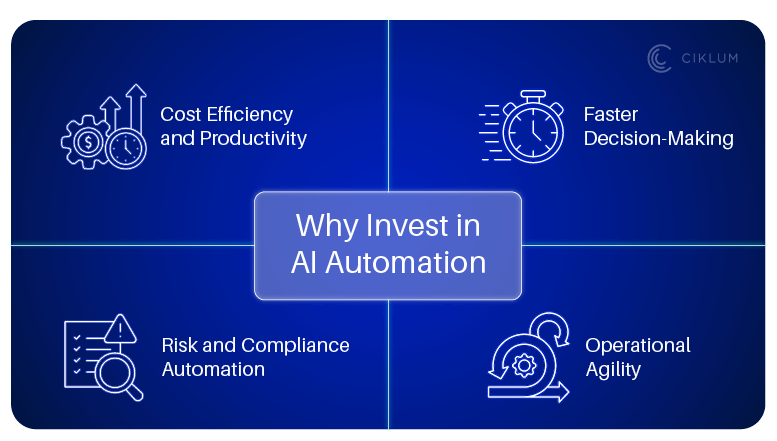
Cost Efficiency and Productivity
The financial impact of AI automation is substantial. Organizations are rapidly increasing their investments in AI infrastructure, reflecting strong confidence in the technology’s potential. These investments are already demonstrating tangible results (see McKinsey on the economic potential of generative AI), with most enterprises reporting that they achieve a return on their AI deployments within their initial year. High-maturity organizations are not only realizing significant cost savings but also experiencing considerable boosts in productivity as a result of AI automation.
These gains come from two sources: elimination of repetitive cognitive work and reallocation of knowledge workers to higher-value activities. A hospital implementing AI-powered documentation automation frees providers to spend more time on patient care. A finance team deploying intelligent invoice processing shifts resources from routine processing to vendor management and cash flow optimization.
Faster Decision-Making
One of the most profound benefits of enterprise AI automation is the compression of the decision cycle. In traditional enterprises, data is gathered, reports are generated, and humans analyze those reports to make decisions, a process that can take days or weeks. Intelligent automation moves these decisions to the edge of the process. By embedding machine learning and predictive analytics directly into data pipelines, organizations can detect anomalies, forecast disruptions, or identify fraud in real-time. This transforms operations from reactive systems into proactive, adaptive networks.
Risk and Compliance Automation
In highly regulated sectors, compliance often inhibits innovation. AI automation allows for the implementation of "Governance-as-Code," where policy-based guardrails are integrated directly into workflows. Frameworks such as NIST's AI Risk Management Framework help organizations align automation with governance and risk requirements. Autonomous agents can continuously monitor contracts, track transaction patterns, and ensure that every action taken by an automated system is auditable and explainable. This reduces human error while helping organizations comply with evolving regulations without significantly increasing headcount.
Operational Agility
Operational agility in enterprise AI automation refers to the organization’s ability to rapidly adapt its processes and technology in response to changing market conditions, customer demands, or regulatory requirements. Rather than relying on static, hard-coded workflows, AI-enabled enterprises architect systems that are flexible, self-optimizing, and capable of orchestrating resources dynamically across teams and departments. With intelligent workflows and adaptive agents, processes can be reconfigured on the fly allowing for seamless scaling, rapid response to disruptions, and continuous process improvement. This agility enables companies to innovate faster, capture new opportunities, and maintain resilience even in volatile environments. For retail organizations, this means bridging digital storefronts with physical supply chains in real time.
Generative AI Workflows in Enterprise Automation
Generative AI has fundamentally changed how organizations process information, shifting the focus from simply uncovering insights to making them actionable. Generative AI workflows are adaptive, context-aware processes that generate content, code, or decisions on demand.
How GenAI Fits in Enterprise Processes
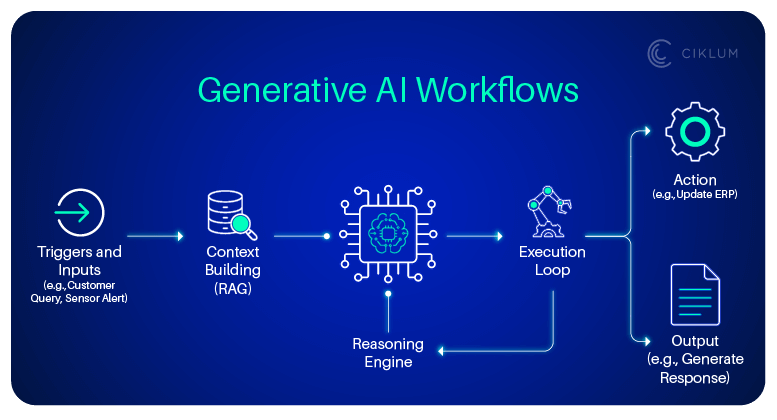
Unlike conventional tools, generative AI workflows excel at handling creativity and variability. They typically follow a structured path:
- Triggers and Inputs: The process starts via API or event, such as a customer query, sensor alert, or email receipt.
- Context Building: Using techniques like Retrieval-Augmented Generation (RAG), the system ingests proprietary data to ground outputs in factual reality, significantly reducing hallucinations.
- Reasoning Engine: The system evaluates options and routes tasks, such as determining if a refund meets policy criteria.
- Execution Loop: The system acts on insights via APIs or bots, updating ERP records or auto-generating responses.
One significant advancement is "Adaptive Process Intelligence." Rather than remaining static, these workflows continually observe process flows, error patterns, and business metrics. They automatically adjust branch logic or routing thresholds without manual reprogramming. For example, a lead-nurturing workflow might observe that certain email templates are more effective in specific regions and autonomously adjust its outreach strategy. This concept of compounding AI systems represents a fundamental shift in how automation delivers value over time.
Governance and Scalability Considerations
Scaling generative AI across the enterprise requires a robust governance layer. Every decision made by a generative model must be traceable and auditable. Organizations are increasingly adopting "AI gateways" to standardize APIs and centralize access controls, ensuring that personal data is properly handled before being processed by large language models.
Successful enterprises adopt layered architectures that don't depend on a single model. A routing engine evaluates each task and selects the optimal model based on accuracy, cost, and latency requirements. This approach prevents vendor lock-in, reduces costs, and provides resilience. The 2026 GenAI landscape continues to evolve rapidly, making this flexibility increasingly important.
AI Agents for Enterprises
If generative AI is the "brain," AI agents are the "orchestrators." While a chatbot might answer a question, an AI agent is designed to achieve a high-level goal by planning and executing multi-step actions across various systems.
What AI Agents Are
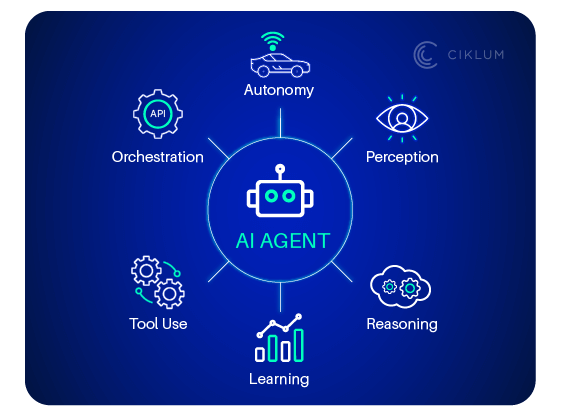
An AI agent is a system that perceives its environment, reasons about it, and takes action toward defined goals (in computer science, such systems are often discussed under intelligent agents). Unlike a chatbot, which responds to user queries, or RPA bots, which execute predetermined sequences, agents actively plan multi-step workflows, adjust strategies based on outcomes, and operate autonomously toward objectives.
Key characteristics of enterprise AI agents include:
- Autonomy: Execute tasks and make decisions without requiring human approval at each step
- Perception: Understand context and current state through data integration and environmental monitoring
- Reasoning: Think through multi-step workflows, evaluate alternatives, and adapt strategies
- Learning: Improve performance over time based on outcomes and feedback
- Tool Use: Integrate with existing systems to execute decisions
Difference vs. Chatbots and RPA
The distinction matters because deployment requirements differ significantly:
- RPA bots automate task execution through interface automation. They're deterministic, reliable, and narrow in scope. They struggle with exceptions or changes to system interfaces.
- Chatbots provide conversational interfaces that respond to user input. They're reactive and often stateless, requiring humans to drive interactions.
- AI agents operate toward defined goals with minimal human direction. They perceive situations, plan actions, execute decisions, and adapt based on outcomes.
Autonomous Orchestration Examples
The true power of agents is realized in multi-agent systems, where specialized agents collaborate on complex tasks. In a supply chain context, a "Sourcing Agent" might identify potential vendors, while a "Risk Agent" evaluates their financial stability and a "Logistics Agent" calculates shipping routes. These agents work together to present a comprehensive procurement recommendation, reducing weeks of manual work to minutes.
In finance, agents manage autonomous billing and expense report generation by reading receipts, applying policy rules, and compiling submissions without human intervention. In IT operations, AIOps agents can move beyond reporting issues to actively diagnosing, troubleshooting, and fixing bottlenecks by autonomously modifying their problem-solving approach based on real-time feedback. The key to making this work is connecting AI to business systems through robust integration frameworks.
Intelligent Automation Services and Architecture
Building enterprise-scale AI automation requires a fundamentally different architecture than traditional IT projects. It is no longer about building static workflows but about architecting systems that can adapt and scale.
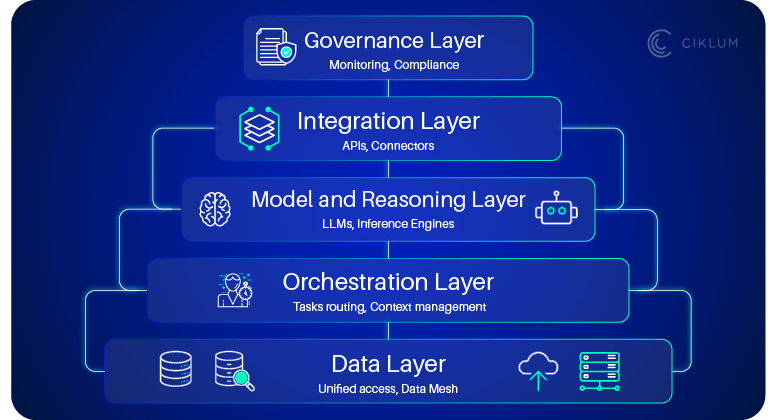
Components of Intelligent Automation Services
Enterprise AI automation services operate across distinct but interconnected layers:
- Data Layer: Collection and integration of data from all enterprise sources. Intelligent automation requires unified data access where agents can draw from consistent, reliable data regardless of source.
- Orchestration Layer: Coordinates agents, routes tasks, maintains context, and handles exceptions. This layer determines which agent handles which task and sequences multi-agent workflows.
- Model and Reasoning Layer: Large language models, specialized models fine-tuned on enterprise data, and reasoning engines that support complex inference.
- Integration Layer: APIs, connectors, and system integrations that allow agents to take action.
- Governance Layer: Real-time monitoring, compliance enforcement, decision logging, and explainability.
High-Level Architecture
The new stack requires three distinct components working in concert:
- The Workflow Engine: The "hands" that execute actions across systems
- The Reasoning Layer (LLM): The "brain" that figures out logic and steps dynamically
- The Vector Memory: The "past experience" that reduces hallucinations by storing context and embedded data
In environments where AI interacts with physical machinery or high-stakes financial systems, an "Orchestration Layer" acts as a vital safeguard. This layer validates every AI-driven suggestion against system state, business rules, and human permissions before anything reaches the execution layer.
Security and Scalability
Operationalizing AI requires a robust framework to manage the entire lifecycle, from prompt engineering and fine-tuning to version control and performance monitoring. Architecture must support multi-tenancy at scale while ensuring complete isolation between business units. Security architecture must address prompt injection attacks, model vulnerabilities, and unauthorized access to sensitive data.
Data and Platforms Behind AI Automation
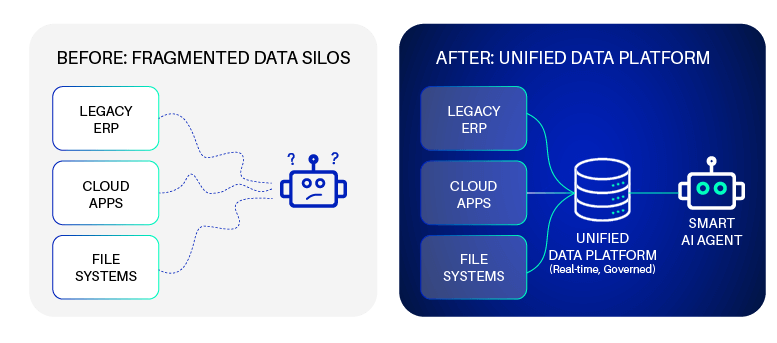
AI is only as good as the data it runs on. Data readiness is the primary hurdle for many organizations implementing AI automation. Most enterprises have data scattered across legacy ERPs, cloud applications, and siloed file systems, creating a fragmentation problem that limits AI performance.
Why Data Platforms Are Critical
AI agents cannot operate effectively in fragmented data environments. A fraud detection agent that can't access transaction history, customer behavior patterns, and external risk signals will make poor decisions. A contract analysis agent that can't access historical contracts and regulatory requirements will miss context.
Traditional enterprise data architectures, built for periodic batch reporting, don't serve AI automation well. They create latency, fragmentation, and governance challenges. Successful enterprises are modernizing to data platforms that provide:
- Unified access to all enterprise data regardless of source, format, or storage location
- Real-time availability for agents immediately, not hours later after batch processing
- Consistent governance with a single source of truth for data definitions and access policies
- Semantic understanding to relate concepts across systems
Role of Modern Data Architecture
Modern data architecture enables AI automation through:
- Data Mesh and Data Fabric frameworks that allow for domain-level ownership while ensuring shared governance
- Master Data Management that enforces a single source of truth, preventing schema drift and minimizing integration conflicts
- Efficient data pipelines that perform validation, cleansing, and semantic harmonization
Building AI-ready data pipelines is essential for organizations serious about scaling automation beyond pilot projects.
Data Readiness Challenges
Organizations commonly encounter legacy systems and data silos, data quality issues, unstructured data in documents and emails, and data governance requirements. Organizations successfully implementing AI automation treat these challenges as strategic imperatives rather than infrastructure issues. The investment creates benefits beyond AI, improving decision-making across the organization.
Industry Use Cases of Enterprise AI Automation
While the foundational principles of AI automation are universal, application varies significantly across sectors.
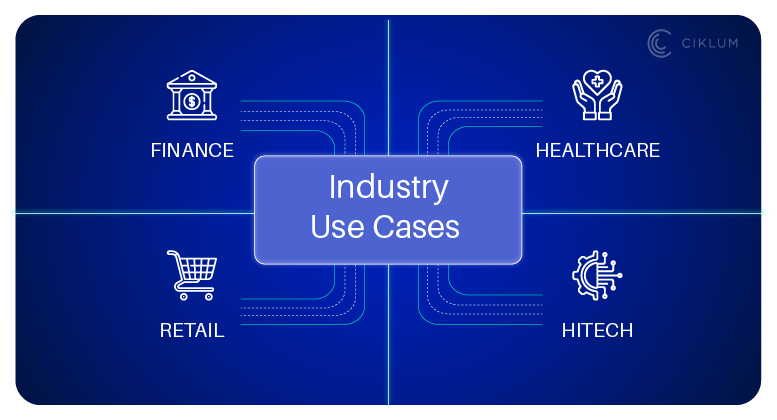
Banking and Financial Services
In financial services, AI automation is primarily used for fraud prevention, credit risk analysis, and automated processing:
- Fraud Detection: Systems analyze transactions in real-time with high accuracy, reducing false positives significantly
- Credit Analysis: AI agents draft credit assessments by autonomously synthesizing financials and peer data in minutes
- Dispute Resolution: Agents flag discrepancies in invoices and contracts proactively, saving thousands of hours in manual reconciliation
Organizations like Santander have transformed mortgage transfer processes through intelligent automation, while others like Inspira have achieved seamless banking transitions through API integration.
Healthcare
The focus in healthcare is on diagnostic precision and administrative efficiency:
- Diagnostics: AI systems analyze medical imaging with accuracy exceeding human radiologists in some cases
- Clinical Operations: LLMs automatically summarize notes and handle medical coding, reducing documentation time significantly
- Administrative Automation: Healthcare organizations can unlock substantial savings through administrative automation
Retail
Retailers use AI to bridge the gap between digital storefronts and physical supply chains:
- Inventory Management: Predictive analytics reduce out-of-stocks and inventory costs
- Personalization: AI analyzes purchase history and browsing habits to offer unique recommendations
- Autonomous Operations: Computer vision enables cashier-free experiences with real-time visibility
Examples include ticketing platforms accelerating conversions and Salling Group's digital transformation across Denmark's largest retail operation.
Hi-Tech and Software Engineering
For the Hi-Tech IT sector, AI is the backbone of modern software development:
- Code Generation: AI-enabled engineering can significantly increase developer productivity by automating coding, testing, and documentation
- Modernization: AI can accelerate the migration of legacy applications to modern tech stacks
- Operational Intelligence: Agents monitor networks continuously to prevent outages and identify security threats in real-time
Stena Line's AI-driven fleet optimization demonstrates how intelligent systems reduce operational costs, while Seeking Alpha achieved 50% reduction in testing time through automation frameworks.
How to Get Started with Enterprise AI Automation
Implementing AI automation at scale is an organizational transformation, not just a technology deployment. Research and industry studies show that the majority of AI projects fail due to inadequate data quality or misaligned expectations.
High-Level Roadmap
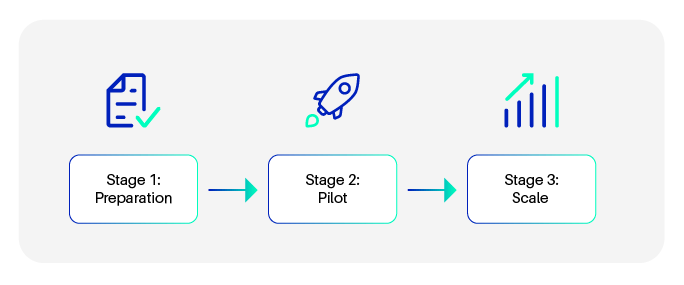
Success requires a phased approach that balances quick wins with long-term capability building:
Stage 1: Preparation Executive alignment, data audit, and strategy definition. Identify high-impact opportunities with clear business cases.
Stage 2: Pilot Launch high-impact, low-risk use cases such as accounts payable automation or support agents. Establish clear success metrics and implement governance frameworks upfront.
Stage 3: Scale Establish an AI Center of Excellence, standardize platforms, and upskill the workforce. Integrate automation into production systems with appropriate risk controls.
Common Pitfalls
- Overengineering the MVP: Trying to build a full-scale product before learning from a simple pilot leads to delays and features users didn't request.
- The "Black Box" Problem: Implementing models that can't be explained to stakeholders or compliance officers reduces trust and creates regulatory risk.
- Data Quality Neglect: Training models on inconsistent data leads to inaccurate outputs that undermine the entire business case.
- Treating AI as a Tech Project: AI must be a business strategy. Without alignment with core business goals, even the most advanced tools will fail to deliver ROI.
Choosing the Right Partner
As satisfaction with legacy vendors declines due to rising costs and complex implementations, many CIOs are exploring agile partners. The right partner should provide not just tools, but a framework for responsible AI, including fairness, accountability, and data governance. They should help navigate the complexity of infrastructure while bringing domain expertise and change management capability.

Frequently Asked Questions
Enterprise AI automation combines artificial intelligence, including LLMs and machine learning, with traditional execution tools to manage end-to-end business processes. Unlike traditional automation, which is rule-based and breaks if process conditions change, AI automation is adaptive. It can handle unstructured data, learn from past outcomes, and make decisions in real-time without constant manual re-scripting.
What business outcomes do enterprises achieve with AI automation?
Organizations typically experience significant boosts in productivity, greater cost efficiency, and quicker decision-making with AI automation. Many see measurable gains in efficiency and cost savings where automation is well applied. Those who excel with AI automation also benefit from accelerating their time-to-market, raising employee satisfaction by eliminating repetitive work, and strengthening compliance through automated audit tracking.
How are enterprises using generative AI to automate complex workflows?
Enterprises use generative AI to bridge the "unstructured data gap." By utilizing large language models, organizations can ingest messy data, such as emails, handwritten notes, or complex contracts, and synthesize it into structured data for downstream systems. Using techniques like Retrieval-Augmented Generation, generative AI can also provide contextual answers based on proprietary internal knowledge.
What are AI agents, and how do they work in enterprise environments?
AI agents are autonomous, goal-oriented systems that plan and execute multi-step tasks. Unlike chatbots that respond to queries, agents can act independently. In an enterprise, they work by observing their environment, reasoning through a high-level goal, and orchestrating various tools and models to achieve that goal. They can collaborate in multi-agent systems to solve complex cross-departmental problems.
What architecture is required to support enterprise AI automation at scale?
Scale requires a three-layer architectural stack: a Workflow Engine (the "hands" for execution), a Reasoning Layer (LLMs for the "brain"), and Vector Memory (to store context and reduce hallucinations). This is often supported by an AI Gateway for API standardization and security, and an Orchestration Layer to provide safety guardrails for high-stakes decisions.
How should enterprises get started with AI automation while managing risk and governance?
Start by identifying high-impact, low-risk use cases that provide a clear business case. Address data quality by adopting modern data architectures. Implement "Governance-as-Code" to integrate safety and compliance directly into workflows. Form cross-functional teams that include both IT and business domain experts to ensure that AI adoption reflects operational reality and business goals.

By Ciklum Editorial Team

Ciklum’s Editorial Board is a collective of experienced writers and industry experts, bringing together perspectives shaped by real-world engineering and delivery experience. Through collaborative insights, the team explores how technology, AI, and digital innovation move from concept to execution across industries.
Blogs
Discover Similar Insights
Inside PRODIGY: The Knowledge Engine Behind Enterprise AI
Learn More
Agentic AI in Retail: Closing the Gap Between Customer Intent and Enterprise Systems
Learn More
Why AI Automation Fails Without Modern Enterprise Data Platforms
Learn More
AI Agents in the Enterprise: Hype, Reality, and Where They Actually Deliver Value
Learn More