- Retail Has Plenty of Data. It Has a Shortage of Decisions.
- Where the Data Actually Lives, and Why It Stays There
- Decision Intelligence Is the Frontier, Not AI Adoption
- Where Data-Driven Retail Actually Creates Value
- What the Operating Layer Looks Like When It Works
- What This Looks Like in Practice
- Conclusion
Key Takeaways
Retail does not have a data problem in 2026, it has a decision problem: Roughly 55% to 60% of enterprise data sits unused across most organizations, and the share is higher in retail because of how many parallel systems the business runs. The bottleneck has moved from collecting data to turning it into a decision that moves a number.
Decision intelligence is the new differentiator, not AI adoption: 87% of retailers have already deployed AI in at least one area. The retailers pulling ahead are the ones who can name the specific high-value decision each AI investment improves, not the ones with the longest tools list.
Unified customer data is the foundation that decides whether everything else works: Retailers running on a mature Customer Data Platform report roughly $2.70 in return for every $1 invested, identity match rates near 88%, segment activation times under five minutes, and a 2.5x higher likelihood of outperforming peers on revenue growth.
The compounding wins come from pairing data with action: AI-driven demand forecasting is hitting 85% to 95% accuracy with 20% to 30% reductions in inventory carrying costs, while hyper-personalization is lifting conversion by up to 23%. The pattern is consistent across categories: data foundation first, decision engine second, autonomous action last, in that order.
Most retailers in 2026 are not short on data. Point-of-sale captures every transaction, e-commerce logs every click, loyalty programs collect zero-party preferences, in-store IoT tracks shelf state, and the supply chain produces telemetry every hour. What most retailers are short on is the architecture that turns that data into a specific decision the business can act on. The retailers pulling ahead are not the ones with the most tools. They are the ones who have built the operating layer between data and decision, and they treat that layer as the product that decides everything else.
Retail Has Plenty of Data. It Has a Shortage of Decisions.
The interesting statistic about retail data in 2026 is not how much of it exists. It is how little of it is used. Industry research from IBM on dark data describes how a majority of enterprise data sits unused inside silos, never touched by analytics and producing no decision the business can attribute back to it. For retail the share runs higher than the cross-industry average, because retail runs more parallel systems than almost any other category. A mid-size retailer typically operates between ten and twenty distinct platforms across the front office, the back office, and the supply chain, and each of those platforms was selected to solve a specific problem before anyone was thinking about what the combined data would be worth.
That fragmentation is the actual cost of underused data, not the storage bill. A customer who browses a product online, walks into a store to look at it, and then comes back to the website to buy it represents three separate data events in three separate systems for most retailers. None of those events trigger an action in the others. The recommendation engine on the website does not know about the store visit. The loyalty program does not know about the abandoned cart. The replenishment system does not know that demand has spiked in a specific store catchment because of a regional event. Each system can describe what it sees. None of them can describe the customer.
The cost shows up everywhere downstream. Marketing teams measure attribution against models that miss most of the customer journey. Merchandising teams plan assortments against demand signals that ignore half the data they generate. Operations teams react to stockouts that a connected system would have flagged in advance. And executives make capital allocation decisions on dashboards that report aggregate spend rather than the unit economics of each decision the business actually makes.
Where the Data Actually Lives, and Why It Stays There
If the leak is fragmentation, the next useful question is where the data is fragmented and why. Across most retail organizations the same five categories show up.
1. Point-of-sale: Captures the most granular transaction data in the business. Historically, the system was optimized for a single decision (did the customer pay successfully)? Linking transactions to a customer identity, marketing channel, basket-level recommendation, or supply-chain signal was not part of the original design, making retrofitting for these purposes expensive.
2. E-commerce: Captures customer intent at a level physical retail can only infer: what the customer searched for, what they compared, what they added to the cart or removed, and what brought them back. While this data is rich, most of it never reaches the merchandising team that could benefit, as the e-commerce platform and merchandising tool were never designed to share a customer identity.
3. CRM and loyalty: Provides the closest thing to a customer record that retail has. Yet, the identity in these systems almost never matches the identity in the POS log. The same person is “loyal” in the loyalty system and “anonymous” in the POS system, and the failure to resolve that gap undermines the entire personalization layer the loyalty program was supposed to enable.
4. Inventory and warehouse systems: Captures supply-side data that should be informing demand-side decisions. In most retailers, this does not happen because the systems were procured by operations instead of merchandising, and integration was never funded. As a result, stockouts that a connected system would have anticipated continue to surprise both teams.
5. Supply chain and IoT: These are the newest entrants and add real-time signals that older parts of the stack cannot consume. Shelf-level sensors can flag an empty facing in seconds, yet the workflow that should respond is still measured in minutes or hours because alerts route through a person who is reading a different dashboard.
Each of these systems works. None of them was designed to share data with each other, which is why dark data is not really a storage problem in retail. It is an integration problem with a customer-identity problem sitting underneath it.
Decision Intelligence Is the Frontier, Not AI Adoption
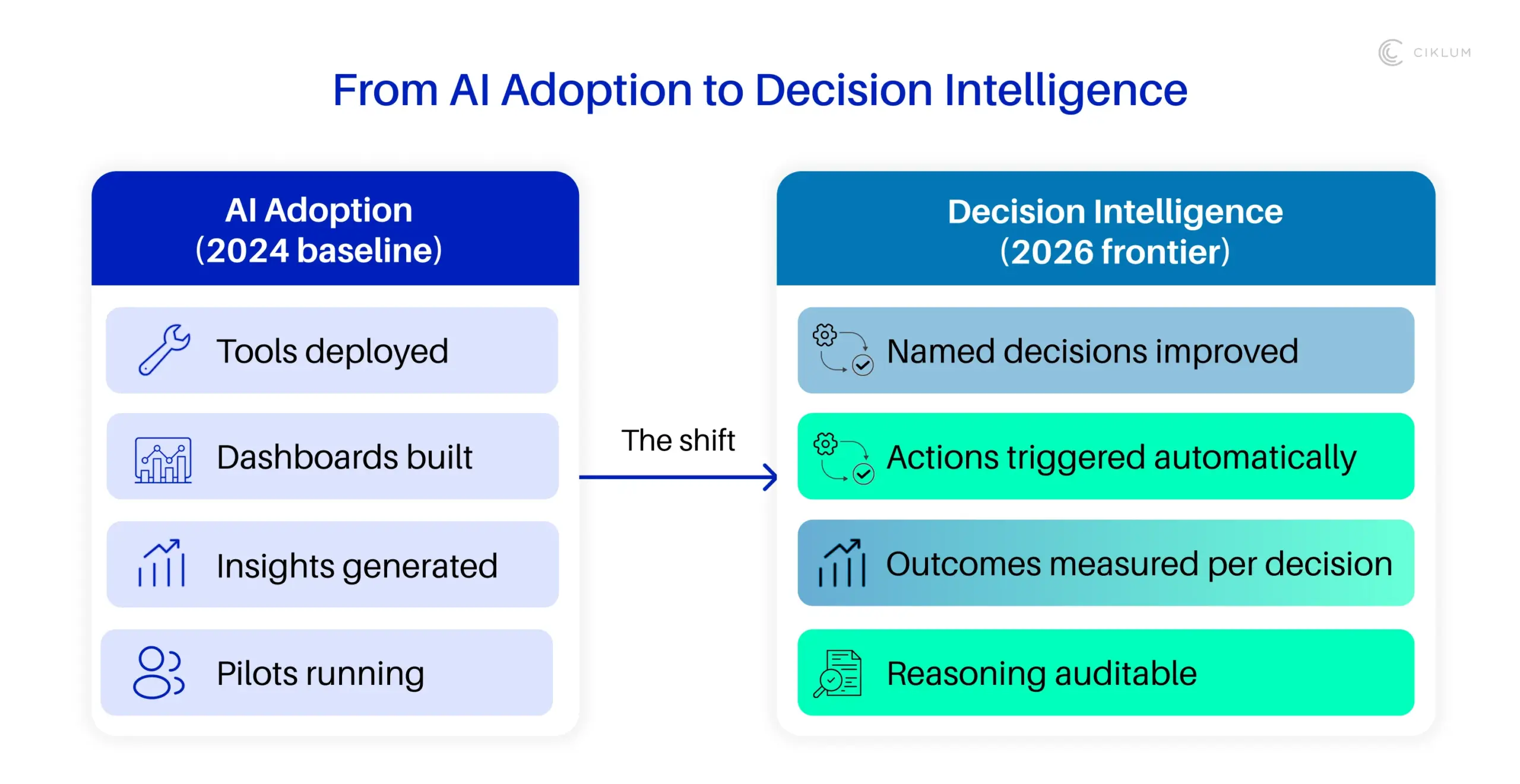
The conversation in retail has moved on from whether to use AI. Industry research consistently puts adoption above the 80% mark, with McKinsey's State of AI survey showing widespread enterprise use of generative AI across functions, which makes adoption a baseline rather than a differentiator. The frontier in 2026 is what the industry has started calling decision intelligence: connecting AI not to a tool but to a specific business decision, and measuring whether that decision improves.
The useful question is not "where can we apply AI" but "which of the high-value decisions in this business are still being made with incomplete data." Pricing decisions made monthly when competitor data refreshes hourly. Assortment decisions made quarterly when demand patterns shift weekly. Promotion decisions tied to campaign cycles when the inventory position changes daily. Each of those is a decision being made with the data the calendar allowed, not the data the business actually has.
The retailers getting the most out of decision intelligence treat the work as building a decision inventory rather than an AI roadmap. Every system investment has to pass a single test: which named, repeatable, measurable decision does this improve, and by how much. The decisions that survive that filter are the ones with clear data inputs, a clear action on the other side, and a number the business can track. Most other investments end up looking like dashboards with no operator and tools with no consumer.
The other shift is from black box to glass box. A pricing recommendation that lifts margin by two points but cannot explain why it shifted is a strategic liability the moment something goes wrong. The decision engines moving into production this year are the ones that operate inside human-defined guardrails, expose their reasoning to merchants and ops teams, and produce audit trails for every automated action. Trust is becoming a real operating KPI in retail, not a soft one, and it correlates directly with whether the business is willing to expand the scope of automated decisions over time.

Where Data-Driven Retail Actually Creates Value
When the data layer and the decision layer are in place, the use cases that compound the fastest are the ones where retail has the most data and the highest decision frequency. Five areas show up consistently in 2026 implementations.
Demand forecasting is the highest-leverage entry point for most retailers. Modern implementations combining historical sales data with seasonality, promotional calendars, weather signals, and external context are landing at notably higher accuracy than traditional statistical methods, with Gartner forecasting that 70% of large organizations will adopt AI-based supply chain forecasting by 2030. The savings show up in two places at once: less money tied up in slow-moving inventory, and fewer revenue losses from empty shelves on the products customers actually want. IHL Group's research puts the global cost of retail inventory distortion (the combined cost of stockouts and overstocks) at around $1.73 trillion annually, which is the size of the problem the forecasting layer is actually addressing.
Dynamic pricing has become the second-largest decision-intelligence category. AI systems monitoring competitor data, demand signals, inventory positions, and margin thresholds in real time can adjust prices and reallocate promotional budgets without waiting for the next pricing committee meeting. The pricing layer matters most in categories where margins are tight and elasticity is genuine, and the retailers running it well are also the ones with explainable models, because every price shift has to be defensible to merchants, finance, and (increasingly) regulators.
Hyper-personalization has moved past the "name in the email" stage. Real-time personalization built on a unified customer profile is lifting sales-conversion rates by roughly 10 to 15 percent, according to McKinsey, with retailers in the top quartile generating 40 percent more revenue from these activities than slower-growing peers. The systems doing this well combine collaborative filtering, content-based signals, session context, and live inventory availability so the recommendation never points the customer at a product that is out of stock or out of margin. The cost-side benefit is just as important: paid-media budgets stop being spent on customers who have already converted, which is one of the largest line-item efficiencies a CDP unlocks.
Replenishment and store operations are where decision automation moves from analysis into action. An empty-shelf detection is task automation. The decision-automation version checks backroom inventory, estimates the revenue at risk over the next hour, prioritizes against other in-flight tasks, and dispatches an associate with specific instructions. Each link in that chain produces an action, not an insight. The retailers running this at scale are also the ones reporting some of the largest labor-productivity improvements, because the system removes the task of figuring out what to do next.
Loss prevention, post-purchase experience, and supply chain optimization round out the highest-ROI categories, and the pattern is the same in each. The retailers who win these use cases are not the ones with the most sophisticated models. They are the ones whose data foundation is clean enough that the models can actually do something useful with the signals coming in.
What the Operating Layer Looks Like When It Works
The architecture that supports decision-intelligence at scale is recognizable across the retailers who have built it.
A unified customer profile sits at the center. Identity resolution across the POS, e-commerce, CRM, loyalty, and app channels moves match rates from the partial coverage traditional CRMs achieve into the high-confidence range a mature CDP supports. That single change is what makes the rest of the personalization, attribution, and lifecycle work possible. Without it, every downstream system is operating on a partial view of the same customer.
A real-time event layer carries the signals from where they happen to where they decide. Shelf sensors, click streams, transaction events, and inventory updates flow into a stream-processing layer that the decision engines subscribe to. The data does not get refreshed nightly into a warehouse and then queried slowly. It moves in seconds, because the decisions that depend on it cannot wait.
A governed data foundation, increasingly built on lakehouse architectures, becomes the single source of truth across analytics, ML, and reporting. The retailers that skip this step end up with multiple, mutually inconsistent versions of revenue, customer count, and inventory turn, and every executive review starts with a reconciliation argument. The retailers that invest in it end up with a single number for each business question, which is a quiet but decisive operational advantage.
Decision engines sit on top of that foundation rather than next to it. Pricing, forecasting, personalization, replenishment, and store ops each consume the unified data and produce a recommendation or an action. The mature implementations close the loop with outcome tracking, so the system learns from what worked.
Explainability and governance are designed in, not bolted on. Every automated action carries the reasoning behind it and the boundary it operated inside. The retailers building toward agentic operations (where consumer-side AI agents will increasingly transact on behalf of shoppers) are also the retailers who are already investing in explainable, governed decision systems on the retailer side. The two trends converge.
What This Looks Like in Practice
Two engagements show the shape of the work concretely.
Empowering the digital transformation of Salling Group, Denmark's largest retailing group, is a useful illustration of what happens when a multi-format retailer treats the data and platform layer as the product. Salling operates across grocery, hypermarket, and department-store formats with the kind of fragmented system landscape every large retailer recognizes. The engineering investment was in the platform underneath the customer-facing experience, the integrations across channels, and the operating model that supports continuous improvement. The result that matters is not a single launch. It is that subsequent customer-facing capabilities ship on a foundation that was built once and continues to compound.
Engineering the platform that powers Just Eat, one of the largest food delivery platforms in the world, illustrates the same principle at real-time scale. Order routing, restaurant onboarding, courier dispatch, customer experience, and post-order operations all have to operate against shared, low-latency data. The engineering work was not a single feature. It was the platform that lets every downstream decision (which restaurant to surface, which courier to assign, which promotion to push, which incident to triage) operate on a consistent picture of the moment. The competitive advantage shows up in the metrics every food-delivery business cares about: time to delivery, conversion at checkout, repeat rate, and the rate at which new markets can be brought online without rebuilding the stack.
The thread between them is straightforward. Retail wins come from clean, unified data feeding decision engines that operate on a rhythm faster than the calendar. Neither company is famous for the AI model it picked. Both are competitive because the layer underneath the model was built deliberately.
Conclusion
The real mark of a data-driven retail organization isn’t a headline-grabbing initiative or a high-profile tech launch. It’s the everyday momentum and operational excellence the business achieves as a matter of course. Forecasts evolve from broad directional guesses to actionable, trusted numbers, empowering inventory teams to act with confidence. Pricing adapts dynamically within defined bounds, freeing up merchants to focus on strategic opportunities, not manual updates. Personalization becomes seamless and relevant. Customers only see what’s in stock and meaningful to them, while associates know exactly which task matters most in each moment. Marketing attribution, once a drawn-out debate, now provides rapid, actionable insight that informs decisions every day.
Achieving this doesn’t require bottomless IT budgets or bleeding-edge algorithms. The difference lies in treating the data foundation and decision engines as core, living capabilities invested in continuously, measured, and improved like any customer-facing product. Retailers who commit to this mindset consistently ship faster, control costs, and create customer experiences that move the metrics that matter. Becoming truly data-driven isn’t about adopting the latest tools; it’s about building an operating model where smart decisions happen everywhere, all the time. The results speak for themselves, even if the underlying machinery goes mostly unnoticed.
Frequently Asked Questions
1. Where should a retailer start if data is fragmented across many systems?
Start with customer identity. Identity resolution across POS, e-commerce, loyalty, and app channels is the single highest-impact data investment - almost every personalization, attribution, and inventory decision depends on it. First, audit which systems collect which identifiers and where match gaps are. A modern CDP layer with strong matching can boost identity rates from the 40s to high-80% without replacing existing systems.
2. Is a Customer Data Platform actually necessary, or is a good CRM enough?
For most mid-size and larger retailers, CRM and CDP serve different purposes - a CRM manages relationships and messaging, while a CDP unifies raw behavioral data across all channels and feeds every tool, including the CRM. Retailers on mature CDPs report higher marketing ROI, faster segment activation, and a bigger, more engaged customer base than those relying on CRM alone.
3. How realistic are the ROI numbers quoted for retail AI and personalization?
They’re realistic with a strong data foundation, unreliable without. Industry benchmarks (CDP ROI, double-digit forecast gains from Gartner, 10–15% conversion lift per McKinsey) reflect organizations that unified data first and layered decision engines later. Trying to layer AI on fragmented data rarely pays off.
4. How does decision intelligence change the role of merchants and operators?
It reshapes, not replaces, their work. With decision intelligence at scale, merchants focus on strategy, setting guardrails, auditing outcomes, and addressing complex exceptions, while routine pricing, restock, and personalization are automated. Their work becomes more high-leverage, steering systems that operate at a speed no manual team can match.

By Ciklum Editorial Team

Ciklum’s Editorial Board is a collective of experienced writers and industry experts, bringing together perspectives shaped by real-world engineering and delivery experience. Through collaborative insights, the team explores how technology, AI, and digital innovation move from concept to execution across industries.
Blogs
Discover Similar Insights

The Confidence Gap: Payments Don’t Need More Innovation. They Need More Confidence
Learn More
AI Agent Orchestration: Types, Architecture, and Production Checklist
Learn More
A Practical Enterprise Architecture for Intelligent Automation
Explore the Reference Architecture