



- Key Takeaways
- Most Enterprise GenAI Projects Stall After the Pilot
- The Gap Between Capability and Workflow Readiness
- The Cost of Getting GenAI Placement Wrong
- Four Workflow Zones Where GenAI Delivers Measurable Returns
- What Scaled Deployments Look Like in Practice
- Conclusion
- Frequently Asked Questions
Key Takeaways
- GenAI works best in bounded, repeatable knowledge tasks, not open-ended problem solving. The use cases delivering measurable ROI share a pattern: high-volume, structured-enough tasks where AI handles the first pass and humans handle the exceptions. Customer support, documentation, code generation, and content workflows fit. Unstructured strategic decisions do not.
- The gap is no longer capability. It is operationalization. According to Deloitte, 68% of organizations have moved 30% or fewer GenAI experiments into full production. The bottleneck has shifted from "can GenAI do this?" to "can our processes, governance, and data support it at scale?"
- GenAI does not replace workflows. It compresses specific steps within them. The productive pattern is not "automate this process with AI." It is "identify the steps in this workflow that are high-volume, repetitive, and tolerance-appropriate, then apply GenAI there."
- The organizations seeing the largest returns redesigned workflows around AI, not the other way around. Layering GenAI onto processes designed for manual execution produces small gains. Redesigning the workflow with AI as a first-class participant produces transformative ones.
Most Enterprise GenAI Projects Stall After the Pilot
Two years into mainstream enterprise adoption, a clearer picture is emerging of where generative AI fits in day-to-day operations and where it does not.
The early promise was broad: GenAI would transform customer service, automate content creation, accelerate software development, streamline back-office operations, and reshape decision-making. Some of that has materialized. Much of it has not, at least not in the way the initial hype suggested.
According to Gartner's 2026 survey, only 28% of AI infrastructure projects fully deliver on their ROI expectations. One in five fails outright. Forrester reports that three years into the GenAI era, most enterprises are still chasing transformative value rather than realizing it. The pattern is consistent: organizations can launch pilots, but scaling them into production workflows remains the central challenge.
Yet the companies that do get placement right are seeing real results. JPMorgan Chase deployed its internal AI platform to 250,000 employees and allocated $2 billion to AI, reclassifying it from discretionary innovation to core infrastructure. Travelers Insurance scaled Claude AI across its entire 30,000-person workforce, automating the classification of millions of customer communications. Goldman Sachs is deploying AI agents for transaction reconciliation and trade accounting, tasks that resisted automation for decades.
These results share a pattern most enterprise implementations miss: the AI was applied to specific, bounded steps within larger workflows, not to entire processes wholesale.
The Gap Between Capability and Workflow Readiness
The technology works. The organizational infrastructure around it often does not.
Deloitte's State of Generative AI in the Enterprise report found that 68% of organizations have moved 30% or fewer GenAI experiments into full production. The problem is not a lack of ambition: two-thirds of respondents are increasing GenAI investment. The problem is that most organizations are trying to insert AI into workflows designed for manual execution without redesigning the workflow itself.
McKinsey's research across 150+ companies identifies two issues that consistently sink GenAI programs. First, 30 to 50% of innovation time is consumed by compliance work or by waiting for compliance requirements to solidify. Second, teams duplicate work, build one-off solutions, and fail to create reusable platforms that could scale successful experiments across the organization.
Harvard Business Review frames the same challenge from the workforce side: organizations relying on ad hoc employee experimentation with GenAI rarely achieve large-scale results. Individual productivity gains from drafting emails or brainstorming faster do not translate into bottom-line impact without disciplined workflow integration.
The result is what researchers at Harvard Business School and Stanford describe as a productivity J-curve. Organizations should expect an initial dip in productivity before sustained gains emerge, reflecting the growing pains of integrating new systems, reorganizing workflows, and investing in complementary capabilities.
The Cost of Getting GenAI Placement Wrong
The financial consequences are significant. Gartner found that 72% of organizations report breaking even or losing money on their AI investments. Among leaders reporting setbacks, 38% cited skill gaps and 38% pointed to poor data quality or limited data access.
The measurement gap compounds the problem. While 79% of organizations perceive productivity gains from AI, only 29% can actually measure AI ROI. That disconnect between perception and measurement means organizations often double down on investments they cannot evaluate, or abandon pilots that were delivering value they could not see.
Indirect costs add up as well. Teams that spend months building custom GenAI solutions for tasks better handled by deterministic automation waste engineering capacity. Workflows that introduce AI without adequate review steps generate outputs requiring rework, eroding the time savings the AI was supposed to deliver. Organizations that treat GenAI as a universal solution rather than a precision tool end up with fragmented implementations that create more operational overhead than they eliminate.
Four Workflow Zones Where GenAI Delivers Measurable Returns
The use cases delivering consistent production value share four characteristics: high volume, repeatable structure, human review built into the process, and tolerance for imperfect first outputs.
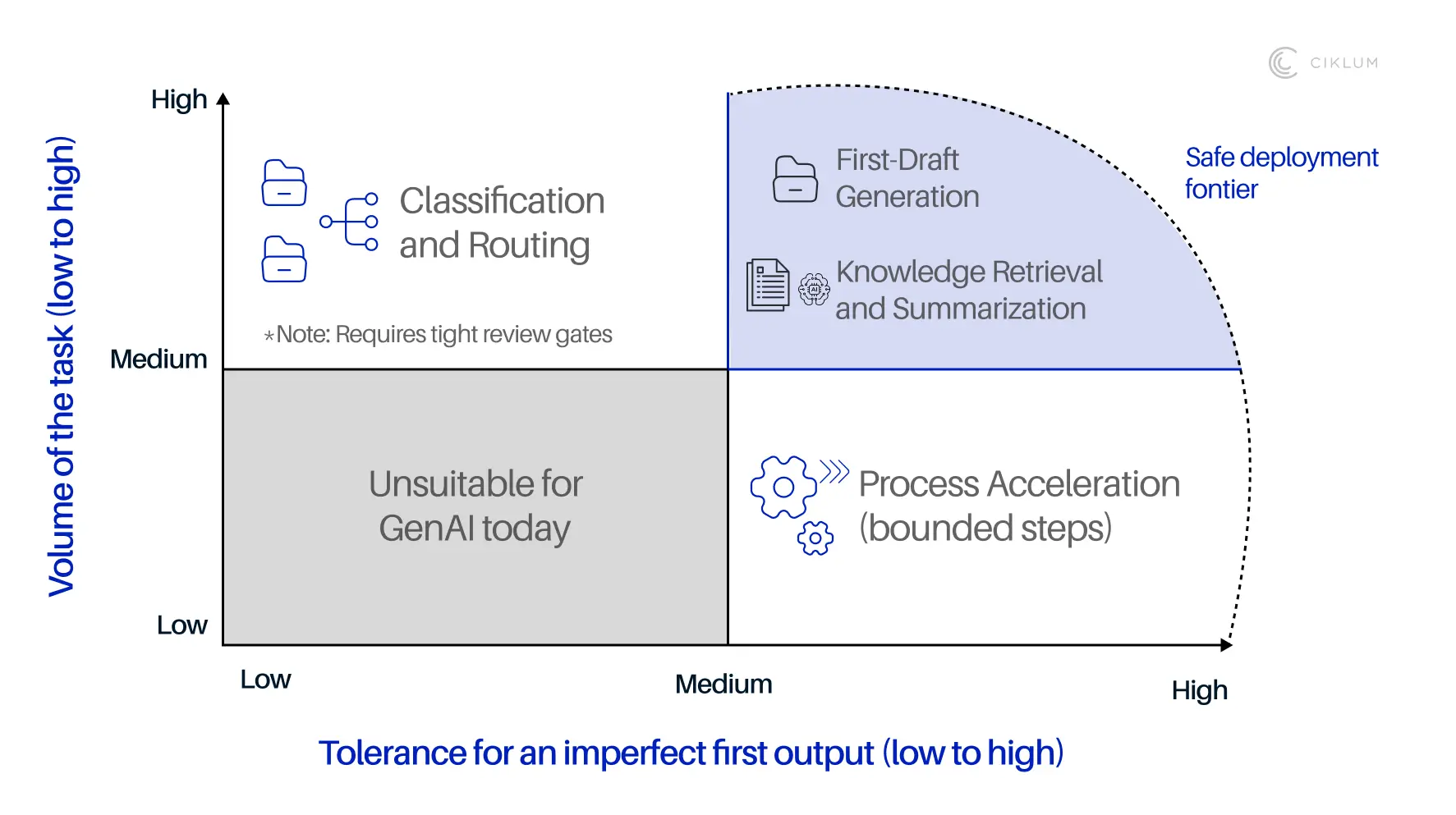
Knowledge Retrieval and Summarization
The simplest and most reliable GenAI use case is finding and condensing information that already exists. Employees spend hours searching across systems, reading documents, and synthesizing answers from scattered sources. GenAI compresses this from hours to seconds.
This works because the task is bounded: the information exists, the AI retrieves and summarizes it, and the employee validates the output. Hallucination risk is manageable because the source material is available for verification. Customer support teams use this to surface relevant knowledge base articles and past case resolutions during live interactions. Internal operations teams use it to navigate policy documents, compliance requirements, and process documentation. The practical value of enterprise AI automation starts here.
First-Draft Generation
GenAI is not reliable enough to produce final outputs in most enterprise contexts. It is highly effective at producing first drafts that humans refine. Documentation, reports, proposals, customer communications, code comments, test cases, and release notes all fit this pattern. The AI handles 60 to 80% of the work. The human handles judgment, accuracy verification, and final refinement.
Stanford and MIT researchers studying nearly 5,200 customer support agents at a Fortune 500 company found that AI-assisted workers resolved 14% more tasks per hour, with the largest gains going to less-experienced employees, who saw improvements up to 34%. This extends naturally to engineering workflows, where AI-driven approaches to the software development lifecycle generate test cases, boilerplate code, and documentation, compressing tasks that previously consumed hours into minutes.
Classification and Routing
High-volume classification tasks are among the most production-ready GenAI use cases. Categorizing support tickets, routing requests, triaging issues, tagging documents, and scoring leads are repetitive, time-consuming when done manually, and well-suited to language models that can interpret unstructured text and assign structured labels.
Goldman Sachs is deploying agents for transaction reconciliation that investigate mismatches, trace root causes, and route complex issues to human reviewers with full context. A pharmaceutical company Ciklum partnered with faced the same pattern at scale: 400,000+ audit events requiring categorization that was previously handled manually with significant inconsistency.
Process Acceleration Within Bounded Workflows
The most advanced production use case is GenAI embedded within structured workflows, accelerating specific steps rather than replacing the whole process.
JPMorgan's internal coding assistant delivered 10 to 20% efficiency gains for software engineers, but the AI operates within a defined engineering process where code review, testing, and deployment gates still apply. The same pattern works in back-office operations. An American cloud computing company Ciklum partnered with needed to modernize its entire Lead-to-Cash process. Ciklum built 40 automation bots, migrated 200+ existing bots to the cloud, and integrated intelligent document processing at specific steps in the workflow. The result was measurably higher deal velocity, not because AI replaced the process, but because it compressed the slowest steps within it.
What Scaled Deployments Look Like in Practice
The organizations extracting real value share three traits. They identified precise insertion points within workflows rather than applying AI broadly. They redesigned processes to accommodate AI as a participant, not an afterthought. And they built governance structures that keep speed from outpacing quality.
JPMorgan did not hand AI an entire loan review process. It deployed its Contract Intelligence system to review 12,000 commercial loan agreements, extracting 360,000 hours of annual legal processing time. Travelers did not automate all claims handling. It automated the classification of incoming communications, freeing agents to focus on complex claims that require judgment. Goldman Sachs is not replacing its accounting teams. It is deploying agents for reconciliation and onboarding tasks where the rules are clear and the data volumes are high.
The pattern holds across industries. Legacy modernization and process documentation are often prerequisites rather than parallel workstreams, because GenAI accelerates known processes. If the process itself is undocumented or inconsistent, the AI has nothing to ground its outputs against.
Conclusion
The enterprise GenAI conversation has moved past "does it work?" The technology works, and it has been working long enough that the live question is a narrower one: where inside a given workflow does GenAI earn its place, and where does it merely add surface area to manage?
The organizations extracting consistent returns answered that question with discipline. They did not pilot GenAI across the business. They identified the specific steps inside specific workflows where a first-pass language model compresses time in a way a human can verify and sign off on. They redesigned the work around that insertion point. They measured the outcome in throughput and turnaround rather than in adoption. The ones still chasing transformative value are, in most cases, still trying to replace whole processes wholesale, which is the pattern the data keeps flagging as the failure mode.
For the next budget cycle, the leverage is in placement, not in procurement. Picking a better model rarely rescues a program that inserted it at the wrong step. Picking the right step usually rescues a program running on a perfectly ordinary model.

Frequently Asked Questions
1. What types of tasks are best suited for generative AI in enterprise workflows?
High-volume, repeatable knowledge tasks where the output is reviewable and the data is accessible. Knowledge retrieval, first-draft generation, classification, and bounded process acceleration consistently deliver measurable returns.
2. Why do most GenAI pilots fail to scale into production?
The technology usually works. The surrounding infrastructure does not. Poor data quality, unclear governance, compliance bottlenecks, and workflows designed for manual execution prevent organizations from scaling what worked in a controlled pilot.
3. How should enterprises measure GenAI ROI?
Measure workflow compression rather than headcount replacement. Track time removed from specific workflow steps, throughput increases, and quality consistency. Compounding AI systems that improve incrementally deliver far more value than one-time automation projects.
4. Is GenAI reliable enough for high-stakes enterprise outputs?
Not without human review. Regulatory filings, legal contracts, financial disclosures, and clinical decisions require accuracy levels that current models cannot guarantee on their own. GenAI can draft, but a human must certify.

By Ciklum Editorial Team

Ciklum’s Editorial Board is a collective of experienced writers and industry experts, bringing together perspectives shaped by real-world engineering and delivery experience. Through collaborative insights, the team explores how technology, AI, and digital innovation move from concept to execution across industries.
Blogs
Discover Similar Insights

AI-Ready Data Infrastructure for Financial Services: A Practical Guide for UK Banks and Insurers
Learn More
Designing Scalable Software Architecture for High-Growth Products
Learn More
Understanding the True Impact of Technical Debt on Product Development Success
Learn More
Why Software Teams Miss Deadlines and How to Build a Predictable Roadmap
Learn More